
拍品信息
拍品名称
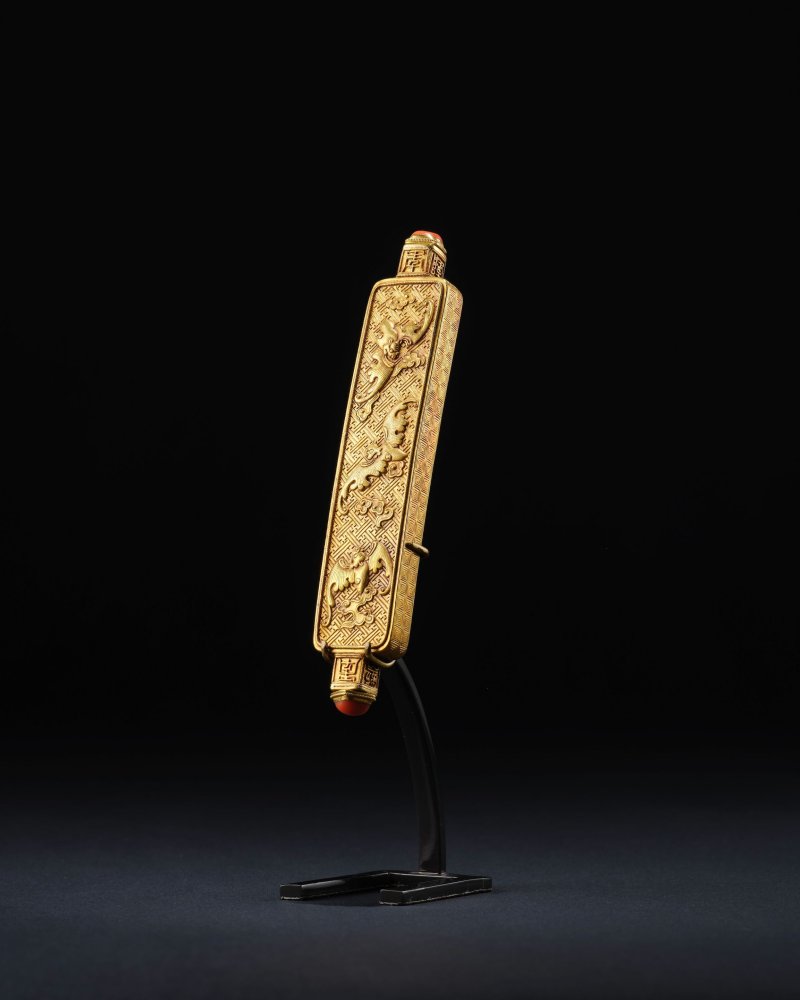
清乾隆 御製金胎鏨雲蝠紋嵌綠松石「太平如意」雙頭藥瓶 | AN IMPERIAL GOLD TURQUOISE-INLAID DOUBLE-HEADED MEDICINE BOTTLE
年代
Qianlong seal mark and of the period
起拍价
HKD 1,500,000
估值区间
HKD 1500000 - 2500000
尺寸
未知
品相
未知
更多信息
Qianlong seal mark and of the period
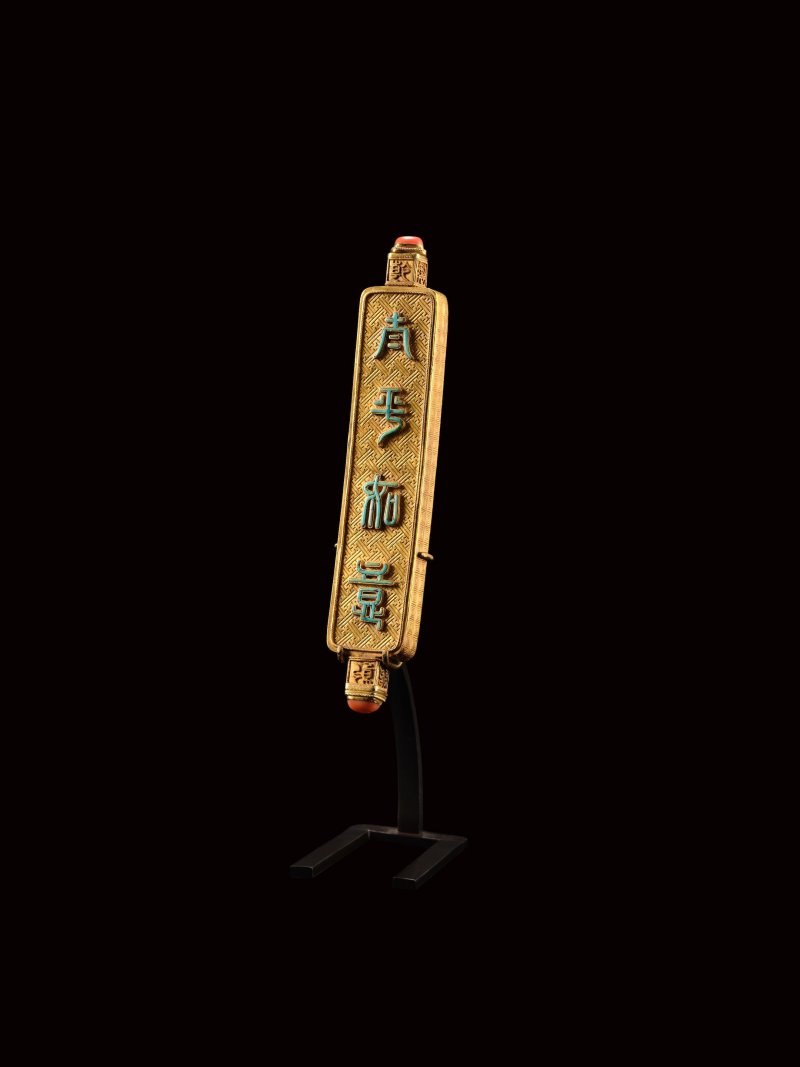
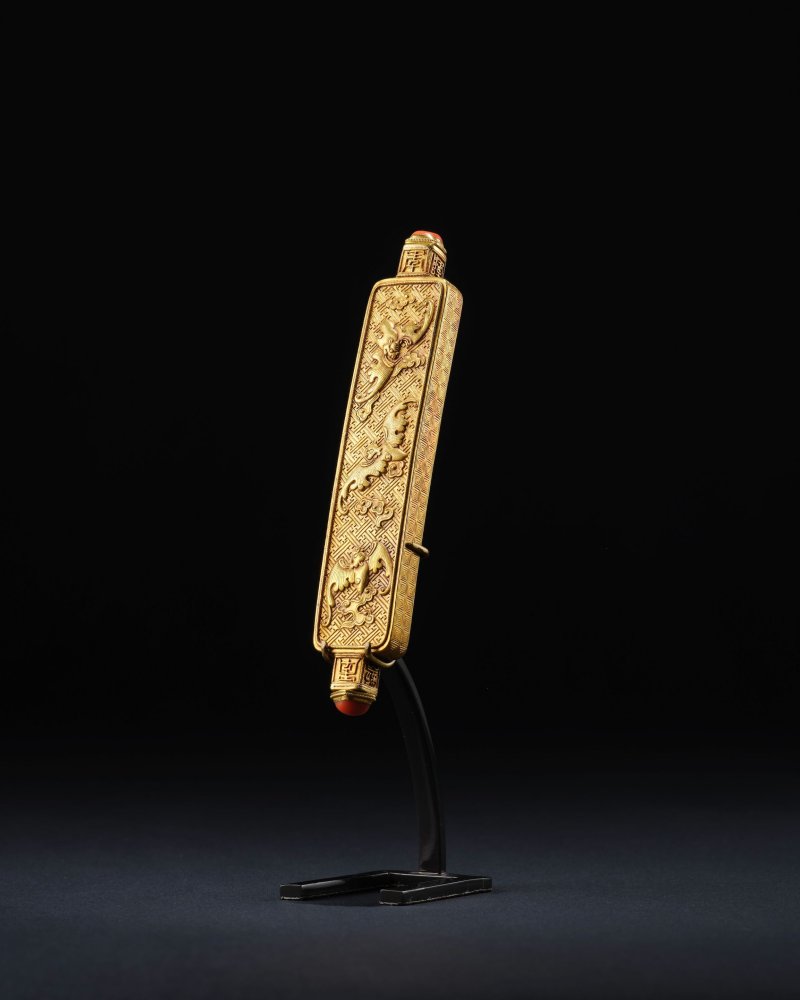
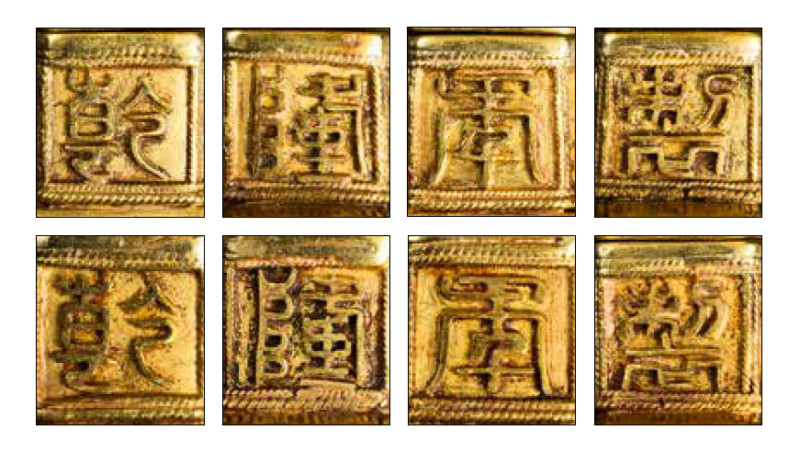
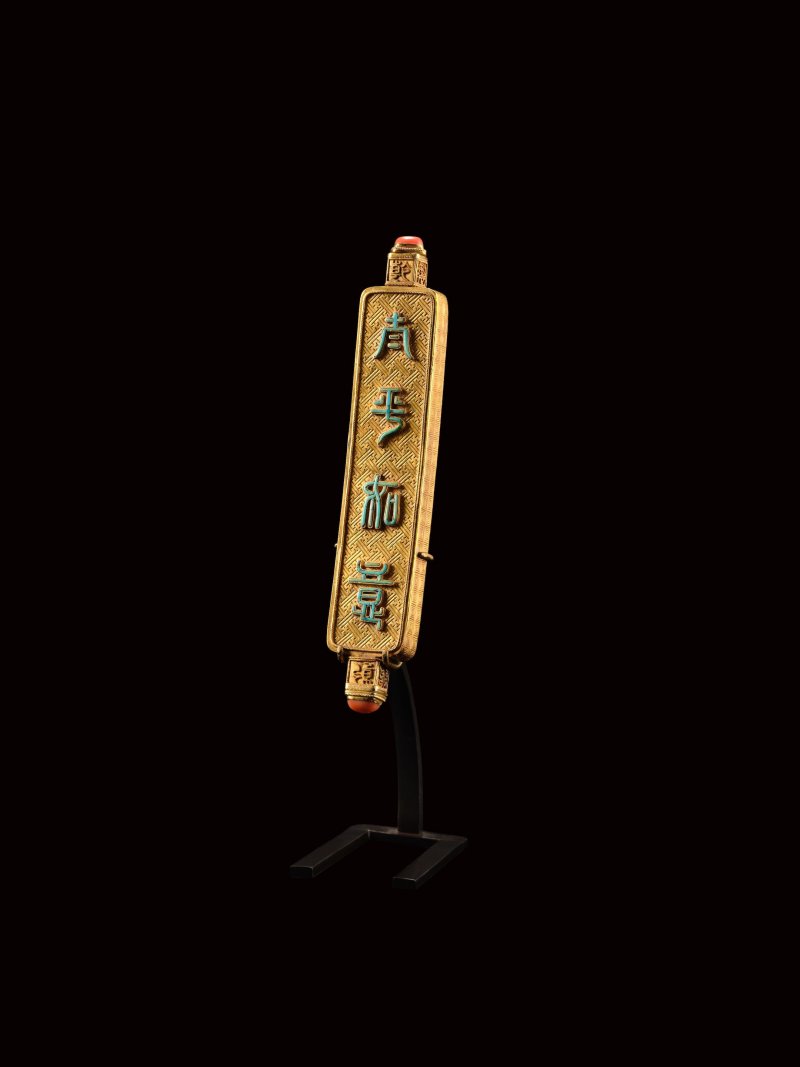
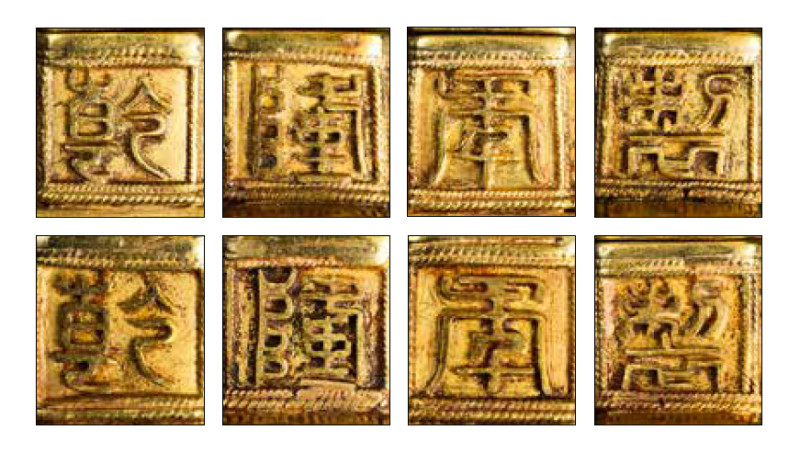
Delicately crafted in a curved rectangular form with two chambers opening from both ends, one main side inlaid with turquoise featuring four characters in seal script reading Taiping ruyi ('Peace and fulfilment of wishes') against a finely incised wan-diaper ground within a beaded-edge frame, the reverse similarly rendered and decorated with three repoussé bats in flight amidst scrolling clouds, the narrow sides detailed with a key-fret pattern, each end surmounted by a facetted neck collared by a four-character reign mark with one character per side, each of the square fitted screw stoppers set with a coral-inset knop and slender spoon, stand.
12.3cm (4 7/8in) long, 91.8g, 22kt gold. (2).
Footnotes
清乾隆 御製金胎鏨雲蝠紋嵌綠松石「太平如意」雙頭藥瓶
「乾隆年製」篆書款
Provenance:
A French private collection
Christie's Paris, 7 June 2011, lot 249
法國私人收藏
巴黎佳士得,2011年6月7日,拍品編號249
The present lot is exceedingly rare and notable for its generous use of the precious metal and the high level of craftsmanship, demonstrated through its unique form, detailed rendering of the bats and meticulous carving of the carefully arranged patterns.
Gold is regarded as one of the most valuable and prestigious metals, embodying an opulence that reflects the refined tastes typically associated with the Emperor and the Imperial family in the past. Goldware from the Qing dynasty is exceptionally rare, and high-quality pieces such as the present lot were produced by the Imperial Workshops and destined for use at the Imperial Court, generally only by the Emperor and his family. Symbolically, gold represents Imperial authority, while turquoise, an esteemed and sacred stone within Tibetan culture and the Tibetan Buddhist tradition, symbolises auspiciousness and prosperity. Therefore, the use of turquoise inlay decoration on gold was particularly preferred by the Qianlong Emperor, a devout practitioner of the faith. In 1770, on the occasion of the Qianlong Emperor's sixtieth birthday, Court officials commissioned a special set of sixty gold filigree scepters decorated with turquoise inlay as a birthday gift for the Emperor. Each scepter was inlaid with the four-character inscription ('may all your wishes be fulfilled eternally') at the handle, while the head was also inlaid with characters representing the Chinese sexagenary cycle year (sixty ). This set is now held in the Palace Museum, Beijing (accession no. 故00011686). The manner in which the craftsmen worked on the turquoise inlay is comparable to that of the present lot. See also a gold snuff bottle with gem inlay, Qianlong four-character mark and of the period, in the Qing Court Collection, Palace Museum, Taipei (acc.no.故雜000908N000000000).
Similar repoussé bat decoration can be observed on cloisonné enamel vessels from the Qing dynasty. For example, a cloisonné enamel incense burner featuring gilt-bronze reticulated panels and cover adorned with bats flying among clouds, mid Qing dynasty, is illustrated in , Beijing, 2011, no.218. See also a cloisonné enamel hexagonal jardinière featuring a reticulated panels decorated with bats and peach, Qing dynasty, in the Palace Museum, Taipei (acc.no.:故琺000070N000000000).
The motif depicting three bats on a ground symbolises the wish for 'ten thousand blessings ()'. The bat () represents 'blessings', while the ground corresponds to the Chinese term for 'ten thousand'. Along with the inlaid inscription expressing hope for 'peace and fulfilment of wishes', the present lot conveys an auspicious message, wishing for peace under the Emperor's rule and for all desires to be realised.
Compare with an Imperial turquoise-inlaid gold filigree twin box and cover, Qianlong, which was sold at Sotheby's New York, 18 September 2024, lot 18. See also a large pair of gold 'Daoist Emblem' presentation boxes and covers, Qing dynasty, which was sold at Christie's London, 8 July 2021, lot 1. See also a gold-plated silver and copper 'dragon' snuff bottle, Qianlong, which was sold at Bonhams San Francisco, 17 December 2013, lot 8160.
此器形制特殊,存世極罕。以金為胎,手感沉實,用料奢華;工藝繁複精麗,造型別出心裁,蝙蝠紋飾細膩生動,圖案布局嚴謹有序,足見宮廷造辦處工匠之非凡技藝。
金自古即象徵尊貴與財富,清代金器多為皇室專用,以彰顯帝王之尊。清代金製器皿傳世甚少,而如本品之精工細作,當屬宮廷御製之作,專供內廷使用。綠松石在藏傳佛教與西藏文化中向被視為尊貴神聖之寶石,象徵吉祥與繁盛。乾隆皇帝篤信藏傳佛教,尤喜以綠松石鑲嵌金器,藉以表達虔敬與祈福之意。乾隆三十五年(1770年),值乾隆帝六十壽辰,王公大臣特製一套金累絲嵌綠松石如意共六十柄,每柄柄部嵌「萬年如意」四字,如意頭則分別鑲嵌干支記年字樣,正合六十年一週之數。此套如意現藏北京故宮博物院(館藏編號:故00011686),其於金器上鑲嵌綠松石作飾之工藝,可與本品比較。台北故宮博物院有一件清宮舊藏乾隆四字款金鼻煙壺,飾有寶石,工藝相類。(館藏編號:故雜000908N000000000)。
瓶身之錘鍱蝙蝠紋飾,亦見於清代掐絲琺瑯器。參考一件清中期掐絲琺瑯纏枝蓮紋象腿薰爐,其鎏金鏤空面板及蓋均飾類似之雲蝠紋,著錄於《故宮博物院藏品大系:琺瑯器編3:清掐絲琺瑯》,北京,2011年,編號218;另見台北故宮博物院藏一件清代掐絲琺瑯六楞花盆,亦飾有蝠桃紋鏤空面板(館藏編號:故琺000070N000000000),可供比對。
紋飾部分以「萬字錦」為地,上綴三蝠,寓「萬福」之意。蝠諧「福」,「萬字錦」象徵萬事長久,加上器身嵌字「太平如意」,合而為一,寄寓天下太平、萬事如意之祥瑞祝願。
比較其他綠松石鑲嵌之金器,例如一件乾隆時期御製金鑲松石雙元盒,售於紐約蘇富比,2024年9月18日,拍品編號18;一對清代金暗八仙蓋盒,售於倫敦佳士得,2021年7月8日,拍品編號1;及一件乾隆時期金雙龍紋鼻烟壺,售於舊金山邦瀚斯,2013年12月17日,拍品編號8160。
Delicately crafted in a curved rectangular form with two chambers opening from both ends, one main side inlaid with turquoise featuring four characters in seal script reading Taiping ruyi ('Peace and fulfilment of wishes') against a finely incised wan-diaper ground within a beaded-edge frame, the reverse similarly rendered and decorated with three repoussé bats in flight amidst scrolling clouds, the narrow sides detailed with a key-fret pattern, each end surmounted by a facetted neck collared by a four-character reign mark with one character per side, each of the square fitted screw stoppers set with a coral-inset knop and slender spoon, stand.
12.3cm (4 7/8in) long, 91.8g, 22kt gold. (2).
Footnotes
清乾隆 御製金胎鏨雲蝠紋嵌綠松石「太平如意」雙頭藥瓶
「乾隆年製」篆書款
Provenance:
A French private collection
Christie's Paris, 7 June 2011, lot 249
法國私人收藏
巴黎佳士得,2011年6月7日,拍品編號249
The present lot is exceedingly rare and notable for its generous use of the precious metal and the high level of craftsmanship, demonstrated through its unique form, detailed rendering of the bats and meticulous carving of the carefully arranged patterns.
Gold is regarded as one of the most valuable and prestigious metals, embodying an opulence that reflects the refined tastes typically associated with the Emperor and the Imperial family in the past. Goldware from the Qing dynasty is exceptionally rare, and high-quality pieces such as the present lot were produced by the Imperial Workshops and destined for use at the Imperial Court, generally only by the Emperor and his family. Symbolically, gold represents Imperial authority, while turquoise, an esteemed and sacred stone within Tibetan culture and the Tibetan Buddhist tradition, symbolises auspiciousness and prosperity. Therefore, the use of turquoise inlay decoration on gold was particularly preferred by the Qianlong Emperor, a devout practitioner of the faith. In 1770, on the occasion of the Qianlong Emperor's sixtieth birthday, Court officials commissioned a special set of sixty gold filigree scepters decorated with turquoise inlay as a birthday gift for the Emperor. Each scepter was inlaid with the four-character inscription ('may all your wishes be fulfilled eternally') at the handle, while the head was also inlaid with characters representing the Chinese sexagenary cycle year (sixty ). This set is now held in the Palace Museum, Beijing (accession no. 故00011686). The manner in which the craftsmen worked on the turquoise inlay is comparable to that of the present lot. See also a gold snuff bottle with gem inlay, Qianlong four-character mark and of the period, in the Qing Court Collection, Palace Museum, Taipei (acc.no.故雜000908N000000000).
Similar repoussé bat decoration can be observed on cloisonné enamel vessels from the Qing dynasty. For example, a cloisonné enamel incense burner featuring gilt-bronze reticulated panels and cover adorned with bats flying among clouds, mid Qing dynasty, is illustrated in , Beijing, 2011, no.218. See also a cloisonné enamel hexagonal jardinière featuring a reticulated panels decorated with bats and peach, Qing dynasty, in the Palace Museum, Taipei (acc.no.:故琺000070N000000000).
The motif depicting three bats on a ground symbolises the wish for 'ten thousand blessings ()'. The bat () represents 'blessings', while the ground corresponds to the Chinese term for 'ten thousand'. Along with the inlaid inscription expressing hope for 'peace and fulfilment of wishes', the present lot conveys an auspicious message, wishing for peace under the Emperor's rule and for all desires to be realised.
Compare with an Imperial turquoise-inlaid gold filigree twin box and cover, Qianlong, which was sold at Sotheby's New York, 18 September 2024, lot 18. See also a large pair of gold 'Daoist Emblem' presentation boxes and covers, Qing dynasty, which was sold at Christie's London, 8 July 2021, lot 1. See also a gold-plated silver and copper 'dragon' snuff bottle, Qianlong, which was sold at Bonhams San Francisco, 17 December 2013, lot 8160.
此器形制特殊,存世極罕。以金為胎,手感沉實,用料奢華;工藝繁複精麗,造型別出心裁,蝙蝠紋飾細膩生動,圖案布局嚴謹有序,足見宮廷造辦處工匠之非凡技藝。
金自古即象徵尊貴與財富,清代金器多為皇室專用,以彰顯帝王之尊。清代金製器皿傳世甚少,而如本品之精工細作,當屬宮廷御製之作,專供內廷使用。綠松石在藏傳佛教與西藏文化中向被視為尊貴神聖之寶石,象徵吉祥與繁盛。乾隆皇帝篤信藏傳佛教,尤喜以綠松石鑲嵌金器,藉以表達虔敬與祈福之意。乾隆三十五年(1770年),值乾隆帝六十壽辰,王公大臣特製一套金累絲嵌綠松石如意共六十柄,每柄柄部嵌「萬年如意」四字,如意頭則分別鑲嵌干支記年字樣,正合六十年一週之數。此套如意現藏北京故宮博物院(館藏編號:故00011686),其於金器上鑲嵌綠松石作飾之工藝,可與本品比較。台北故宮博物院有一件清宮舊藏乾隆四字款金鼻煙壺,飾有寶石,工藝相類。(館藏編號:故雜000908N000000000)。
瓶身之錘鍱蝙蝠紋飾,亦見於清代掐絲琺瑯器。參考一件清中期掐絲琺瑯纏枝蓮紋象腿薰爐,其鎏金鏤空面板及蓋均飾類似之雲蝠紋,著錄於《故宮博物院藏品大系:琺瑯器編3:清掐絲琺瑯》,北京,2011年,編號218;另見台北故宮博物院藏一件清代掐絲琺瑯六楞花盆,亦飾有蝠桃紋鏤空面板(館藏編號:故琺000070N000000000),可供比對。
紋飾部分以「萬字錦」為地,上綴三蝠,寓「萬福」之意。蝠諧「福」,「萬字錦」象徵萬事長久,加上器身嵌字「太平如意」,合而為一,寄寓天下太平、萬事如意之祥瑞祝願。
比較其他綠松石鑲嵌之金器,例如一件乾隆時期御製金鑲松石雙元盒,售於紐約蘇富比,2024年9月18日,拍品編號18;一對清代金暗八仙蓋盒,售於倫敦佳士得,2021年7月8日,拍品編號1;及一件乾隆時期金雙龍紋鼻烟壺,售於舊金山邦瀚斯,2013年12月17日,拍品編號8160。
常见问题
这件清乾隆 御製金胎鏨雲蝠紋嵌綠松石「太平如意」雙頭藥瓶 | AN IMPERIAL GOLD TURQUOISE-INLAID DOUBLE-HEADED MEDICINE BOTTLE的成交价是多少?
落槌价为 预展中。 成交价为 预展中。