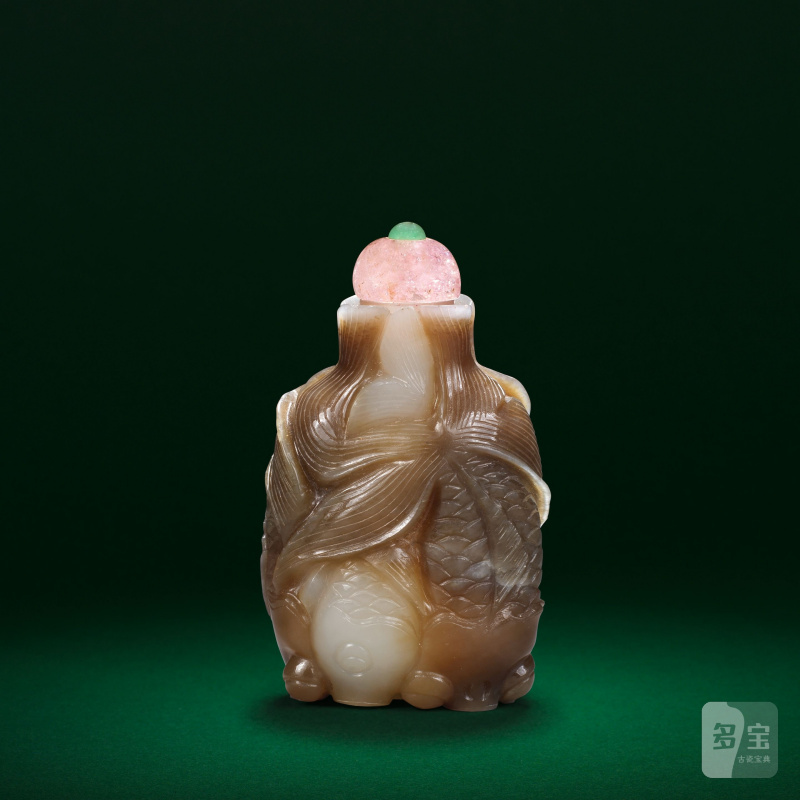

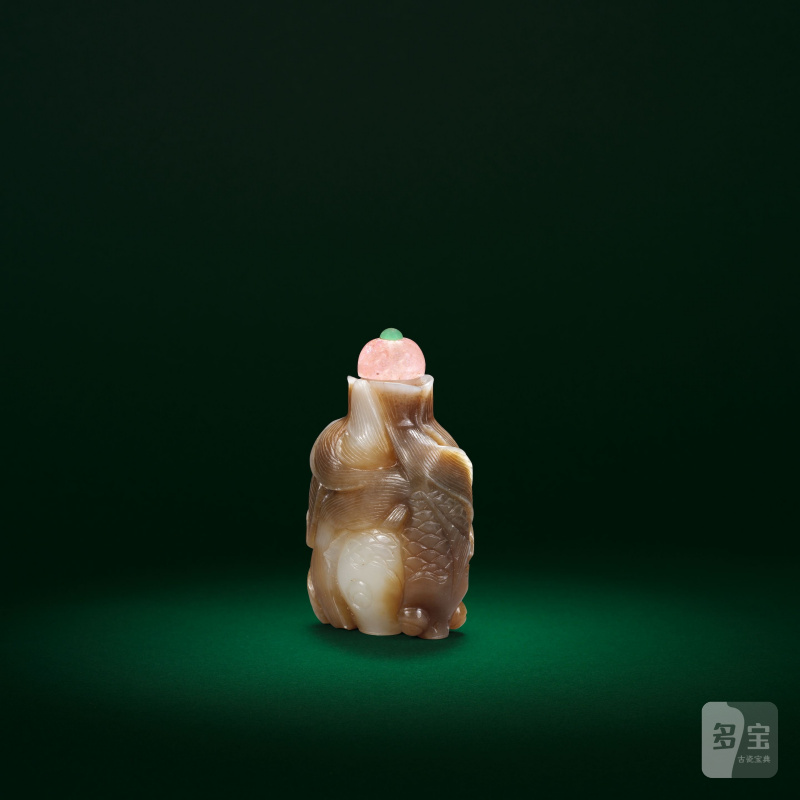


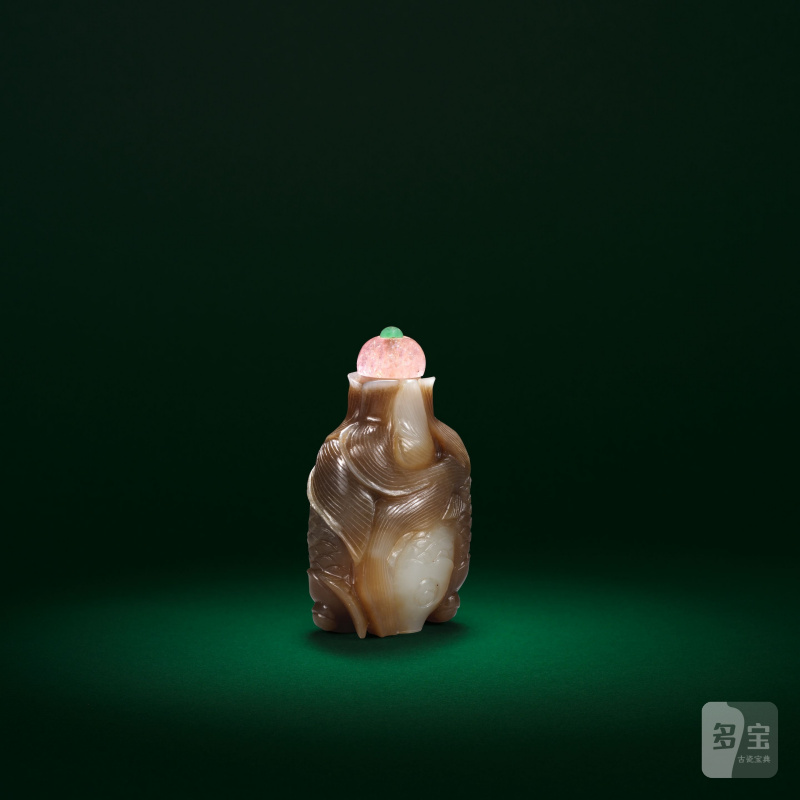
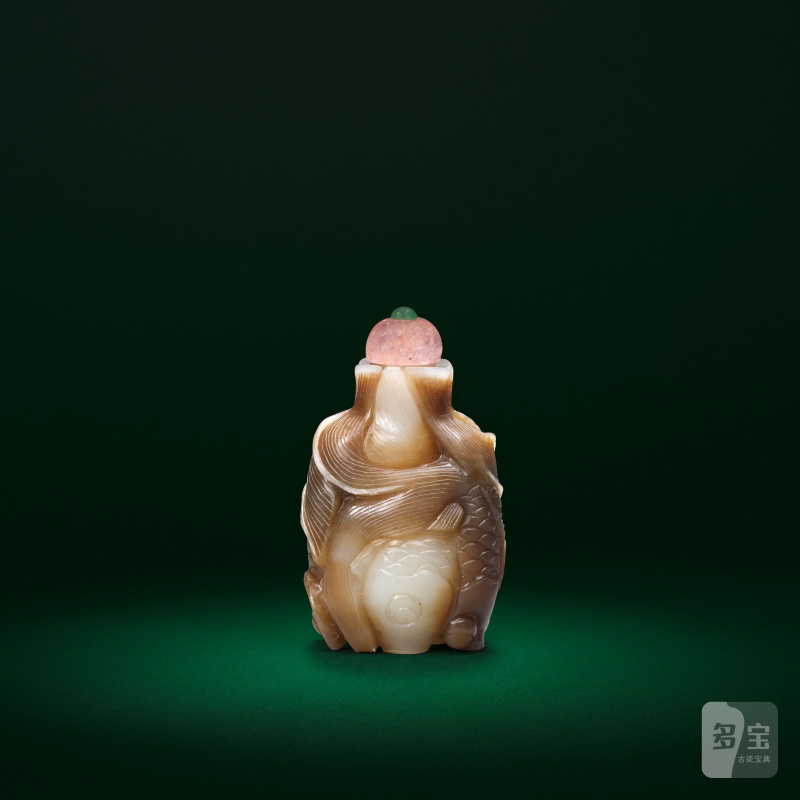
Lot 356Y 十八/十九世紀 糖白玉雕雙魚紋鼻烟壺 | A CHESTNUT-BROWN AND WHITE JADE 'PAIRS OF FISH' SNUFF BOTTLE
落槌价
****
成交价
****
| 拍卖公司 | 邦瀚斯 |
|---|---|
| 拍卖时间 | 2026年05月18日 |
请安装多宝古瓷宝典APP,查看高清无损大图
拍品信息
拍品名称
十八/十九世紀 糖白玉雕雙魚紋鼻烟壺 | A CHESTNUT-BROWN AND WHITE JADE 'PAIRS OF FISH' SNUFF BOTTLE
起拍价
GBP 3,000
估值区间
未知
尺寸
未知
品相
未知
更多信息
18th/19th century
The white and chestnut-brown stone naturalistically carved as four intertwined fish of contrasting colours, with finely detailed eyes, fins and gills, the mouths converging to form the bottle's base and the tails rising to form the neck, stopper. 6cm (2 3/8in) high. (2).
Footnotes
The item within this lot containing ivory has been registered in accordance with the Ivory Act (Section 10). Ref.ZPVCWPS9
該批次中含有象牙的物品已根據《象牙法案》(章節10)註冊Ref.ZPVCWPS9
十八/十九世紀 糖白玉雕雙魚紋鼻烟壺
Provenance: Hugh Moss Ltd., London
Trudy and John Cohen, collection no.B58, acquired from the above circa 1974
H.Moss, 'Criteria for Judging Snuff Bottles', in , December 1977, p.18, fig.16
倫敦古董商Hugh Moss Ltd.
Trudy及John Cohen伉儷,藏品編號B58,約1974年從上處獲得
H.Moss,《Criteria for Judging Snuff Bottles》,《The International Chinese Snuff Bottle Society Journal》,1977年12月,第18頁,插圖16
Homophonous with (餘), meaning abundance, the fish ( 魚) has long symbolised plenitude of wealth, children, or good health, and its link to Zhuangzi's reflection on the joy of fish adds an element of happiness. A pair of fish ( 雙魚) represents marital harmony, while their fertility evokes the auspicious wish for numerous offspring.
The depiction of two fish thus encompasses rich symbolic meaning, and therefore enjoyed popularity as an auspicious motif, including in snuff bottles. H.Moss, V.Graham, and K.B.Tsang, in , New York, 1993, p.254, describe a group of chalcedony and jade bottles which featuring intertwined fish defined by the stone's natural markings, with the neck seamlessly incorporated in the design. They suggest that these bottles may originate from workshops specialised in this design. An example in chalcedony is illustrated in , no.158.
The present lot appears to belong to this category. Two pairs of fish are masterfully intertwined, with the carving cleverly following the stone's natural coloration to render two fish white and the other two green. The eyes, fins and scales are rendered with naturalistic precision, making it visually striking and delightfully tactile.
Compare with a related 'conjoined fish' jade snuff bottle, 1760-1880, illustrated by R.Hall, , London, 2005, no.79.
The white and chestnut-brown stone naturalistically carved as four intertwined fish of contrasting colours, with finely detailed eyes, fins and gills, the mouths converging to form the bottle's base and the tails rising to form the neck, stopper. 6cm (2 3/8in) high. (2).
Footnotes
The item within this lot containing ivory has been registered in accordance with the Ivory Act (Section 10). Ref.ZPVCWPS9
該批次中含有象牙的物品已根據《象牙法案》(章節10)註冊Ref.ZPVCWPS9
十八/十九世紀 糖白玉雕雙魚紋鼻烟壺
Provenance: Hugh Moss Ltd., London
Trudy and John Cohen, collection no.B58, acquired from the above circa 1974
H.Moss, 'Criteria for Judging Snuff Bottles', in , December 1977, p.18, fig.16
倫敦古董商Hugh Moss Ltd.
Trudy及John Cohen伉儷,藏品編號B58,約1974年從上處獲得
H.Moss,《Criteria for Judging Snuff Bottles》,《The International Chinese Snuff Bottle Society Journal》,1977年12月,第18頁,插圖16
Homophonous with (餘), meaning abundance, the fish ( 魚) has long symbolised plenitude of wealth, children, or good health, and its link to Zhuangzi's reflection on the joy of fish adds an element of happiness. A pair of fish ( 雙魚) represents marital harmony, while their fertility evokes the auspicious wish for numerous offspring.
The depiction of two fish thus encompasses rich symbolic meaning, and therefore enjoyed popularity as an auspicious motif, including in snuff bottles. H.Moss, V.Graham, and K.B.Tsang, in , New York, 1993, p.254, describe a group of chalcedony and jade bottles which featuring intertwined fish defined by the stone's natural markings, with the neck seamlessly incorporated in the design. They suggest that these bottles may originate from workshops specialised in this design. An example in chalcedony is illustrated in , no.158.
The present lot appears to belong to this category. Two pairs of fish are masterfully intertwined, with the carving cleverly following the stone's natural coloration to render two fish white and the other two green. The eyes, fins and scales are rendered with naturalistic precision, making it visually striking and delightfully tactile.
Compare with a related 'conjoined fish' jade snuff bottle, 1760-1880, illustrated by R.Hall, , London, 2005, no.79.