
拍品信息
拍品名称
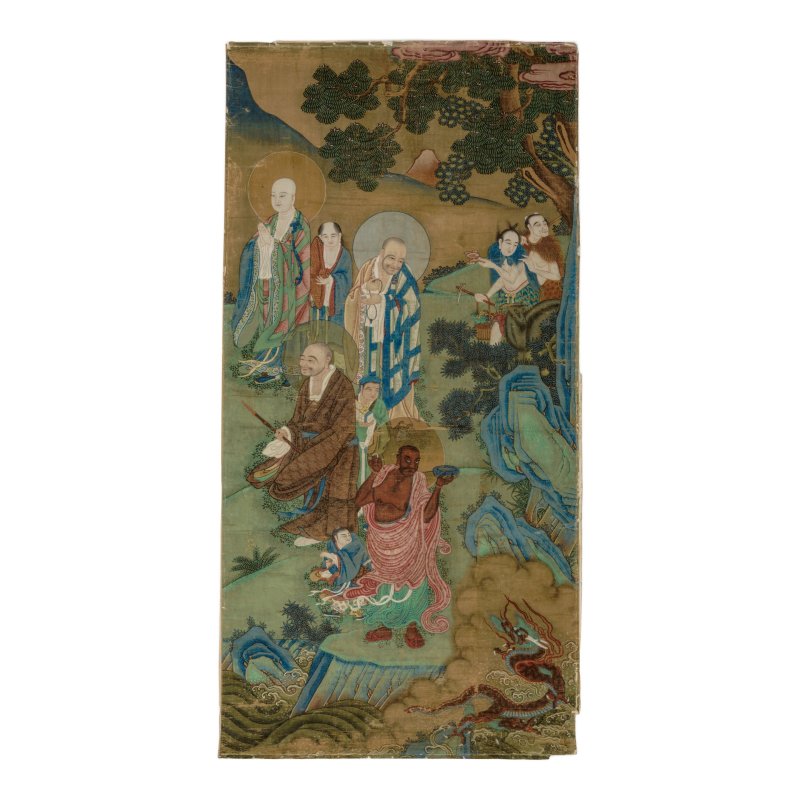
佚名宮廷畫師 羅漢 設色絹本 托裱 清順治 十七世紀中葉 | ANONYMOUS QING COURT ARTISTS
年代
Luohan, Shunzhi period, mid-17th century
起拍价
USD 18,000
估值区间
未知
尺寸
未知
品相
未知
更多信息
Luohan, Shunzhi period, mid-17th century
Mounted for framing, ink and color on silk, unsigned and absent seals.
70 5/8 x 35in (178 x 89cm)
Footnotes
Provenance:
Sotheby's, New York, Fine Classical Chinese Paintings, 21 March 2013, lot 513
The present painting depicts four arhats accompanied by attendants and foreign servants. The foremost arhat holds a pearl with which he summons a dragon into his alms bowl, while behind him stand three other arhats, respectively holding a walking stick, fingering prayer beads, and joining their palms in reverence. Although the painting bears no signature, its format and style are virtually identical to a 17th-century painting of arhats sold at Christie's Hong Kong on 1 June 2024, lot 809, which likewise depicts four arhats with attendants. The two paintings likely each once formed a panel from a separate four-panel screen rendering the Sixteen Arhats. At the lower left of the Christie's painting is a lotus-shaped cartouche bearing an inscription in gold reading: "Commissioned by Zhou Tiancheng, Qixinlang of the Ministry of Justice, and others 刑部啟心郎周天成等造." Zhou Tiancheng was likely the official responsible for overseeing the commission. The inscription strongly suggests that the original set was specially designed for an important institutional setting, possibly a palace or a major Buddhist monastery, for devotional display during Buddhist ceremonies.
Qixinlang was a distinctive civil-service position of the early Qing dynasty. Established under the Later Jin (1616-1636) in the fifth year of Tiancong (1631), the posts of Qixinlang in most of the Six Ministries and other government offices had been abolished by the fifteenth year of Emperor Shunzhi's reign (1658). The 1892 edition of the (Gazetteer of Shanxi), vol. 149, in its record of Shanxi officials who served under the Shunzhi Emperor, states: "Zhou Tiancheng, style name Ningtu, a native of Wenxi County. From the Luanyiwei (Imperial Procession Guard), he was appointed Qixinlang of the Ministry of Justice, promoted to Vice Minister of Works, and subsequently transferred to the Siliyuan, where he was successively placed in charge of manufacture in Suzhou, Hangzhou, and Jiangning." Further evidence for Zhou's tenure is found in the 1647 edition of the (Great Qing Code, with Collected Commentaries and Substatutes), compiled by Ganglin (?-1651). A memorial following the preface records that "the Vice Ministers of Justice, Tiqiao and Fang Kezhuang, repeatedly scrutinized and verified [the text], together with the Qixinlang Bai Sechun and Zhou Tiancheng ... examining it chapter by chapter." This confirms that Zhou Tiancheng was serving as Qixinlang of the Ministry of Justice during the early Shunzhi period.
Of particular relevance is further evidence preserved in a Buddhist context. Among the (Yongle Northern Canon) held by the Peking University Library are fifteen fascicles supplied in manuscript between the sixth and seventh years of Shunzhi (1649–1650). Fascicle 224, designated by the character 君, contains an inscription within an outlined lotus cartouche reading: "The devout official Zhou Tiancheng, Qixinlang of the Ministry of Justice, donated one fascicle of the scriptures 信官刑部啟心郎周天成施經一函." This not only provides further confirmation of Zhou's official position during the early Shunzhi period but also demonstrates his direct involvement in Buddhist patronage. Taken together, the evidence discussed above suggests that the Christie's panel can be dated approximately to the 1640s-1650s, and the present lot was likely executed around the same period.
Comparable monumental sets of the Sixteen Arhats executed in rich mineral colors include a group of four hanging scrolls sold at Bonhams, San Francisco, on 29 June 2009, lot 8222 (). Also comparable is a pair of arhat paintings attributed to Ding Yunpeng (1547–1628) and Sheng Maoye (active 1607–1638), sold at Christie's New York on 12 September 2017, lot 13.
References:
Shen, Yimin. "'Qixinlang' and Politics of Early Qing." In , 2006 (6), pp. 31–36.
Gang, Lin, comp. (Great Qing Code, with Collected Commentaries and Substatutes), 1647 edition, Erudition Database.
Zeng, Guoquan et al. eds. (Gazetteer of Shanxi), 1892 edition, Erudition Database.
Yang, Fen. "A Study of the in Peking University Library." In , 2016 (4), pp. 82–94.
佚名宮廷畫師 羅漢 設色絹本 托裱 清順治 十七世紀中葉
紐約蘇富比,「中國古代書畫」,2013年3月21日,拍品編號513
本幅羅漢圖繪羅漢四人,居前者手持寳珠,引龍入缽,其後有持杖、捻珠、合掌羅漢各一,輔以侍童蠻奴。雖無款署,但其形製筆法,均與2024年6月1日於香港佳士得「中國古代書畫」專場釋出的拍品809號十七世紀〈羅漢〉圖如出一轍。該圖亦繪羅漢四人並隨從,此二幅或出自兩套相近的十六羅漢四聯屏。佳士得本左下角繪一紅底藍框蓮花龕,以泥金款署「刑部啟心郎周天成等造」。周天成或為監修或主事之人,此組畫屏當年或為宮廷或名刹定製,用以奉祀或法會儀軌之用。
啟心郎為清初特有文官官製,始立於後金天聰五年(1631),至順治十五年(1658),各部院啟心郎已大部裁撤。《山西通志》光緒十八年(1892)刻本〈卷一百四十九仕實錄五〉記「國朝順治」山西籍官員名錄,中有「周天成,字凝圖,聞喜人。由鑾儀衛𢟍刑部啟心郎,進工部侍郎,調司吏院,隨掌製造蘇杭江甯。」另據剛林(?-1651)纂《大清律集解附例》順治四年(1647)刻本序後〈奏摺〉一章記「又該刑部侍郎提橋、房可壯再四詳核,率同啓心郎白色純、周天成......逐篇磨勘」,知周天成任刑部啟心郎當在順治初年。此外,北京大學圖書館藏佛教典籍《永樂北藏》607函,收錄順治六年至七年(1649-1650)間抄配本15函,其中第224「君」字函題「信官刑部啟心郎周天成施經一函」於白描蓮花龕内,亦足證周天成於順治初任刑部啟心郎,且與佛事淵源頗深。綜上,佳士得屏的繪製年代範可大致推定為十七世紀四十至五十年代,本拍品年份當與之相埒。
與此二屏相類的重彩十六羅漢屏鉅製,可參考舊金山邦瀚斯於2009年6月29日釋出的羅漢四聯屏,拍品編號8222。()亦可類比紐約佳士得於2017年9月12日售出傳丁雲鵬(1547-1628)及盛懋燁(活躍於1607-1638)合繪羅漢對屏,拍品編號13。
參考:
沈一民著〈啟心郎與清初政治〉,收錄於《史學月刊》2006年第6期,頁31-36
(清)剛林纂《大清律集解附例》順治四年(1647)刻本,愛如生中國基本古籍庫
(清)曾國荃、張煦修、王軒、楊篤纂《山西通志》光緒十八年(1892)刻本,愛如生中國基本古籍庫
楊芬著〈佛典重現 寳藏增輝——北京大學圖書館藏《永樂北藏》述略〉,收錄于《大學圖書館學報》2016年第4期,頁82-94
Mounted for framing, ink and color on silk, unsigned and absent seals.
70 5/8 x 35in (178 x 89cm)
Footnotes
Provenance:
Sotheby's, New York, Fine Classical Chinese Paintings, 21 March 2013, lot 513
The present painting depicts four arhats accompanied by attendants and foreign servants. The foremost arhat holds a pearl with which he summons a dragon into his alms bowl, while behind him stand three other arhats, respectively holding a walking stick, fingering prayer beads, and joining their palms in reverence. Although the painting bears no signature, its format and style are virtually identical to a 17th-century painting of arhats sold at Christie's Hong Kong on 1 June 2024, lot 809, which likewise depicts four arhats with attendants. The two paintings likely each once formed a panel from a separate four-panel screen rendering the Sixteen Arhats. At the lower left of the Christie's painting is a lotus-shaped cartouche bearing an inscription in gold reading: "Commissioned by Zhou Tiancheng, Qixinlang of the Ministry of Justice, and others 刑部啟心郎周天成等造." Zhou Tiancheng was likely the official responsible for overseeing the commission. The inscription strongly suggests that the original set was specially designed for an important institutional setting, possibly a palace or a major Buddhist monastery, for devotional display during Buddhist ceremonies.
Qixinlang was a distinctive civil-service position of the early Qing dynasty. Established under the Later Jin (1616-1636) in the fifth year of Tiancong (1631), the posts of Qixinlang in most of the Six Ministries and other government offices had been abolished by the fifteenth year of Emperor Shunzhi's reign (1658). The 1892 edition of the (Gazetteer of Shanxi), vol. 149, in its record of Shanxi officials who served under the Shunzhi Emperor, states: "Zhou Tiancheng, style name Ningtu, a native of Wenxi County. From the Luanyiwei (Imperial Procession Guard), he was appointed Qixinlang of the Ministry of Justice, promoted to Vice Minister of Works, and subsequently transferred to the Siliyuan, where he was successively placed in charge of manufacture in Suzhou, Hangzhou, and Jiangning." Further evidence for Zhou's tenure is found in the 1647 edition of the (Great Qing Code, with Collected Commentaries and Substatutes), compiled by Ganglin (?-1651). A memorial following the preface records that "the Vice Ministers of Justice, Tiqiao and Fang Kezhuang, repeatedly scrutinized and verified [the text], together with the Qixinlang Bai Sechun and Zhou Tiancheng ... examining it chapter by chapter." This confirms that Zhou Tiancheng was serving as Qixinlang of the Ministry of Justice during the early Shunzhi period.
Of particular relevance is further evidence preserved in a Buddhist context. Among the (Yongle Northern Canon) held by the Peking University Library are fifteen fascicles supplied in manuscript between the sixth and seventh years of Shunzhi (1649–1650). Fascicle 224, designated by the character 君, contains an inscription within an outlined lotus cartouche reading: "The devout official Zhou Tiancheng, Qixinlang of the Ministry of Justice, donated one fascicle of the scriptures 信官刑部啟心郎周天成施經一函." This not only provides further confirmation of Zhou's official position during the early Shunzhi period but also demonstrates his direct involvement in Buddhist patronage. Taken together, the evidence discussed above suggests that the Christie's panel can be dated approximately to the 1640s-1650s, and the present lot was likely executed around the same period.
Comparable monumental sets of the Sixteen Arhats executed in rich mineral colors include a group of four hanging scrolls sold at Bonhams, San Francisco, on 29 June 2009, lot 8222 (). Also comparable is a pair of arhat paintings attributed to Ding Yunpeng (1547–1628) and Sheng Maoye (active 1607–1638), sold at Christie's New York on 12 September 2017, lot 13.
References:
Shen, Yimin. "'Qixinlang' and Politics of Early Qing." In , 2006 (6), pp. 31–36.
Gang, Lin, comp. (Great Qing Code, with Collected Commentaries and Substatutes), 1647 edition, Erudition Database.
Zeng, Guoquan et al. eds. (Gazetteer of Shanxi), 1892 edition, Erudition Database.
Yang, Fen. "A Study of the in Peking University Library." In , 2016 (4), pp. 82–94.
佚名宮廷畫師 羅漢 設色絹本 托裱 清順治 十七世紀中葉
紐約蘇富比,「中國古代書畫」,2013年3月21日,拍品編號513
本幅羅漢圖繪羅漢四人,居前者手持寳珠,引龍入缽,其後有持杖、捻珠、合掌羅漢各一,輔以侍童蠻奴。雖無款署,但其形製筆法,均與2024年6月1日於香港佳士得「中國古代書畫」專場釋出的拍品809號十七世紀〈羅漢〉圖如出一轍。該圖亦繪羅漢四人並隨從,此二幅或出自兩套相近的十六羅漢四聯屏。佳士得本左下角繪一紅底藍框蓮花龕,以泥金款署「刑部啟心郎周天成等造」。周天成或為監修或主事之人,此組畫屏當年或為宮廷或名刹定製,用以奉祀或法會儀軌之用。
啟心郎為清初特有文官官製,始立於後金天聰五年(1631),至順治十五年(1658),各部院啟心郎已大部裁撤。《山西通志》光緒十八年(1892)刻本〈卷一百四十九仕實錄五〉記「國朝順治」山西籍官員名錄,中有「周天成,字凝圖,聞喜人。由鑾儀衛𢟍刑部啟心郎,進工部侍郎,調司吏院,隨掌製造蘇杭江甯。」另據剛林(?-1651)纂《大清律集解附例》順治四年(1647)刻本序後〈奏摺〉一章記「又該刑部侍郎提橋、房可壯再四詳核,率同啓心郎白色純、周天成......逐篇磨勘」,知周天成任刑部啟心郎當在順治初年。此外,北京大學圖書館藏佛教典籍《永樂北藏》607函,收錄順治六年至七年(1649-1650)間抄配本15函,其中第224「君」字函題「信官刑部啟心郎周天成施經一函」於白描蓮花龕内,亦足證周天成於順治初任刑部啟心郎,且與佛事淵源頗深。綜上,佳士得屏的繪製年代範可大致推定為十七世紀四十至五十年代,本拍品年份當與之相埒。
與此二屏相類的重彩十六羅漢屏鉅製,可參考舊金山邦瀚斯於2009年6月29日釋出的羅漢四聯屏,拍品編號8222。()亦可類比紐約佳士得於2017年9月12日售出傳丁雲鵬(1547-1628)及盛懋燁(活躍於1607-1638)合繪羅漢對屏,拍品編號13。
參考:
沈一民著〈啟心郎與清初政治〉,收錄於《史學月刊》2006年第6期,頁31-36
(清)剛林纂《大清律集解附例》順治四年(1647)刻本,愛如生中國基本古籍庫
(清)曾國荃、張煦修、王軒、楊篤纂《山西通志》光緒十八年(1892)刻本,愛如生中國基本古籍庫
楊芬著〈佛典重現 寳藏增輝——北京大學圖書館藏《永樂北藏》述略〉,收錄于《大學圖書館學報》2016年第4期,頁82-94