
拍品信息
拍品名称
尼泊爾 十四世紀 銅鎏金綠度母像 | A GILT COPPER ALLOY FIGURE OF GREEN TARA
年代
NEPAL, 14TH CENTURY
起拍价
HKD 180,000
估值区间
HKD 180000 - 280000
尺寸
未知
品相
未知
更多信息
NEPAL, 14TH CENTURY
Himalayan Art Resources item no. 16819
10.5 cm (4 1/8 in.) high
Footnotes
尼泊爾 十四世紀 銅鎏金綠度母像
Provenance
Private Swiss Collection
Bonhams, New York, 23 September 2020, lot 619
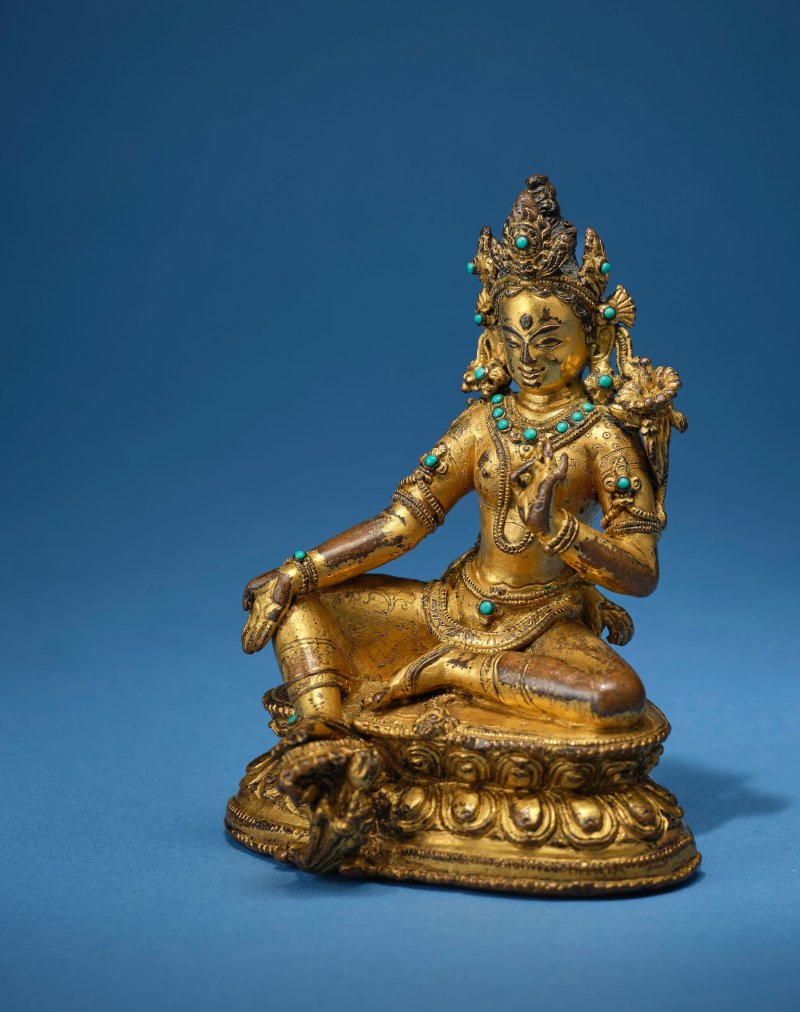
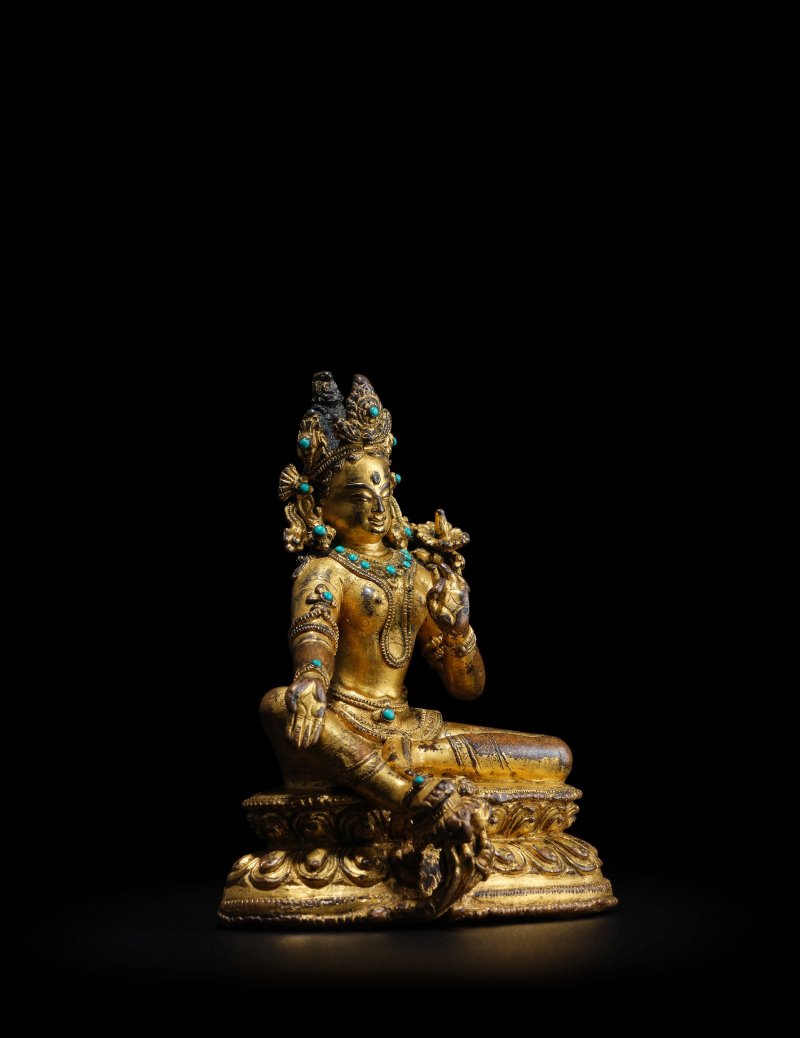
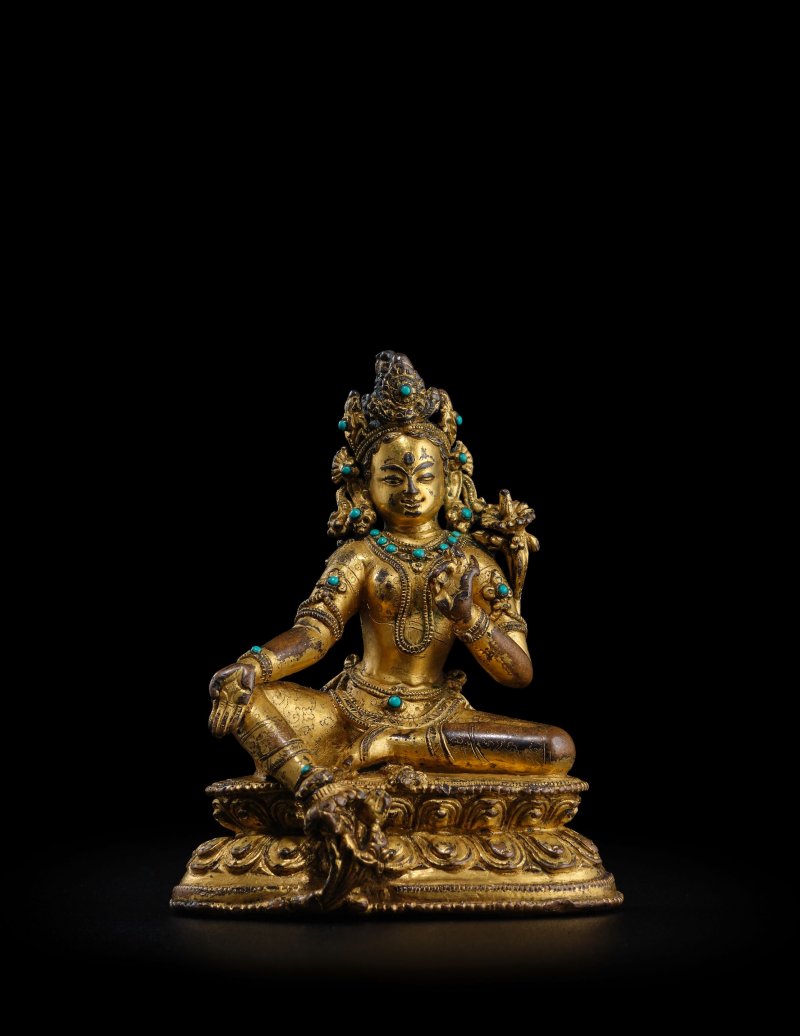
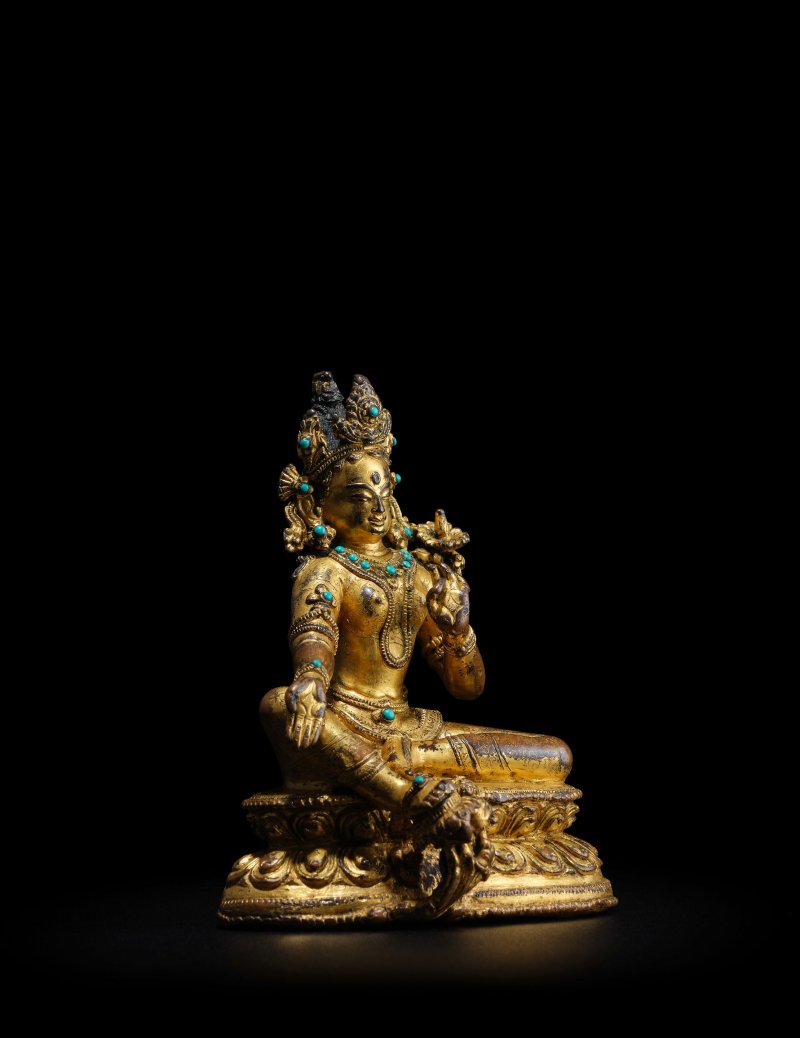
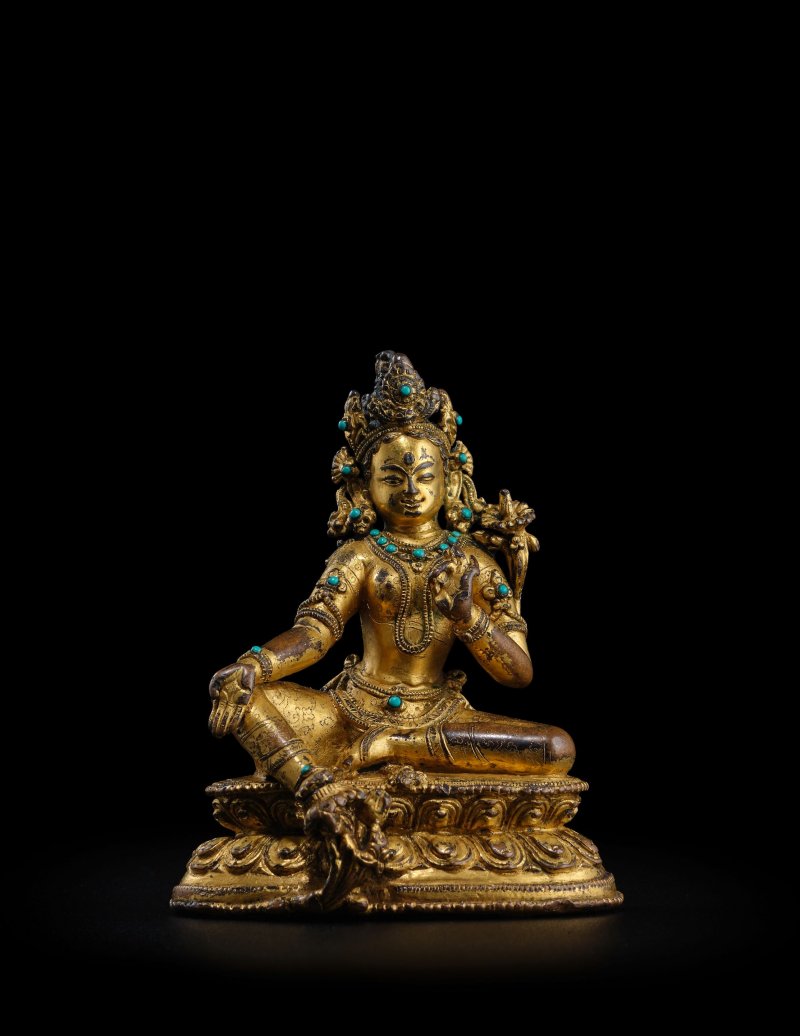
Warmly gilded, this jewel-like Green Tara displays the lush refinement and assured finesse that Newar artists brought to the Himalayas. Every element works in harmony: the supple, rhythmic contours of the body, the opulence of her ornaments and the serene, moon-like face. Her youthful countenance is tenderly rendered, with finely arched brows, heavy-lidded crescent eyes, full cheeks, a rounded chin and lips gently pursed in a smile.
Green Tara is venerated as the swift saviour who protects the faithful from worldly perils and delivers them from the cycle of rebirth. According to legend, she was born from the tears Avalokiteshvara shed for the suffering of all sentient beings, and her open, giving hand is the most eloquent expression of that boundless compassion.
Unusually, she wears a close-fitting bodice incised with roundel and lozenge motifs rather than a sash wrapped around the torso. Such patterns appear on other large Malla-period bronzes (e.g. the sash of a standing Tara; see Pal, , 1975, pp. 54-5, fig. 38), but a fitted bodice is rarely seen in sculpture. It recalls instead paintings by Nepalese artists working for Tibetan monasteries, such as the 14th-century Jataka of the Dancer at Zhalu (see Richardson, "Mural Painting at Zhalu Monastery: Mongol Patronage, Nepalese Artists, and Murals as a Public Marketing Strategy for Sacred Books," , Rubin Museum of Art, 2023, fig. 1).
Possibly cast by a Newar master working under the patronage of a leading monastery in Central Tibet, the figure shares several details with other Nepalese paintings and bronzes. Her lower garment is finely engraved with floral scrolls and loose, curling tendrils, and an incised ribbon is knotted at her waist and draped across her lap. The waist ribbon and floral patterns recur on a figure of Syamatara sold at Bonhams, New York, 20 March 2018, lot 3204. Her tiara is composed of a large central roundel flanked by foliate lobes, with small fans and fluttering ribbons above the ears. It sits over soft curls and a tall chignon crowned by a jewel. Comparable conventions of posture and expression appear on a Tara of similar date sold at Bonhams, New York, 22 March 2022, lot 305. A larger Syamatara, likely also cast by Newar artists for Tibetan patrons, has the same ribbons falling beside the ears (Bonhams, New York, 19 March 2012, lot 1097).
Himalayan Art Resources item no. 16819
10.5 cm (4 1/8 in.) high
Footnotes
尼泊爾 十四世紀 銅鎏金綠度母像
Provenance
Private Swiss Collection
Bonhams, New York, 23 September 2020, lot 619
Warmly gilded, this jewel-like Green Tara displays the lush refinement and assured finesse that Newar artists brought to the Himalayas. Every element works in harmony: the supple, rhythmic contours of the body, the opulence of her ornaments and the serene, moon-like face. Her youthful countenance is tenderly rendered, with finely arched brows, heavy-lidded crescent eyes, full cheeks, a rounded chin and lips gently pursed in a smile.
Green Tara is venerated as the swift saviour who protects the faithful from worldly perils and delivers them from the cycle of rebirth. According to legend, she was born from the tears Avalokiteshvara shed for the suffering of all sentient beings, and her open, giving hand is the most eloquent expression of that boundless compassion.
Unusually, she wears a close-fitting bodice incised with roundel and lozenge motifs rather than a sash wrapped around the torso. Such patterns appear on other large Malla-period bronzes (e.g. the sash of a standing Tara; see Pal, , 1975, pp. 54-5, fig. 38), but a fitted bodice is rarely seen in sculpture. It recalls instead paintings by Nepalese artists working for Tibetan monasteries, such as the 14th-century Jataka of the Dancer at Zhalu (see Richardson, "Mural Painting at Zhalu Monastery: Mongol Patronage, Nepalese Artists, and Murals as a Public Marketing Strategy for Sacred Books," , Rubin Museum of Art, 2023, fig. 1).
Possibly cast by a Newar master working under the patronage of a leading monastery in Central Tibet, the figure shares several details with other Nepalese paintings and bronzes. Her lower garment is finely engraved with floral scrolls and loose, curling tendrils, and an incised ribbon is knotted at her waist and draped across her lap. The waist ribbon and floral patterns recur on a figure of Syamatara sold at Bonhams, New York, 20 March 2018, lot 3204. Her tiara is composed of a large central roundel flanked by foliate lobes, with small fans and fluttering ribbons above the ears. It sits over soft curls and a tall chignon crowned by a jewel. Comparable conventions of posture and expression appear on a Tara of similar date sold at Bonhams, New York, 22 March 2022, lot 305. A larger Syamatara, likely also cast by Newar artists for Tibetan patrons, has the same ribbons falling beside the ears (Bonhams, New York, 19 March 2012, lot 1097).
常见问题
这件尼泊爾 十四世紀 銅鎏金綠度母像 | A GILT COPPER ALLOY FIGURE OF GREEN TARA的成交价是多少?
落槌价为 预展中。 成交价为 预展中。