
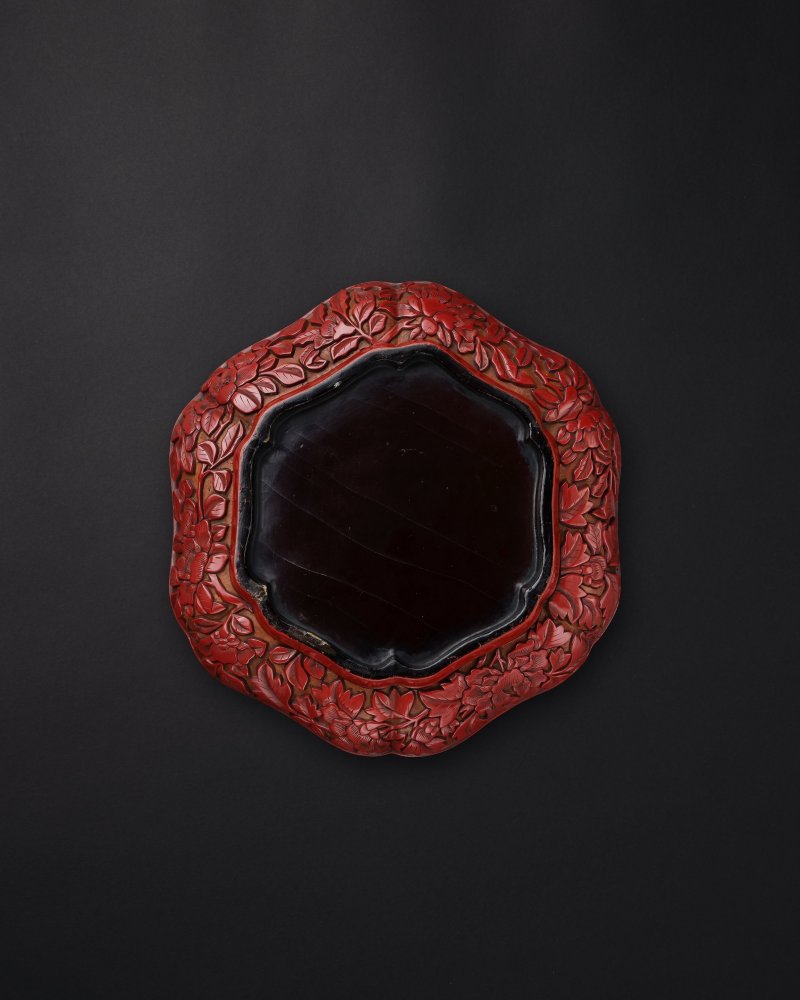

Lot 10 明 剔紅納涼圖瓣式盤 | A CARVED CINNABAR LACQUER 'RESTING SCHOLAR' HEXALOBED DISH
落槌价
预展中
成交价
预展中
| 拍卖公司 | 邦瀚斯 |
|---|---|
| 拍卖时间 | 2026年10月28日 |
拍品信息
拍品名称
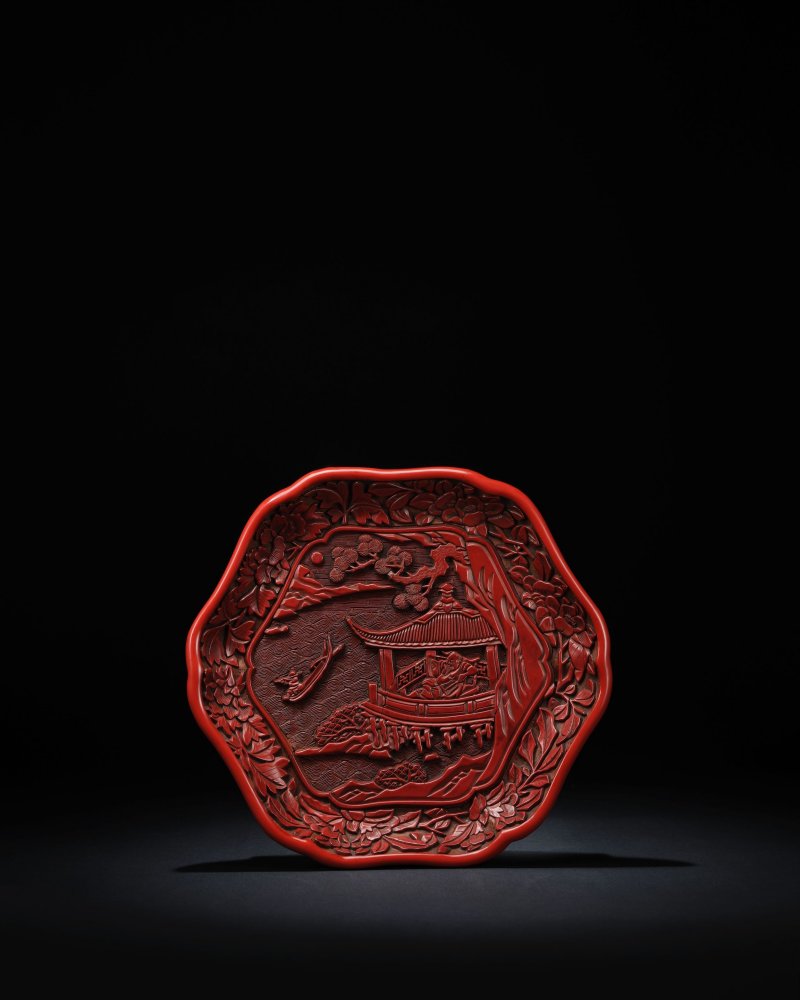
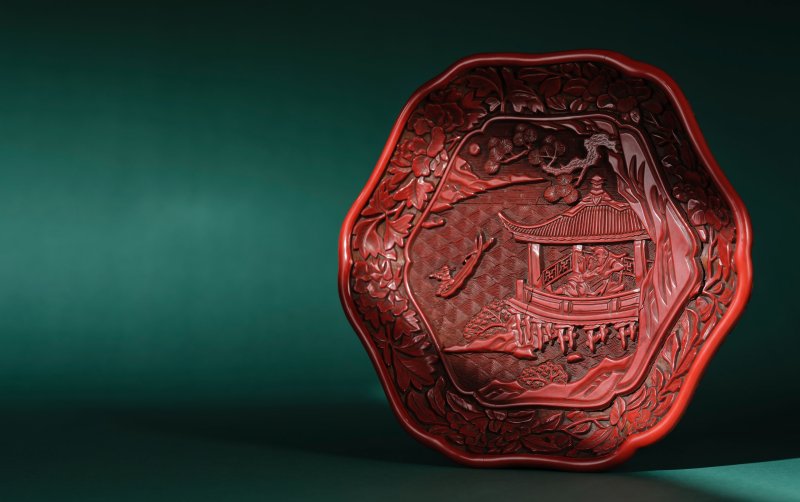
明 剔紅納涼圖瓣式盤 | A CARVED CINNABAR LACQUER 'RESTING SCHOLAR' HEXALOBED DISH
年代
Ming Dynasty
起拍价
HKD 1,000,000
估值区间
HKD 1000000 - 1200000
尺寸
未知
品相
未知
更多信息
Ming Dynasty
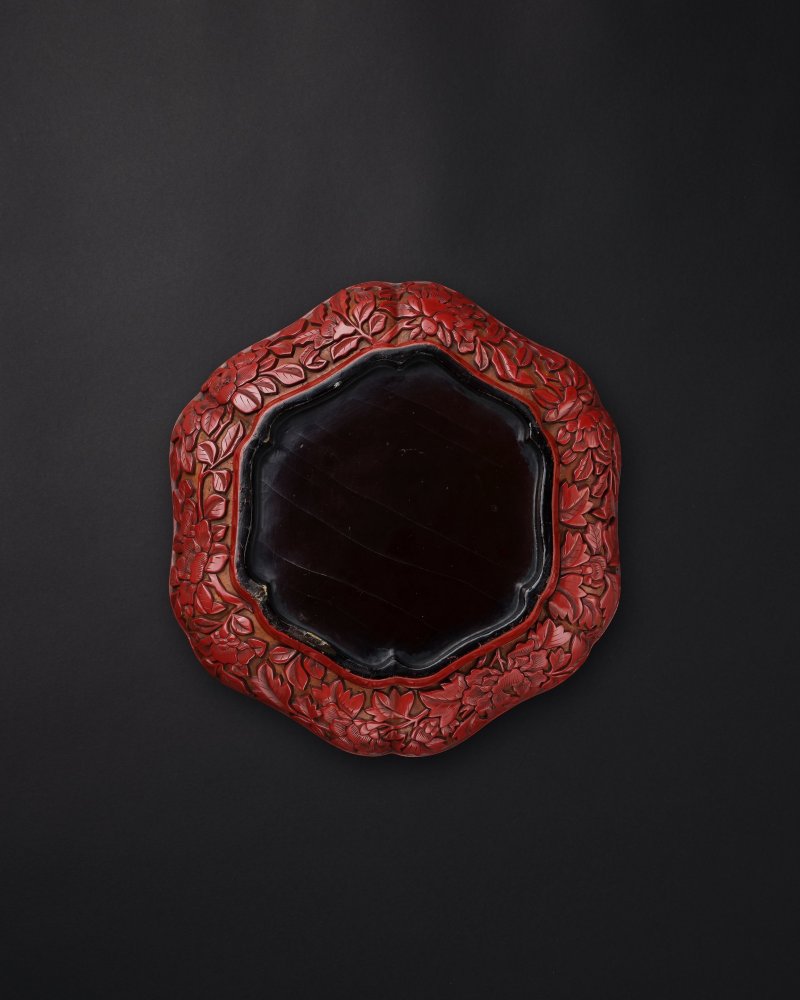
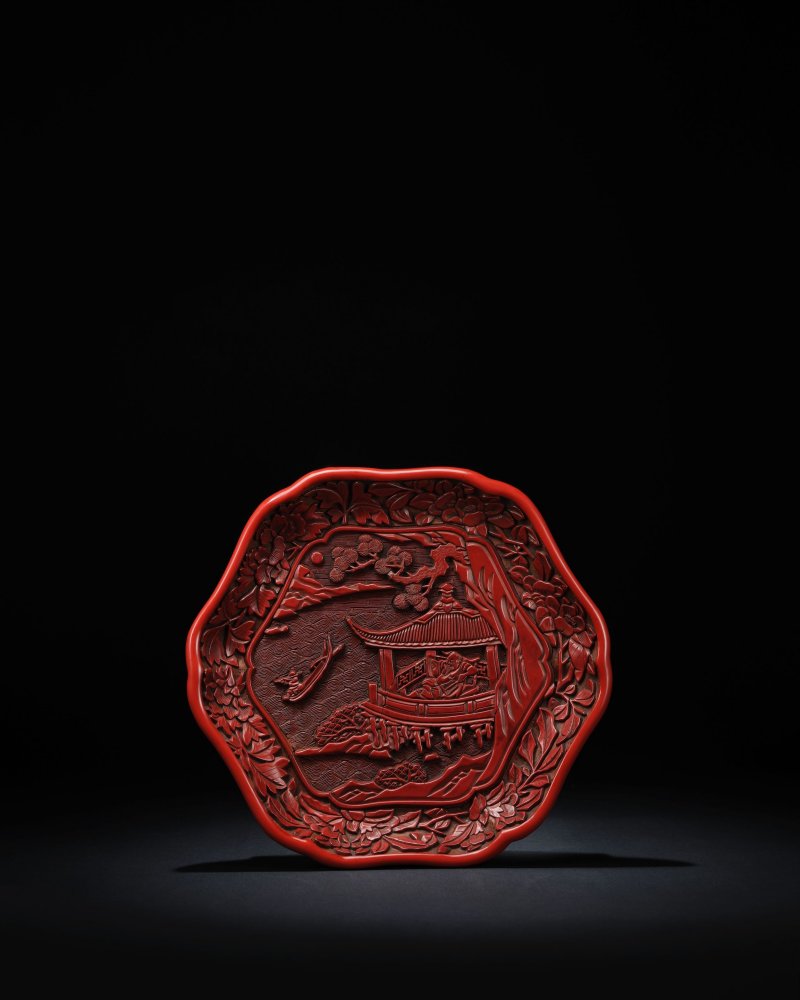
The shallow rounded sides divided into six lobes, deftly carved through layers of cinnabar lacquer with a dense band of blossoming camellia, pomegranate, and peony, all borne on leafy sprigs against an ochre ground, the central panel depicting a scholar reclining in a pavilion, his feet resting against the balustrade, his loose robes open at the chest and belly, holding a book and fan as he gazes out across a lake towards a sampan with a flute player, with rocky mountains rising in the distance, the exterior further adorned with floral sprays, Japanese wood box.
19.2cm (7 1/2in) diam. (2).
Footnotes
明 剔紅納涼圖瓣式盤
Provenance:
The Takahashi Family Collection, acquired prior to 1928
Tokyo Bijutsu Club, 5 March 1928, lot 237
A Japanese private collection, acquired circa 1970s-1980s
Christie's Hong Kong, 29 May 2013, lot 2318
Tokyo Bijutsu Club, , Tokyo, 1928, lot 237
Zhang Rong, ed., , Beijing, 2020, pp.118-119, no.35
高橋家族收藏,1928年前入藏
東京美術俱樂部,1928年3月5日,拍品編號237
日本私人收藏,約1970-1980年代入藏
香港佳士得,2013年5月29日,拍品編號2318
東京美術俱樂部,《第二回高橋家藏品入札》,東京,1928年,拍品編號237
張榮主編,《巧法造化:陽明山房藏宋元明清漆器》,北京,2020年,頁118至119,編號35
The present dish is particularly noteworthy for its Japanese provenance, having belonged to the Takahashi family collection prior to 1928. This history is especially evocative in view of the important role played by Chinese carved lacquer in the diplomatic and cultural exchange between the Ming Court and Japan during the early fifteenth century. Documents survive recording gifts from the Court of the Yongle Emperor to the Ashikaga military rulers, including an extensive consignment of carved red lacquer wares sent in 1403, while further inventories survive for 1406, 1407, 1433 and 1434. The surviving records offer striking documentary evidence for the importance of lacquer among the luxury goods presented by the Ming Court to Japan. See C.Clunas and J.Harrison-Hall, , London, 2014, p.267.
The decoration of the present dish preserves a pictorial tradition with roots in Yuan painting, in which a cultivated figure is shown enjoying a moment of leisure within an expansive landscape. The asymmetrical arrangement, with the principal elements concentrated towards one side and framed by open water, rocks and trees, likewise recalls the corner-focused compositions associated with the Southern Song dynasty Ma-Xia tradition, which continued to exert a strong influence upon Yuan and early Ming painting. Such compositions were particularly well suited to the shallow, circular format of carved lacquer, where the restricted pictorial field could be transformed into a self-contained landscape while retaining a strong sense of recession and spaciousness.
The relaxed figure at the centre of the scene is of particular interest. Bare-chested and reclining with his feet crossed, he appears entirely at ease as music drifts towards him from a flute player seated aboard a . The unusual pose finds a striking parallel in Zhu Zhanji (1399–1435), the Xuande Emperor's celebrated (武侯高卧圖, ), dated 1428 and presented by the Emperor to the distinguished military commander Chen Xuan (1365–1433). See, ., p.176. In the painting, Zhuge Liang is similarly depicted reclining in studied ease, bare-chested beside his books. Although there is no reason to posit a direct relationship between the two works, the similarity of the figure type is notable and points to a shared early Ming pictorial vocabulary in which the cultivated man at leisure could evoke ideals of learning, withdrawal from worldly concerns and, ultimately, service to the state. The scene on this dish also recalls a painting by Zhou Chen (周臣, ?-1535) titled 'Pure Joy in the Waterside Pavilion' (水亭清興圖), in the Palace Museum, Taipei (acc.no.Guhua000914).
The identity of the figures on the present dish remains open to interpretation. The seated figure may represent a scholar enjoying a moment of cultivated leisure, while the flute player could simply be a musician providing entertainment from the water. Alternatively, the pair may be intended as the Daoist immortals Zhongli Quan and Han Xiangzi, identifiable respectively by the fan and flute, although the attributes are not sufficiently explicit to make this identification certain. The imagery is therefore best understood within the broader tradition of idealised scholarly or Immortal figures living in harmony with the natural world.
For a related treatment of a figure enjoying a secluded lakeside retreat, compare a cinnabar lacquer hexafoil dish, late 14th/15th century, illustrated in Bluett & Sons, , London, 1989, pp.44–45, no.13. See also a scholar fishing beside a lake, on the cover of a two-tier box and cover, Mid-Ming dynasty, in the Qing Court Collection, illustrated in , Hong Kong, 2006, pp.116-117, no.85. Compare also with a foliated oval dish, Yuan dynasty, with a scholar on a boat with his legs crossed in ease, illustrated in , Hong Kong, 1993, pp.84-85, no.37.
See also a carved cinnabar lacquer six-lobed dish with figures in a pavilion, Yongle incised mark and of the period, which was sold at Sotheby's Hong Kong, 7 April 2014, lot 35.
盤作六方委角葵瓣式,弧壁斜敞,淺腹平底。盤內髹朱漆,包漿溫潤。器心隨形開光,內作天、地、水三種錦地,雕山水人物圖景。軒榭臨水,一高士閒坐其中,拂扇閱讀,波光瀲灩,一童子泛舟游弋,怡然自得。石崖嶙峋,松枝斜出,遠山蒼茫,朗月高懸。開光外素地剔雕花卉,枝葉扶疏,環抱不絕。壁內紋飾細緻緊密,更襯開光圖景之恬淡意趣。
本品由日本藏家遞藏,1928年以前曾屬高橋家族收藏。此一脈絡,呼應十五世紀早期中國剔紅漆器於明廷與日本之間的外交、文化交流中所扮演之重要角色。按文獻記載,永樂朝曾饋贈室町幕府將領大批剔紅漆器,其中1403年所贈數量尤為可觀;此外,1406年、1407年、1433年及1434年亦有相關清冊留存。這些文獻印證剔紅漆器在明廷贈日名貴品中之重要地位。詳細討論見柯律格與霍吉淑合編,《Ming China: 50 Years That Changed China》,倫敦,2014年,頁267。
此盤紋飾承襲元代繪畫風格,繪文人雅士於廣袤山水間享受閒適時光。其構圖不求對稱,主景偏聚一側,而以空闊水面、岩石林木環繞,令人聯想南宋馬夏一派之構圖風格,此風格對元至明初繪畫猶有深遠影響。此類章法尤合剔紅漆器之制,方寸畫面得以自成山水天地,而深邃開闊之感仍存其間。
畫面中央之閒逸人物尤堪玩味。其人袒胸露腹,交足而臥,神態自若,一笛聲自舟中吹來,悠然入耳。此姿態與宣德皇帝朱瞻基(1399–1435)名作《武侯高臥圖》極為相似。此幅作於明宣德三年(1428年),是宣德皇帝賜予名將陳瑄(1365–1433)的御作,見上書,頁176。畫中諸葛亮亦袒胸而臥,悠然自得,書卷旁置。雖無直接證據顯示本品與此畫有關聯,然所繪人物之相似殊值注意,兩者同畫文士閒居,寄寓學養、出世之志,乃至終歸報國之理想。此盤所繪場景亦與周臣(?–1535)《水亭清興圖》相似,畫作現藏台北故宮博物院(館藏編號:故畫000914)。
此盤所畫人物之身份,亦可作其他解讀。端坐者或為享受文雅閒適之文士,吹笛者則或僅為水上奏樂助興之樂人。另一可能為二人乃道教八仙中之鍾離權與韓湘子,一人執扇、一人吹笛。因此解讀此畫面,宜置於更宏闊之傳統中觀之,即理想中之文士或仙真,棲遲自然,與天地相融。
類似畫面,可參考一件十四世紀晚期/十五世紀剔紅六瓣盤,其文士臨湖幽居之景與本品相類,見Bluett & Sons,《From Innovation to Conformity: Chinese Lacquer from the 13th to 16th Centuries》,倫敦,1989年,頁44至45,編號13。另參考清宮舊藏一件明中期雙層蓋盒,盒面飾文士垂釣圖,著錄於《故宮博物院藏文物珍品全集:元明漆器》,香港,2006年,頁116至117,編號85。又可比對一件元代剔紅人物樓閣葵瓣式盤,飾文士於舟中閒坐之景,見《中國漆藝二千年》,香港,1993年,頁84至85,編號37。
另見一件永樂款剔紅六瓣人物樓閣圖盤,售於香港蘇富比,2014年4月7日,拍品編號35。
The shallow rounded sides divided into six lobes, deftly carved through layers of cinnabar lacquer with a dense band of blossoming camellia, pomegranate, and peony, all borne on leafy sprigs against an ochre ground, the central panel depicting a scholar reclining in a pavilion, his feet resting against the balustrade, his loose robes open at the chest and belly, holding a book and fan as he gazes out across a lake towards a sampan with a flute player, with rocky mountains rising in the distance, the exterior further adorned with floral sprays, Japanese wood box.
19.2cm (7 1/2in) diam. (2).
Footnotes
明 剔紅納涼圖瓣式盤
Provenance:
The Takahashi Family Collection, acquired prior to 1928
Tokyo Bijutsu Club, 5 March 1928, lot 237
A Japanese private collection, acquired circa 1970s-1980s
Christie's Hong Kong, 29 May 2013, lot 2318
Tokyo Bijutsu Club, , Tokyo, 1928, lot 237
Zhang Rong, ed., , Beijing, 2020, pp.118-119, no.35
高橋家族收藏,1928年前入藏
東京美術俱樂部,1928年3月5日,拍品編號237
日本私人收藏,約1970-1980年代入藏
香港佳士得,2013年5月29日,拍品編號2318
東京美術俱樂部,《第二回高橋家藏品入札》,東京,1928年,拍品編號237
張榮主編,《巧法造化:陽明山房藏宋元明清漆器》,北京,2020年,頁118至119,編號35
The present dish is particularly noteworthy for its Japanese provenance, having belonged to the Takahashi family collection prior to 1928. This history is especially evocative in view of the important role played by Chinese carved lacquer in the diplomatic and cultural exchange between the Ming Court and Japan during the early fifteenth century. Documents survive recording gifts from the Court of the Yongle Emperor to the Ashikaga military rulers, including an extensive consignment of carved red lacquer wares sent in 1403, while further inventories survive for 1406, 1407, 1433 and 1434. The surviving records offer striking documentary evidence for the importance of lacquer among the luxury goods presented by the Ming Court to Japan. See C.Clunas and J.Harrison-Hall, , London, 2014, p.267.
The decoration of the present dish preserves a pictorial tradition with roots in Yuan painting, in which a cultivated figure is shown enjoying a moment of leisure within an expansive landscape. The asymmetrical arrangement, with the principal elements concentrated towards one side and framed by open water, rocks and trees, likewise recalls the corner-focused compositions associated with the Southern Song dynasty Ma-Xia tradition, which continued to exert a strong influence upon Yuan and early Ming painting. Such compositions were particularly well suited to the shallow, circular format of carved lacquer, where the restricted pictorial field could be transformed into a self-contained landscape while retaining a strong sense of recession and spaciousness.
The relaxed figure at the centre of the scene is of particular interest. Bare-chested and reclining with his feet crossed, he appears entirely at ease as music drifts towards him from a flute player seated aboard a . The unusual pose finds a striking parallel in Zhu Zhanji (1399–1435), the Xuande Emperor's celebrated (武侯高卧圖, ), dated 1428 and presented by the Emperor to the distinguished military commander Chen Xuan (1365–1433). See, ., p.176. In the painting, Zhuge Liang is similarly depicted reclining in studied ease, bare-chested beside his books. Although there is no reason to posit a direct relationship between the two works, the similarity of the figure type is notable and points to a shared early Ming pictorial vocabulary in which the cultivated man at leisure could evoke ideals of learning, withdrawal from worldly concerns and, ultimately, service to the state. The scene on this dish also recalls a painting by Zhou Chen (周臣, ?-1535) titled 'Pure Joy in the Waterside Pavilion' (水亭清興圖), in the Palace Museum, Taipei (acc.no.Guhua000914).
The identity of the figures on the present dish remains open to interpretation. The seated figure may represent a scholar enjoying a moment of cultivated leisure, while the flute player could simply be a musician providing entertainment from the water. Alternatively, the pair may be intended as the Daoist immortals Zhongli Quan and Han Xiangzi, identifiable respectively by the fan and flute, although the attributes are not sufficiently explicit to make this identification certain. The imagery is therefore best understood within the broader tradition of idealised scholarly or Immortal figures living in harmony with the natural world.
For a related treatment of a figure enjoying a secluded lakeside retreat, compare a cinnabar lacquer hexafoil dish, late 14th/15th century, illustrated in Bluett & Sons, , London, 1989, pp.44–45, no.13. See also a scholar fishing beside a lake, on the cover of a two-tier box and cover, Mid-Ming dynasty, in the Qing Court Collection, illustrated in , Hong Kong, 2006, pp.116-117, no.85. Compare also with a foliated oval dish, Yuan dynasty, with a scholar on a boat with his legs crossed in ease, illustrated in , Hong Kong, 1993, pp.84-85, no.37.
See also a carved cinnabar lacquer six-lobed dish with figures in a pavilion, Yongle incised mark and of the period, which was sold at Sotheby's Hong Kong, 7 April 2014, lot 35.
盤作六方委角葵瓣式,弧壁斜敞,淺腹平底。盤內髹朱漆,包漿溫潤。器心隨形開光,內作天、地、水三種錦地,雕山水人物圖景。軒榭臨水,一高士閒坐其中,拂扇閱讀,波光瀲灩,一童子泛舟游弋,怡然自得。石崖嶙峋,松枝斜出,遠山蒼茫,朗月高懸。開光外素地剔雕花卉,枝葉扶疏,環抱不絕。壁內紋飾細緻緊密,更襯開光圖景之恬淡意趣。
本品由日本藏家遞藏,1928年以前曾屬高橋家族收藏。此一脈絡,呼應十五世紀早期中國剔紅漆器於明廷與日本之間的外交、文化交流中所扮演之重要角色。按文獻記載,永樂朝曾饋贈室町幕府將領大批剔紅漆器,其中1403年所贈數量尤為可觀;此外,1406年、1407年、1433年及1434年亦有相關清冊留存。這些文獻印證剔紅漆器在明廷贈日名貴品中之重要地位。詳細討論見柯律格與霍吉淑合編,《Ming China: 50 Years That Changed China》,倫敦,2014年,頁267。
此盤紋飾承襲元代繪畫風格,繪文人雅士於廣袤山水間享受閒適時光。其構圖不求對稱,主景偏聚一側,而以空闊水面、岩石林木環繞,令人聯想南宋馬夏一派之構圖風格,此風格對元至明初繪畫猶有深遠影響。此類章法尤合剔紅漆器之制,方寸畫面得以自成山水天地,而深邃開闊之感仍存其間。
畫面中央之閒逸人物尤堪玩味。其人袒胸露腹,交足而臥,神態自若,一笛聲自舟中吹來,悠然入耳。此姿態與宣德皇帝朱瞻基(1399–1435)名作《武侯高臥圖》極為相似。此幅作於明宣德三年(1428年),是宣德皇帝賜予名將陳瑄(1365–1433)的御作,見上書,頁176。畫中諸葛亮亦袒胸而臥,悠然自得,書卷旁置。雖無直接證據顯示本品與此畫有關聯,然所繪人物之相似殊值注意,兩者同畫文士閒居,寄寓學養、出世之志,乃至終歸報國之理想。此盤所繪場景亦與周臣(?–1535)《水亭清興圖》相似,畫作現藏台北故宮博物院(館藏編號:故畫000914)。
此盤所畫人物之身份,亦可作其他解讀。端坐者或為享受文雅閒適之文士,吹笛者則或僅為水上奏樂助興之樂人。另一可能為二人乃道教八仙中之鍾離權與韓湘子,一人執扇、一人吹笛。因此解讀此畫面,宜置於更宏闊之傳統中觀之,即理想中之文士或仙真,棲遲自然,與天地相融。
類似畫面,可參考一件十四世紀晚期/十五世紀剔紅六瓣盤,其文士臨湖幽居之景與本品相類,見Bluett & Sons,《From Innovation to Conformity: Chinese Lacquer from the 13th to 16th Centuries》,倫敦,1989年,頁44至45,編號13。另參考清宮舊藏一件明中期雙層蓋盒,盒面飾文士垂釣圖,著錄於《故宮博物院藏文物珍品全集:元明漆器》,香港,2006年,頁116至117,編號85。又可比對一件元代剔紅人物樓閣葵瓣式盤,飾文士於舟中閒坐之景,見《中國漆藝二千年》,香港,1993年,頁84至85,編號37。
另見一件永樂款剔紅六瓣人物樓閣圖盤,售於香港蘇富比,2014年4月7日,拍品編號35。
常见问题
这件明 剔紅納涼圖瓣式盤 | A CARVED CINNABAR LACQUER 'RESTING SCHOLAR' HEXALOBED DISH的成交价是多少?
落槌价为 预展中。 成交价为 预展中。