
拍品信息
拍品名称
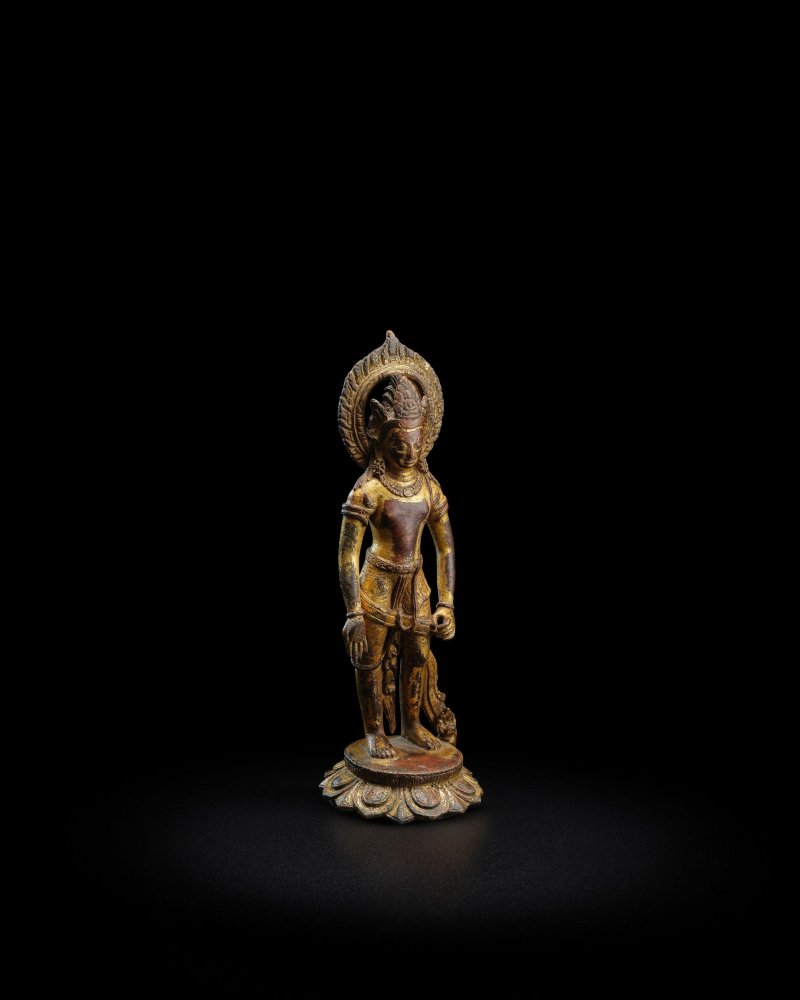
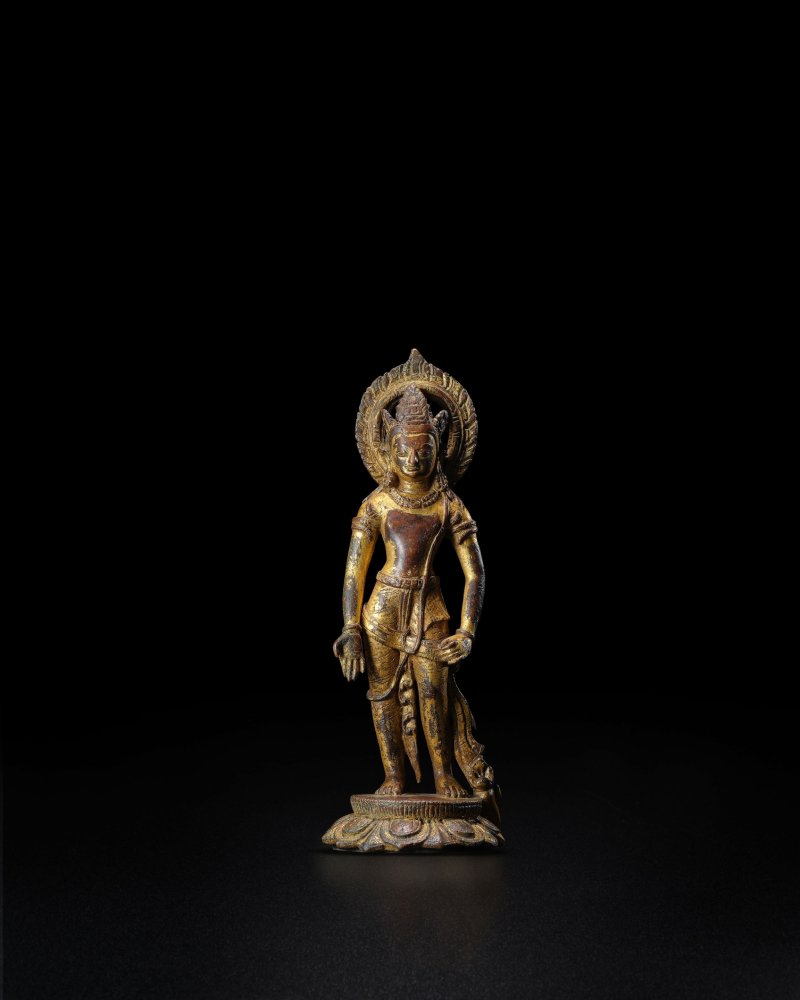
尼泊爾 過渡時期 約十世紀 銅鎏金菩薩像 | A GILT COPPER ALLOY FIGURE OF A BODHISATTVA
年代
NEPAL, TRANSITIONAL PERIOD, CIRCA 10TH CENTURY
起拍价
HKD 800,000
估值区间
HKD 800000 - 1200000
尺寸
未知
品相
未知
更多信息
NEPAL, TRANSITIONAL PERIOD, CIRCA 10TH CENTURY
Himalayan Art Resources item no. 8898
20 cm (7 7/8 in.) high
Footnotes
尼泊爾 過渡時期 約十世紀 銅鎏金菩薩像
Published
Ulrich von Schroeder, Indo-Tibetan Bronzes, Hong Kong, 1981, p. 313, no. 78D.
Provenance
Christie's, London, 11 December 1973, lot 139
Sotheby's, New York, 20 March 1997, lot 64
Private European Collection
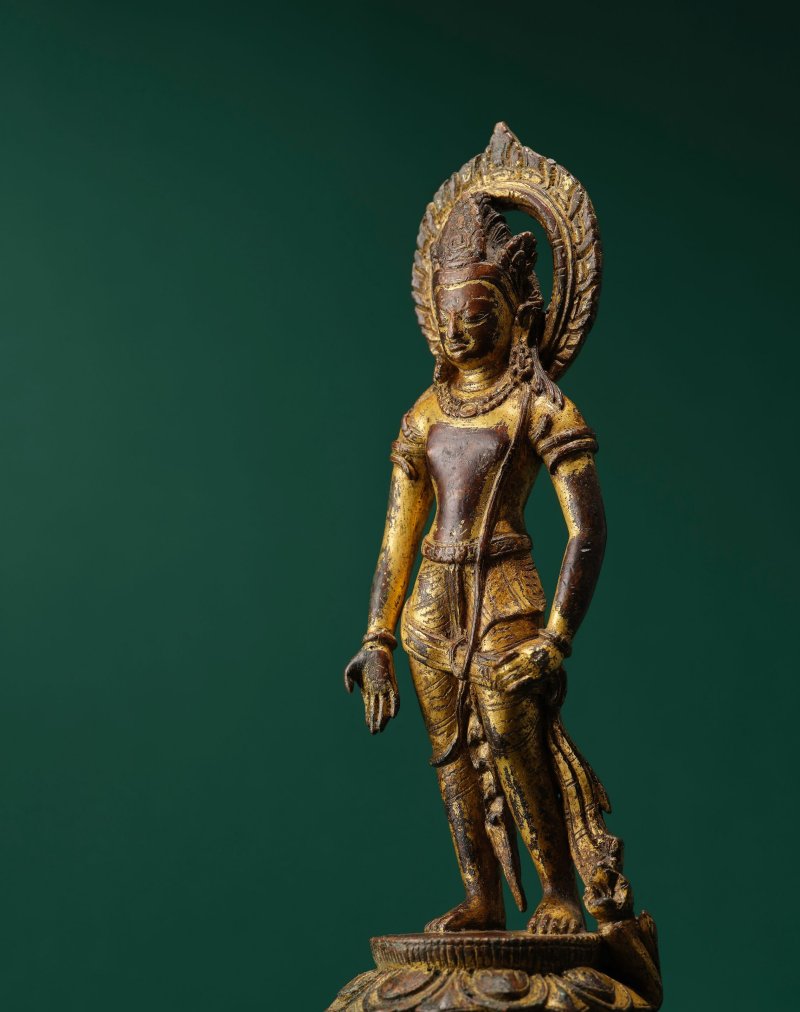
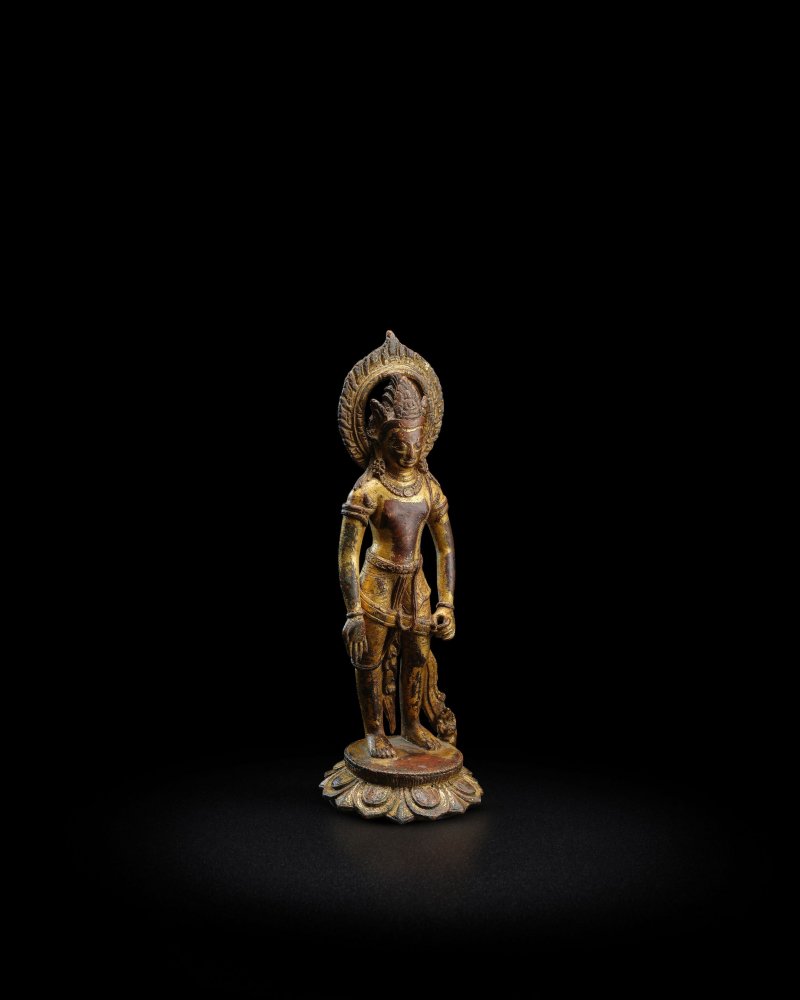
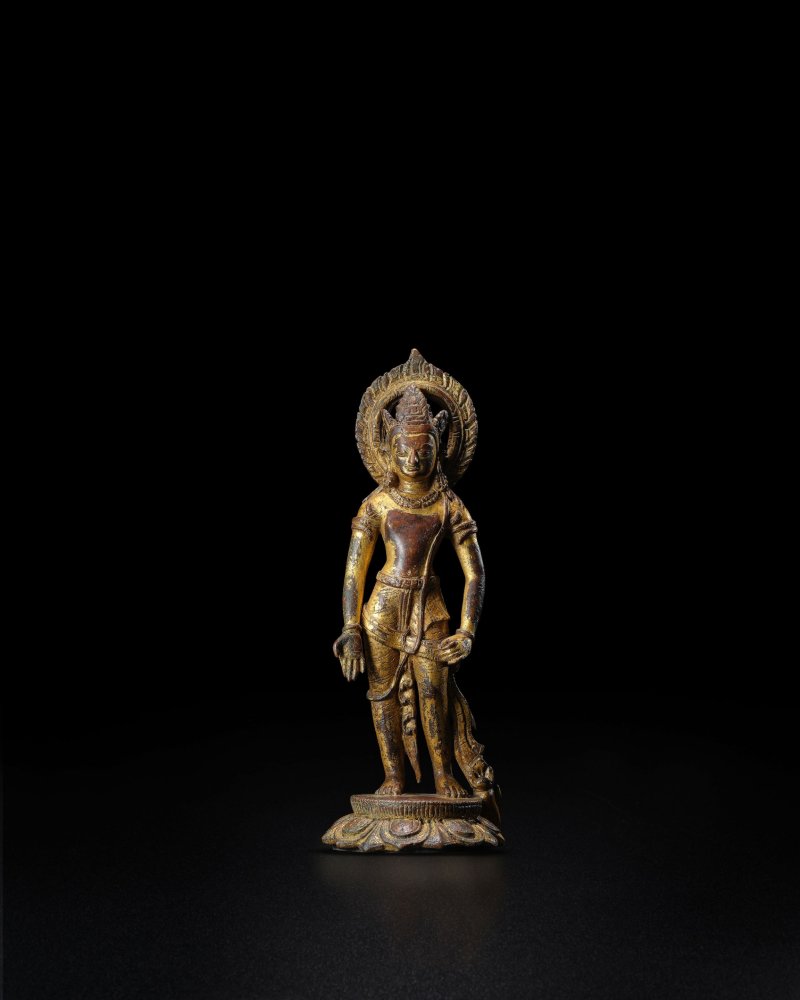
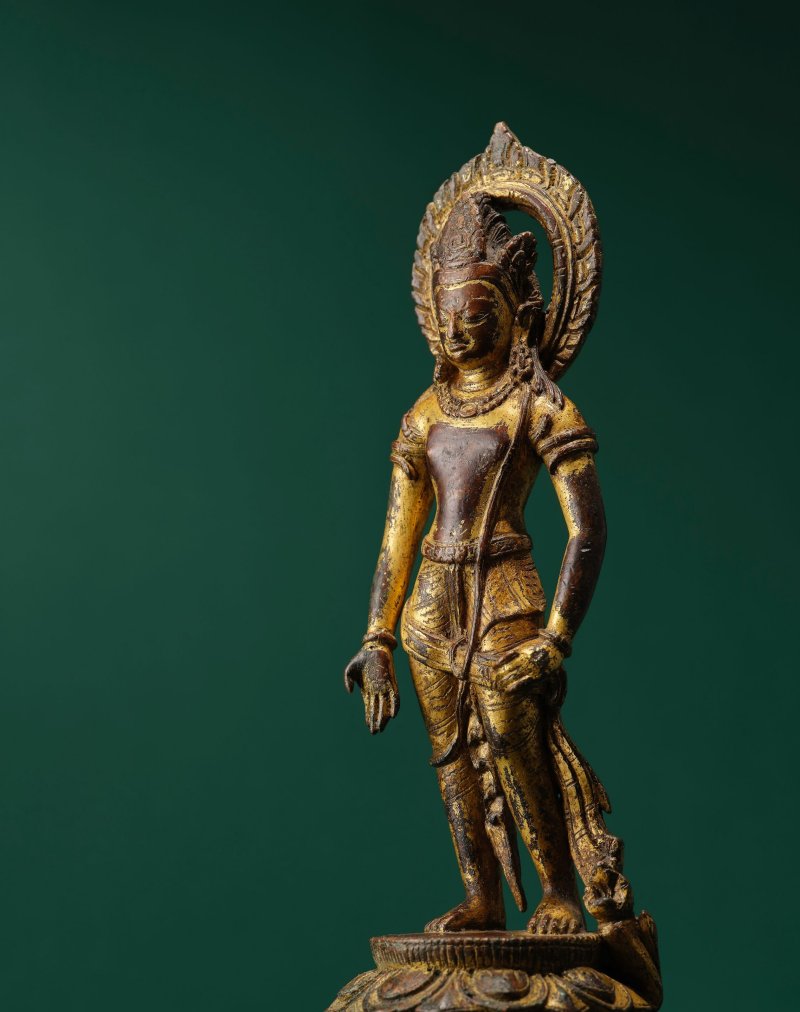
The bodhisattva adopts a gentle tribhanga (triple-bend) posture, with well-proportioned and graceful contours. The right hand is lowered beside the hip in the boon-granting gesture (varada mudra). The limbs are robust and the musculature is rendered with a sense of fullness and suppleness, reflecting the high degree of naturalism achieved by Newar artists. The elegant stance is characteristic of Nepalese sculpture from the Kathmandu Valley during the Licchavi and Transitional periods, a style that ultimately derives from classical Gupta (4th–6th century) and early Pala (8th–9th century) prototypes.
The tiara, with its three leaf-shaped points, recalls early Buddhist artistic conventions. At the centre is a seated figure of Amitabha in meditation. The crown ornaments and earrings, symmetrically arranged on both sides, are rendered in foliate forms. Armlets encircle the upper arms, and an elegant necklace adorns the neck. The face is full and rounded, with slender, elongated eyes and a serene, contemplative expression. The head is backed by a flaming nimbus.
The lower body is clad in a short , deeply incised with fold lines and fine patterns —a characteristic technique of Newar metalwork. The sash drapes naturally from the hip, its flowing folds suggesting movement as if stirred by a gentle breeze. A (sacred thread) passes over the left shoulder and falls diagonally across the torso to the waist.
The figure stands upon a single-tiered, waisted lotus base, its sides incised with lotus stamens above petals that spread outward and downward. The outer petals are broad and rounded with pointed tips, while the inner petals bear incised detailing. This form of lotus base is highly characteristic of the period. Compare the similar lotus bases of two Nepalese sculptures dated circa 10th–11th century in the John and Berthe Ford Collection (Pal, , 2001, pp. 188–189, nos. 104 and 105).
Several closely related examples are known. One is also in the John and Berthe Ford Collection (ibid., p. 186, no. 102). Another was sold at Christie's, New York, 21 March 2008, lot 503. A further example is in the Tsuglakang (Jokhang), Lhasa (HAR 57198).
Himalayan Art Resources item no. 8898
20 cm (7 7/8 in.) high
Footnotes
尼泊爾 過渡時期 約十世紀 銅鎏金菩薩像
Published
Ulrich von Schroeder, Indo-Tibetan Bronzes, Hong Kong, 1981, p. 313, no. 78D.
Provenance
Christie's, London, 11 December 1973, lot 139
Sotheby's, New York, 20 March 1997, lot 64
Private European Collection
The bodhisattva adopts a gentle tribhanga (triple-bend) posture, with well-proportioned and graceful contours. The right hand is lowered beside the hip in the boon-granting gesture (varada mudra). The limbs are robust and the musculature is rendered with a sense of fullness and suppleness, reflecting the high degree of naturalism achieved by Newar artists. The elegant stance is characteristic of Nepalese sculpture from the Kathmandu Valley during the Licchavi and Transitional periods, a style that ultimately derives from classical Gupta (4th–6th century) and early Pala (8th–9th century) prototypes.
The tiara, with its three leaf-shaped points, recalls early Buddhist artistic conventions. At the centre is a seated figure of Amitabha in meditation. The crown ornaments and earrings, symmetrically arranged on both sides, are rendered in foliate forms. Armlets encircle the upper arms, and an elegant necklace adorns the neck. The face is full and rounded, with slender, elongated eyes and a serene, contemplative expression. The head is backed by a flaming nimbus.
The lower body is clad in a short , deeply incised with fold lines and fine patterns —a characteristic technique of Newar metalwork. The sash drapes naturally from the hip, its flowing folds suggesting movement as if stirred by a gentle breeze. A (sacred thread) passes over the left shoulder and falls diagonally across the torso to the waist.
The figure stands upon a single-tiered, waisted lotus base, its sides incised with lotus stamens above petals that spread outward and downward. The outer petals are broad and rounded with pointed tips, while the inner petals bear incised detailing. This form of lotus base is highly characteristic of the period. Compare the similar lotus bases of two Nepalese sculptures dated circa 10th–11th century in the John and Berthe Ford Collection (Pal, , 2001, pp. 188–189, nos. 104 and 105).
Several closely related examples are known. One is also in the John and Berthe Ford Collection (ibid., p. 186, no. 102). Another was sold at Christie's, New York, 21 March 2008, lot 503. A further example is in the Tsuglakang (Jokhang), Lhasa (HAR 57198).
常见问题
这件尼泊爾 過渡時期 約十世紀 銅鎏金菩薩像 | A GILT COPPER ALLOY FIGURE OF A BODHISATTVA的成交价是多少?
落槌价为 预展中。 成交价为 预展中。