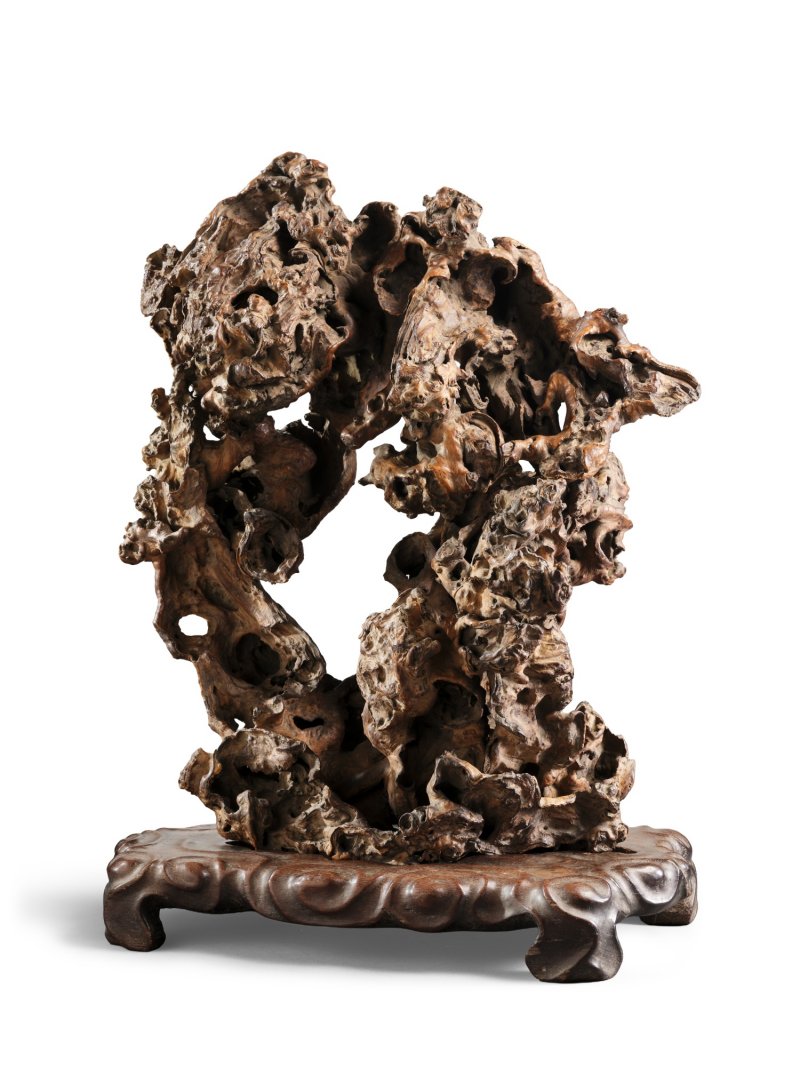

Lot 8068 A large and rare Yingmu ‘dreamroot’ sculpture, Ming dynasty | 明 隨形大木供
落槌价
预展中
成交价
预展中
| 拍卖公司 | 苏富比 |
|---|---|
| 拍卖时间 | 2026年10月30日 |
拍品信息
拍品名称
A large and rare Yingmu ‘dreamroot’ sculpture, Ming dynasty | 明 隨形大木供
起拍价
HKD 2,000,000
估值区间
2,000,000 - 4,000,000 HKD
尺寸
未知
品相
如欲了解本拍品狀況的更多資訊,請聯絡 Rubie.Fong@sothebys.com
更多信息
overall h. 68 cm
著录:Nicolas Chow, The Literati Aesthetic, Hong Kong, 2018, no. 21.
图录
说明:出版
仇國仕,《無盡意》,香港,2018年,編號21
During the mid-to-late Ming dynasty, with the rise of the Jiangnan literati and a prosperous commodity economy, the aesthetic taste for studio objects underwent a paradigm shift from revering archaic bronzes to championing natural forms. Rootwood sculptures, also known as yingmu mountains or dreamroots, with their unadorned and organic morphology, became the core material embodiment of the late Ming literati ideal of 'the unity of heaven and humanity'. Standing at an impressive 68 cm tall and retaining its original tielimu stand, the present large dreamroot sculpture perfectly encapsulates the aesthetic positioning and scholarly value of such monumental studio objects in the Ming dynasty scholar's studio.
In the late Ming period, scholars such as Gao Lian, Wen Zhenheng, and Tu Long systematically deconstructed the highly regulated and luxurious crafts favoured by the court and wealthy merchants (such as cloisonné and carved lacquer), turning their attention instead to the 'beauty of imperfection' and 'withered elegance' found in nature. Wen Zhenheng noted in his Zhangwu zhi (Treatise on Superfluous Things) that natural objects should be appreciated for their inherent twists and turns without the application of carving. The emergence of rootwood offerings was essentially a spiritual practice by the literati to 'condense' and 'relocate' the grandeur of mountains and forests to their desks, achieving a state of 'wandering while reclining' without leaving the city walls.
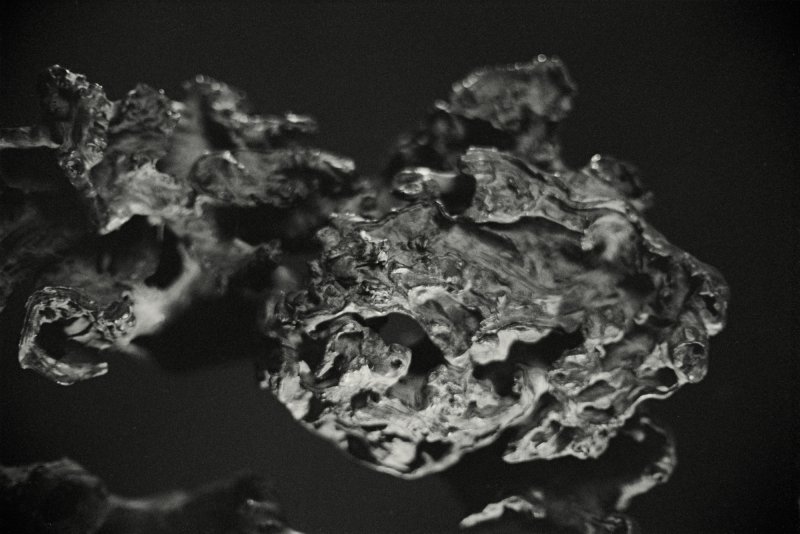
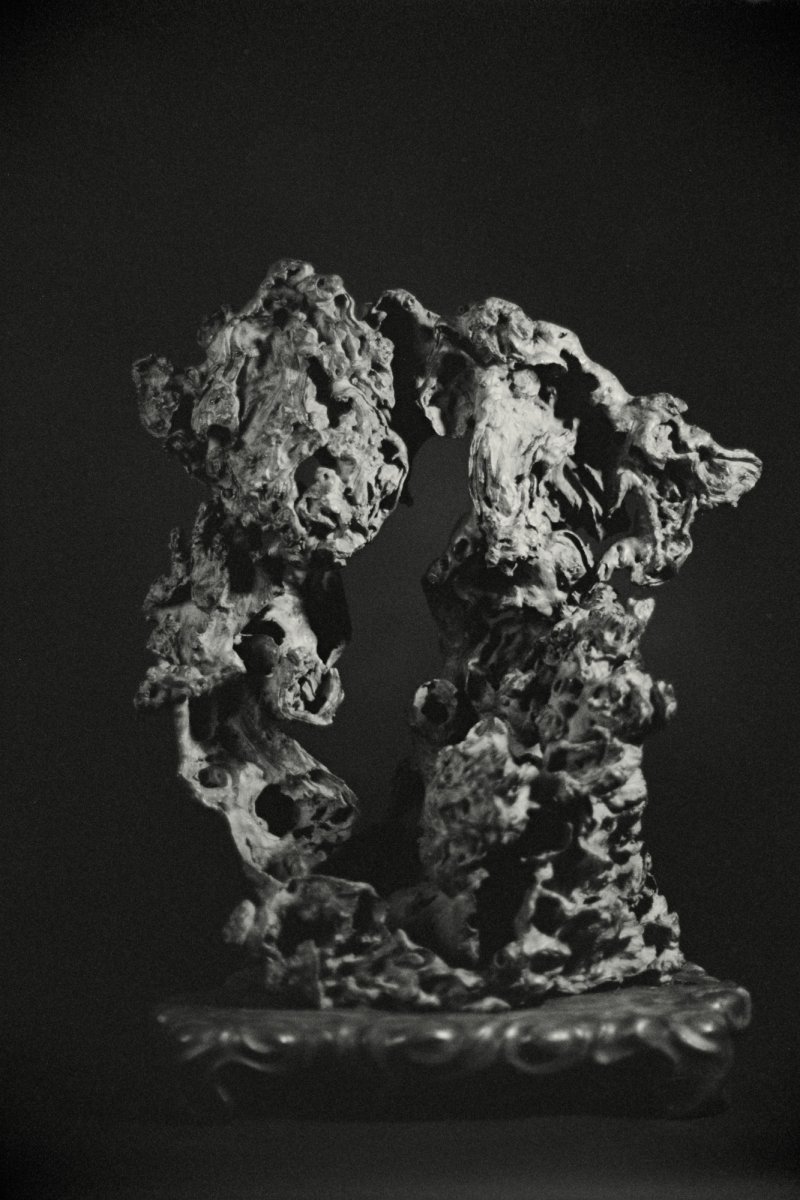
The most striking artistic achievement of this sculpture is its perfect replication of the highest aesthetic standards of traditional scholar's rocks, such as Taihu or Lingbi stones, using wood fibres. It embodies the qualities of shou (slenderness) and tou (permeability) through its tall, upright profile and the large natural hollows that allow light to pass through, rendering the heavy wooden structure visually ethereal. The surface is covered with dense wrinkles and nodules formed by years of weathering, perfectly capturing the zhou (wrinkles) and lou (channels) that mimic the three-dimensional brushstrokes of Song dynasty landscape paintings. The craftsman employed the ultimate technique of 'hidden craftsmanship', only removing decayed parts and polishing the wood, allowing human traces to dissolve entirely into nature's creation.
Surviving Ming dynasty rootwood studio objects typically range from 20 to 40 cm in height. At 68 cm, this piece is an exceptionally rare 'desk peak' or 'hall centrepiece'. The preservation and display of such a large object pose challenges in balance and material distortion. The solution lies in its original tielimu (ironwood) stand. As a premier hardwood of the Ming and early Qing periods, tielimu is incredibly dense and heavy, acting as a perfect physical ballast to ensure the towering, leaning wood above remains stable for centuries. Furthermore, the stand is custom-carved to perfectly interlock with the undulating bottom of the rootwood, creating a visual balance between the solid, archaic base and the porous, dynamic wood above—a hallmark of Ming-style studio aesthetics.
Compare with a Qing dynasty 'Rootwood Immortal Mountain with a Jade Buddha' in the collection of the Palace Museum, Taipei (accession nos: Gu Yu 001344, Gu Diao 000130), published in The Palace Museum Monthly of Chinese Art, No. 488, Nov 2023, p. 94, fig. 16.
明代中晚期,伴隨江南文人集團的興起與商品經濟的繁榮,文房清供的審美趣味經歷了由「崇法重器」向「崇尚自然」的範式轉移。隨形木清供(亦稱根雕、癭木山子)因其天然去雕飾的物質形態,成為晚明文人「天人合一」思想的核心物質載體。本件傳世「明代隨形大木供(高68公分,配鐵力木原座)」,深刻展現了大型隨形木供在明代書齋空間中的美學定位與學術價值。
明代中後期,以高濂、文震亨、屠隆為代表的士大夫,開始系統性地解構宮廷與富商階層所推崇的規整、奢華、繁複工藝,轉而將目光投向大自然中的「殘缺之美」與「枯槁之趣」。文震亨在《長物志》中提出:「天然者,因其勢之曲折,不施雕琢。」高濂亦指出,文人收藏樹根與怪木,核心在於欣賞其「天然玲瓏、穿漏洞竅」的造化奇觀。隨形木供的出現,實質上是文人將宏大的山林野趣「濃縮」並「搬遷」至咫尺案頭的精神實踐。
本件高達68公分的隨形大木供,其最顯著的藝術成就,在於它完美地用「木質纖維」複刻了傳統賞石(如太湖石、靈璧石)的最高審美標準。木供整體線條修長、挺拔,呈現出魏晉高士般孤傲的「瘦」態;中段天然形成巨大的鏤空洞竅,前後透光,使沉重的木質結構在視覺上變得無比空靈(透)。表面布滿了長年風化形成的凹凸結節與密集的皴皺(皺與漏),宛如宋代山水畫中「皴法」的立體呈現。匠人敏銳地捕捉到木料本身的天然走勢,僅對腐朽部分進行必要的剔除與磐磨,使人工痕跡完全消解於天然造化之中。
在傳世的明代文房隨形木中,高度多在20至40公分之間。本件總高達68公分,屬於極其罕見的「中堂大器」。這種大體量器物之所以能跨越數百年完好傳世,關鍵在於其配置的鐵力木原座。鐵力木質地極其堅硬、分量沉重,在物理上起到了完美的「壓艙」作用,確保了上方高聳的木供穩固不倒。底座的上表面依據木供底部的起伏進行了精準的嵌合雕刻,底座的古拙厚重與上部根木的玲瓏剔透形成了一動一靜、一實一虛的視覺平衡。
參看台北故宮博物院所藏一件「清 木根仙山與碧玉釋迦佛」(故玉001344、故雕000130,出版於《故宮文物月刊》第488期・2023年11月,第94頁,圖16。故宮藏品以蒼老枯槁的木根為「賓」,卻在中心置入質地瑩潤的「碧玉佛像」為「主」,反映了清代宮廷對精細度與裝飾性的追求。相較之下,本件明代大木供完全由天然隨形木嵌合,搭配大巧若拙的鐵力木原座,不喧賓奪主,將視覺焦點完全讓給上方的枯木造化,這是最典型的晚明文人「不事雕琢、寄情山水」的孤傲實踐。本件大木供以罕見的體量與純粹天然的結構,更顯現出其作為明代文人文房大器的純粹性與不可替代的歷史標本價值。
常见问题
这件A large and rare Yingmu ‘dreamroot’ sculpture, Ming dynasty | 明 隨形大木供的成交价是多少?
落槌价为 预展中。 成交价为 预展中。
拍品的品相状况如何?
如欲了解本拍品狀況的更多資訊,請聯絡 Rubie.Fong@sothebys.com
这件拍品被哪些著录书籍记载?
Nicolas Chow, The Literati Aesthetic, Hong Kong, 2018, no. 21.
图录
图录