
Lot 803 犍陀羅 三/四世紀 片岩說法佛石碑 | A GREY SCHIST GABLE RELIEF WITH THE TEACHING BUDDHA
落槌价
预展中
成交价
预展中
| 拍卖公司 | 邦瀚斯 |
|---|---|
| 拍卖时间 | 2026年10月29日 |
拍品信息
拍品名称
犍陀羅 三/四世紀 片岩說法佛石碑 | A GREY SCHIST GABLE RELIEF WITH THE TEACHING BUDDHA
年代
ANCIENT REGION OF GANDHARA, 3RD/4TH CENTURY
起拍价
HKD 2,000,000
估值区间
HKD 2000000 - 3000000
尺寸
未知
品相
未知
更多信息
ANCIENT REGION OF GANDHARA, 3RD/4TH CENTURY
52.5 cm (20 5/8 in.) high
Footnotes
犍陀羅 三/四世紀 片岩說法佛石碑
Provenance
Private UK Collection, London, 1990/91
Asian Private Collection
Hong Kong Art Market, 2018
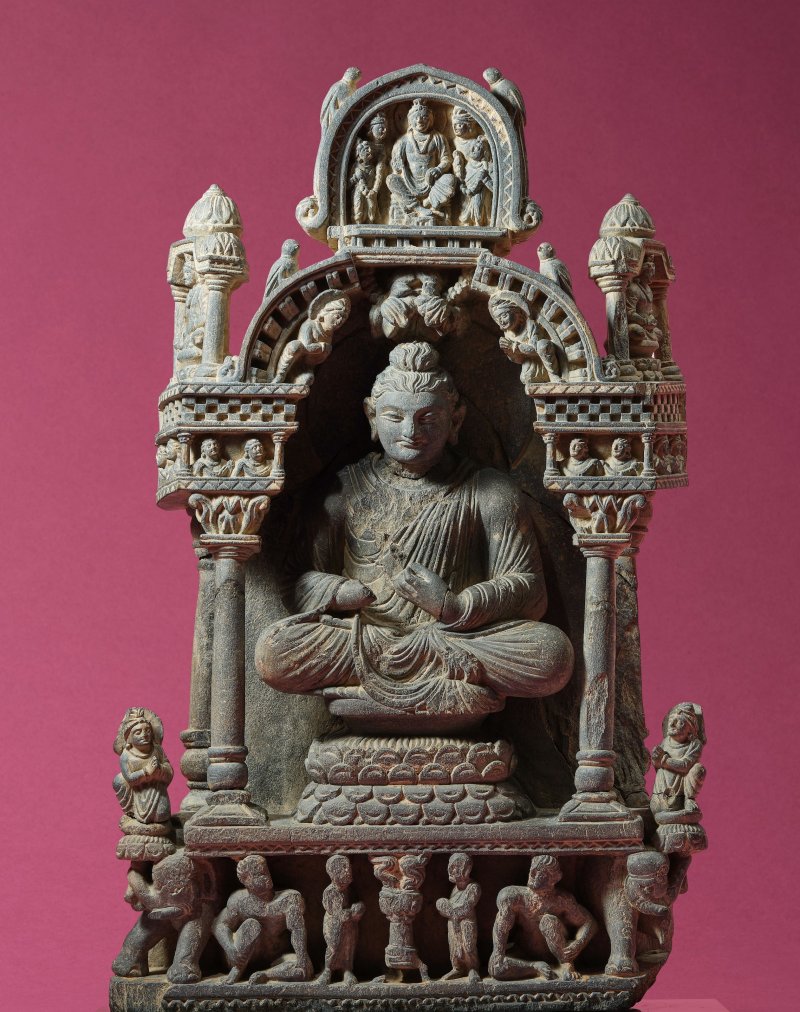
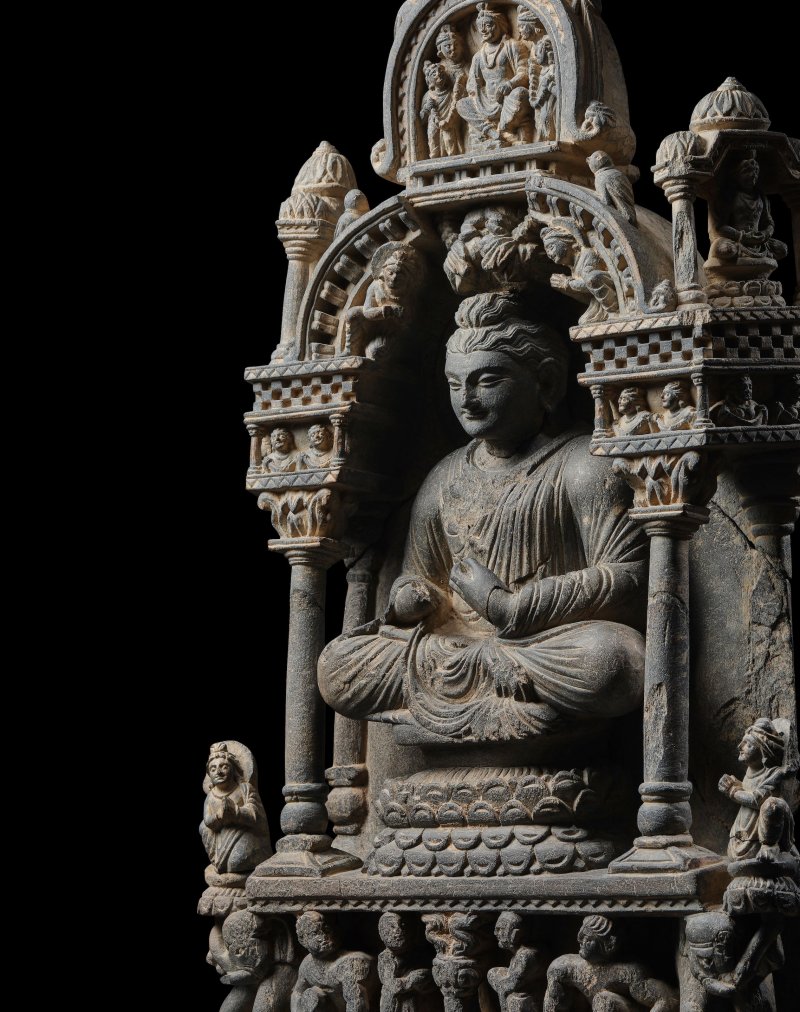
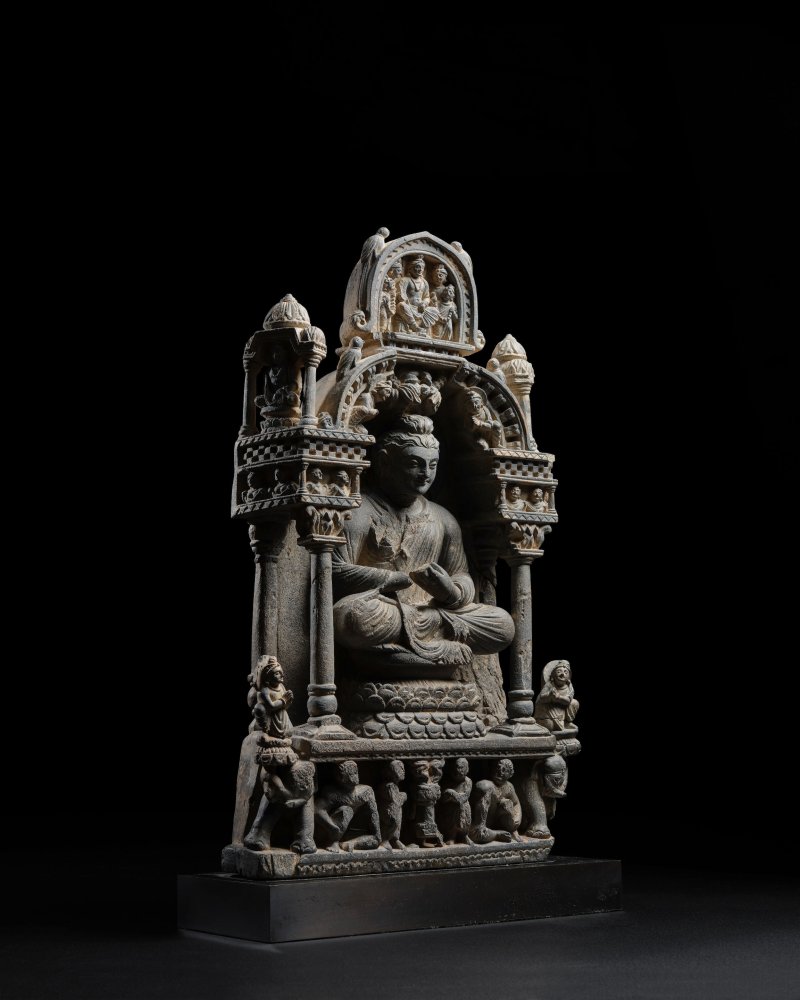
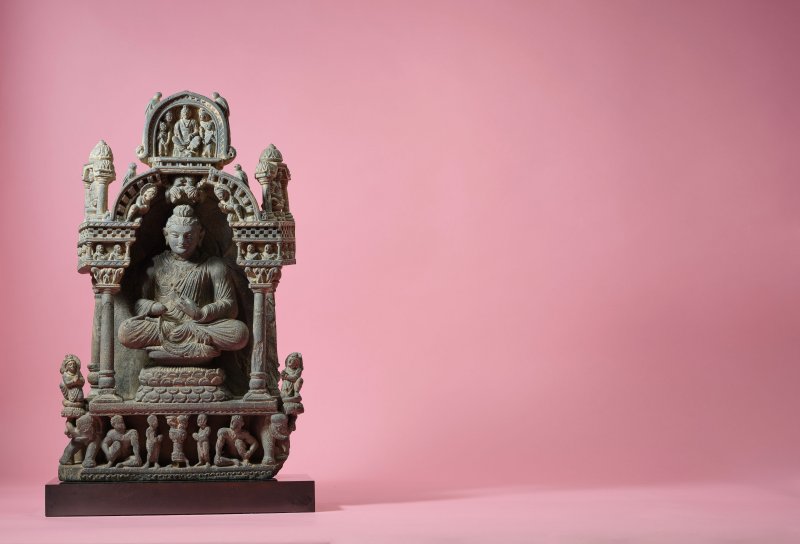
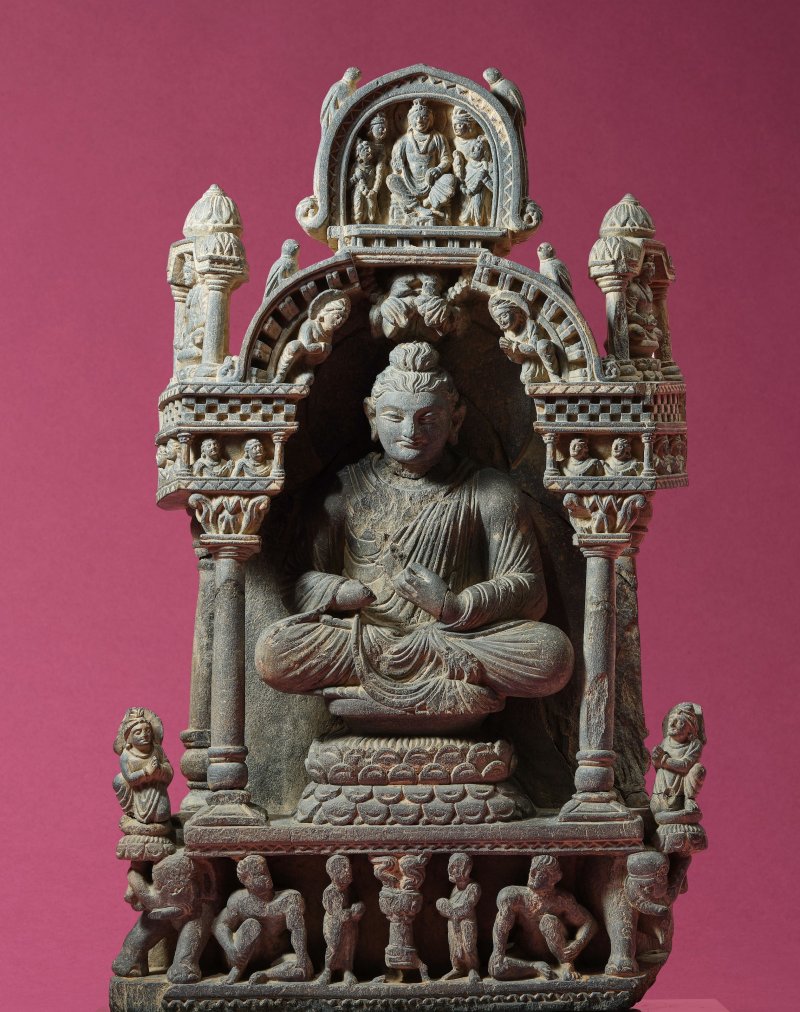
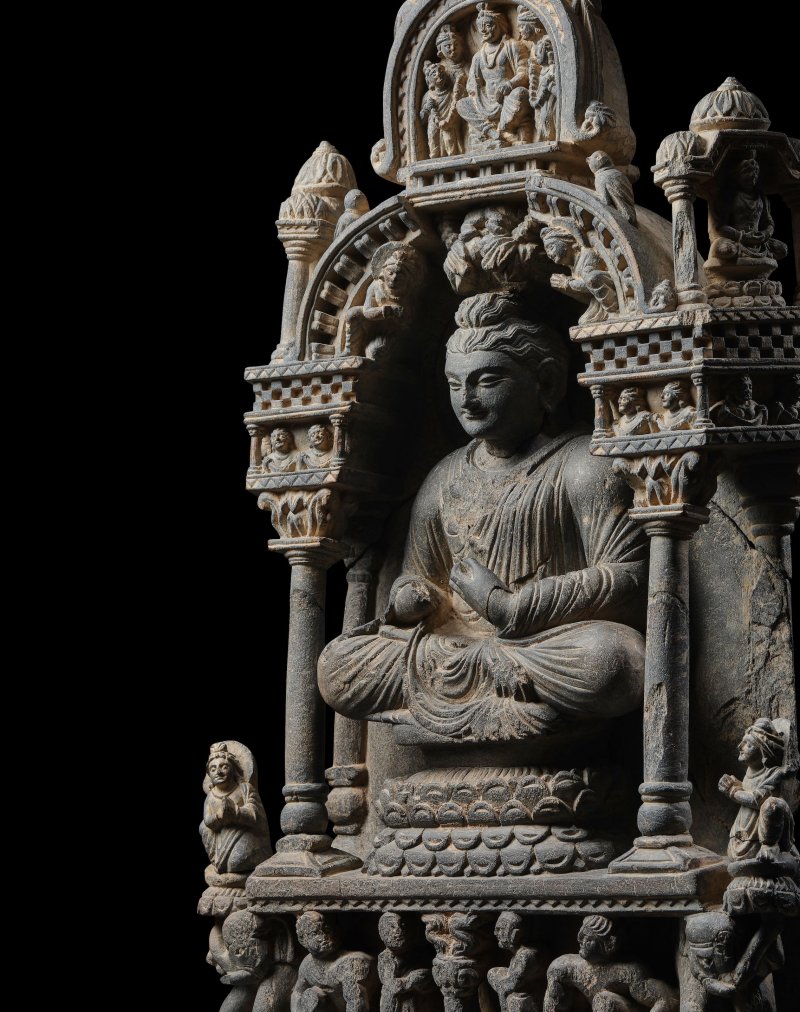
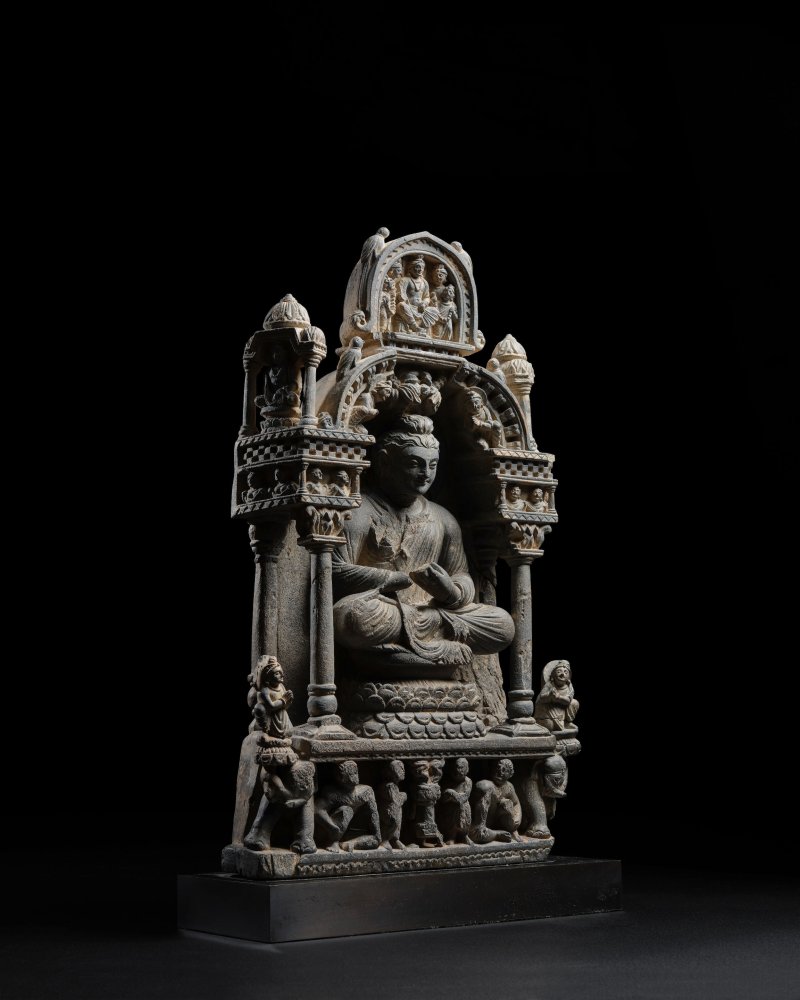
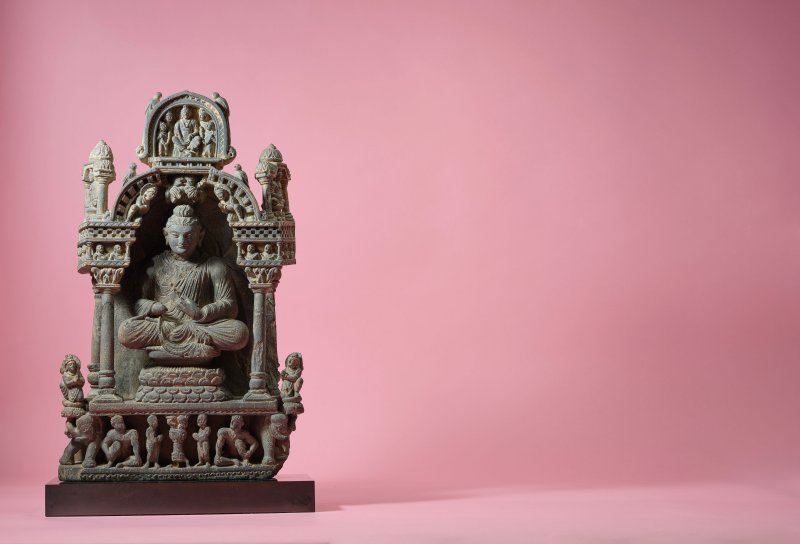
This false gable frieze, carved on three sides and originally part of a stupa, shows a richly detailed architectural composition with a haloed Buddha in the act of preaching at the centre. The Buddha is seated within a double-domed sanctuary, with the upper dome containing a seated Maitreya attended by donor figures. The domes are supported by a pilaster and a cut-out carved column with a Corinthian capital. Above the side columns are pillared chambers containing donors, surmounted by miniature double-domed sanctuaries housing seated bodhisattvas. The lower dome rests on a cyma reversa cornice, while the upper dome is supported by a saw-tooth cornice. Birds perch symmetrically on either side of each dome. The Buddha sits upon a high double-lotus throne set on a platform decorated with a saw-tooth cornice and flanked by kneeling donors. Beneath, the base is adorned with lion corbels, atlas-figure supports, and a central fire altar attended by worshippers.
Stupas were among the earliest Buddhist monuments, originally constructed to enshrine relics of the Buddha. Evolving from simple burial mounds, they developed into increasingly elaborate structures that served as focal points for devotion and pilgrimage. During the Kushan period in the 2nd century CE, numerous Buddhist monuments were commissioned to commemorate the Buddha's life, enlightenment, and the Mahayana path to Buddhahood. Architectural features such as the cyma reversa and saw-tooth cornices imitate timber construction traditions, preserving elements of architectural styles that were originally executed in wood. False gables such as this one would have been positioned on the exterior of a stupa between narrative reliefs illustrating episodes from the Buddha's life. As worshippers circumambulated the monument clockwise, these sculptural programmes provided visual aids for contemplation and devotion. A stone panel in the British Museum (1902,1002.29) depicts monks and donor figures engaged in this ritual practice.
Gandharan art is distinguished by a unique visual language that emerged from the interaction of diverse cultural traditions. Situated in present-day Pakistan at the intersection of major trade routes, the ancient region of Gandhara became a center of artistic and religious exchange, where elements of the classical Mediterranean world merged with Indian religious imagery and local artistic practices. The region played a pivotal role in the development of Buddhist iconography, producing some of the earliest anthropomorphic representations of the Buddha and creating sophisticated narrative reliefs illustrating key events in his life.
Through the movement of merchants, pilgrims, and monks along the Silk Roads, Gandharan imagery, architectural forms, and religious ideas were transmitted to Central Asia and China, where they were adapted to local cultural contexts. Over time, these traditions contributed to the development of Buddhist visual culture across East Asia and parts of Southeast Asia, leaving a lasting legacy in regions far removed from Gandhara itself. Gandhara thus represents one of the most important centers for the transmission and transformation of Buddhism in the ancient world.
Compare the present work with an elaborately carved, gilt, and polychromed Gandharan false gable relief depicting the Teaching Buddha, sold at Christie's, New York, 12 September 2012, lot 522; and a slightly larger example sold at Bonhams, New York, 20 March 2024, lot 754 (fig. 1), both of which display a similar architectural arrangement.
For the figures listed in this essay, please refer to our printed or digital catalogue.
52.5 cm (20 5/8 in.) high
Footnotes
犍陀羅 三/四世紀 片岩說法佛石碑
Provenance
Private UK Collection, London, 1990/91
Asian Private Collection
Hong Kong Art Market, 2018
This false gable frieze, carved on three sides and originally part of a stupa, shows a richly detailed architectural composition with a haloed Buddha in the act of preaching at the centre. The Buddha is seated within a double-domed sanctuary, with the upper dome containing a seated Maitreya attended by donor figures. The domes are supported by a pilaster and a cut-out carved column with a Corinthian capital. Above the side columns are pillared chambers containing donors, surmounted by miniature double-domed sanctuaries housing seated bodhisattvas. The lower dome rests on a cyma reversa cornice, while the upper dome is supported by a saw-tooth cornice. Birds perch symmetrically on either side of each dome. The Buddha sits upon a high double-lotus throne set on a platform decorated with a saw-tooth cornice and flanked by kneeling donors. Beneath, the base is adorned with lion corbels, atlas-figure supports, and a central fire altar attended by worshippers.
Stupas were among the earliest Buddhist monuments, originally constructed to enshrine relics of the Buddha. Evolving from simple burial mounds, they developed into increasingly elaborate structures that served as focal points for devotion and pilgrimage. During the Kushan period in the 2nd century CE, numerous Buddhist monuments were commissioned to commemorate the Buddha's life, enlightenment, and the Mahayana path to Buddhahood. Architectural features such as the cyma reversa and saw-tooth cornices imitate timber construction traditions, preserving elements of architectural styles that were originally executed in wood. False gables such as this one would have been positioned on the exterior of a stupa between narrative reliefs illustrating episodes from the Buddha's life. As worshippers circumambulated the monument clockwise, these sculptural programmes provided visual aids for contemplation and devotion. A stone panel in the British Museum (1902,1002.29) depicts monks and donor figures engaged in this ritual practice.
Gandharan art is distinguished by a unique visual language that emerged from the interaction of diverse cultural traditions. Situated in present-day Pakistan at the intersection of major trade routes, the ancient region of Gandhara became a center of artistic and religious exchange, where elements of the classical Mediterranean world merged with Indian religious imagery and local artistic practices. The region played a pivotal role in the development of Buddhist iconography, producing some of the earliest anthropomorphic representations of the Buddha and creating sophisticated narrative reliefs illustrating key events in his life.
Through the movement of merchants, pilgrims, and monks along the Silk Roads, Gandharan imagery, architectural forms, and religious ideas were transmitted to Central Asia and China, where they were adapted to local cultural contexts. Over time, these traditions contributed to the development of Buddhist visual culture across East Asia and parts of Southeast Asia, leaving a lasting legacy in regions far removed from Gandhara itself. Gandhara thus represents one of the most important centers for the transmission and transformation of Buddhism in the ancient world.
Compare the present work with an elaborately carved, gilt, and polychromed Gandharan false gable relief depicting the Teaching Buddha, sold at Christie's, New York, 12 September 2012, lot 522; and a slightly larger example sold at Bonhams, New York, 20 March 2024, lot 754 (fig. 1), both of which display a similar architectural arrangement.
For the figures listed in this essay, please refer to our printed or digital catalogue.
常见问题
这件犍陀羅 三/四世紀 片岩說法佛石碑 | A GREY SCHIST GABLE RELIEF WITH THE TEACHING BUDDHA的成交价是多少?
落槌价为 预展中。 成交价为 预展中。