
拍品信息
拍品名称
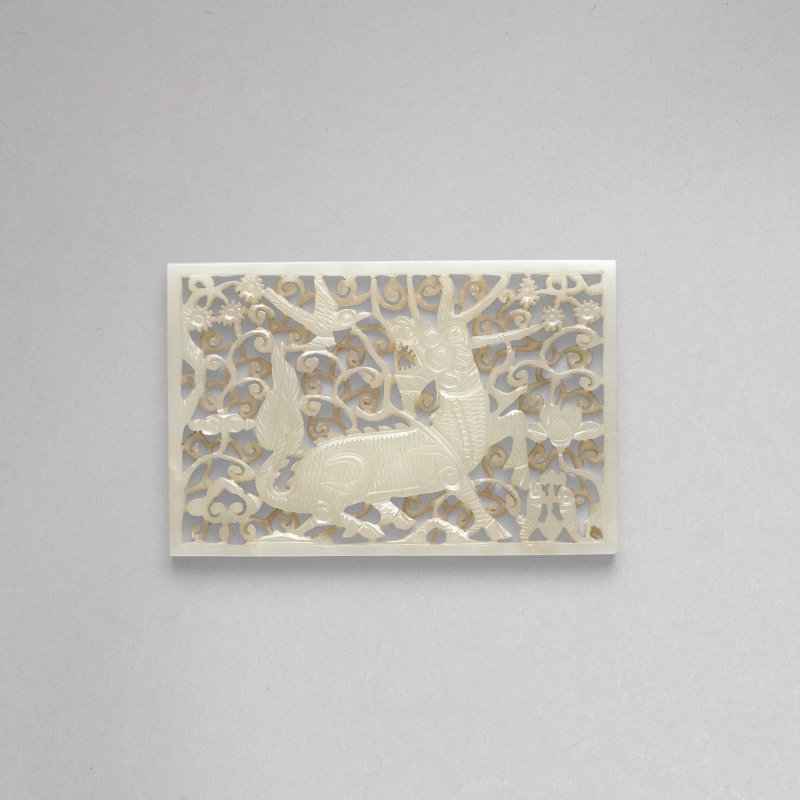
明 白玉麒麟紋帶板 | A WHITE JADE RETICULATED 'QILIN' BELT PLAQUE
年代
Ming Dynasty
起拍价
GBP 1,500
估值区间
GBP 1500 - 2500
尺寸
未知
品相
未知
更多信息
Ming Dynasty
Of rectangular shape, finely carved and pierced with a qilin, its head turning back towards a flying bird, striding amongst scrolling foliage, flanked on either side by three auspicious emblems including double-fish, lingzhi fungus, lotus blossoms, and flowering sprays, the stone of an even white tone. 7.4cm (2 7/8in) wide.
Footnotes
明 白玉麒麟紋帶板
Provenance: a Norwegian private collection, acquired while working at the Royal Norwegian Embassy in Beijing in the 1960s–1970s, and thence by descent
來源:挪威私人收藏,於1960至1970年代在北京挪威皇家大使館任職期間獲得,後由家族傳承迄今
Jade belt plaques, known from as early as the Northern Zhou period, remained highly fashionable through to the Ming dynasty. Throughout successive dynasties, jade belts were closely associated with the authority, rank, and social status of the ruling elite. The History of the Ming (明史), in the section on ceremonial and Court dress (與服志), records: 'Jade belts were permitted only for Emperors, officials of the first rank, princes and nobles, Imperial sons-in-law, or those to whom they had been specially bestowed by the Emperor' (凡帝王一品公侯伯駙馬或皇帝特賜方可用玉帶).
See a related white jade '' plaque, Ming dynasty, in the collection of Guangdong Provincial Museum, illustrated in (中國傳世玉器全集), vol.4, Beijing, 2010, p.40.
Compare also with a related reticulated white jade '' belt plaque, Ming dynasty, which was sold at Sotheby's London, 2 November 2022, lot 257.
Of rectangular shape, finely carved and pierced with a qilin, its head turning back towards a flying bird, striding amongst scrolling foliage, flanked on either side by three auspicious emblems including double-fish, lingzhi fungus, lotus blossoms, and flowering sprays, the stone of an even white tone. 7.4cm (2 7/8in) wide.
Footnotes
明 白玉麒麟紋帶板
Provenance: a Norwegian private collection, acquired while working at the Royal Norwegian Embassy in Beijing in the 1960s–1970s, and thence by descent
來源:挪威私人收藏,於1960至1970年代在北京挪威皇家大使館任職期間獲得,後由家族傳承迄今
Jade belt plaques, known from as early as the Northern Zhou period, remained highly fashionable through to the Ming dynasty. Throughout successive dynasties, jade belts were closely associated with the authority, rank, and social status of the ruling elite. The History of the Ming (明史), in the section on ceremonial and Court dress (與服志), records: 'Jade belts were permitted only for Emperors, officials of the first rank, princes and nobles, Imperial sons-in-law, or those to whom they had been specially bestowed by the Emperor' (凡帝王一品公侯伯駙馬或皇帝特賜方可用玉帶).
See a related white jade '' plaque, Ming dynasty, in the collection of Guangdong Provincial Museum, illustrated in (中國傳世玉器全集), vol.4, Beijing, 2010, p.40.
Compare also with a related reticulated white jade '' belt plaque, Ming dynasty, which was sold at Sotheby's London, 2 November 2022, lot 257.
常见问题
这件明 白玉麒麟紋帶板 | A WHITE JADE RETICULATED 'QILIN' BELT PLAQUE的成交价是多少?
落槌价为 预展中。 成交价为 预展中。


