
拍品信息
拍品名称
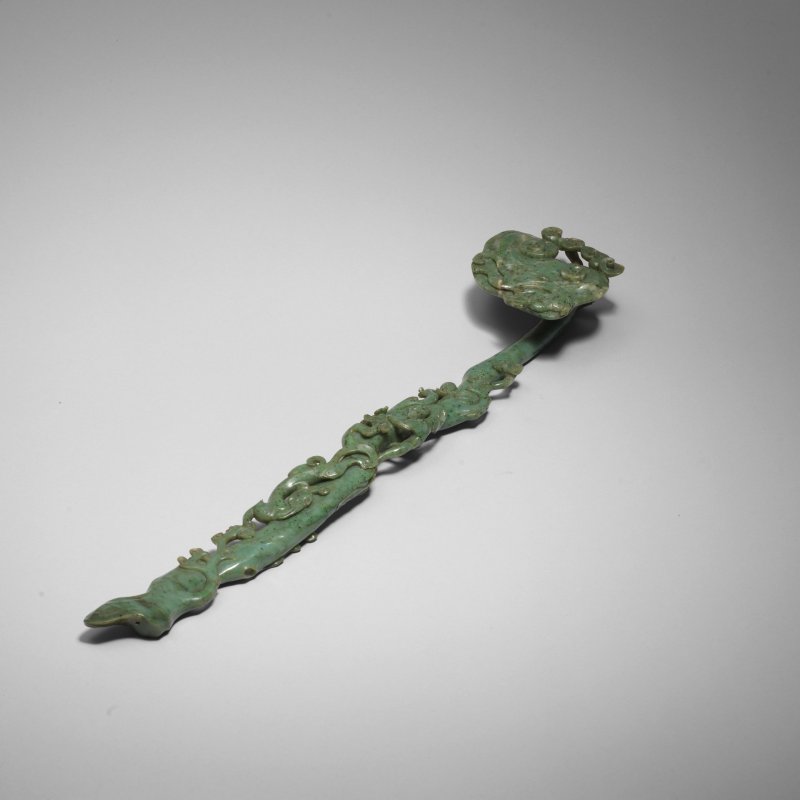
清乾隆 碧玉螭龍紋如意 | A SPINACH GREEN JADE 'CHILONG' SCEPTRE, RUYI
年代
Qianlong
起拍价
GBP 4,000
估值区间
GBP 4000 - 6000
尺寸
未知
品相
未知
更多信息
Qianlong
The sceptre crisply carved as a large auspicious lingzhi fungus issuing seven smaller lingzhi from the shaft, with two archaistic chilong with bifurcated tails clambering in pursuit of a flaming pearl, and a larger chilong surmounting the large head of the ruyi, the stone of dark emerald-green tone with black flecks. 48.2cm (19in) long.
Footnotes
清乾隆 碧玉螭龍紋如意
Provenance: Sir George Mowlem Burt KBE (1884–1964), Surrey, and thence by descent
來源:大英帝國爵級司令勛章獲得者George Mowlem Burt爵士(1884-1964),英國薩裏,并由後人保存迄今
Born in Westminster on 10 January 1884, Sir George Mowlem Burt KBE joined the family firm, John Mowlem & Co., in 1902, following in the footsteps of his father and uncle. He subsequently became supervising director of the company and was involved in a number of major engineering and building projects. He was a prominent figure in the development of the civil engineering industry, serving as a founding member of the Federation of Civil Engineering Contractors and on various Government committees and missions. He was also Master of the Worshipful Company of Paviors. Outside his professional life, Burt was a distinguished fencer, winning the British épée championship in 1922 and representing Great Britain in épée at the 1920 Olympic Games. He was knighted in 1942 and died at Blindley Heath, Surrey, on 1 September 1964. An enthusiastic collector of art, his collection included paintings, ivory, netsuke and jade.
The present lot is similar to one presented by the Qianlong Emperor to Sir George Staunton, Lord Macartney's deputy, in 1793, and now in the collection of the Victoria and Albert Museum, London, see , London, 2004, p.94, fig.7.2.
Compare also with two similar green jade sceptres, Qing dynasty, in the Qing Court Collection, illustrated in the , Beijing, 2011, nos.72-73. See also a similar green jade sceptre, 18th century, illustrated by J.Ayers, , vol.III, London, 2016, no.1770.
See a related but smaller green jade sceptre, 18th century, which was sold at Bonhams London, 11 May 2021, lot 335.
The sceptre crisply carved as a large auspicious lingzhi fungus issuing seven smaller lingzhi from the shaft, with two archaistic chilong with bifurcated tails clambering in pursuit of a flaming pearl, and a larger chilong surmounting the large head of the ruyi, the stone of dark emerald-green tone with black flecks. 48.2cm (19in) long.
Footnotes
清乾隆 碧玉螭龍紋如意
Provenance: Sir George Mowlem Burt KBE (1884–1964), Surrey, and thence by descent
來源:大英帝國爵級司令勛章獲得者George Mowlem Burt爵士(1884-1964),英國薩裏,并由後人保存迄今
Born in Westminster on 10 January 1884, Sir George Mowlem Burt KBE joined the family firm, John Mowlem & Co., in 1902, following in the footsteps of his father and uncle. He subsequently became supervising director of the company and was involved in a number of major engineering and building projects. He was a prominent figure in the development of the civil engineering industry, serving as a founding member of the Federation of Civil Engineering Contractors and on various Government committees and missions. He was also Master of the Worshipful Company of Paviors. Outside his professional life, Burt was a distinguished fencer, winning the British épée championship in 1922 and representing Great Britain in épée at the 1920 Olympic Games. He was knighted in 1942 and died at Blindley Heath, Surrey, on 1 September 1964. An enthusiastic collector of art, his collection included paintings, ivory, netsuke and jade.
The present lot is similar to one presented by the Qianlong Emperor to Sir George Staunton, Lord Macartney's deputy, in 1793, and now in the collection of the Victoria and Albert Museum, London, see , London, 2004, p.94, fig.7.2.
Compare also with two similar green jade sceptres, Qing dynasty, in the Qing Court Collection, illustrated in the , Beijing, 2011, nos.72-73. See also a similar green jade sceptre, 18th century, illustrated by J.Ayers, , vol.III, London, 2016, no.1770.
See a related but smaller green jade sceptre, 18th century, which was sold at Bonhams London, 11 May 2021, lot 335.
常见问题
这件清乾隆 碧玉螭龍紋如意 | A SPINACH GREEN JADE 'CHILONG' SCEPTRE, RUYI的成交价是多少?
落槌价为 预展中。 成交价为 预展中。


