
拍品信息
拍品名称
明成化十年(1474) 銅銜芝臥鹿 | A VERY LARGE AND IMPORTANT DOCUMENTARY BRONZE FIGURE OF A DEER
年代
Dated to the tenth year of the Chenghua reign corresponding to 1474 and of the period
起拍价
HKD 7,000,000
估值区间
HKD 7000000 - 9000000
尺寸
未知
品相
未知
更多信息
Dated to the tenth year of the Chenghua reign corresponding to 1474 and of the period
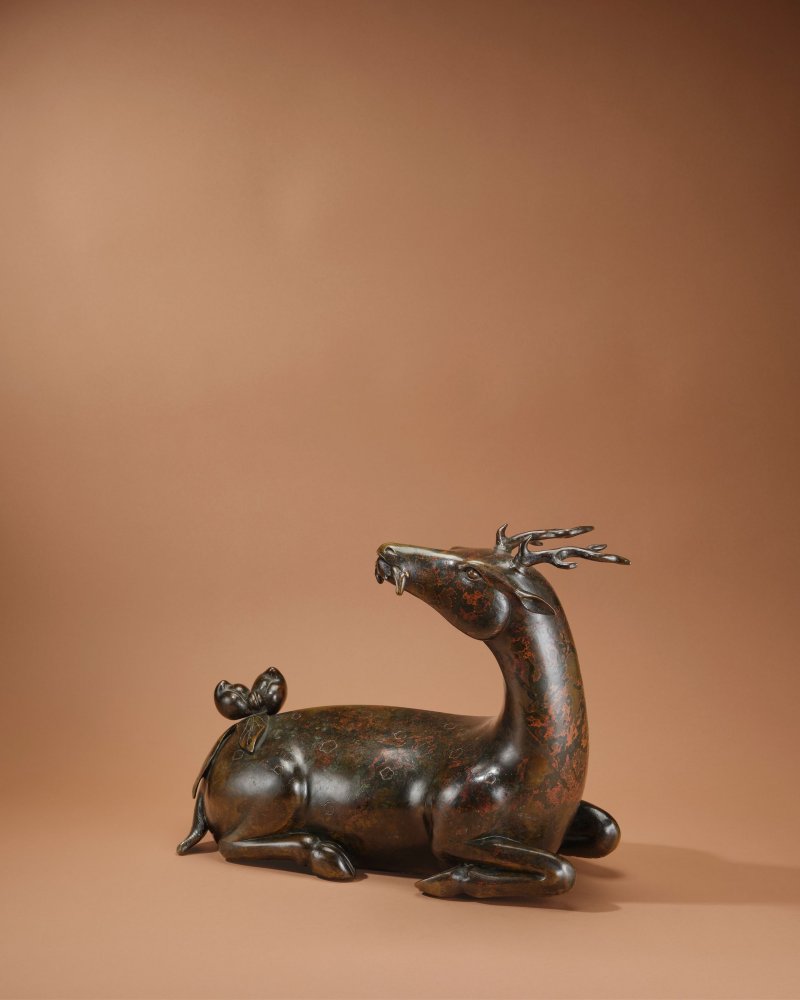
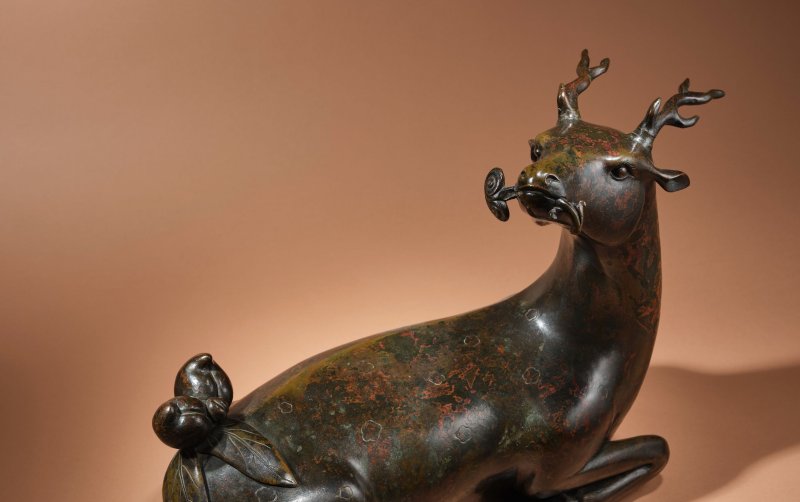
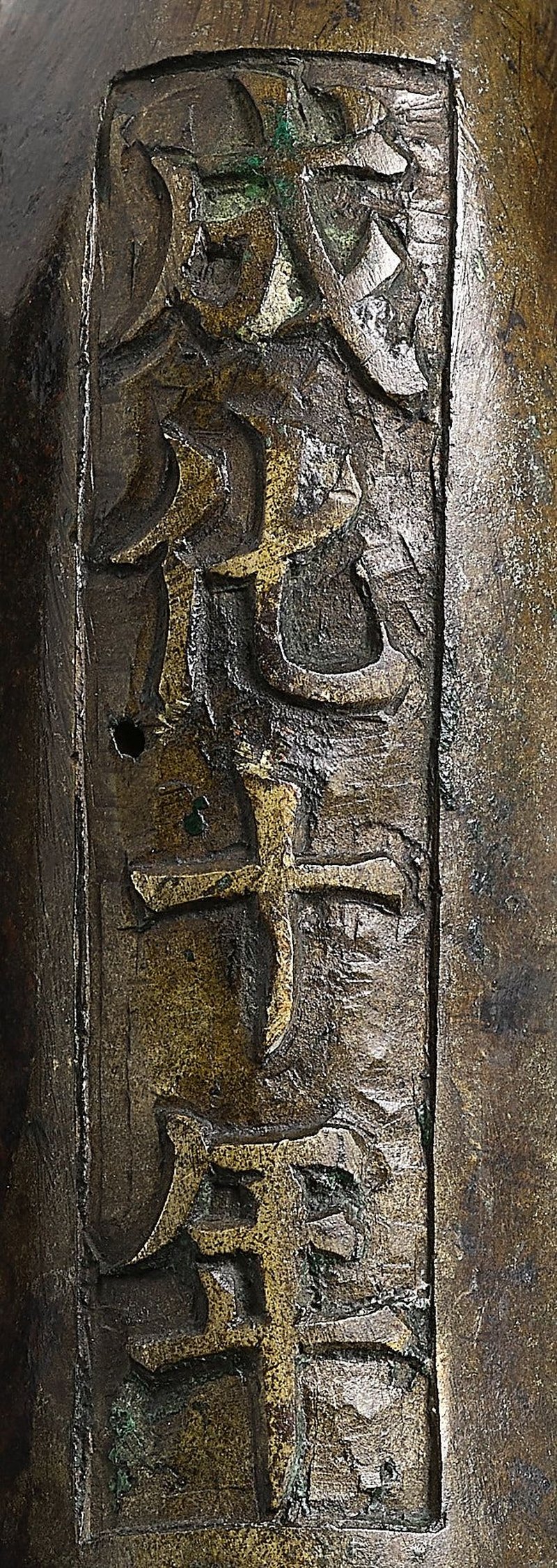
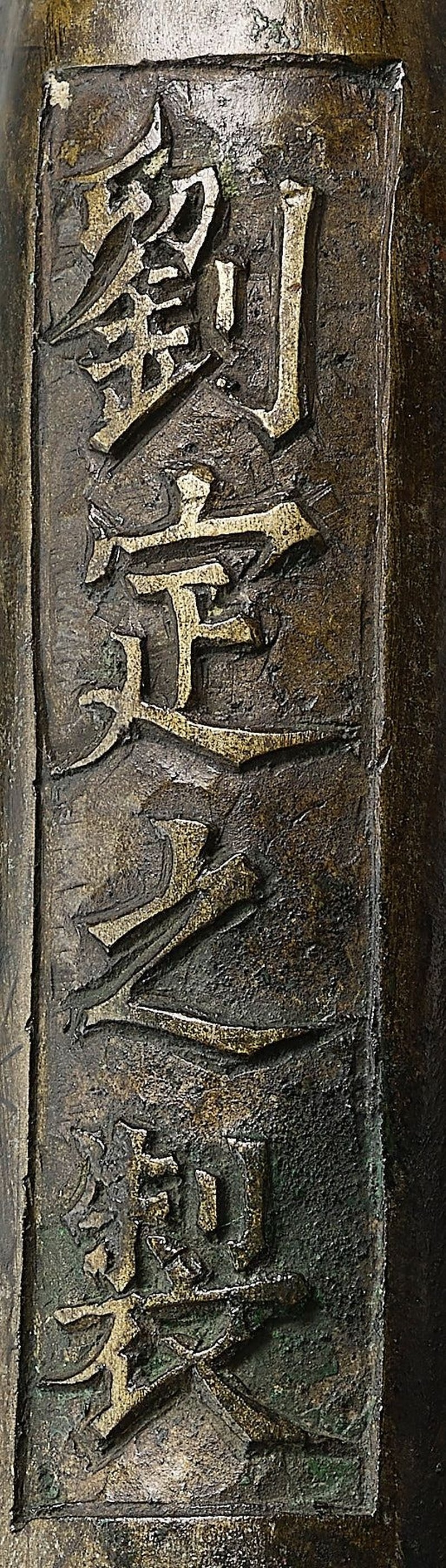
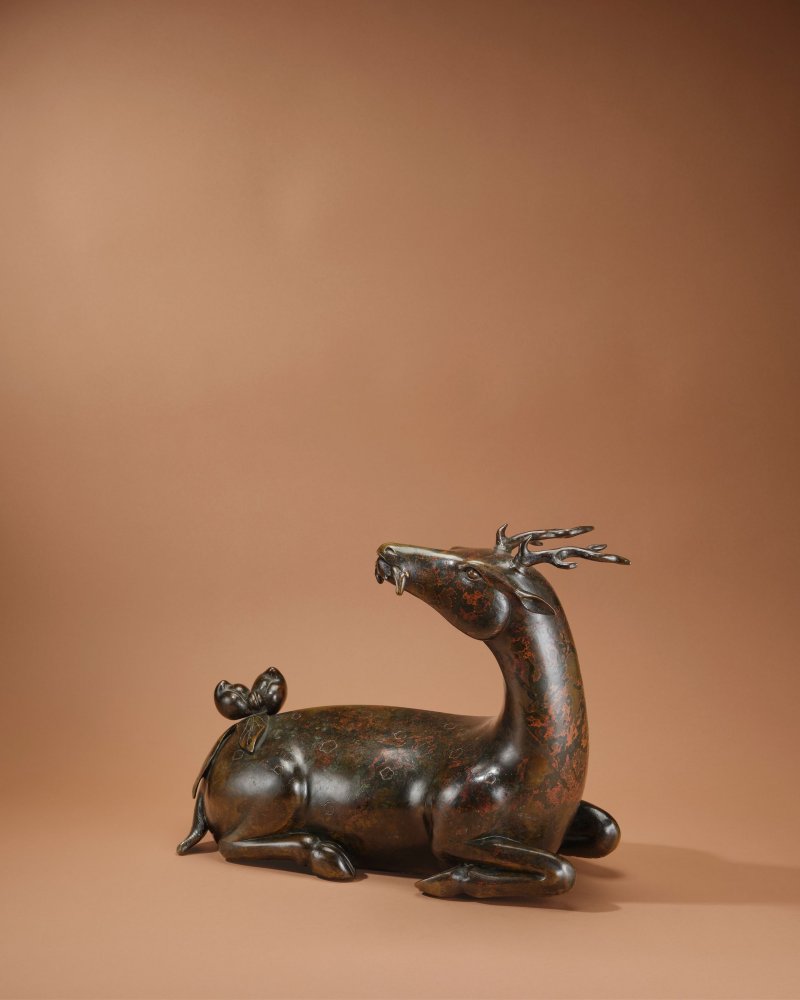
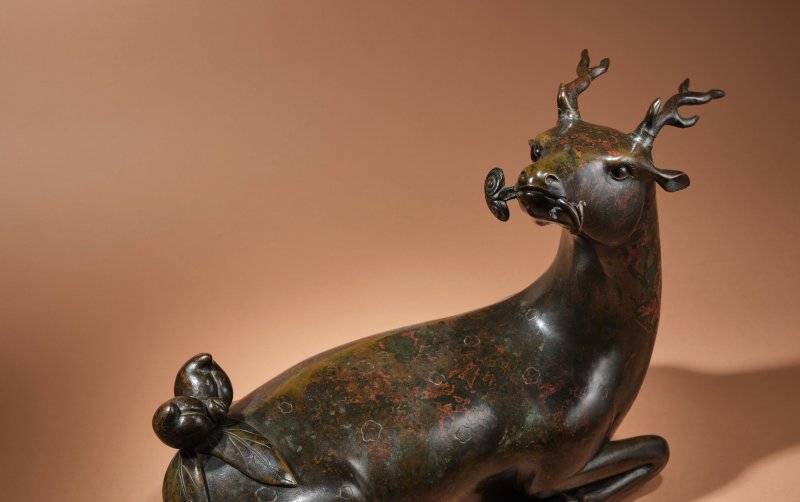
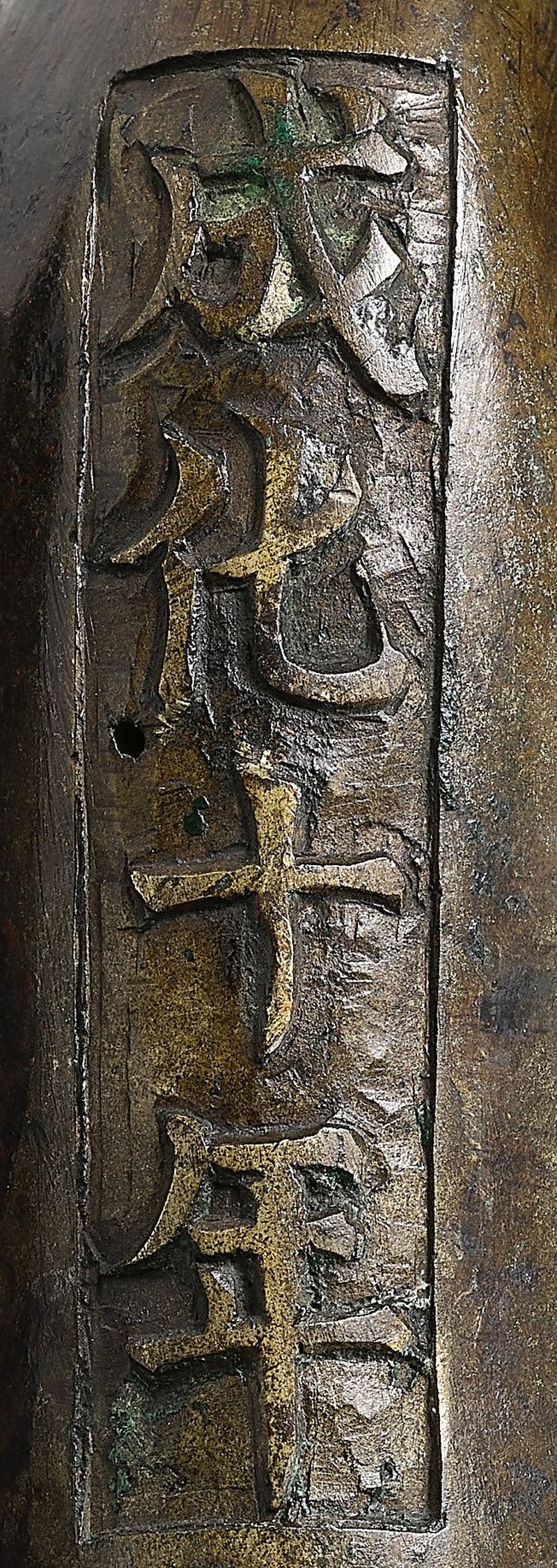
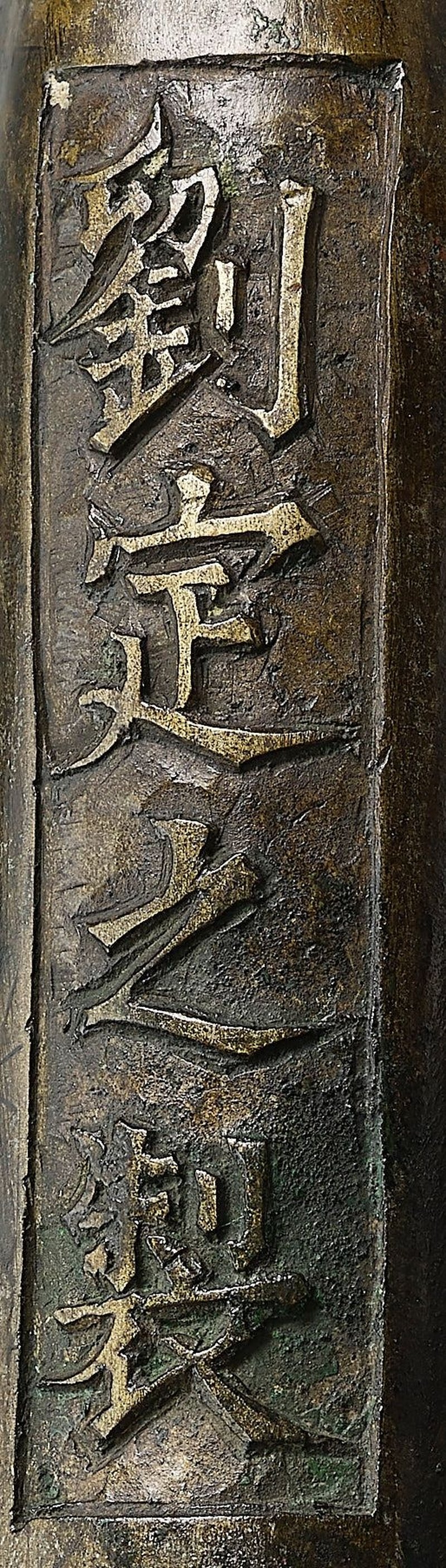
Deftly cast in a recumbent posture, the deer rests with its legs neatly folded alongside a powerfully modelled body, the surface delicately incised with spots arranged as five-petalled blossoms, the slender, gracefully arched neck twists sharply backward as the open jaws grasp a sprig of auspicious lingzhi, its alert, almond-shaped eyes, pricked ears, and finely rendered antlers conveying a lively naturalism, while a sprig of ripe peaches rests by the tail, the underside of the front legs bearing inscriptions within cartouches, the right leg reading Liu Dingzhi zhi (made by Liu Dingzhi), and the left inscribed Chenghua shi nian (Tenth year of Chenghua), the bronze of dark brown tone and richly patinated, further enhanced with traces of cinnabar lacquer red and green splashes.
45cm (17 3/4in) long.
Footnotes
明成化十年(1474) 銅銜芝臥鹿
「成化十年」「劉定之製」款
Provenance:
An American private collection, Florida
Sotheby's New York, 18 September 1996, lot 145
美國佛羅里達州私人收藏
紐約蘇富比,1996年9月18日,拍品編號145
Exceptionally rare both in scale and documentation, this finely cast bronze deer bears an eight-character inscription beneath the forelegs, , dating the sculpture to the tenth year of the Chenghua reign (1466). Few Chinese animal bronzes of the Ming dynasty are known that combine such monumental scale and sophisticated naturalistic modelling with a precise date. The inscription therefore gives the present sculpture an unusual historical significance, providing a rare fixed point for the study of 15th century bronze casting. Its substantial scale, quiet poise and sensitive modelling convey an unusual sense of dignity and restraint, demonstrating the ability of Ming bronze craftsmen to translate a living animal into a monumental sculptural form.
The rarity of the present work becomes particularly apparent when considered alongside other dated Chenghua bronzes. Only one other Chenghua-dated representation of a deer appears to be recorded: a Longquan celadon cup supported by a deer from the Jack Chia collection, which was sold at Sotheby's Hong Kong, 5 November 1996, lot 642, and subsequently at Christie's Hong Kong, 30 November 2011, lot 3021. Its base has the inscription ('Made at Longquan in the Chenghua period'). Chenghua-dated metalwork is itself exceptionally uncommon. Compare with two bronze incense burners with the mark ('Made by the Wan family in the Chenghua reign'), one formerly in the Water, Pine and Stone Retreat collection, which was sold at Sotheby's Hong Kong, 4 April 2012, lot 158, and another in the Musée Cernuschi, Paris, illustrated by S.Jenyns and W.Watson, , London, 1963, p.137, pl.60, and M.Maucuer, , Paris, 2013, no.73. A dated gilt-bronze Buddhist sculpture of the period is the figure of Sakyamuni (32cm high) in the British Museum, London, whose dedicatory inscription dates it to 1467, illustrated by Ulrich von Schroeder, , Hong Kong, 1981, p.529, fig.150F.
The inscription of the present deer may be read either as 'Made by Liu Dingzhi in the tenth year of the Chenghua period' or 'Made for Liu Dingzhi'. The , compiled by Zhang Tingyu, records a scholar-official of this name (1409–1469), renowned for his literary accomplishments, who rose to Assistant Minister of Rites in 1468 and was posthumously elevated to Minister of Rites. Although the identification cannot be established with certainty, the possibility that the inscription refers to this distinguished official adds a further dimension to the sculpture, suggesting that it may have been commissioned in connection with an individual of considerable status.
The deer itself possesses an exceptionally long and distinguished history in Chinese art. An early and remarkable example is the lacquered wood figure of a reclining sika deer excavated in 1978 from the tomb of the Marquis Yi of Zeng, dating to the late Spring and Autumn period, illustrated in , Shanghai, 1996, p.153, pl.004. The continued appearance of the deer across the following centuries demonstrates the enduring appeal of the animal as both a naturalistic subject and an auspicious symbol. Examples occur in Song Cizhou ware; see for example, J.Wirgin, , Stockholm, 1970, pl.42; Song silver, see B.Gyllensvärd, , Stockholm, 1953, pl.138, Liao painting, including in the Palace Museum, Taipei; see L.Sickman and A.Soper, , 1956, p.239, pl.164, and Yuan blue and white porcelain, such as the jar which was sold at Christie's Hong Kong, 30 May 2006, lot 1384, depicting a deer turning towards growing among rocks.
The deer carried particularly auspicious associations in Chinese culture. The word (鹿), 'deer', is a homophone for (祿), meaning emolument or official salary, making the animal an established visual pun for rank, prosperity and advancement. Its association with longevity is equally important, reinforced by its traditional connection with the fungus, the miraculous herb of immortality, which the present deer holds gently in its mouth. By the Ming and Qing periods, the deer was increasingly incorporated into imagery of longevity, most notably in representations of Shoulao, the Daoist deity of longevity, where the animal commonly accompanies the deity as an auspicious attendant. Related late Ming bronzes depicting Shoulao with a deer, including incense burners in which the deity and deer are incorporated into the vessel design, demonstrate how the animal could function simultaneously as a naturalistic motif and as a bearer of wishes for longevity, prosperity and high rank.
The present deer thus stands at the intersection of two enduring traditions: the representation of the animal as a highly refined naturalistic subject and its increasingly elaborate auspicious symbolism. From the lacquered deer of the Marquis Yi of Zeng through Song, Liao and Yuan representations, and ultimately the longevity imagery of the Ming and Qing dynasties, the deer remained one of the most resonant animal motifs in Chinese art. Against this exceptionally long tradition, the present sculpture is distinguished by its monumental scale, remarkable naturalism and, above all, the rare survival of a precise contemporary date. Its combination of documentary importance, technical accomplishment and auspicious meaning makes it an exceptional example of mid-Ming bronze sculpture.
Compare with a naturalistically cast gilt-bronze 'duck' incense burner and cover, Xuande six-character mark and of the period, which was sold at Sotheby's Hong Kong, 8 April 2014, lot 85.
此銅鹿體量碩大,鑄造精良,且前腿下帶「成化十年」、「劉定之製」款,明確斷代於成化十年(1474年),在傳世與文獻記載中極罕。明代大型銅雕動物之中,兼具寫實風格與確切紀年者屈指可數,使本品在十五世紀銅雕藝術研究中成為珍貴之定年標尺。其體量宏偉、姿態靜穆、造型細膩,展現明代銅匠將寫實動物轉化為具紀念性雕塑之功力。本品之珍稀,可由其他成化朝署年款銅器相較而益顯。成化署年款鹿形器似僅見另一例:Jack Chia舊藏一件龍泉青釉爵祿封侯盃,其底部刻「成化年龍泉造」楷書款,售於香港蘇富比,1996年11月5日,拍品編號642,後再售於香港佳士得,2011年11月30日,拍品編號3021。成化署年款金屬器本身已屬極罕,可比對兩件「大明成化年萬家造」款銅香爐,一為水松石山房舊藏,售於香港蘇富比,2012年4月4日,拍品編號158;另一件藏於巴黎賽努奇博物館,見S.Jenyns與W.Watson著《Chinese Art: The Minor Arts》,倫敦,1963年,頁137,圖版60,及M.Maucuer著《Bronzes de la Chine Impériale des Song aux Qing》,巴黎,2013年,編號73。至於成化朝紀年之銅鎏金佛像,參考倫敦大英博物館藏一件1467年款之釋迦牟尼像(高32厘米),見施羅德,《Indo-Tibetan Bronzes》,香港,1981年,頁529,圖150F。
至於劉定之,據張廷玉編《明史》,當中載有同名文臣,生卒年1409–1469,以文學才華著稱,於1468年擢升禮部侍郎,身後追贈禮部尚書。雖無法確證所指即為此人,然若屬實,則此鹿或與一位地位顯赫之人物相關,增添歷史深度。
鹿之形象在中國藝術中源遠流長,早見於1978年湖北隨州曾侯乙墓出土之戰國晚期漆木臥鹿,見《中國文物精華大辭典:金銀玉石卷》,上海,1996年,頁153,圖版004。此後歷代不衰,可見鹿既是寫實的描繪對象,也是吉祥的象徵,千百年來始終受人喜愛。其他門類包括宋代磁州窯(見J.Wirgin,《Sung Ceramic Designs》,斯德哥爾摩,1970年,圖版42)、宋代銀器(見B.Gyllensvärd,《Chinese Gold and Silver in the Carl Kempe Collection》,斯德哥爾摩,1953年,圖版138)、遼代繪畫(包括台北故宮藏《秋林群鹿圖》,見L.Sickman與A.Soper,《The Art and Architecture of China》,1956年,頁239,圖版164),以及元代青花瓷(如香港佳士得2006年5月30日售出之青花鹿銜靈芝紋罐,拍品編號1384,繪一鹿回首望向石間靈芝),皆可見鹿之形象。
鹿在中國文化中承載著尤為深厚的祥瑞意涵。「鹿」與「祿」諧音,而「祿」意指官職俸祿,故鹿很自然地成為官運、財富與仕途晉升之雙關。本鹿口銜靈芝,又寓意長壽。至明清時期,鹿常出現在長壽題材裏,尤其與壽老結伴出現。明代晚期相關銅器,如將壽老與鹿融入器形設計之香爐,正可說明鹿如何兼具寫實題材與長壽、富貴、高官等祝願之雙重功能。
本品正處於兩大悠久傳統之交匯點:一是將鹿作為寫實對象,二是其日益豐富之吉祥象徵意涵。從曾侯乙墓之漆鹿,歷經宋、遼、元各代之詮釋,至明清長壽題材,鹿始終是中國藝術中最具感染力之動物母題之一。本品體量宏偉,生動寫實,以及尤為難得之確切紀年,堪稱明代中期銅雕藝術之傑出典範。
比較一件銅鎏金鴨形蓋爐,帶宣德六字款,售於香港蘇富比,2014年4月8日,拍品編號85。
Deftly cast in a recumbent posture, the deer rests with its legs neatly folded alongside a powerfully modelled body, the surface delicately incised with spots arranged as five-petalled blossoms, the slender, gracefully arched neck twists sharply backward as the open jaws grasp a sprig of auspicious lingzhi, its alert, almond-shaped eyes, pricked ears, and finely rendered antlers conveying a lively naturalism, while a sprig of ripe peaches rests by the tail, the underside of the front legs bearing inscriptions within cartouches, the right leg reading Liu Dingzhi zhi (made by Liu Dingzhi), and the left inscribed Chenghua shi nian (Tenth year of Chenghua), the bronze of dark brown tone and richly patinated, further enhanced with traces of cinnabar lacquer red and green splashes.
45cm (17 3/4in) long.
Footnotes
明成化十年(1474) 銅銜芝臥鹿
「成化十年」「劉定之製」款
Provenance:
An American private collection, Florida
Sotheby's New York, 18 September 1996, lot 145
美國佛羅里達州私人收藏
紐約蘇富比,1996年9月18日,拍品編號145
Exceptionally rare both in scale and documentation, this finely cast bronze deer bears an eight-character inscription beneath the forelegs, , dating the sculpture to the tenth year of the Chenghua reign (1466). Few Chinese animal bronzes of the Ming dynasty are known that combine such monumental scale and sophisticated naturalistic modelling with a precise date. The inscription therefore gives the present sculpture an unusual historical significance, providing a rare fixed point for the study of 15th century bronze casting. Its substantial scale, quiet poise and sensitive modelling convey an unusual sense of dignity and restraint, demonstrating the ability of Ming bronze craftsmen to translate a living animal into a monumental sculptural form.
The rarity of the present work becomes particularly apparent when considered alongside other dated Chenghua bronzes. Only one other Chenghua-dated representation of a deer appears to be recorded: a Longquan celadon cup supported by a deer from the Jack Chia collection, which was sold at Sotheby's Hong Kong, 5 November 1996, lot 642, and subsequently at Christie's Hong Kong, 30 November 2011, lot 3021. Its base has the inscription ('Made at Longquan in the Chenghua period'). Chenghua-dated metalwork is itself exceptionally uncommon. Compare with two bronze incense burners with the mark ('Made by the Wan family in the Chenghua reign'), one formerly in the Water, Pine and Stone Retreat collection, which was sold at Sotheby's Hong Kong, 4 April 2012, lot 158, and another in the Musée Cernuschi, Paris, illustrated by S.Jenyns and W.Watson, , London, 1963, p.137, pl.60, and M.Maucuer, , Paris, 2013, no.73. A dated gilt-bronze Buddhist sculpture of the period is the figure of Sakyamuni (32cm high) in the British Museum, London, whose dedicatory inscription dates it to 1467, illustrated by Ulrich von Schroeder, , Hong Kong, 1981, p.529, fig.150F.
The inscription of the present deer may be read either as 'Made by Liu Dingzhi in the tenth year of the Chenghua period' or 'Made for Liu Dingzhi'. The , compiled by Zhang Tingyu, records a scholar-official of this name (1409–1469), renowned for his literary accomplishments, who rose to Assistant Minister of Rites in 1468 and was posthumously elevated to Minister of Rites. Although the identification cannot be established with certainty, the possibility that the inscription refers to this distinguished official adds a further dimension to the sculpture, suggesting that it may have been commissioned in connection with an individual of considerable status.
The deer itself possesses an exceptionally long and distinguished history in Chinese art. An early and remarkable example is the lacquered wood figure of a reclining sika deer excavated in 1978 from the tomb of the Marquis Yi of Zeng, dating to the late Spring and Autumn period, illustrated in , Shanghai, 1996, p.153, pl.004. The continued appearance of the deer across the following centuries demonstrates the enduring appeal of the animal as both a naturalistic subject and an auspicious symbol. Examples occur in Song Cizhou ware; see for example, J.Wirgin, , Stockholm, 1970, pl.42; Song silver, see B.Gyllensvärd, , Stockholm, 1953, pl.138, Liao painting, including in the Palace Museum, Taipei; see L.Sickman and A.Soper, , 1956, p.239, pl.164, and Yuan blue and white porcelain, such as the jar which was sold at Christie's Hong Kong, 30 May 2006, lot 1384, depicting a deer turning towards growing among rocks.
The deer carried particularly auspicious associations in Chinese culture. The word (鹿), 'deer', is a homophone for (祿), meaning emolument or official salary, making the animal an established visual pun for rank, prosperity and advancement. Its association with longevity is equally important, reinforced by its traditional connection with the fungus, the miraculous herb of immortality, which the present deer holds gently in its mouth. By the Ming and Qing periods, the deer was increasingly incorporated into imagery of longevity, most notably in representations of Shoulao, the Daoist deity of longevity, where the animal commonly accompanies the deity as an auspicious attendant. Related late Ming bronzes depicting Shoulao with a deer, including incense burners in which the deity and deer are incorporated into the vessel design, demonstrate how the animal could function simultaneously as a naturalistic motif and as a bearer of wishes for longevity, prosperity and high rank.
The present deer thus stands at the intersection of two enduring traditions: the representation of the animal as a highly refined naturalistic subject and its increasingly elaborate auspicious symbolism. From the lacquered deer of the Marquis Yi of Zeng through Song, Liao and Yuan representations, and ultimately the longevity imagery of the Ming and Qing dynasties, the deer remained one of the most resonant animal motifs in Chinese art. Against this exceptionally long tradition, the present sculpture is distinguished by its monumental scale, remarkable naturalism and, above all, the rare survival of a precise contemporary date. Its combination of documentary importance, technical accomplishment and auspicious meaning makes it an exceptional example of mid-Ming bronze sculpture.
Compare with a naturalistically cast gilt-bronze 'duck' incense burner and cover, Xuande six-character mark and of the period, which was sold at Sotheby's Hong Kong, 8 April 2014, lot 85.
此銅鹿體量碩大,鑄造精良,且前腿下帶「成化十年」、「劉定之製」款,明確斷代於成化十年(1474年),在傳世與文獻記載中極罕。明代大型銅雕動物之中,兼具寫實風格與確切紀年者屈指可數,使本品在十五世紀銅雕藝術研究中成為珍貴之定年標尺。其體量宏偉、姿態靜穆、造型細膩,展現明代銅匠將寫實動物轉化為具紀念性雕塑之功力。本品之珍稀,可由其他成化朝署年款銅器相較而益顯。成化署年款鹿形器似僅見另一例:Jack Chia舊藏一件龍泉青釉爵祿封侯盃,其底部刻「成化年龍泉造」楷書款,售於香港蘇富比,1996年11月5日,拍品編號642,後再售於香港佳士得,2011年11月30日,拍品編號3021。成化署年款金屬器本身已屬極罕,可比對兩件「大明成化年萬家造」款銅香爐,一為水松石山房舊藏,售於香港蘇富比,2012年4月4日,拍品編號158;另一件藏於巴黎賽努奇博物館,見S.Jenyns與W.Watson著《Chinese Art: The Minor Arts》,倫敦,1963年,頁137,圖版60,及M.Maucuer著《Bronzes de la Chine Impériale des Song aux Qing》,巴黎,2013年,編號73。至於成化朝紀年之銅鎏金佛像,參考倫敦大英博物館藏一件1467年款之釋迦牟尼像(高32厘米),見施羅德,《Indo-Tibetan Bronzes》,香港,1981年,頁529,圖150F。
至於劉定之,據張廷玉編《明史》,當中載有同名文臣,生卒年1409–1469,以文學才華著稱,於1468年擢升禮部侍郎,身後追贈禮部尚書。雖無法確證所指即為此人,然若屬實,則此鹿或與一位地位顯赫之人物相關,增添歷史深度。
鹿之形象在中國藝術中源遠流長,早見於1978年湖北隨州曾侯乙墓出土之戰國晚期漆木臥鹿,見《中國文物精華大辭典:金銀玉石卷》,上海,1996年,頁153,圖版004。此後歷代不衰,可見鹿既是寫實的描繪對象,也是吉祥的象徵,千百年來始終受人喜愛。其他門類包括宋代磁州窯(見J.Wirgin,《Sung Ceramic Designs》,斯德哥爾摩,1970年,圖版42)、宋代銀器(見B.Gyllensvärd,《Chinese Gold and Silver in the Carl Kempe Collection》,斯德哥爾摩,1953年,圖版138)、遼代繪畫(包括台北故宮藏《秋林群鹿圖》,見L.Sickman與A.Soper,《The Art and Architecture of China》,1956年,頁239,圖版164),以及元代青花瓷(如香港佳士得2006年5月30日售出之青花鹿銜靈芝紋罐,拍品編號1384,繪一鹿回首望向石間靈芝),皆可見鹿之形象。
鹿在中國文化中承載著尤為深厚的祥瑞意涵。「鹿」與「祿」諧音,而「祿」意指官職俸祿,故鹿很自然地成為官運、財富與仕途晉升之雙關。本鹿口銜靈芝,又寓意長壽。至明清時期,鹿常出現在長壽題材裏,尤其與壽老結伴出現。明代晚期相關銅器,如將壽老與鹿融入器形設計之香爐,正可說明鹿如何兼具寫實題材與長壽、富貴、高官等祝願之雙重功能。
本品正處於兩大悠久傳統之交匯點:一是將鹿作為寫實對象,二是其日益豐富之吉祥象徵意涵。從曾侯乙墓之漆鹿,歷經宋、遼、元各代之詮釋,至明清長壽題材,鹿始終是中國藝術中最具感染力之動物母題之一。本品體量宏偉,生動寫實,以及尤為難得之確切紀年,堪稱明代中期銅雕藝術之傑出典範。
比較一件銅鎏金鴨形蓋爐,帶宣德六字款,售於香港蘇富比,2014年4月8日,拍品編號85。
常见问题
这件明成化十年(1474) 銅銜芝臥鹿 | A VERY LARGE AND IMPORTANT DOCUMENTARY BRONZE FIGURE OF A DEER的成交价是多少?
落槌价为 预展中。 成交价为 预展中。