
拍品信息
拍品名称
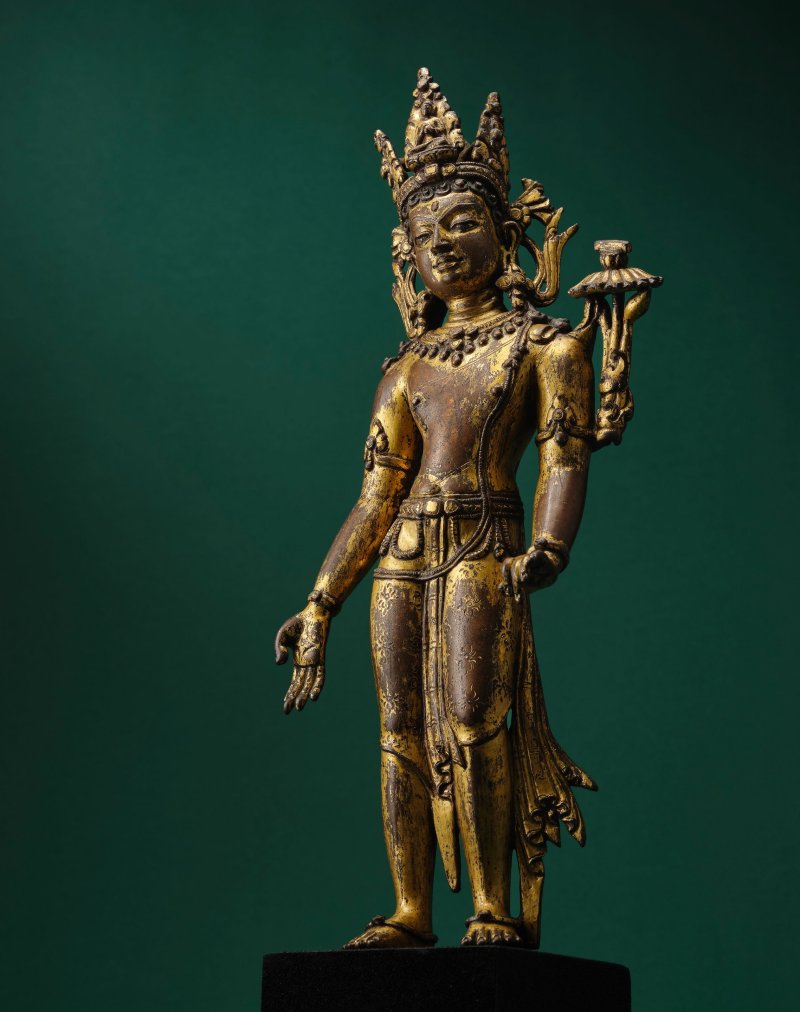
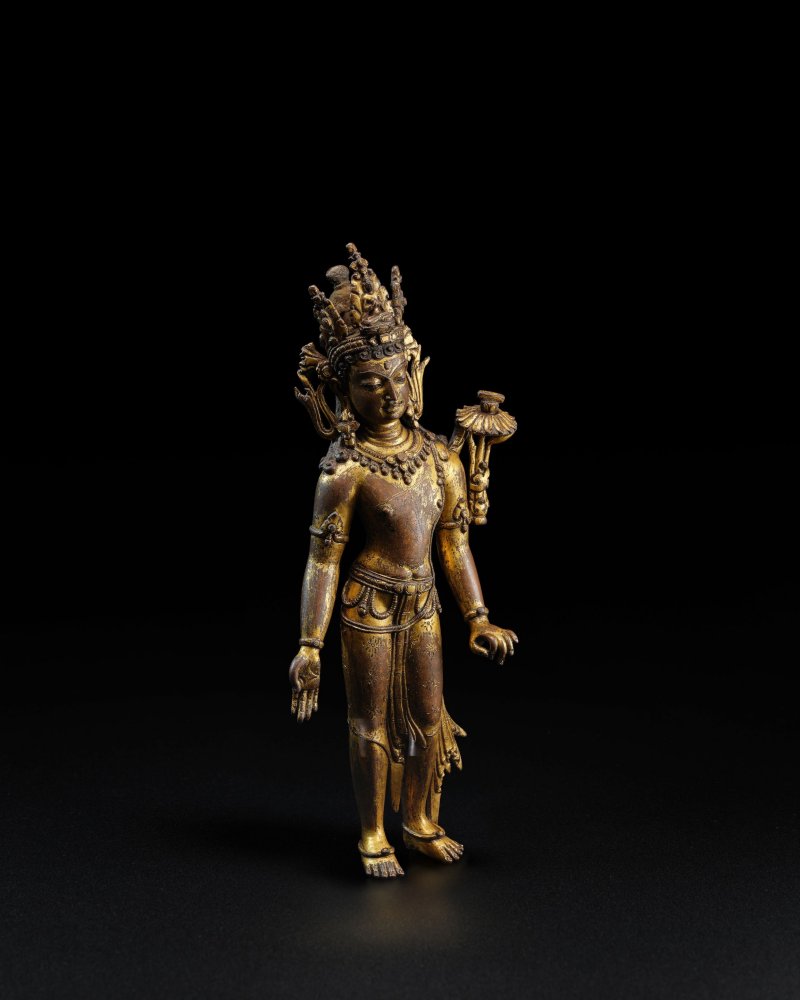
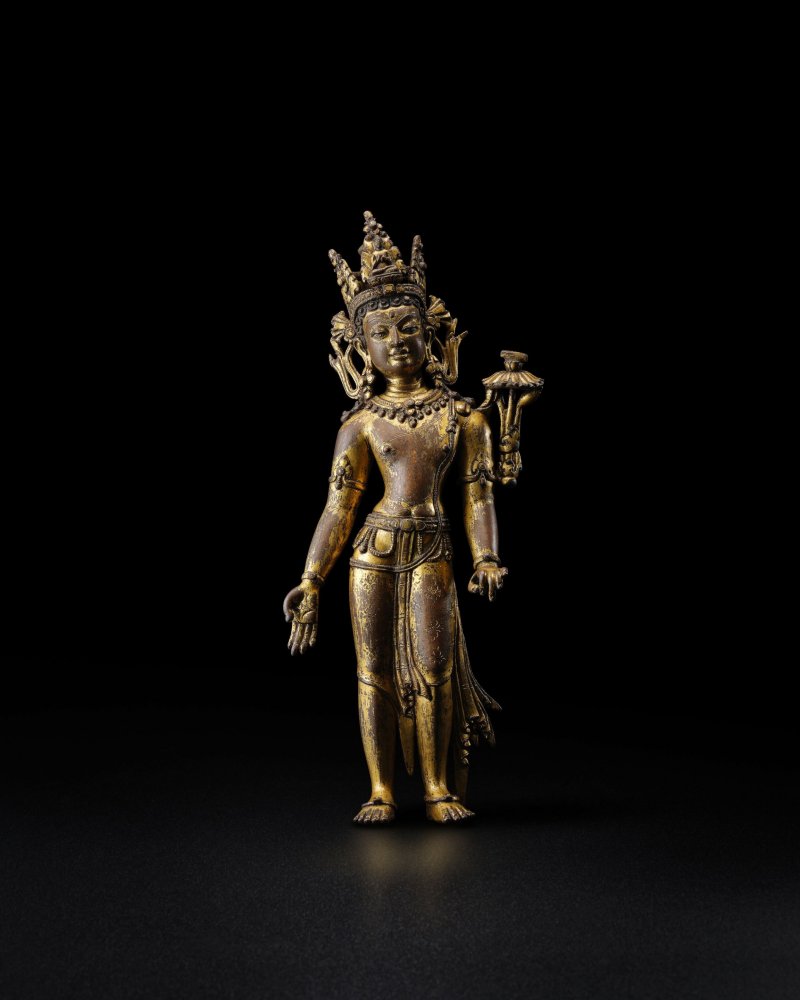
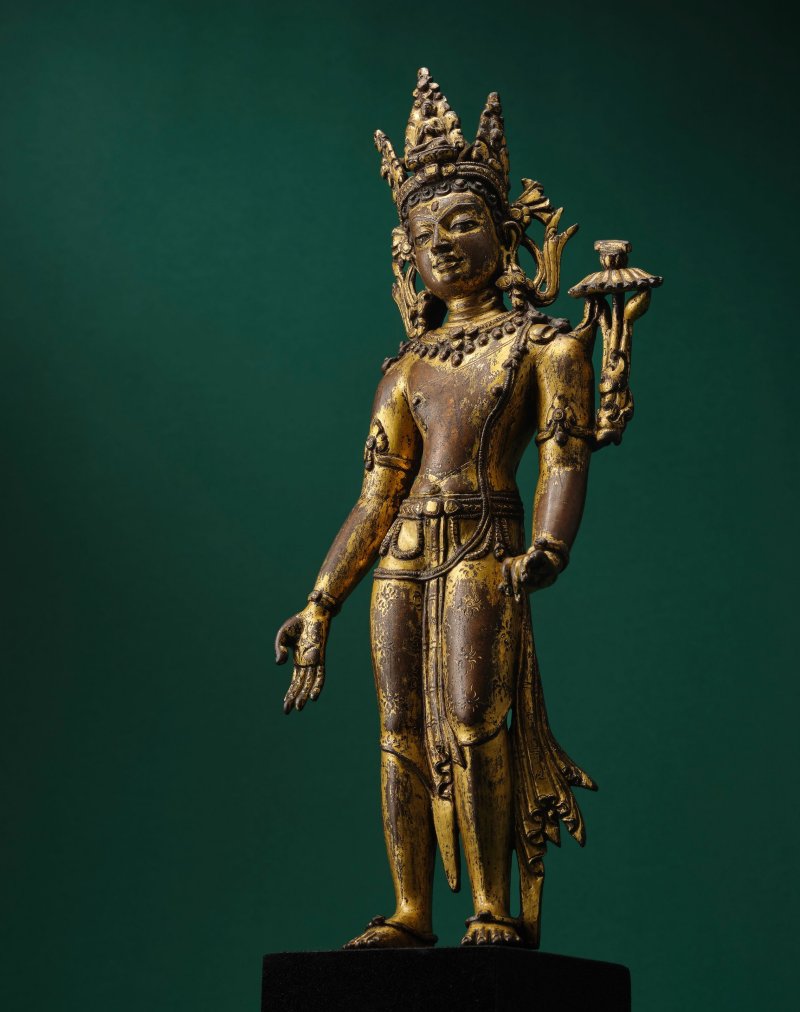
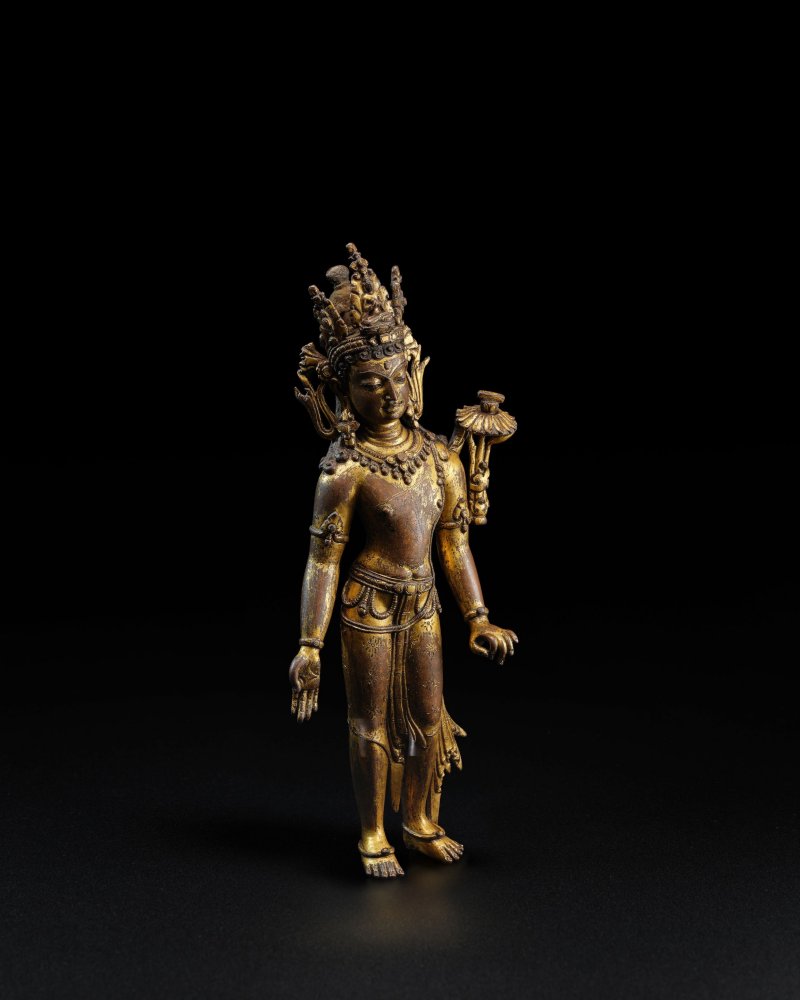
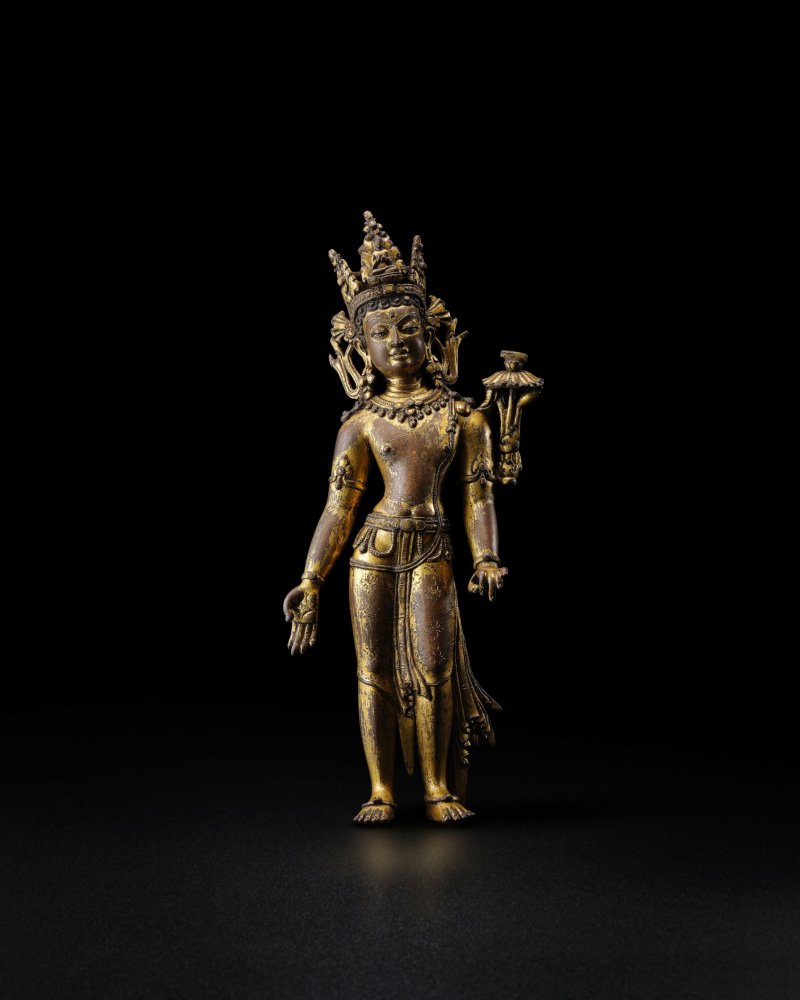
西藏或尼泊爾 十二世紀 銅鎏金文殊菩薩像 | A GILT COPPER ALLOY FIGURE OF MANJUSHRI
年代
TIBET OR NEPAL, 12TH CENTURY
起拍价
HKD 1,300,000
估值区间
HKD 1300000 - 1600000
尺寸
未知
品相
未知
更多信息
TIBET OR NEPAL, 12TH CENTURY
Himalayan Art Resources item no. 15012
32.8 cm (12 7/8 in.) high
Footnotes
西藏或尼泊爾 十二世紀 銅鎏金文殊菩薩像
Provenance
Acquired in Paris in the 1990s (by repute)
Sotheby's, New York, 21 March 2024, lot 806
Manjushri is the bodhisattva of transcendent wisdom, and his principal attribute is the Prajnaparamita manuscript, shown resting on a lotus at his shoulder. In this peaceful, princely manifestation, Manjushri stands with one hand in varada mudra, the gesture of generosity, while the other holds the stem of the lotus. His serene expression and youthful appearance reinforce his role as the personification of wisdom in its most refined and accessible form. Prajnaparamita, or "Perfection of Wisdom," refers both to a body of Mahayana Buddhist scriptures and to the transcendent wisdom that enables practitioners to perceive the true nature of reality. For Tibetan and Nepalese adherents, the sacred manuscript is often revered as an embodiment of the Buddha's enlightened teachings.
At the center of Manjushri's crown is a small image of the historical Buddha, his hands in , the gesture of teaching. This feature appears in several early Himalayan representations of Manjushri and underscores the bodhisattva's close association with the Buddha's teachings; see von Schroeder, , Vol. II, 2001, p. 1024, pl. 252C. The strings of pearls hanging in loops from the belt are another distinctive feature, comparable to those on a 12th-century Tibetan figure of Manjushri in the Metropolitan Museum of Art, New York (1983.554.2).
The sculpture dates from the Later Diffusion of Buddhism in Tibet, which began in the late 10th century and was a formative period in the development of Tibetan Buddhist art. Following the earlier suppression of Buddhism, the religion was re-established and revitalized through the foundation, restoration and expansion of monasteries, creating substantial demand for religious images and ritual objects. Tibetan rulers, religious leaders and monastic communities actively sought Buddhist texts, images and artistic expertise from neighboring regions, particularly India and Nepal. Artists and craftsmen from the Kathmandu Valley played an important role in this process, while the importation of Indian texts and images introduced new iconographic and stylistic models.
Although likely created in Tibet, the sculpture reflects the cosmopolitan character of artistic production in the Himalayas during this period. The elegant treatment of the jewelry, the prominent (sacred cord), the three-lobed crown and the refined modeling of the body all find close parallels in Nepalese metal sculpture of the 11th and 12th centuries. In its youthful grace, the sculpture particularly recalls a Nepalese Avalokiteshvara in the Asia Society Museum, New York (1979.51). At the same time, the relatively restrained rendering of the pose distinguishes the present figure from more fluid Nepalese prototypes, suggesting an adaptation of Newar artistic conventions within a Tibetan cultural setting.
The sculpture also displays characteristics associated with the late Pala tradition of eastern India, including its elongated proportions, narrow waist, softly modeled torso, restrained jewelry, looped belt and calm expression. Compare, for example, a Pala Manjushri (HAR 1471), which also features flying ribbons attached to the crown, a motif found in contemporary Newar representations. See also a 12th-century Nepalese figure of Manjushri published in Pal, , 2003, pp. 34-35, cat. no. 11. This combination of Pala-derived forms and the youthful elegance of Nepalese sculpture typifies the artistic exchange that accompanied the Later Diffusion of Buddhism in Tibet.
Himalayan Art Resources item no. 15012
32.8 cm (12 7/8 in.) high
Footnotes
西藏或尼泊爾 十二世紀 銅鎏金文殊菩薩像
Provenance
Acquired in Paris in the 1990s (by repute)
Sotheby's, New York, 21 March 2024, lot 806
Manjushri is the bodhisattva of transcendent wisdom, and his principal attribute is the Prajnaparamita manuscript, shown resting on a lotus at his shoulder. In this peaceful, princely manifestation, Manjushri stands with one hand in varada mudra, the gesture of generosity, while the other holds the stem of the lotus. His serene expression and youthful appearance reinforce his role as the personification of wisdom in its most refined and accessible form. Prajnaparamita, or "Perfection of Wisdom," refers both to a body of Mahayana Buddhist scriptures and to the transcendent wisdom that enables practitioners to perceive the true nature of reality. For Tibetan and Nepalese adherents, the sacred manuscript is often revered as an embodiment of the Buddha's enlightened teachings.
At the center of Manjushri's crown is a small image of the historical Buddha, his hands in , the gesture of teaching. This feature appears in several early Himalayan representations of Manjushri and underscores the bodhisattva's close association with the Buddha's teachings; see von Schroeder, , Vol. II, 2001, p. 1024, pl. 252C. The strings of pearls hanging in loops from the belt are another distinctive feature, comparable to those on a 12th-century Tibetan figure of Manjushri in the Metropolitan Museum of Art, New York (1983.554.2).
The sculpture dates from the Later Diffusion of Buddhism in Tibet, which began in the late 10th century and was a formative period in the development of Tibetan Buddhist art. Following the earlier suppression of Buddhism, the religion was re-established and revitalized through the foundation, restoration and expansion of monasteries, creating substantial demand for religious images and ritual objects. Tibetan rulers, religious leaders and monastic communities actively sought Buddhist texts, images and artistic expertise from neighboring regions, particularly India and Nepal. Artists and craftsmen from the Kathmandu Valley played an important role in this process, while the importation of Indian texts and images introduced new iconographic and stylistic models.
Although likely created in Tibet, the sculpture reflects the cosmopolitan character of artistic production in the Himalayas during this period. The elegant treatment of the jewelry, the prominent (sacred cord), the three-lobed crown and the refined modeling of the body all find close parallels in Nepalese metal sculpture of the 11th and 12th centuries. In its youthful grace, the sculpture particularly recalls a Nepalese Avalokiteshvara in the Asia Society Museum, New York (1979.51). At the same time, the relatively restrained rendering of the pose distinguishes the present figure from more fluid Nepalese prototypes, suggesting an adaptation of Newar artistic conventions within a Tibetan cultural setting.
The sculpture also displays characteristics associated with the late Pala tradition of eastern India, including its elongated proportions, narrow waist, softly modeled torso, restrained jewelry, looped belt and calm expression. Compare, for example, a Pala Manjushri (HAR 1471), which also features flying ribbons attached to the crown, a motif found in contemporary Newar representations. See also a 12th-century Nepalese figure of Manjushri published in Pal, , 2003, pp. 34-35, cat. no. 11. This combination of Pala-derived forms and the youthful elegance of Nepalese sculpture typifies the artistic exchange that accompanied the Later Diffusion of Buddhism in Tibet.
常见问题
这件西藏或尼泊爾 十二世紀 銅鎏金文殊菩薩像 | A GILT COPPER ALLOY FIGURE OF MANJUSHRI的成交价是多少?
落槌价为 预展中。 成交价为 预展中。