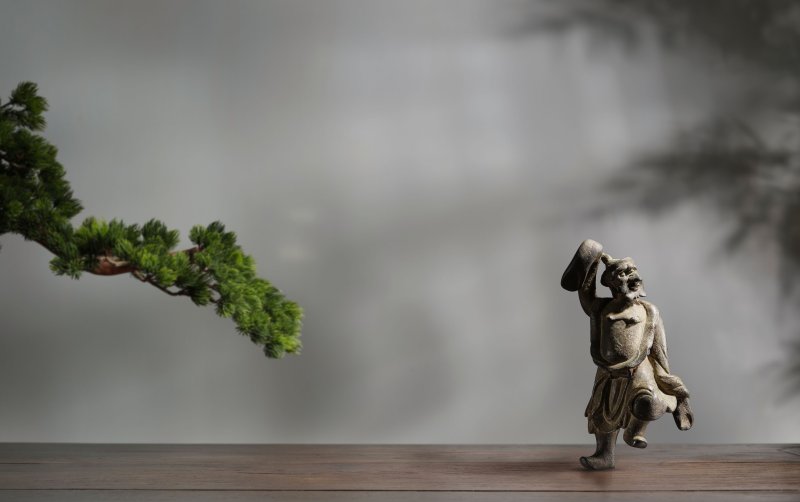

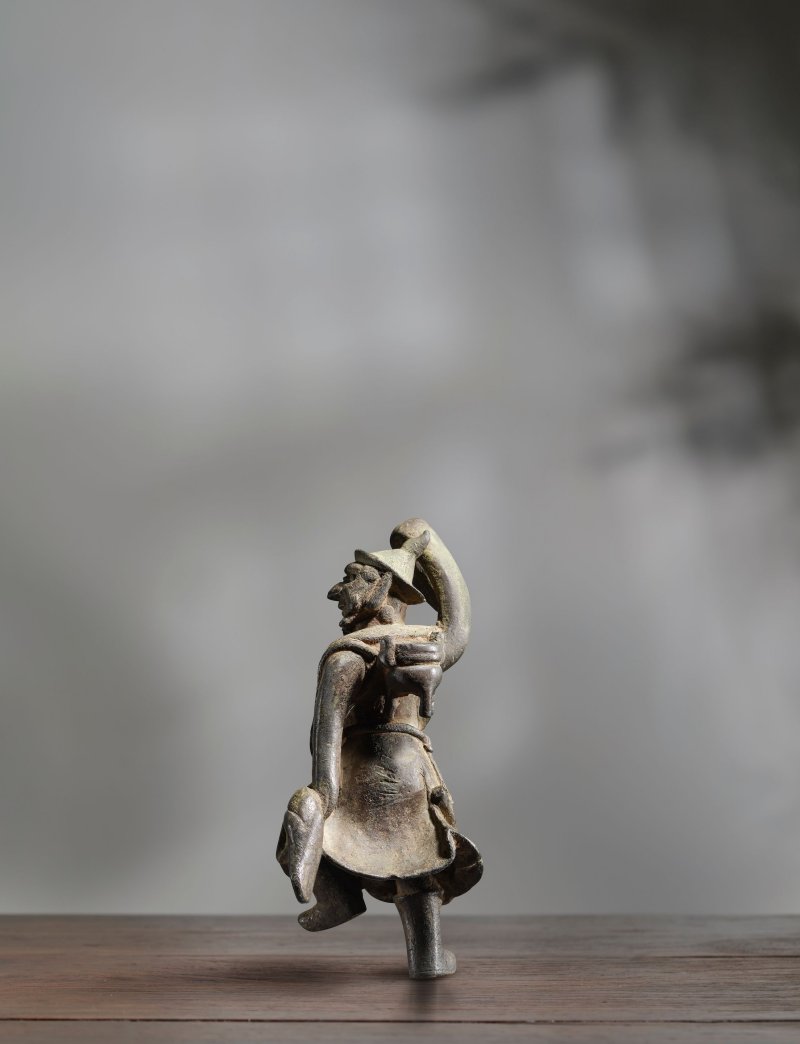

Lot 104 明 銅胡人進寶立像 | A BRONZE FIGURE OF A FOREIGN TRIBUTE BEARER
落槌价
预展中
成交价
预展中
| 拍卖公司 | 邦瀚斯 |
|---|---|
| 拍卖时间 | 2026年10月28日 |
拍品信息
拍品名称
明 銅胡人進寶立像 | A BRONZE FIGURE OF A FOREIGN TRIBUTE BEARER
年代
Ming Dynasty
起拍价
HKD 60,000
估值区间
HKD 60000 - 80000
尺寸
未知
品相
未知
更多信息
Ming Dynasty
dynamically modelled in a spirited, striding posture with one leg raised in motion, the expressively rendered facial features of Central Asian (Hu) character with deep-set eyes, a prominent hooked nose, and a tufted beard framing an open mouth, the head surmounted by a pointed conical hat, the chest partially bare and draped in a short tunic tied tightly at the waist with fluttering sashes, the upper back laden with a tripod ding vessel slung across the shoulders, the right arm raised high above the head and the left trailing low, each hand grasping a slipper, the boots captured in mid-stride, the dark metal covered in an attractive, olive-brown patina.
18.2cm (7 1/8in) high (2).
Footnotes
明 銅胡人進寶立像
Provenance:
Acquired in 1992
來源:
1992年購藏
The strong facial features, curly beards and the pointed hat displayed by the present foreigner closely compare with two bronze foreigners, Ming dynasty, from the collection of George Eumorfopoulos (1863-1939), and now preserved at the British Museum, London, acc.nos.1938,0524.712.a and 1938,0524.713.a.
Figures of foreigners depicted with large rounded eyes and bushy eyebrows have been a popular subject in Chinese art dating from at least the Tang period, when the increased presence of foreigners in China prompted a new fascination and a gradual stylisation of the image of the foreigner in Chinese art. Painters of Buddhist luohan and tribute missions to the Imperial Court continued the fascination with the exotic in subsequent periods.
See a related pair of larger parcel-gilt bronze figures of foreigners, dated by inscription to 1566, which was sold at Sotheby's New York, 23 September 2020, lot 616.
本胡人立像深目高鼻,鬚髮捲曲,頭戴尖帽,其特徵與George Eumorfopoulos舊藏之明代銅胡人像極為相似,該兩例現藏於倫敦大英博物館(館藏編號:1938,0524.712.a 及 1938,0524.713.a)。
自唐代以來,眼圓深邃、鬚眉濃密之胡人形象即為中國藝術常見之題材。彼時異域訪客日增,激發了人們對外來文化之好奇,胡人形象亦隨之在藝術創作中逐漸形成固定之風格化表現。至後世,畫家於創作佛教羅漢像及繪製宮廷進貢圖時,亦延續了此種對異域風情之摹寫與著迷。
另可參考一對體量較大之局部鎏金銅胡人立像,背帶「嘉靖丙寅年記」(1566年)銘款,售於紐約蘇富比,2020年9月23日,拍品編號616。
dynamically modelled in a spirited, striding posture with one leg raised in motion, the expressively rendered facial features of Central Asian (Hu) character with deep-set eyes, a prominent hooked nose, and a tufted beard framing an open mouth, the head surmounted by a pointed conical hat, the chest partially bare and draped in a short tunic tied tightly at the waist with fluttering sashes, the upper back laden with a tripod ding vessel slung across the shoulders, the right arm raised high above the head and the left trailing low, each hand grasping a slipper, the boots captured in mid-stride, the dark metal covered in an attractive, olive-brown patina.
18.2cm (7 1/8in) high (2).
Footnotes
明 銅胡人進寶立像
Provenance:
Acquired in 1992
來源:
1992年購藏
The strong facial features, curly beards and the pointed hat displayed by the present foreigner closely compare with two bronze foreigners, Ming dynasty, from the collection of George Eumorfopoulos (1863-1939), and now preserved at the British Museum, London, acc.nos.1938,0524.712.a and 1938,0524.713.a.
Figures of foreigners depicted with large rounded eyes and bushy eyebrows have been a popular subject in Chinese art dating from at least the Tang period, when the increased presence of foreigners in China prompted a new fascination and a gradual stylisation of the image of the foreigner in Chinese art. Painters of Buddhist luohan and tribute missions to the Imperial Court continued the fascination with the exotic in subsequent periods.
See a related pair of larger parcel-gilt bronze figures of foreigners, dated by inscription to 1566, which was sold at Sotheby's New York, 23 September 2020, lot 616.
本胡人立像深目高鼻,鬚髮捲曲,頭戴尖帽,其特徵與George Eumorfopoulos舊藏之明代銅胡人像極為相似,該兩例現藏於倫敦大英博物館(館藏編號:1938,0524.712.a 及 1938,0524.713.a)。
自唐代以來,眼圓深邃、鬚眉濃密之胡人形象即為中國藝術常見之題材。彼時異域訪客日增,激發了人們對外來文化之好奇,胡人形象亦隨之在藝術創作中逐漸形成固定之風格化表現。至後世,畫家於創作佛教羅漢像及繪製宮廷進貢圖時,亦延續了此種對異域風情之摹寫與著迷。
另可參考一對體量較大之局部鎏金銅胡人立像,背帶「嘉靖丙寅年記」(1566年)銘款,售於紐約蘇富比,2020年9月23日,拍品編號616。
常见问题
这件明 銅胡人進寶立像 | A BRONZE FIGURE OF A FOREIGN TRIBUTE BEARER的成交价是多少?
落槌价为 预展中。 成交价为 预展中。