
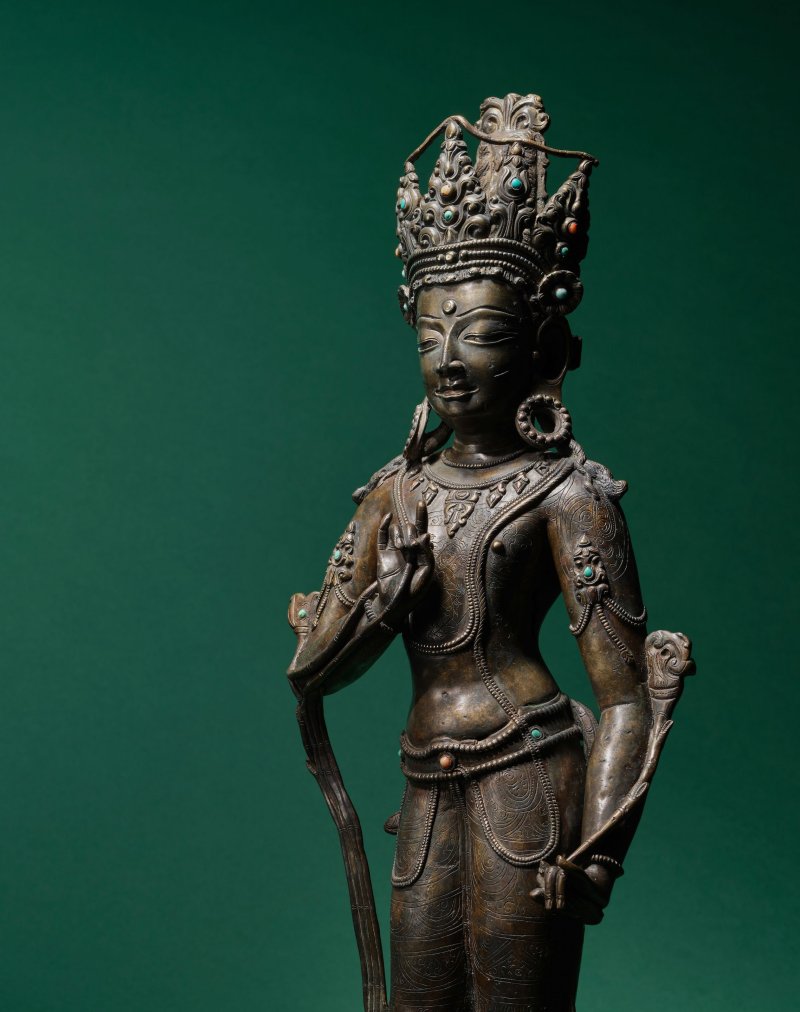
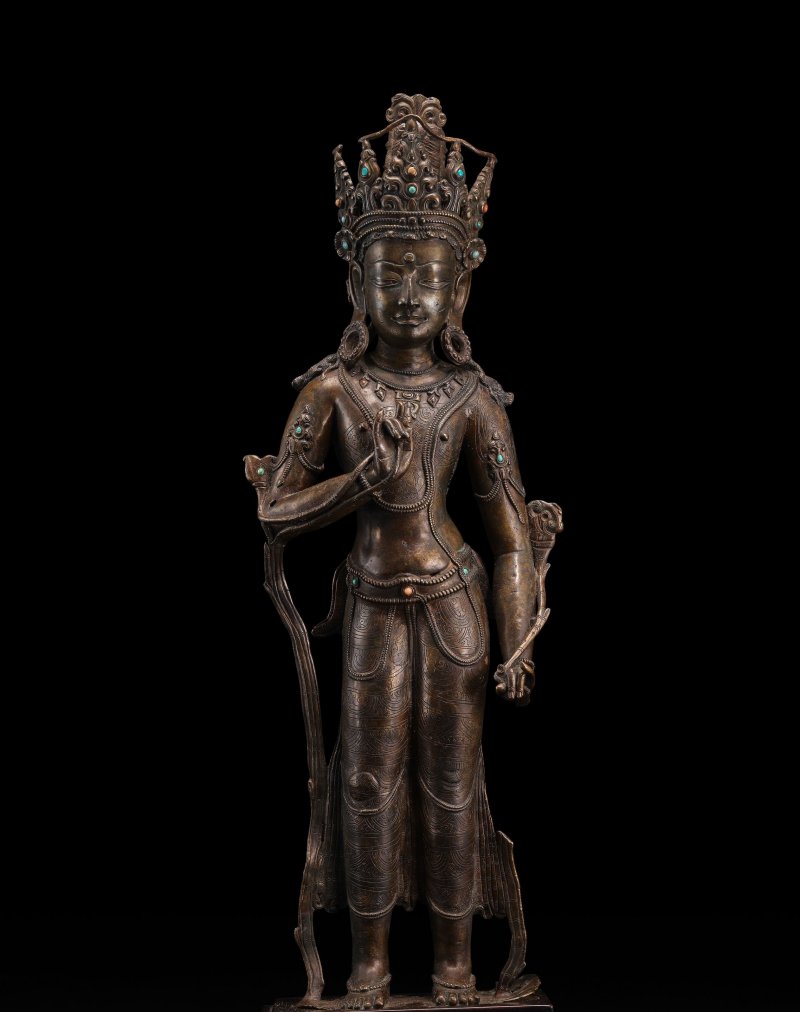
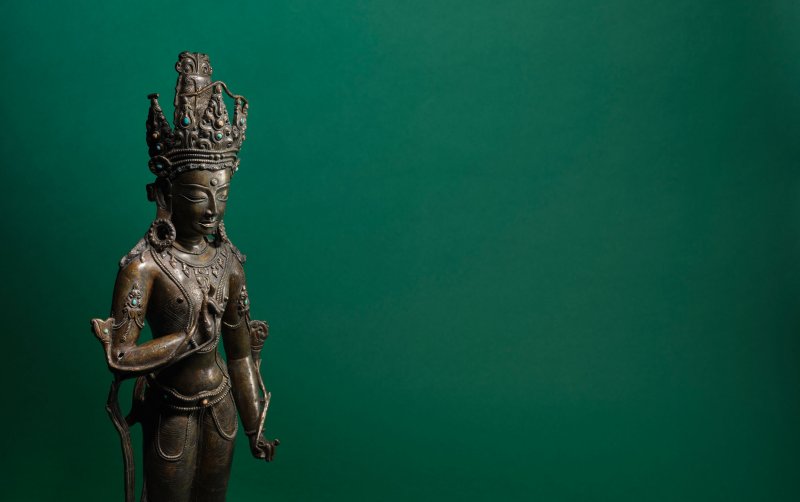
Lot 808 藏中 十三/十四世紀 錯銀錯紅銅菩薩銅像 | A SILVER AND COPPER INLAID COPPER ALLOY FIGURE OF A BODHISATTVA
落槌价
预展中
成交价
预展中
| 拍卖公司 | 邦瀚斯 |
|---|---|
| 拍卖时间 | 2026年10月29日 |
拍品信息
拍品名称
藏中 十三/十四世紀 錯銀錯紅銅菩薩銅像 | A SILVER AND COPPER INLAID COPPER ALLOY FIGURE OF A BODHISATTVA
年代
CENTRAL TIBET, 13TH/14TH CENTURY
起拍价
HKD 1,000,000
估值区间
HKD 1000000 - 1600000
尺寸
未知
品相
未知
更多信息
CENTRAL TIBET, 13TH/14TH CENTURY
Himalayan Art Resources item no. 8869
49 cm (19 1/4 in.) high
Footnotes
藏中 十三/十四世紀 錯銀錯紅銅菩薩銅像
Published
Marcel Nies, Awakening: The Art of Total Perception, 2017, pp.52-53.
Provenance
Private Collection, Paris, 1985-2016
Oliver Hoare, London
Marcel Nies Oriental Art, Antwerp, Belgium, 2017
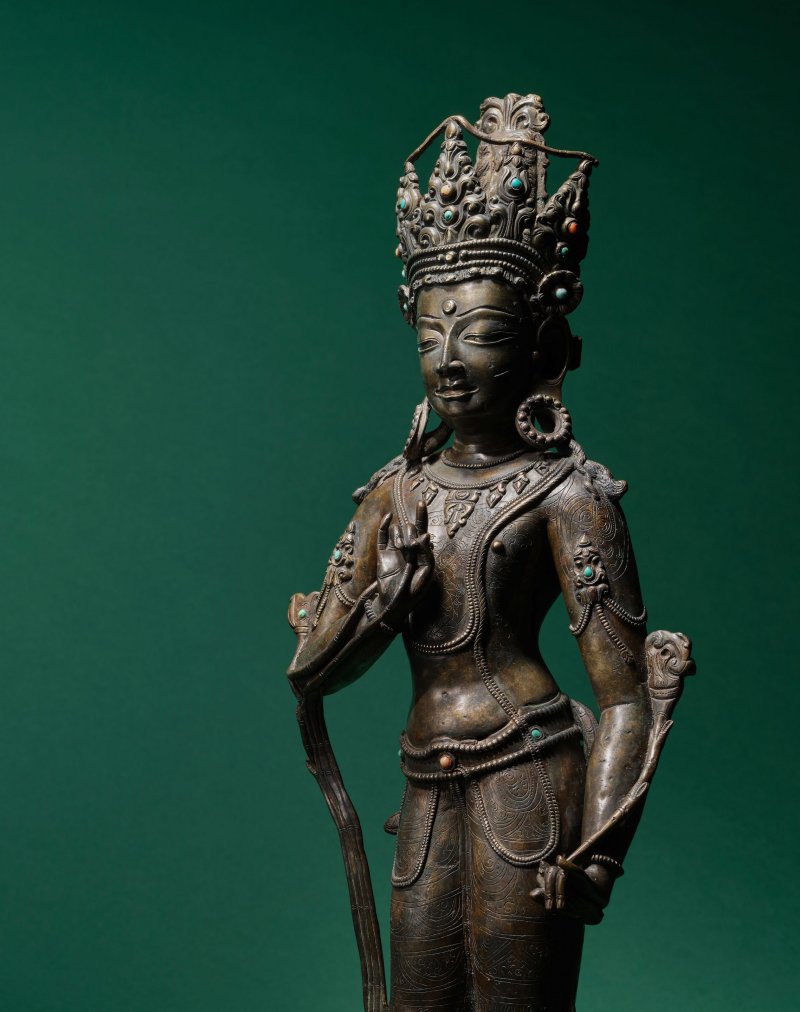
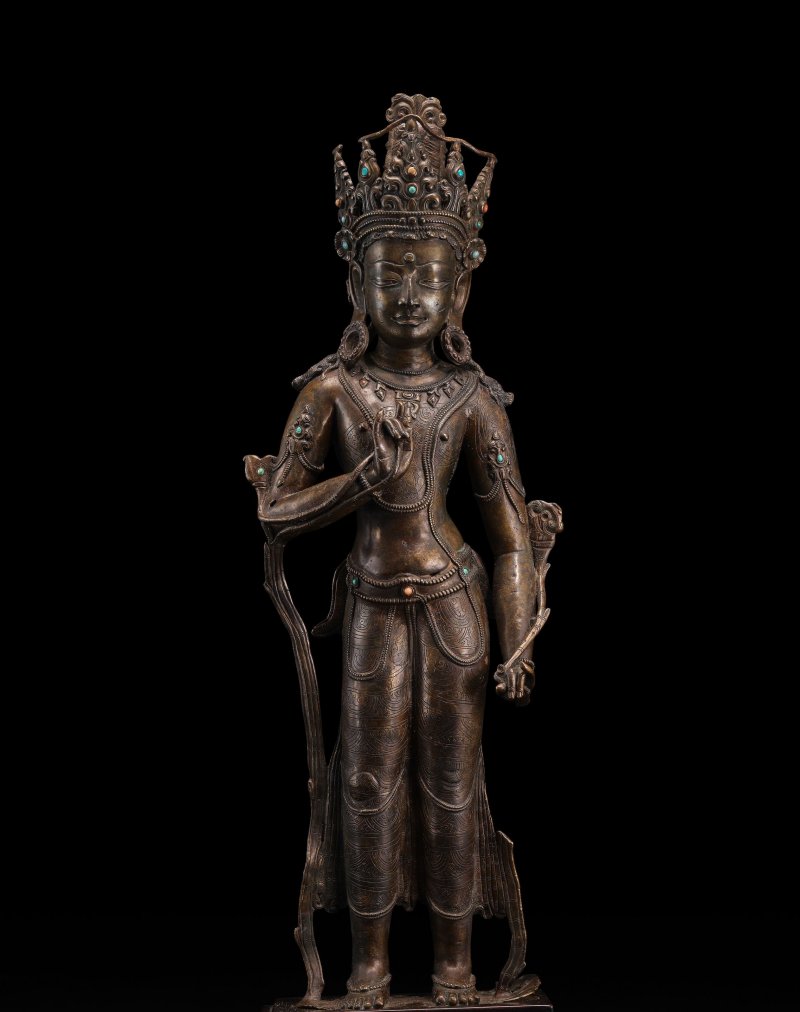
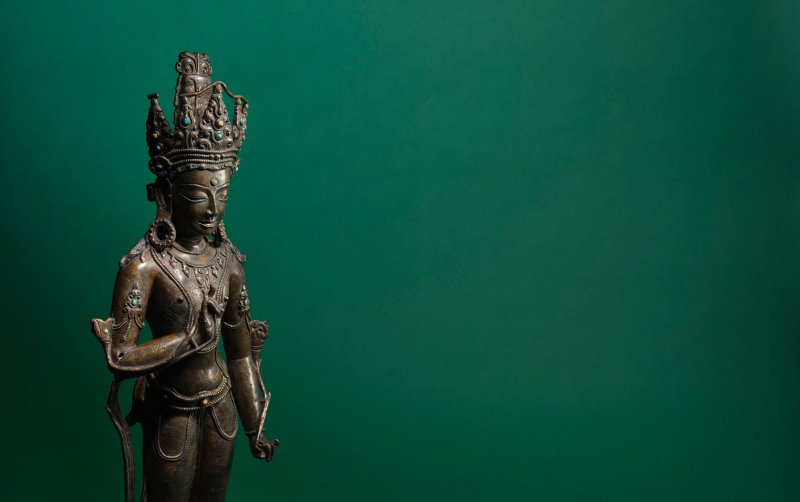
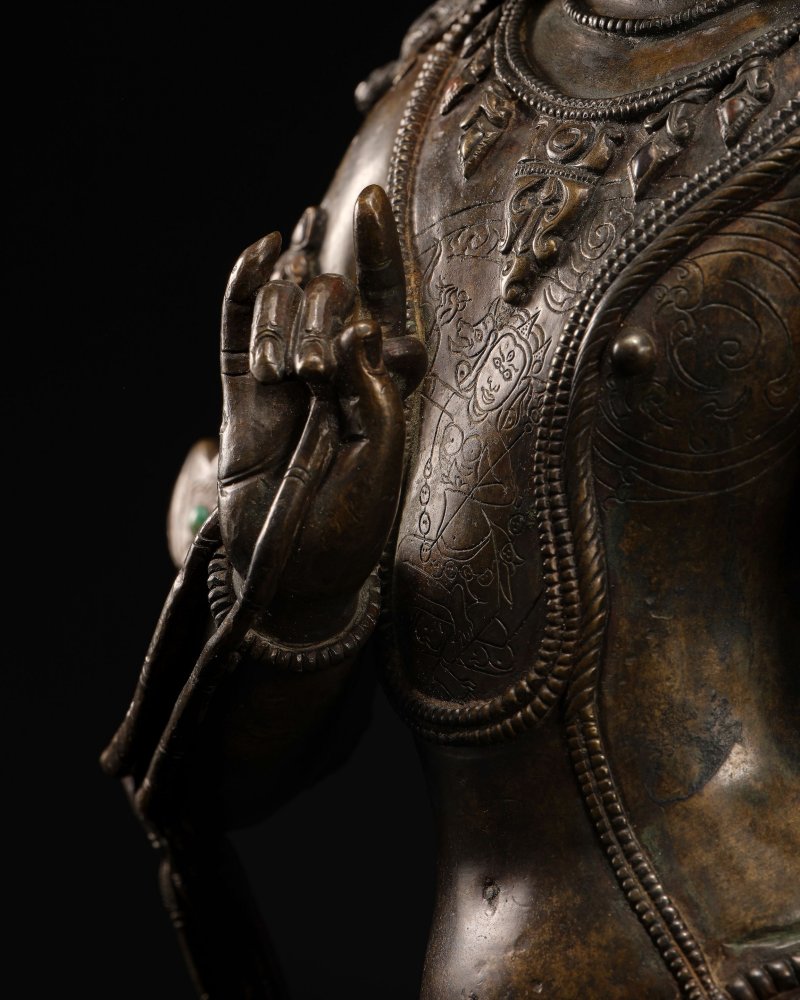
This graceful bodhisattva is an accomplished example of 13th-century Tibetan bronze sculpture. Modeled in the tribhanga (thrice-bent) posture, the figure presents an elegant sinuous silhouette rooted in figural traditions transmitted from northeastern India. The raised right hand forms a modified gesture of charity (varada mudra) while grasping the stem of a lotus; the left hand rests naturally beside the leg, holding a matching lotus stalk. The balanced arrangement of these attributes creates a harmonious rhythm that reinforces the sculpture's poise and elegance. Rendered with the refined features of a youthful prince, the bodhisattva embodies the idealized beauty characteristic of early Tibetan Buddhist bronzes inspired by Indian prototypes.
Stylistic features and the use of copper and silver inlay reveal the enduring influence of the Pala artistic tradition of eastern India. A copper-inlaid appears at the center of the forehead, while gently arched brows frame almond-shaped eyes inlaid with silver. Full lips enriched with copper inlay lend warmth and vitality to the face. The necklace, adorned with leaf-shaped pendants in copper and silver, and the armlets with their upward-turning foliate terminals, recall ornamental conventions seen on late Pala sculptures. Likewise, the five-leaf crown and high chignon derive from iconographic forms widely disseminated throughout the Buddhist world from northeastern India. Comparable treatment of jewelry and ornament may be observed in an 11th-12th century Pala copper alloy Avalokiteshvara sold at Bonhams, Hong Kong, 3 October 2017, lot 1. A closely related Tibetan standing bodhisattva showing similar borrowings from the Pala style is published in Ulrich von Schroeder, , vol. II, p. 1174, pl. 314B (fig. 1).
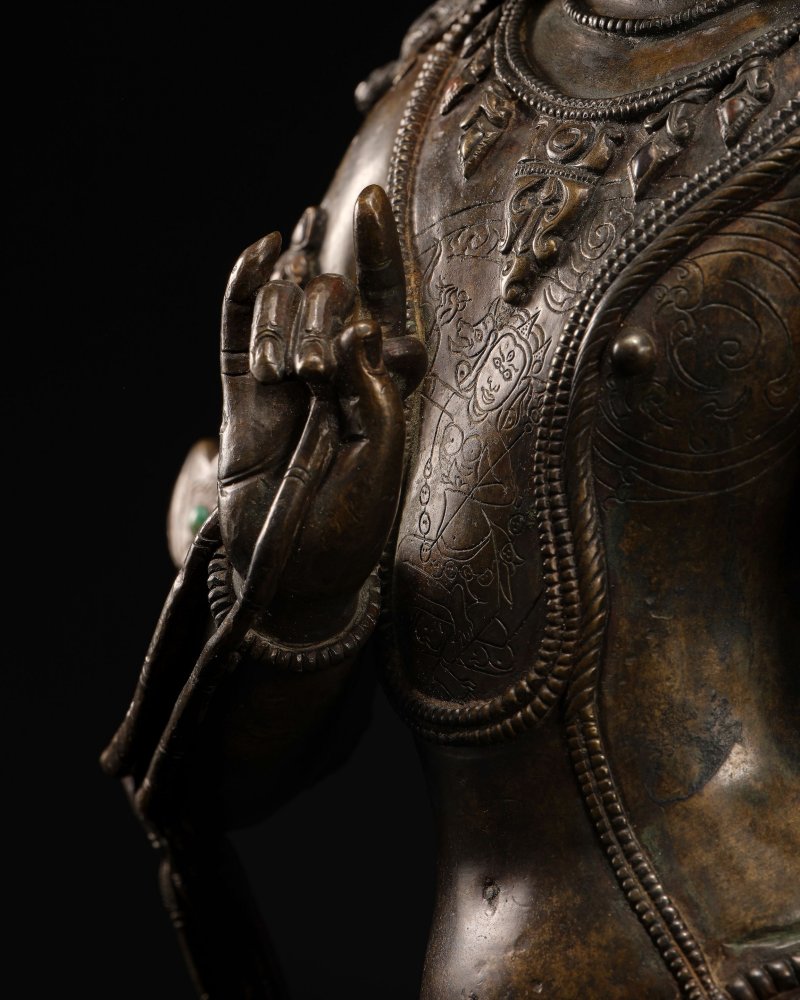
Of particular note is the extensive program of engraved imagery and inscriptions adorning both the front and reverse of the bronze. An image of Vajrayogini is engraved at the center of the chest, while a diminutive wielding a appears at the small of the back. The shawl is ornamented with the Eight Auspicious Symbols (), and behind the shoulders is inscribed the ("Buddhist Creed"), the well-known verse expressing the doctrine of dependent origination frequently found in Buddhist dedicatory contexts. These engravings were likely added during a later phase of consecration and devotional use, attesting to the sculpture's enduring ritual significance and enriching its surface with layers of religious meaning accumulated over time.
For the figures listed in this essay, please refer to our printed or digital catalogue.
Himalayan Art Resources item no. 8869
49 cm (19 1/4 in.) high
Footnotes
藏中 十三/十四世紀 錯銀錯紅銅菩薩銅像
Published
Marcel Nies, Awakening: The Art of Total Perception, 2017, pp.52-53.
Provenance
Private Collection, Paris, 1985-2016
Oliver Hoare, London
Marcel Nies Oriental Art, Antwerp, Belgium, 2017
This graceful bodhisattva is an accomplished example of 13th-century Tibetan bronze sculpture. Modeled in the tribhanga (thrice-bent) posture, the figure presents an elegant sinuous silhouette rooted in figural traditions transmitted from northeastern India. The raised right hand forms a modified gesture of charity (varada mudra) while grasping the stem of a lotus; the left hand rests naturally beside the leg, holding a matching lotus stalk. The balanced arrangement of these attributes creates a harmonious rhythm that reinforces the sculpture's poise and elegance. Rendered with the refined features of a youthful prince, the bodhisattva embodies the idealized beauty characteristic of early Tibetan Buddhist bronzes inspired by Indian prototypes.
Stylistic features and the use of copper and silver inlay reveal the enduring influence of the Pala artistic tradition of eastern India. A copper-inlaid appears at the center of the forehead, while gently arched brows frame almond-shaped eyes inlaid with silver. Full lips enriched with copper inlay lend warmth and vitality to the face. The necklace, adorned with leaf-shaped pendants in copper and silver, and the armlets with their upward-turning foliate terminals, recall ornamental conventions seen on late Pala sculptures. Likewise, the five-leaf crown and high chignon derive from iconographic forms widely disseminated throughout the Buddhist world from northeastern India. Comparable treatment of jewelry and ornament may be observed in an 11th-12th century Pala copper alloy Avalokiteshvara sold at Bonhams, Hong Kong, 3 October 2017, lot 1. A closely related Tibetan standing bodhisattva showing similar borrowings from the Pala style is published in Ulrich von Schroeder, , vol. II, p. 1174, pl. 314B (fig. 1).
Of particular note is the extensive program of engraved imagery and inscriptions adorning both the front and reverse of the bronze. An image of Vajrayogini is engraved at the center of the chest, while a diminutive wielding a appears at the small of the back. The shawl is ornamented with the Eight Auspicious Symbols (), and behind the shoulders is inscribed the ("Buddhist Creed"), the well-known verse expressing the doctrine of dependent origination frequently found in Buddhist dedicatory contexts. These engravings were likely added during a later phase of consecration and devotional use, attesting to the sculpture's enduring ritual significance and enriching its surface with layers of religious meaning accumulated over time.
For the figures listed in this essay, please refer to our printed or digital catalogue.
常见问题
这件藏中 十三/十四世紀 錯銀錯紅銅菩薩銅像 | A SILVER AND COPPER INLAID COPPER ALLOY FIGURE OF A BODHISATTVA的成交价是多少?
落槌价为 预展中。 成交价为 预展中。