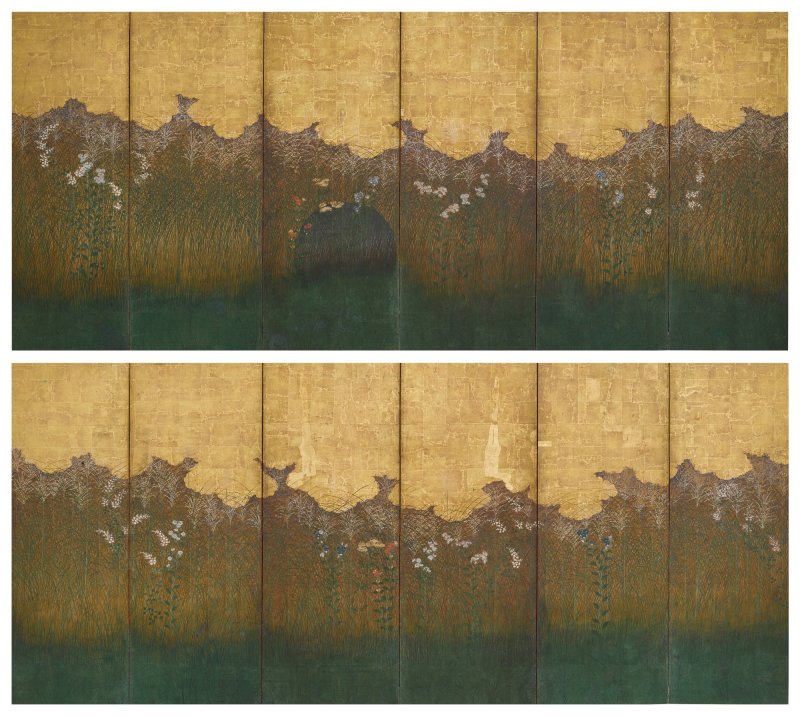

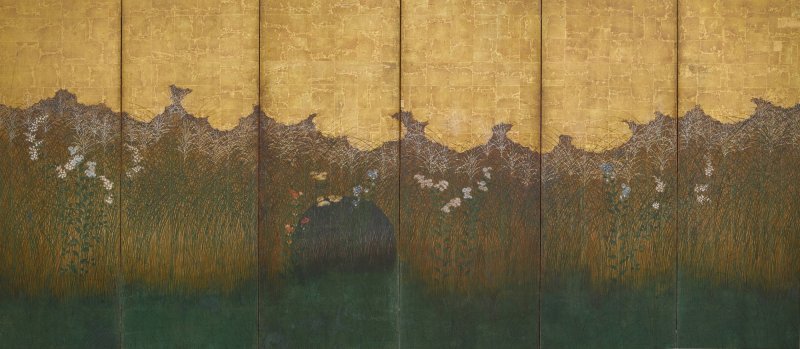
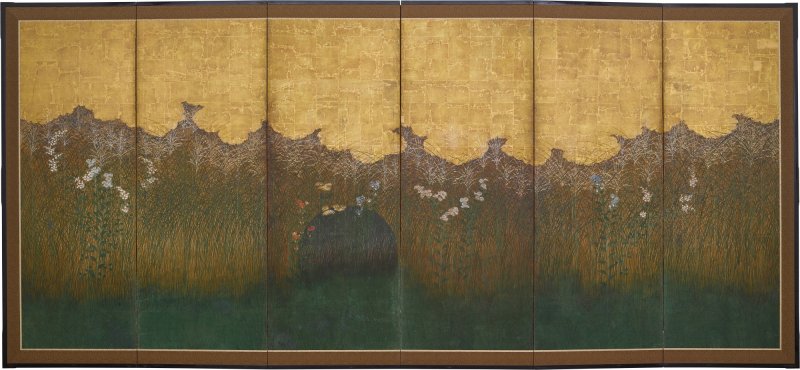
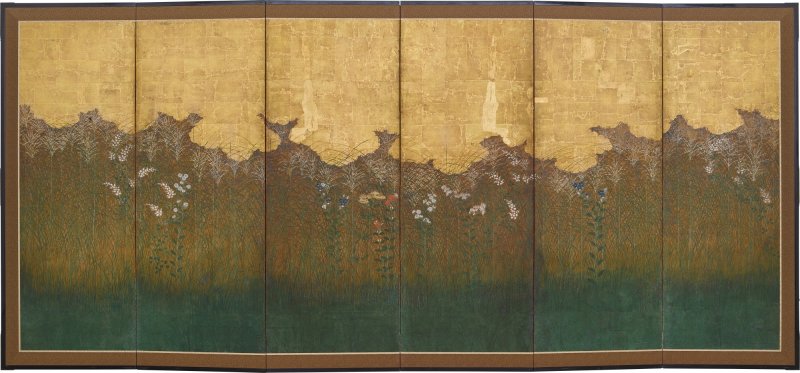
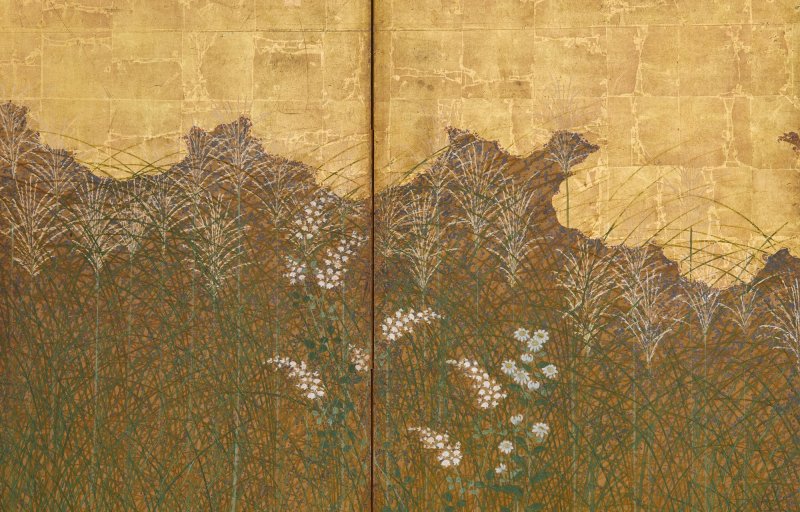
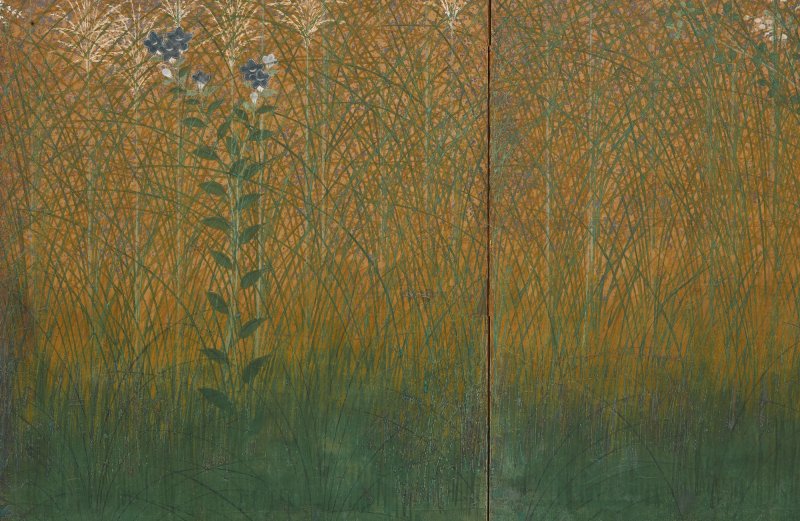
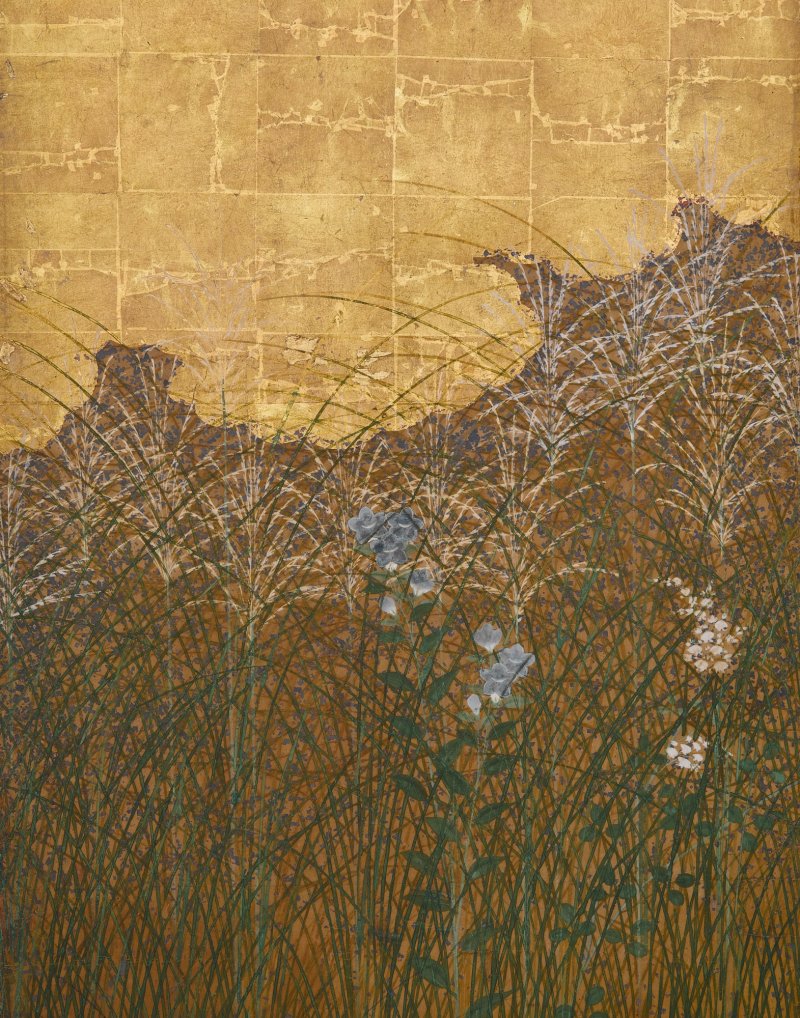
Lot 2024 Anonymous, Moon over Musashi Moor, Edo period, early 17th century | 武蔵野図屏風 江戸時代前期 17世紀初頭
落槌价
****
成交价
****
拍品信息
拍品名称
Anonymous, Moon over Musashi Moor, Edo period, early 17th century | 武蔵野図屏風 江戸時代前期 17世紀初頭
起拍价
HKD 150,000
估值区间
150,000 - 200,000 HKD
尺寸
未知
品相
Overall, the screen is in good condition, most Japanese screens have some restoration by the nature of their use being opened and closed repeatedly, there is some wear around the hinges consistent with age and use, each panel with some small paper losses to the gold ground and with associated repairs, minor rubbing to pigments in places, some minor wormage, as is typical there is restoration particularly around the hinges, slight wear to the paper surface particularly around the malachite green to the lower sections of each panel, the black lacquer mounts with some old wear consistent with age and use, later 20th century backing paper.
If a condition report is provided to assist you with assessing the condition of the lot, it is for guidance purposes only. Such condition report may not refer to all faults, restoration, alterations, or adaptations because Sotheby's is not a professional conservator or restorer but rather a condition report is a statement of subjective, qualified opinion genuinely held by Sotheby's. For these reasons, any such condition report is not an alternative to taking your own professional advice regarding the condition of the lot. Prospective buyers should also refer to the Guide for Buyers at Auction which includes important notices concerning the type of property in this sale.
If a condition report is provided to assist you with assessing the condition of the lot, it is for guidance purposes only. Such condition report may not refer to all faults, restoration, alterations, or adaptations because Sotheby's is not a professional conservator or restorer but rather a condition report is a statement of subjective, qualified opinion genuinely held by Sotheby's. For these reasons, any such condition report is not an alternative to taking your own professional advice regarding the condition of the lot. Prospective buyers should also refer to the Guide for Buyers at Auction which includes important notices concerning the type of property in this sale.
更多信息
pair of six-panel folding screens: ink, colour, gold and scattered silver leaf on paper, silk brocade borders, black lacquer mounts, engraved copper-gilt fittings
172 x 380.4 cm. (when unfolded)
172 x 63.4 cm. (when folded)
图录
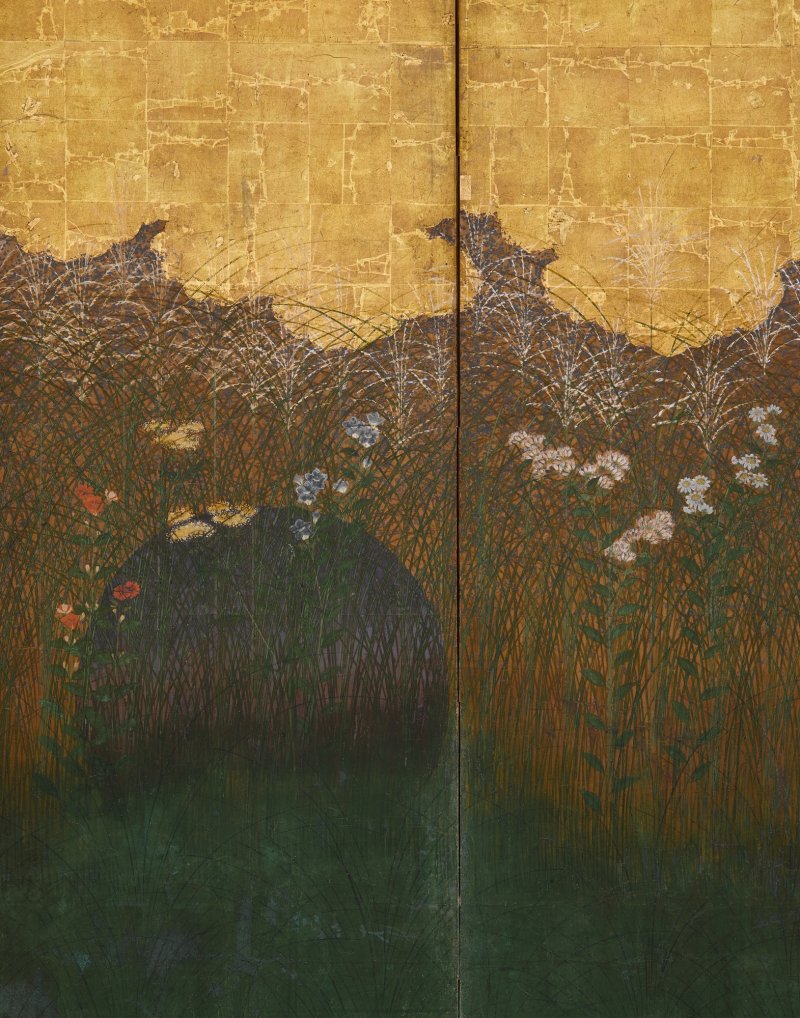
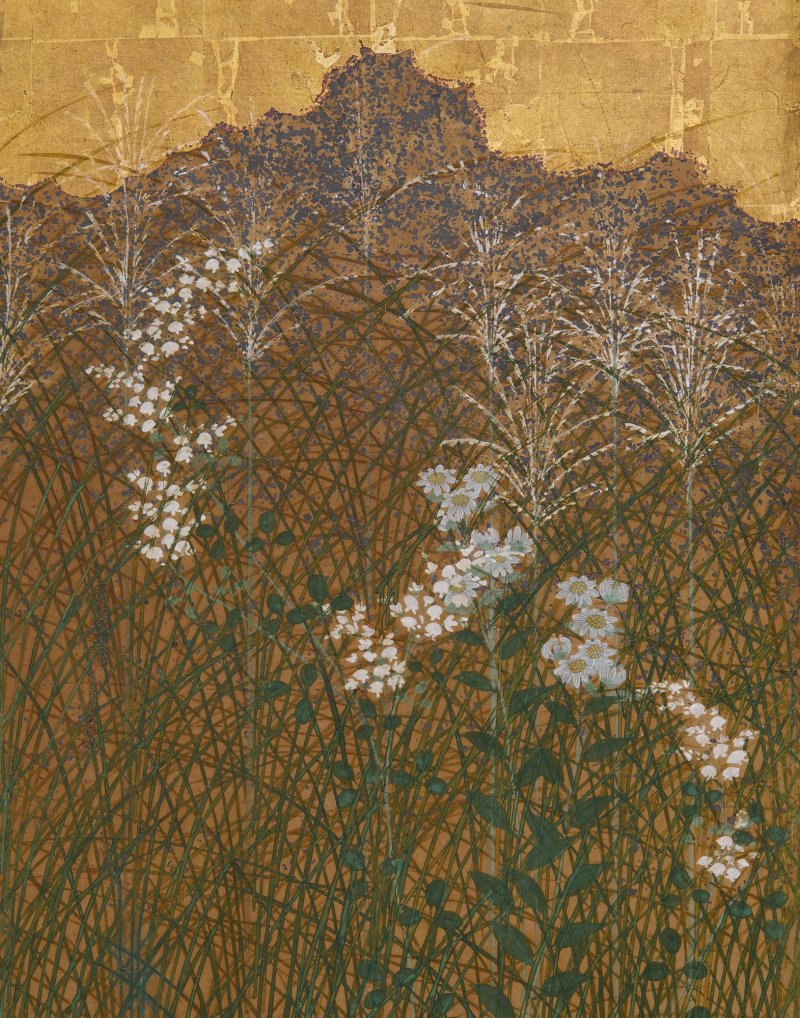
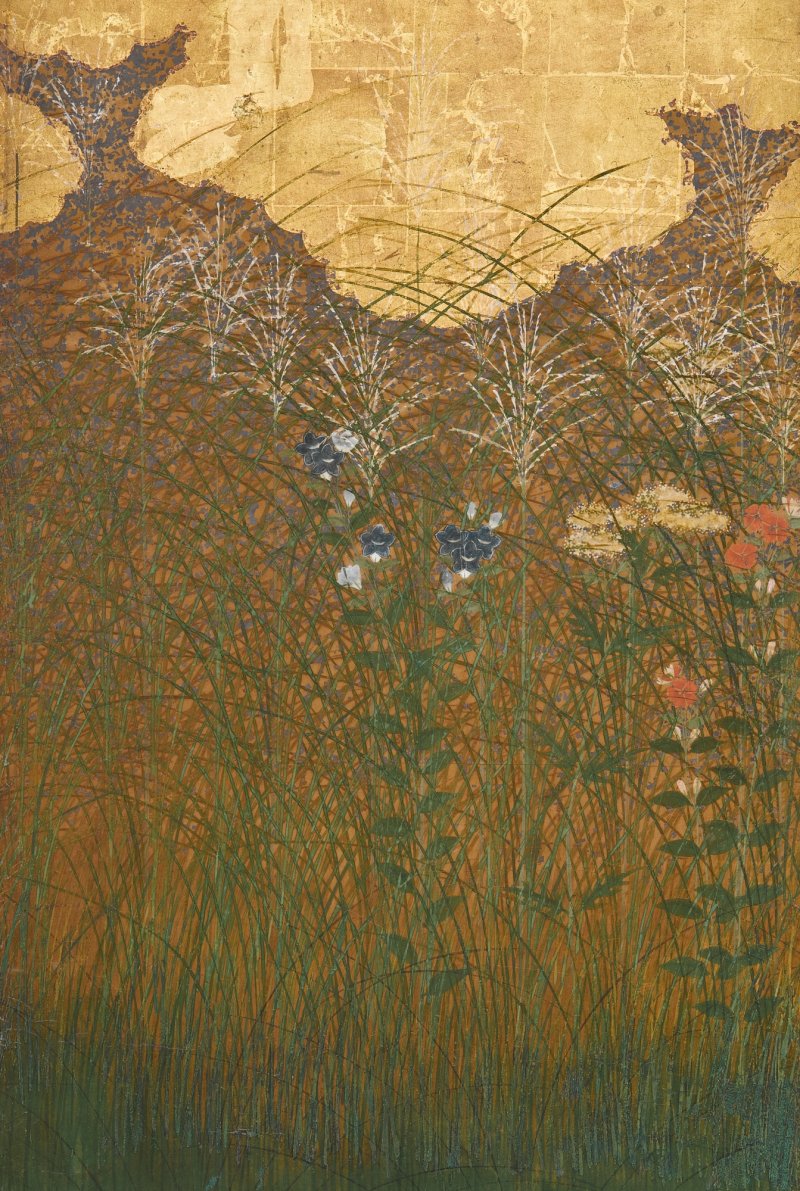
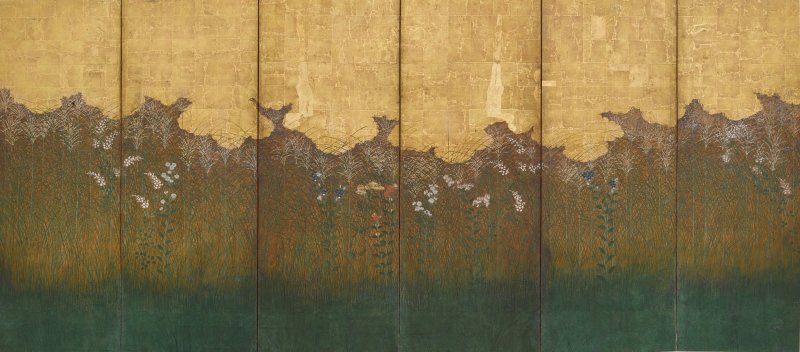
说明:Autumn grasses and flowers rise from a malachite green ground. Plumes of miscanthus (susuki) echo the scalloped form of the golden clouds above, while dianthus, bellflower, bush clover and mugwort are interspersed among the tall grasses. The moon appears faintly through the foliage, rendered in silver leaf; scattered silver flecks throughout the grasses suggest the night sky glimpsed through the verdure, with sky, cloud, moon and earth appearing to merge into a single continuous field.
Musashino, the plain once extending across the Kanto region southwest of present-day Edo, is counted among the classical meisho, or ‘famous places’ of Japanese poetry and painting, celebrated since antiquity for its expanse of open grassland and mentioned as early as the Man'yoshu [lit. Collection of Ten Thousand Leaves]. The theme was given its most famous literary treatment in Chapter 12 of the tenth-century Tale of Ise (Ise monogatari), in which a fleeing woman, hidden with her lover among the grasses of Musashino, begs the pursuing governor: “Please don’t burn, / don’t burn, the grasses/ of the Musashi Plain. My beloved hides here, / and I do, too.”1
The association with Musashi Moor and the moon became a recurring poetic convention. It is thought that the tradition began in a poem by Minamoto no Michikata (1189-1238):
The plains of Musashi
have no mountain peaks
into which the moon can slip,
as white clouds enshroud
spears of plume grasses.2
Musashino wa
tsuki no irubeki
mine mo nashi
obana ga sue ni
kakaru shirakumo
Fujiwara no Yoshitsune (1169-1206) also writes in the Shin kokin wakashu [New Collection of Poems Ancient and Modern]:
my destination
and the sky become one on
Musashi Moor
where from distant field grasses
there emerges bright moonlight.3
yukusuwe ha
sora mo hitotsu no
Musashino ni
kusa no hara yori
idzuru tsukikage
For comparison, there is another pair of screens depicting Musashi Moor and Mount Fuji in the collection of the Suntory Museum of Art, Tokyo, go to:
https://www.suntory.com/sma/collection/gallery/detail?lang=en&id=543
1. Translated in Peter MacMillan, The Tales of Ise, London, 2016, p. 21.
2. Translated by John T. Carpenter in "The Plains of Musashi", The Metropolitan Museum of Art (The MET), accession no. 67.235, https://www.metmuseum.org/art/collection/search/45262
3. Translated by Laurel Rasplica Rodd in Shinkokinshu: New Collection of Poems Ancient and Modern (Leiden, 2015), p. 181, no. 422.
172 x 380.4 cm. (when unfolded)
172 x 63.4 cm. (when folded)
图录
说明:Autumn grasses and flowers rise from a malachite green ground. Plumes of miscanthus (susuki) echo the scalloped form of the golden clouds above, while dianthus, bellflower, bush clover and mugwort are interspersed among the tall grasses. The moon appears faintly through the foliage, rendered in silver leaf; scattered silver flecks throughout the grasses suggest the night sky glimpsed through the verdure, with sky, cloud, moon and earth appearing to merge into a single continuous field.
Musashino, the plain once extending across the Kanto region southwest of present-day Edo, is counted among the classical meisho, or ‘famous places’ of Japanese poetry and painting, celebrated since antiquity for its expanse of open grassland and mentioned as early as the Man'yoshu [lit. Collection of Ten Thousand Leaves]. The theme was given its most famous literary treatment in Chapter 12 of the tenth-century Tale of Ise (Ise monogatari), in which a fleeing woman, hidden with her lover among the grasses of Musashino, begs the pursuing governor: “Please don’t burn, / don’t burn, the grasses/ of the Musashi Plain. My beloved hides here, / and I do, too.”1
The association with Musashi Moor and the moon became a recurring poetic convention. It is thought that the tradition began in a poem by Minamoto no Michikata (1189-1238):
The plains of Musashi
have no mountain peaks
into which the moon can slip,
as white clouds enshroud
spears of plume grasses.2
Musashino wa
tsuki no irubeki
mine mo nashi
obana ga sue ni
kakaru shirakumo
Fujiwara no Yoshitsune (1169-1206) also writes in the Shin kokin wakashu [New Collection of Poems Ancient and Modern]:
my destination
and the sky become one on
Musashi Moor
where from distant field grasses
there emerges bright moonlight.3
yukusuwe ha
sora mo hitotsu no
Musashino ni
kusa no hara yori
idzuru tsukikage
For comparison, there is another pair of screens depicting Musashi Moor and Mount Fuji in the collection of the Suntory Museum of Art, Tokyo, go to:
https://www.suntory.com/sma/collection/gallery/detail?lang=en&id=543
1. Translated in Peter MacMillan, The Tales of Ise, London, 2016, p. 21.
2. Translated by John T. Carpenter in "The Plains of Musashi", The Metropolitan Museum of Art (The MET), accession no. 67.235, https://www.metmuseum.org/art/collection/search/45262
3. Translated by Laurel Rasplica Rodd in Shinkokinshu: New Collection of Poems Ancient and Modern (Leiden, 2015), p. 181, no. 422.
常见问题
拍品的品相状况如何?
Overall, the screen is in good condition, most Japanese screens have some restoration by the nature of their use being opened and closed repeatedly, there is some wear around the hinges consistent with age and use, each panel with some small paper losses to the gold ground and with associated repairs, minor rubbing to pigments in places, some minor wormage, as is typical there is restoration particularly around the hinges, slight wear to the paper surface particularly around the malachite green to the lower sections of each panel, the black lacquer mounts with some old wear consistent with age and use, later 20th century backing paper.
If a condition report is provided to assist you with assessing the condition of the lot, it is for guidance purposes only. Such condition report may not refer to all faults, restoration, alterations, or adaptations because Sotheby's is not a professional conservator or restorer but rather a condition report is a statement of subjective, qualified opinion genuinely held by Sotheby's. For these reasons, any such condition report is not an alternative to taking your own professional advice regarding the condition of the lot. Prospective buyers should also refer to the Guide for Buyers at Auction which includes important notices concerning the type of property in this sale.
If a condition report is provided to assist you with assessing the condition of the lot, it is for guidance purposes only. Such condition report may not refer to all faults, restoration, alterations, or adaptations because Sotheby's is not a professional conservator or restorer but rather a condition report is a statement of subjective, qualified opinion genuinely held by Sotheby's. For these reasons, any such condition report is not an alternative to taking your own professional advice regarding the condition of the lot. Prospective buyers should also refer to the Guide for Buyers at Auction which includes important notices concerning the type of property in this sale.