
拍品信息
拍品名称
元/明 玉馬 一組四件 | FOUR JADE HORSE CARVINGS
年代
Yuan/Ming Dynasty
起拍价
GBP 3,000
估值区间
GBP 3000 - 4000
尺寸
未知
品相
未知
更多信息
Yuan/Ming Dynasty
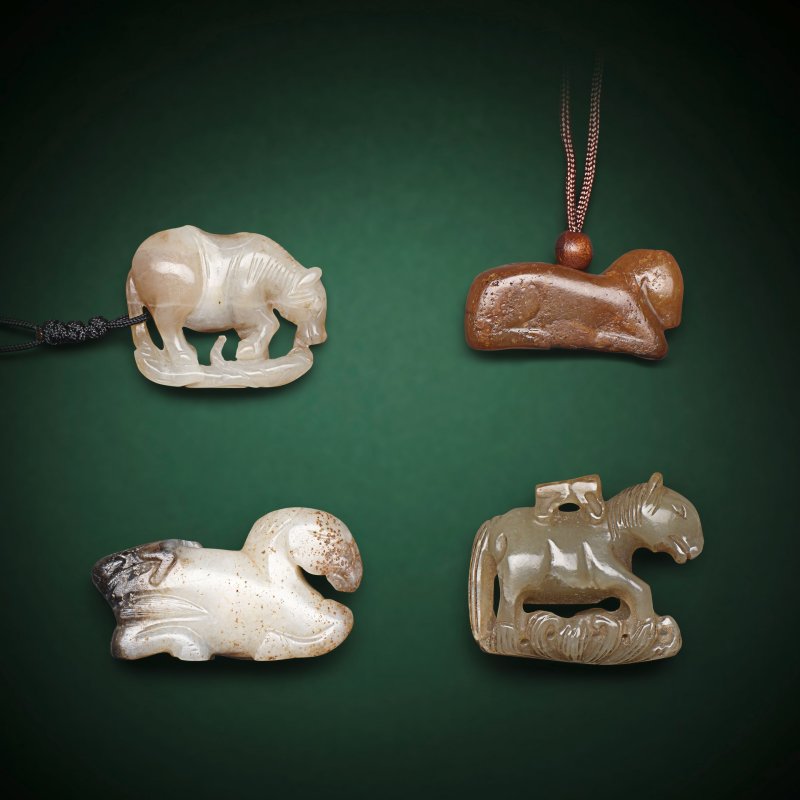
Comprising: a jade pebble expertly carved and pierced as a horse standing atop a grassy knoll, the head lowered in the act of grazing, finely incised with a flowing mane and saddle, the stone of pale grey tone with attractive light chestnut-brown patches, 3.5cm (1 3/8in) wide; a horse of pale white tone with dark brown patches, carved recumbent with its legs tucked neatly beneath the large body, 4.6cm (1 3/4in) wide; a horse atop incised waves, carrying a scroll on its back, the stone of even olive-green tone, 4cm (1 1/2in) wide; and a flat pebble carved as a recumbent horse, the stone of amber-honey tone, 3.7cm (1 1/2in) wide. (4).
Footnotes
元/明 玉馬 一組四件
Horses carry rich symbolic meaning in Chinese culture. They have long been associated with status, authority, and the cultivated life of the elite, and frequently appear in paintings as companions to scholars or as metaphors for talent, ambition, and achievement. Exceptionally gifted individuals are often likened to a 'thousand-li horse' (千里馬) which refers to a horse capable of traveling a thousand li in a single day.
See a related jade reclining horse, Ming dynasty, in the collection of Hangzhou History Museum, illustrated in (中國傳世玉器全集), vol.4 (Ming), Beijing, 2010, p.180.
See a related pale green jade carving of a horse, Ming dynasty, which was sold at Bonhams Hong Kong, 27 November 2018, lot 132.
Comprising: a jade pebble expertly carved and pierced as a horse standing atop a grassy knoll, the head lowered in the act of grazing, finely incised with a flowing mane and saddle, the stone of pale grey tone with attractive light chestnut-brown patches, 3.5cm (1 3/8in) wide; a horse of pale white tone with dark brown patches, carved recumbent with its legs tucked neatly beneath the large body, 4.6cm (1 3/4in) wide; a horse atop incised waves, carrying a scroll on its back, the stone of even olive-green tone, 4cm (1 1/2in) wide; and a flat pebble carved as a recumbent horse, the stone of amber-honey tone, 3.7cm (1 1/2in) wide. (4).
Footnotes
元/明 玉馬 一組四件
Horses carry rich symbolic meaning in Chinese culture. They have long been associated with status, authority, and the cultivated life of the elite, and frequently appear in paintings as companions to scholars or as metaphors for talent, ambition, and achievement. Exceptionally gifted individuals are often likened to a 'thousand-li horse' (千里馬) which refers to a horse capable of traveling a thousand li in a single day.
See a related jade reclining horse, Ming dynasty, in the collection of Hangzhou History Museum, illustrated in (中國傳世玉器全集), vol.4 (Ming), Beijing, 2010, p.180.
See a related pale green jade carving of a horse, Ming dynasty, which was sold at Bonhams Hong Kong, 27 November 2018, lot 132.
常见问题
这件元/明 玉馬 一組四件 | FOUR JADE HORSE CARVINGS的成交价是多少?
落槌价为 预展中。 成交价为 预展中。


