
拍品信息
拍品名称
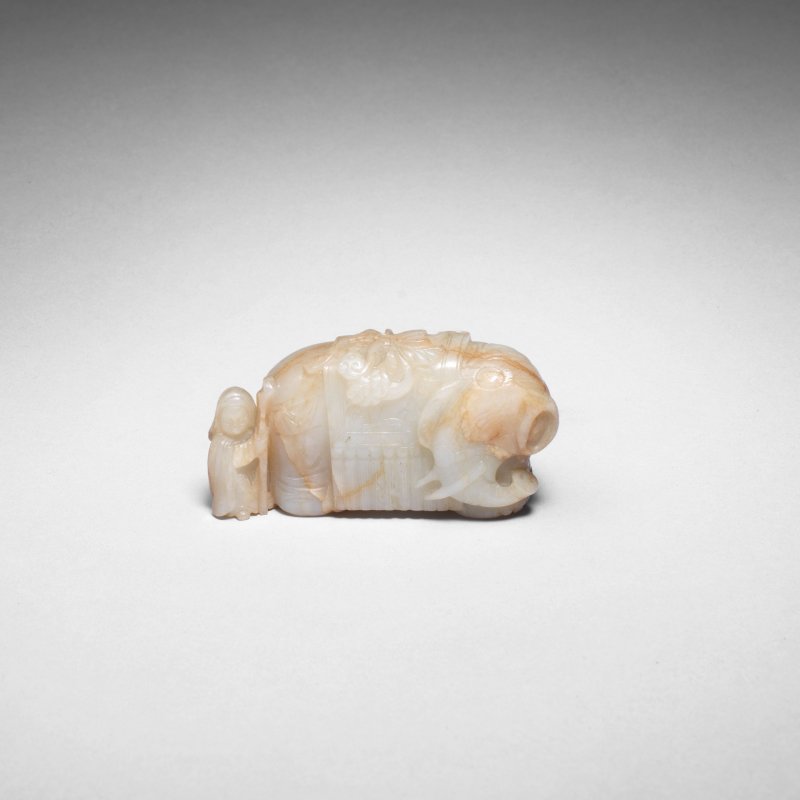
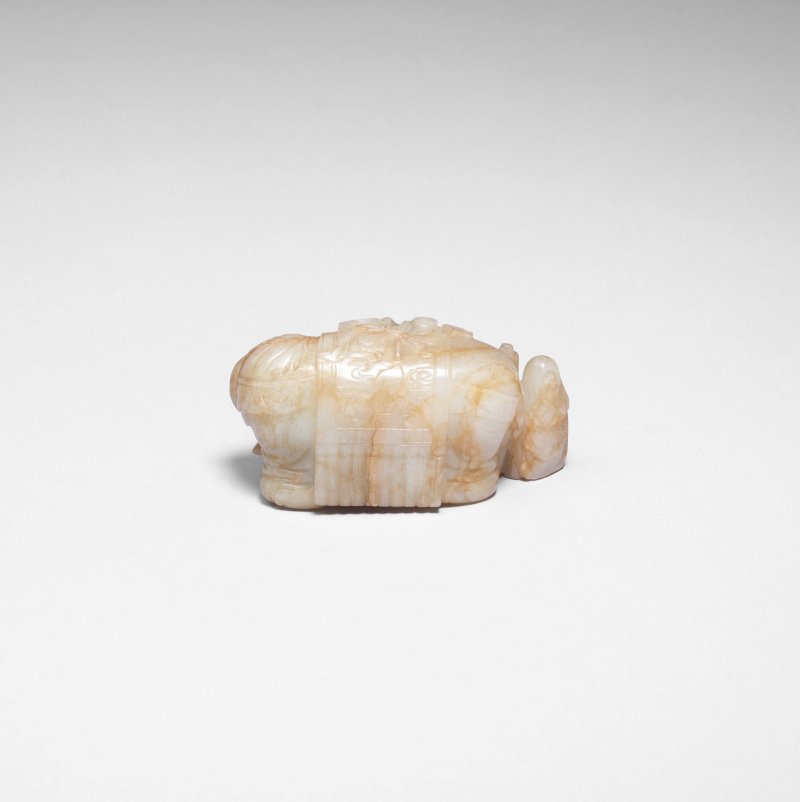
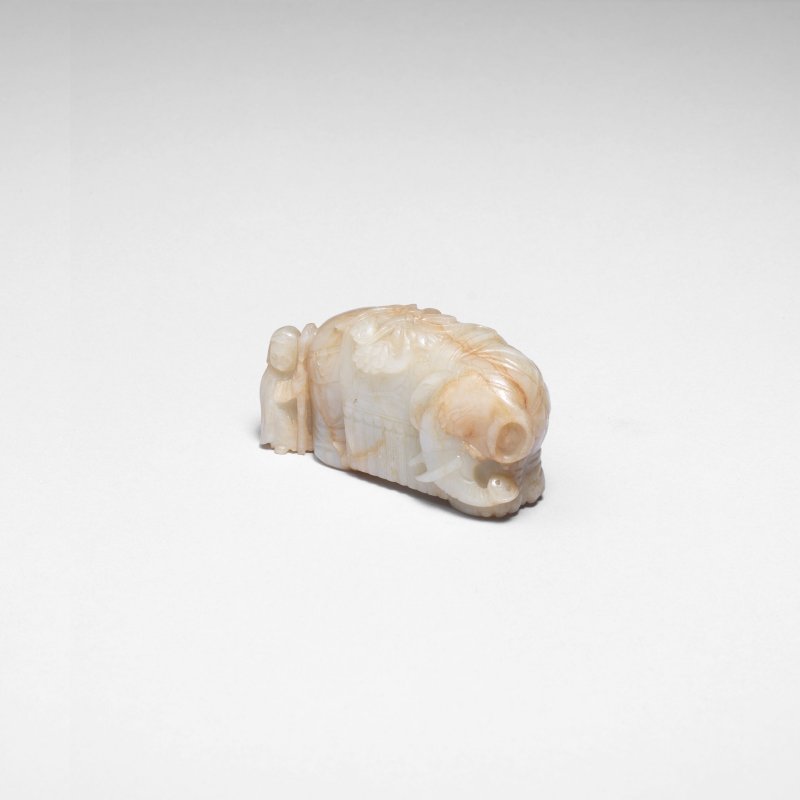
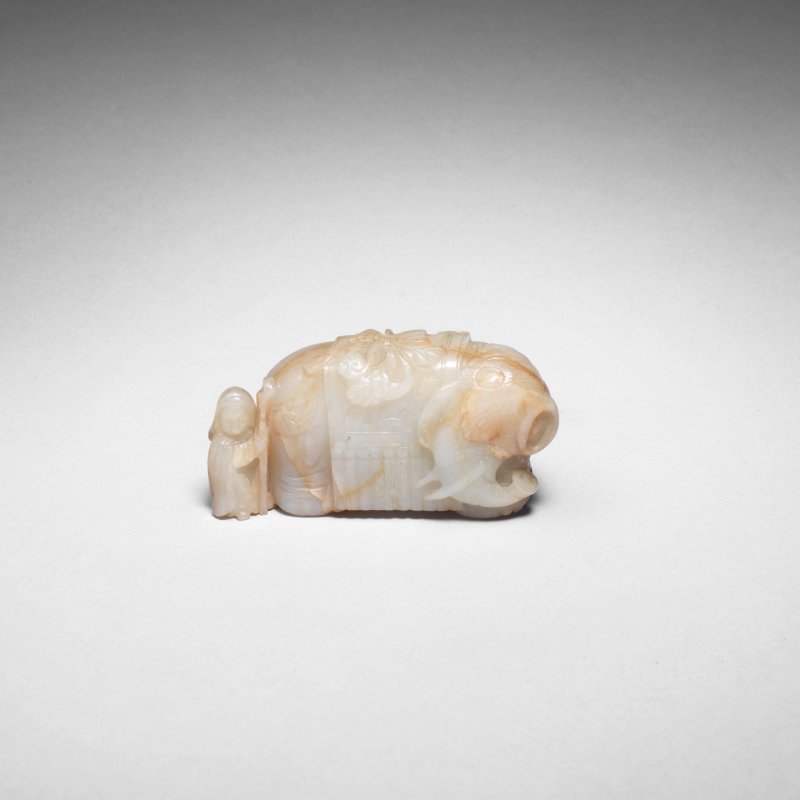
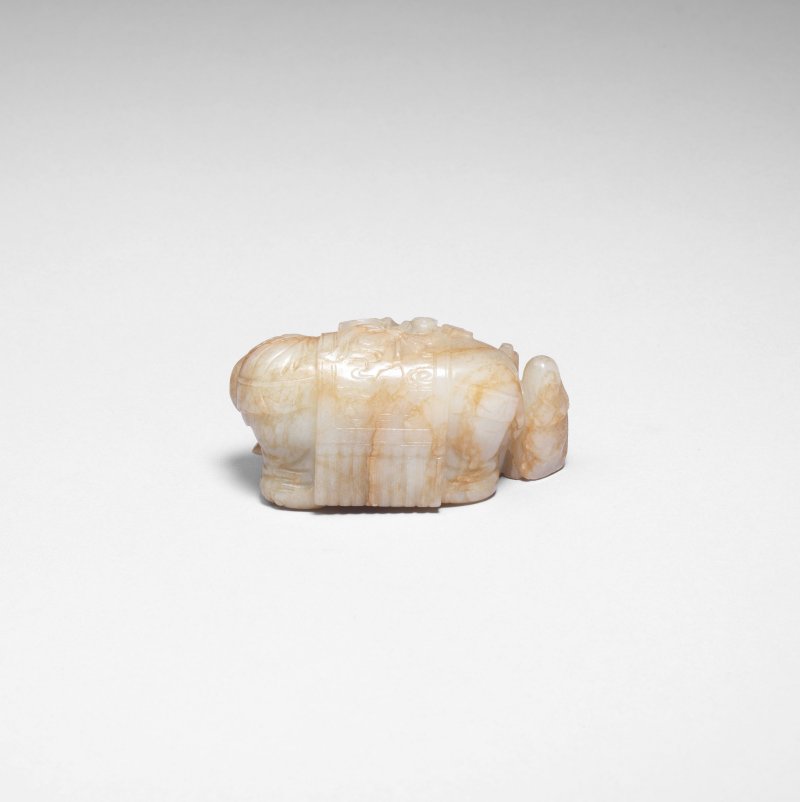
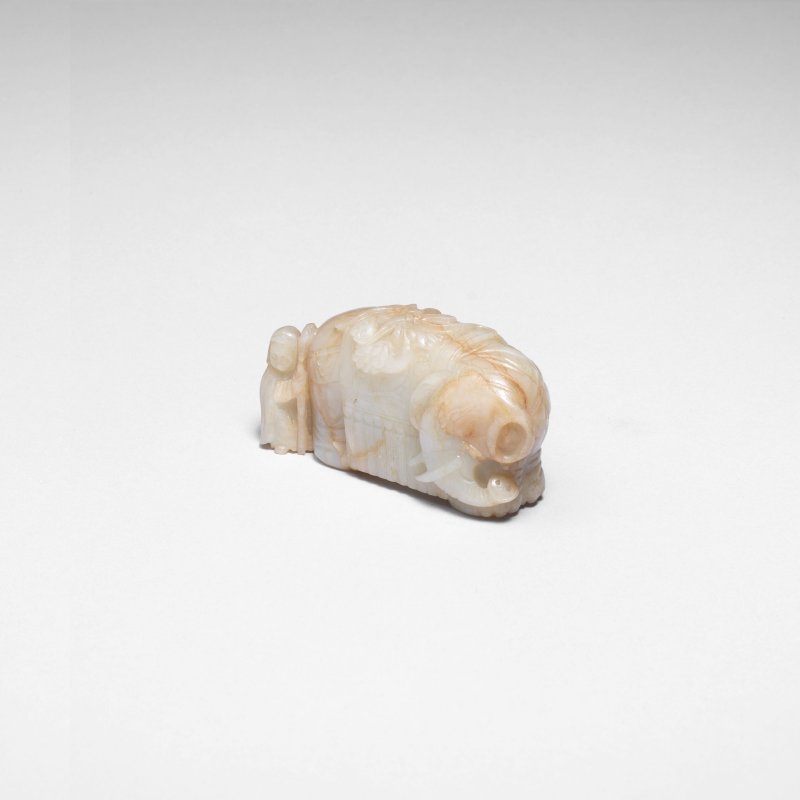
十七/十八世紀 青玉胡人馴象擺件 | A PALE GREEN JADE CARVING OF AN ELEPHANT AND 'FOREIGNER'
年代
17th/18th century
起拍价
GBP 1,200
估值区间
GBP 1200 - 1500
尺寸
未知
品相
未知
更多信息
17th/18th century
The large pebble smoothly carved as a caparisoned elephant standing foursquare, its head turned sharply to the right, the almond-shaped eyes and sharply defined tusks directed towards a standing figure clad in a hooded cloak and holding a staff, the powerfully modelled beast rendered with naturalistic folds of skin and charmingly wrinkled features, surmounted by a flowering peony spray and a ruyi, the stone of even pale tone with russet inclusions. 9cm (3 1/2in) long.
Footnotes
十七/十八世紀 青玉胡人馴象擺件
Provenance: Sir George Mowlem Burt KBE (1884–1964), Surrey, and thence by descent
來源:大英帝國爵級司令勛章獲得者George Mowlem Burt爵士(1884-1964),英國薩裏,并由後人保存迄今
Born in Westminster on 10 January 1884, Sir George Mowlem Burt KBE joined the family firm, John Mowlem & Co., in 1902, following in the footsteps of his father and uncle. He subsequently became supervising director of the company and was involved in a number of major engineering and building projects. He was a prominent figure in the development of the civil engineering industry, serving as a founding member of the Federation of Civil Engineering Contractors and on various Government committees and missions. He was also Master of the Worshipful Company of Paviors. Outside his professional life, Burt was a distinguished fencer, winning the British épée championship in 1922 and representing Great Britain in épée at the 1920 Olympic Games. He was knighted in 1942 and died at Blindley Heath, Surrey, on 1 September 1964. An enthusiastic collector of art, his collection included paintings, ivory, netsuke and jade.
The elephant was among the most auspicious animals in the Chinese decorative repertoire. Its name, (象), is a homophone for (祥), meaning 'auspiciousness', and representations of elephants were therefore widely employed as visual expressions of good fortune. The additional presence of a , symbolising the fulfilment of wishes, and a peony spray, emblematic of wealth, honour and high rank, further enhances the auspicious message conveyed by the present carving.
The standing attendant depicted beside the animal appears to represent a foreigner, identifiable by his distinctive hooded cloak and staff. Figures of this type have a long history in Chinese art and may ultimately derive from representations of foreign merchants, emissaries and travellers produced during the Tang dynasty, reflecting the cosmopolitan character of the period. Comparable jade carvings of foreigners wearing cloaks from the collection of Dr and Mrs Cheng Te-k'un, both dated to the Tang dynasty, are illustrated by J.Rawson and J.Ayers, , London, 1975, nos.216 and 219. The inclusion of such a figure alongside the elephant may allude to the exotic origins of these animals, which reached China through long-distance diplomatic, commercial and tributary networks. See also a similar jade cloaked foreigner, 17th/18th century, which was sold at Bonhams London, 17-18 May 2023, lot 92.
See a related jade elephant with a foreigner, Yuan dynasty, illustrated in , Hong Kong, 2007, no.97, which was later sold at Bonhams Hong Kong, 'The Songzhutang Collection of Early Jades', 30 May 2017, lot 65.
The large pebble smoothly carved as a caparisoned elephant standing foursquare, its head turned sharply to the right, the almond-shaped eyes and sharply defined tusks directed towards a standing figure clad in a hooded cloak and holding a staff, the powerfully modelled beast rendered with naturalistic folds of skin and charmingly wrinkled features, surmounted by a flowering peony spray and a ruyi, the stone of even pale tone with russet inclusions. 9cm (3 1/2in) long.
Footnotes
十七/十八世紀 青玉胡人馴象擺件
Provenance: Sir George Mowlem Burt KBE (1884–1964), Surrey, and thence by descent
來源:大英帝國爵級司令勛章獲得者George Mowlem Burt爵士(1884-1964),英國薩裏,并由後人保存迄今
Born in Westminster on 10 January 1884, Sir George Mowlem Burt KBE joined the family firm, John Mowlem & Co., in 1902, following in the footsteps of his father and uncle. He subsequently became supervising director of the company and was involved in a number of major engineering and building projects. He was a prominent figure in the development of the civil engineering industry, serving as a founding member of the Federation of Civil Engineering Contractors and on various Government committees and missions. He was also Master of the Worshipful Company of Paviors. Outside his professional life, Burt was a distinguished fencer, winning the British épée championship in 1922 and representing Great Britain in épée at the 1920 Olympic Games. He was knighted in 1942 and died at Blindley Heath, Surrey, on 1 September 1964. An enthusiastic collector of art, his collection included paintings, ivory, netsuke and jade.
The elephant was among the most auspicious animals in the Chinese decorative repertoire. Its name, (象), is a homophone for (祥), meaning 'auspiciousness', and representations of elephants were therefore widely employed as visual expressions of good fortune. The additional presence of a , symbolising the fulfilment of wishes, and a peony spray, emblematic of wealth, honour and high rank, further enhances the auspicious message conveyed by the present carving.
The standing attendant depicted beside the animal appears to represent a foreigner, identifiable by his distinctive hooded cloak and staff. Figures of this type have a long history in Chinese art and may ultimately derive from representations of foreign merchants, emissaries and travellers produced during the Tang dynasty, reflecting the cosmopolitan character of the period. Comparable jade carvings of foreigners wearing cloaks from the collection of Dr and Mrs Cheng Te-k'un, both dated to the Tang dynasty, are illustrated by J.Rawson and J.Ayers, , London, 1975, nos.216 and 219. The inclusion of such a figure alongside the elephant may allude to the exotic origins of these animals, which reached China through long-distance diplomatic, commercial and tributary networks. See also a similar jade cloaked foreigner, 17th/18th century, which was sold at Bonhams London, 17-18 May 2023, lot 92.
See a related jade elephant with a foreigner, Yuan dynasty, illustrated in , Hong Kong, 2007, no.97, which was later sold at Bonhams Hong Kong, 'The Songzhutang Collection of Early Jades', 30 May 2017, lot 65.
常见问题
这件十七/十八世紀 青玉胡人馴象擺件 | A PALE GREEN JADE CARVING OF AN ELEPHANT AND 'FOREIGNER'的成交价是多少?
落槌价为 预展中。 成交价为 预展中。


