
拍品信息
拍品名称
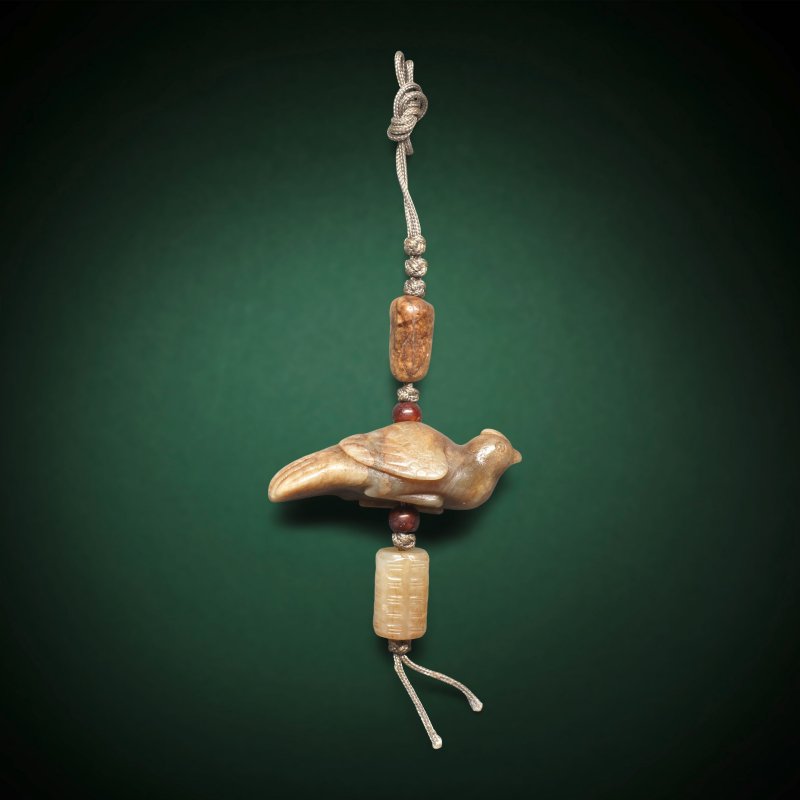
宋/明 玉鳩鳥;或為宋或以後 琮形及卵形玉飾 | A RARE CELADON AND RUSSET JADE 'TURTLEDOVE' PENDANT
年代
The jade turtledove pendant, Song/Ming Dynasty; the jade cong-shaped and ovoid beads, probably Song Dynasty or later
起拍价
GBP 2,000
估值区间
GBP 2000 - 3000
尺寸
未知
品相
未知
更多信息
The jade turtledove pendant, Song/Ming Dynasty; the jade cong-shaped and ovoid beads, probably Song Dynasty or later
Carved in the form of a bird with its head facing forward, the wings folded neatly and incised with feathers, the legs tucked beneath the body, the stone of a greyish tone with brown and russet inclusions, attached to a cord strung with a cong-shaped bead and an ovoid bead. 5.2cm (2in) wide.
Footnotes
宋/明 玉鳩鳥;或為宋或以後 琮形及卵形玉飾
The bird depicted in the present lot may be identified as a turtledove (鳩 jiu). As early as the pre-Qin period, the turtledove already carried connotations of caring for and supporting the elderly. The Rites of Zhou (周禮) records that 'jiu were captured and respectfully offered as food for the senior elders of the state' (獻鳩以養國老). Sima Biao of the Western Jin dynasty, in his Treatise to the Book of the Later Han (《後漢書志》), explains that 'The jiu is a bird that does not choke. It is presented with the wish that the elderly may likewise never choke.'
Jade turtledove carvings were popular during the Han dynasty. A possible prototype may be seen in the Qing Court Collection, in the Palace Museum, Taipei (故玉005827N000000000). See a related pale celadon and brown jade bird-form staff finial, Song/Ming dynasty, which was sold at Sotheby's New York, 23 March 2022, lot 228.
Carved in the form of a bird with its head facing forward, the wings folded neatly and incised with feathers, the legs tucked beneath the body, the stone of a greyish tone with brown and russet inclusions, attached to a cord strung with a cong-shaped bead and an ovoid bead. 5.2cm (2in) wide.
Footnotes
宋/明 玉鳩鳥;或為宋或以後 琮形及卵形玉飾
The bird depicted in the present lot may be identified as a turtledove (鳩 jiu). As early as the pre-Qin period, the turtledove already carried connotations of caring for and supporting the elderly. The Rites of Zhou (周禮) records that 'jiu were captured and respectfully offered as food for the senior elders of the state' (獻鳩以養國老). Sima Biao of the Western Jin dynasty, in his Treatise to the Book of the Later Han (《後漢書志》), explains that 'The jiu is a bird that does not choke. It is presented with the wish that the elderly may likewise never choke.'
Jade turtledove carvings were popular during the Han dynasty. A possible prototype may be seen in the Qing Court Collection, in the Palace Museum, Taipei (故玉005827N000000000). See a related pale celadon and brown jade bird-form staff finial, Song/Ming dynasty, which was sold at Sotheby's New York, 23 March 2022, lot 228.
常见问题
这件宋/明 玉鳩鳥;或為宋或以後 琮形及卵形玉飾 | A RARE CELADON AND RUSSET JADE 'TURTLEDOVE' PENDANT的成交价是多少?
落槌价为 预展中。 成交价为 预展中。


