
Lot 802 藏中 十三/十四世紀 錯紅銅阿閦佛銅像 | A COPPER INLAID COPPER ALLOY FIGURE OF AKSHOBHYA
落槌价
预展中
成交价
预展中
| 拍卖公司 | 邦瀚斯 |
|---|---|
| 拍卖时间 | 2026年10月29日 |
拍品信息
拍品名称
藏中 十三/十四世紀 錯紅銅阿閦佛銅像 | A COPPER INLAID COPPER ALLOY FIGURE OF AKSHOBHYA
年代
CENTRAL TIBET, 13TH/14TH CENTURY
起拍价
HKD 2,000,000
估值区间
HKD 2000000 - 3000000
尺寸
未知
品相
未知
更多信息
CENTRAL TIBET, 13TH/14TH CENTURY
Himalayan Art Resources item no. 8865
48 cm (18 7/8 in.) high
Footnotes
藏中 十三/十四世紀 錯紅銅阿閦佛銅像
Published
Marcel Nies Oriental Art, Avatar: Resurrection of the Gods, 2019, pp. 52-55.
Provenance
Collection of Mr. M. Hürlimann, Switzerland, acquired in the 1960s
Koller Auktionen, Zürich, 26-27 November 1993, lot 12
Private Collection, Switzerland, 1993-2019
Marcel Nies Oriental Art, Antwerp, 2020
Akshobhya, the Buddha of the East, also known as the "Immovable One", is one of the five "Transcendental Buddhas" in Mahayana Buddhism, known as tathagata or jina. The origin of Akshobhya can be traced back to the early Mahayana scriptures. By convention he is located in the east of the Diamond Realm also recognized as the Lord of the Eastern Pure Land, Abhirati ('The Joyous').
As a prominent figure in the Vajra lineage, his invocation serves as an antidote to anger and hatred, while his "perfect mirror-like wisdom" reflects all phenomena without distortion or attachment, thereby cutting off all afflictions and revealing the luminous, undisturbed nature of reality. His compassionate vows pay special attention to the welfare of women; in his pure land, women experience no physical suffering nor gender discrimination, and it is common for women to pray to him for protection before childbirth.
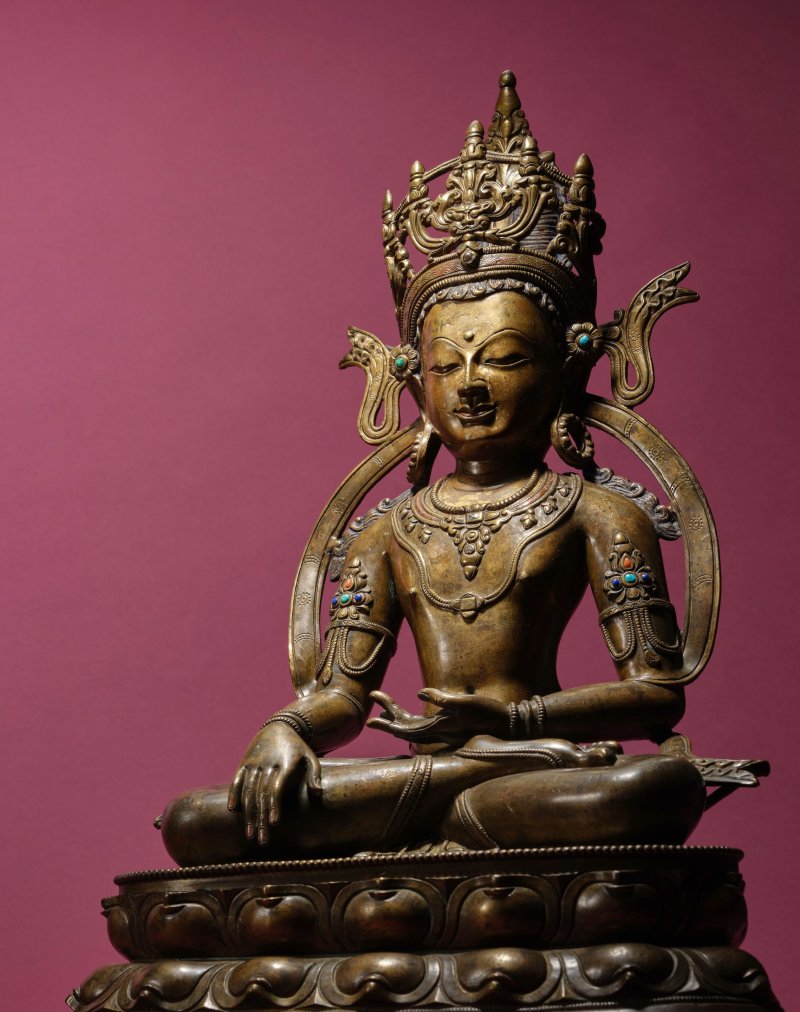
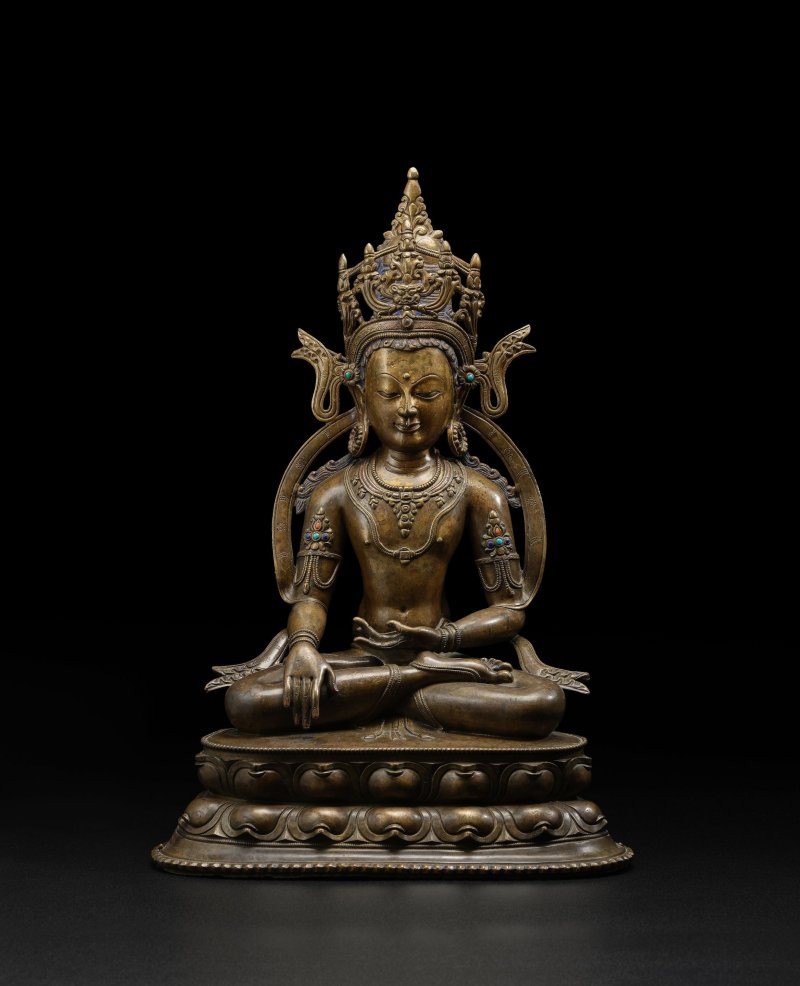
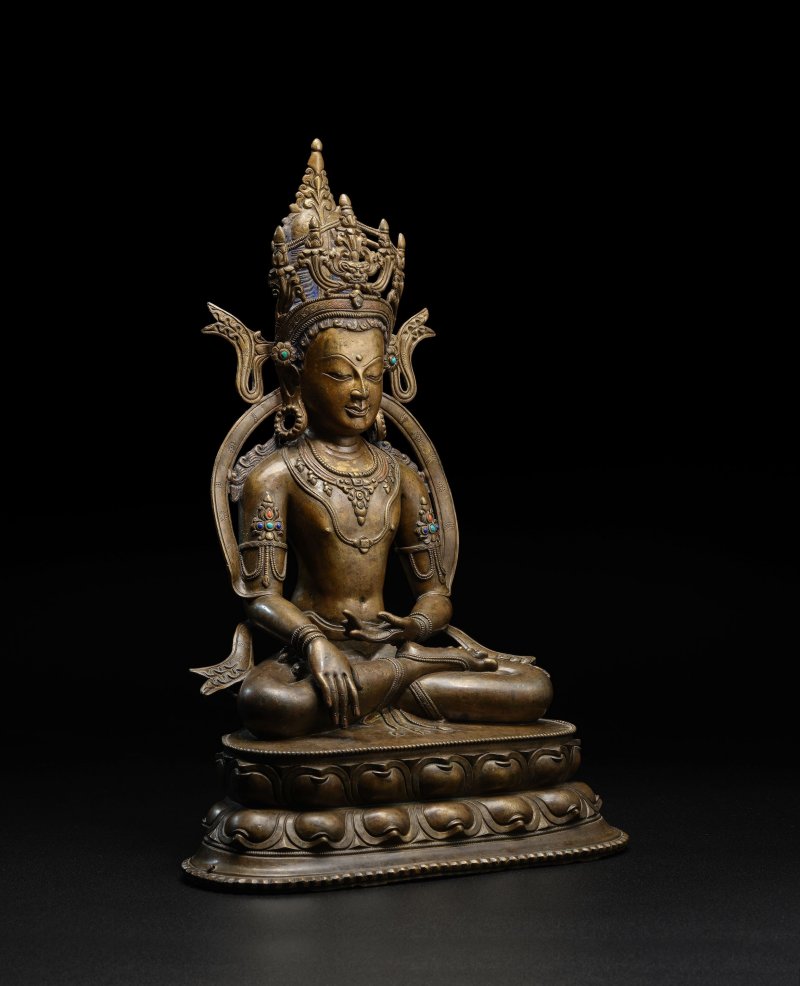
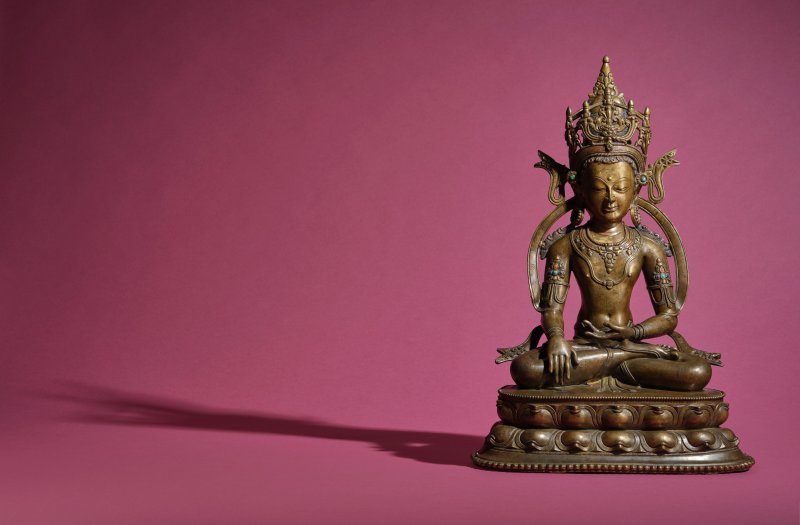
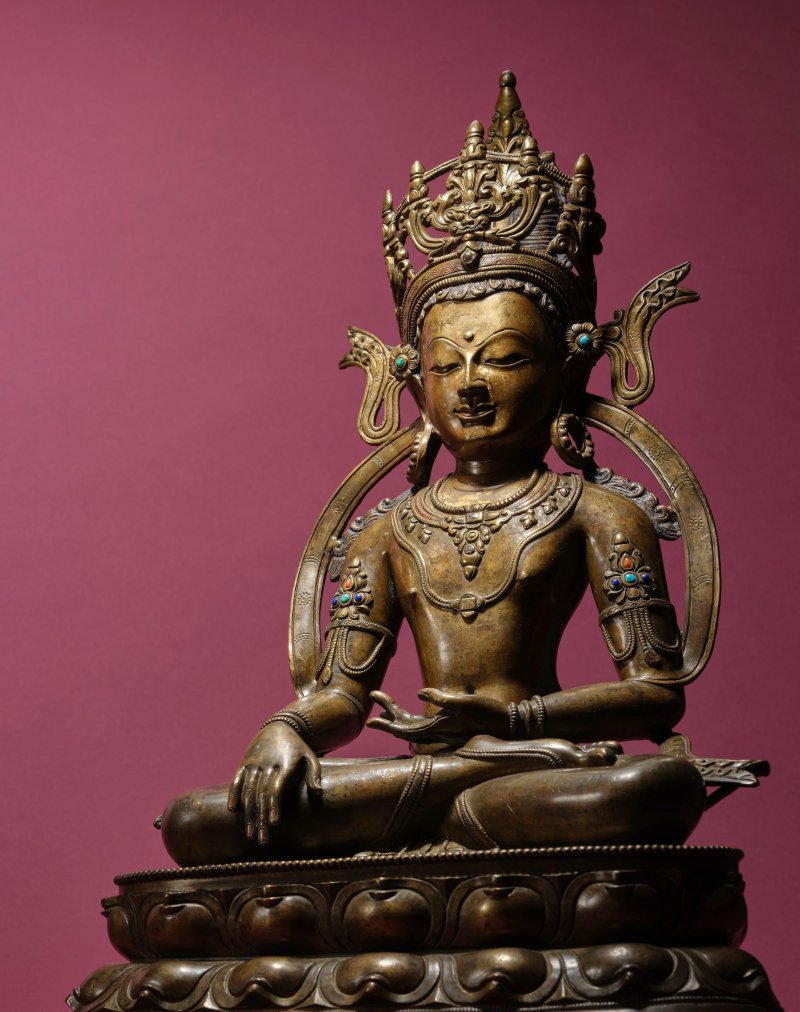
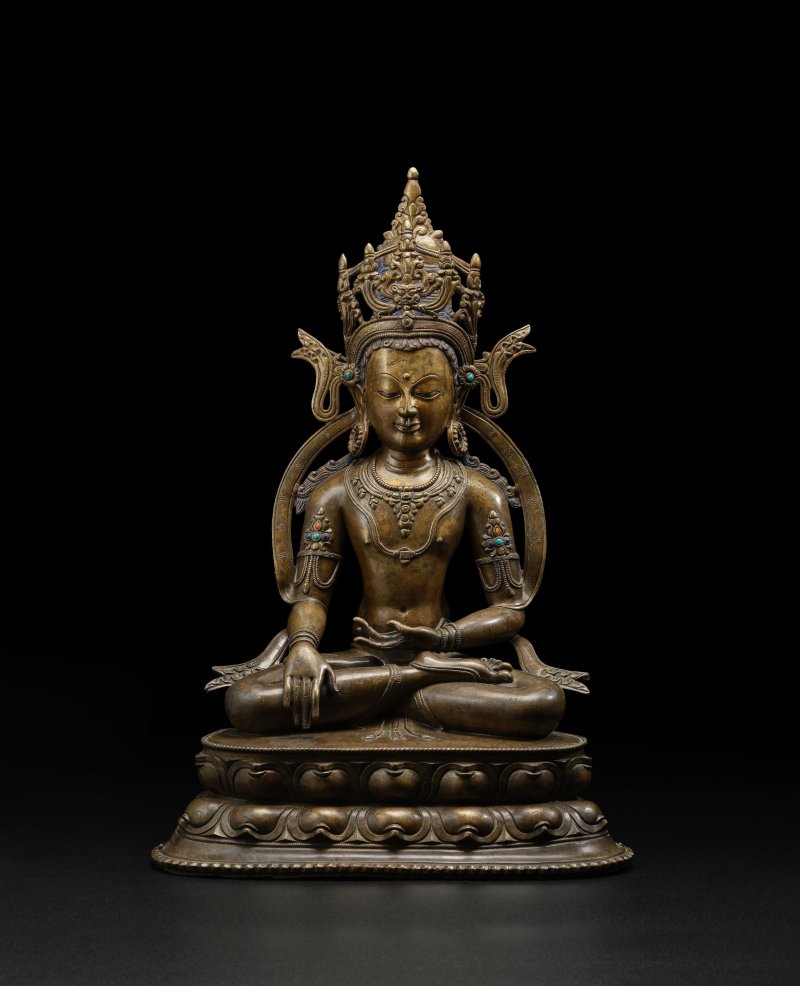
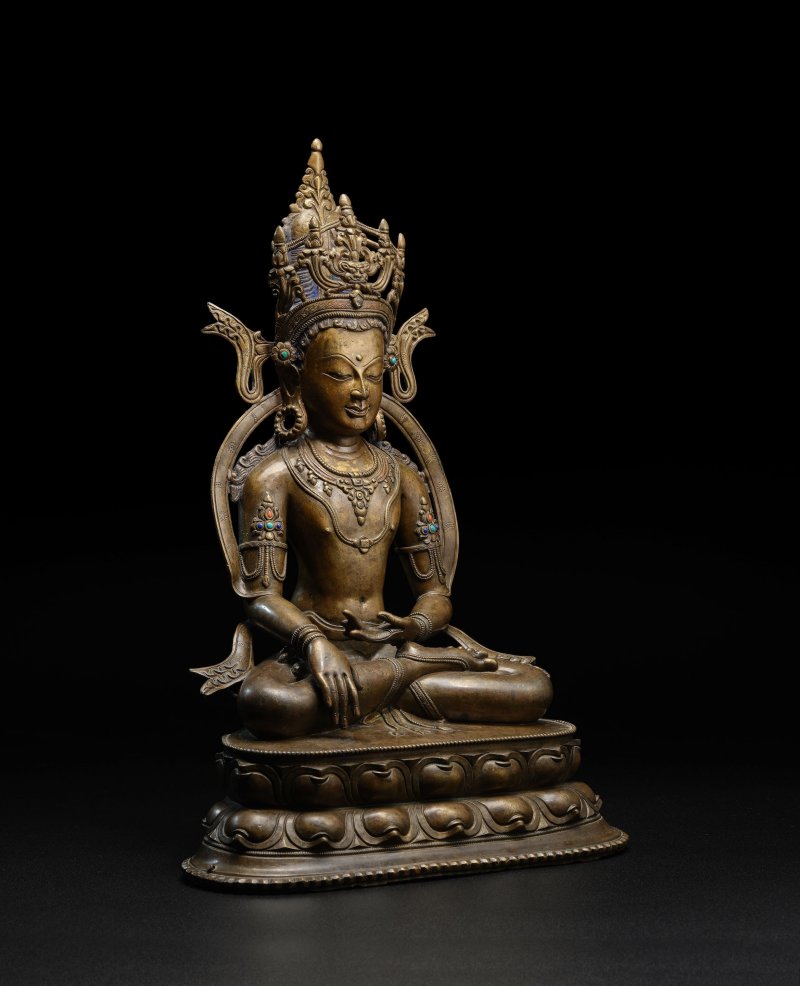
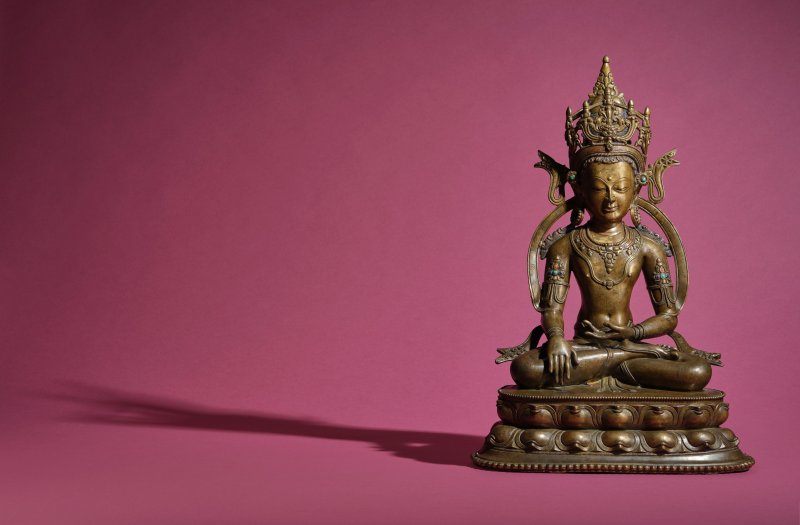
This figure of Akshobhya stands among the finer surviving examples of early non-gilt Tibetan sculpture from the 13th and 14th centuries. This distinct image radiates sublime perfection and wisdom with great calm. The Buddha sits in the diamond posture () upon a double-layer lotus base with beaded rims. His left hand rests in his lap, while his right hand is extended in the gesture of touching the earth (). The fingertips are beautifully inlaid with copper. A cloth is tied around his hips. His bejeweled ornaments include a five-leaved crown fastened with a ribbon with swirling ends in front of the tall knot of hair () with a jeweled tip, a pair of circular earrings, flowers above the ears, two necklaces with attached pendants, and pairs of armlets, bracelets, and anklets. He is encircled by a ribbon-like scarf with swirling ends.
Stylistically, this image of Akshobhya pays homage to the two Indian aesthetic traditions that had the greatest influence on the development of Tibetan art in the formative period during the Second Diffusion of Buddhism in Tibet (). The first is the influence of the greater area of Kashmir and Himachal Pradesh, from where works of art as well as artists were transmitted mainly to western Tibet. The other source of influence, most strongly felt in central Tibet, is the art of the Pala dynasty, which flourished in northeastern India.
This early Tibetan sculpture draws upon the Indian Pala style in its use of materials and craftsmanship. The ungilded, warm-toned copper alloy emits a gentle and inviting luster. The lips, crown, and necklace are inlaid with copper. The copper inlay, subtle in color and gently merging with the bronze's natural glow, does not loudly contrast. Rather, it imparts to the sculpture an unassuming depth and a richer, more resonant surface. The prominent, deeply articulated beaded rims likewise reflect a hallmark of the Pala style. Other details also show influences from the same tradition, appearing in the lozenge-shaped jewellery—each facet carved with exquisite clarity—in the high chignon (), and in the gentle dip of the eyelids, which bestows a tranquil, introspective gaze. Altogether, these features retain the lingering charm of the Pala style. An image of comparable casting quality and similar facial type of seated is published in von Schroeder, , Vol. II, 2001, pp. 1178-1179, pl. 316B (fig. 1).
The sculpture combines the enduring Pala aesthetic influence with early local casting traditions of Central Tibet. The figure is notably slender and elongated, while the taller, broader forehead marks a distinct physiognomic shift away from Pala models. The lotus petals are full, rounded, and gently swelling, each terminating in a small, crisply raised tip—a hallmark of central Tibetan lotus bases from the 13th to 14th century. See a similar lotus base published in von Schroeder, , 1981, pp. 182-183, pl. 35G. The jewellery and ornaments, inlaid with semi-precious stones, further depart from the more restrained Pala tradition. This harmonious blend of Indian and Tibetan aesthetics exemplifies the vibrant cross-cultural currents that shaped Himalayan art during this period. With sound technical execution and remarkably well-preserved detail, this sculpture stands as a compelling example of early Tibetan metalwork at a moment of dynamic stylistic transformation.
For the figures listed in this essay, please refer to our printed or digital catalogue.
Himalayan Art Resources item no. 8865
48 cm (18 7/8 in.) high
Footnotes
藏中 十三/十四世紀 錯紅銅阿閦佛銅像
Published
Marcel Nies Oriental Art, Avatar: Resurrection of the Gods, 2019, pp. 52-55.
Provenance
Collection of Mr. M. Hürlimann, Switzerland, acquired in the 1960s
Koller Auktionen, Zürich, 26-27 November 1993, lot 12
Private Collection, Switzerland, 1993-2019
Marcel Nies Oriental Art, Antwerp, 2020
Akshobhya, the Buddha of the East, also known as the "Immovable One", is one of the five "Transcendental Buddhas" in Mahayana Buddhism, known as tathagata or jina. The origin of Akshobhya can be traced back to the early Mahayana scriptures. By convention he is located in the east of the Diamond Realm also recognized as the Lord of the Eastern Pure Land, Abhirati ('The Joyous').
As a prominent figure in the Vajra lineage, his invocation serves as an antidote to anger and hatred, while his "perfect mirror-like wisdom" reflects all phenomena without distortion or attachment, thereby cutting off all afflictions and revealing the luminous, undisturbed nature of reality. His compassionate vows pay special attention to the welfare of women; in his pure land, women experience no physical suffering nor gender discrimination, and it is common for women to pray to him for protection before childbirth.
This figure of Akshobhya stands among the finer surviving examples of early non-gilt Tibetan sculpture from the 13th and 14th centuries. This distinct image radiates sublime perfection and wisdom with great calm. The Buddha sits in the diamond posture () upon a double-layer lotus base with beaded rims. His left hand rests in his lap, while his right hand is extended in the gesture of touching the earth (). The fingertips are beautifully inlaid with copper. A cloth is tied around his hips. His bejeweled ornaments include a five-leaved crown fastened with a ribbon with swirling ends in front of the tall knot of hair () with a jeweled tip, a pair of circular earrings, flowers above the ears, two necklaces with attached pendants, and pairs of armlets, bracelets, and anklets. He is encircled by a ribbon-like scarf with swirling ends.
Stylistically, this image of Akshobhya pays homage to the two Indian aesthetic traditions that had the greatest influence on the development of Tibetan art in the formative period during the Second Diffusion of Buddhism in Tibet (). The first is the influence of the greater area of Kashmir and Himachal Pradesh, from where works of art as well as artists were transmitted mainly to western Tibet. The other source of influence, most strongly felt in central Tibet, is the art of the Pala dynasty, which flourished in northeastern India.
This early Tibetan sculpture draws upon the Indian Pala style in its use of materials and craftsmanship. The ungilded, warm-toned copper alloy emits a gentle and inviting luster. The lips, crown, and necklace are inlaid with copper. The copper inlay, subtle in color and gently merging with the bronze's natural glow, does not loudly contrast. Rather, it imparts to the sculpture an unassuming depth and a richer, more resonant surface. The prominent, deeply articulated beaded rims likewise reflect a hallmark of the Pala style. Other details also show influences from the same tradition, appearing in the lozenge-shaped jewellery—each facet carved with exquisite clarity—in the high chignon (), and in the gentle dip of the eyelids, which bestows a tranquil, introspective gaze. Altogether, these features retain the lingering charm of the Pala style. An image of comparable casting quality and similar facial type of seated is published in von Schroeder, , Vol. II, 2001, pp. 1178-1179, pl. 316B (fig. 1).
The sculpture combines the enduring Pala aesthetic influence with early local casting traditions of Central Tibet. The figure is notably slender and elongated, while the taller, broader forehead marks a distinct physiognomic shift away from Pala models. The lotus petals are full, rounded, and gently swelling, each terminating in a small, crisply raised tip—a hallmark of central Tibetan lotus bases from the 13th to 14th century. See a similar lotus base published in von Schroeder, , 1981, pp. 182-183, pl. 35G. The jewellery and ornaments, inlaid with semi-precious stones, further depart from the more restrained Pala tradition. This harmonious blend of Indian and Tibetan aesthetics exemplifies the vibrant cross-cultural currents that shaped Himalayan art during this period. With sound technical execution and remarkably well-preserved detail, this sculpture stands as a compelling example of early Tibetan metalwork at a moment of dynamic stylistic transformation.
For the figures listed in this essay, please refer to our printed or digital catalogue.
常见问题
这件藏中 十三/十四世紀 錯紅銅阿閦佛銅像 | A COPPER INLAID COPPER ALLOY FIGURE OF AKSHOBHYA的成交价是多少?
落槌价为 预展中。 成交价为 预展中。