
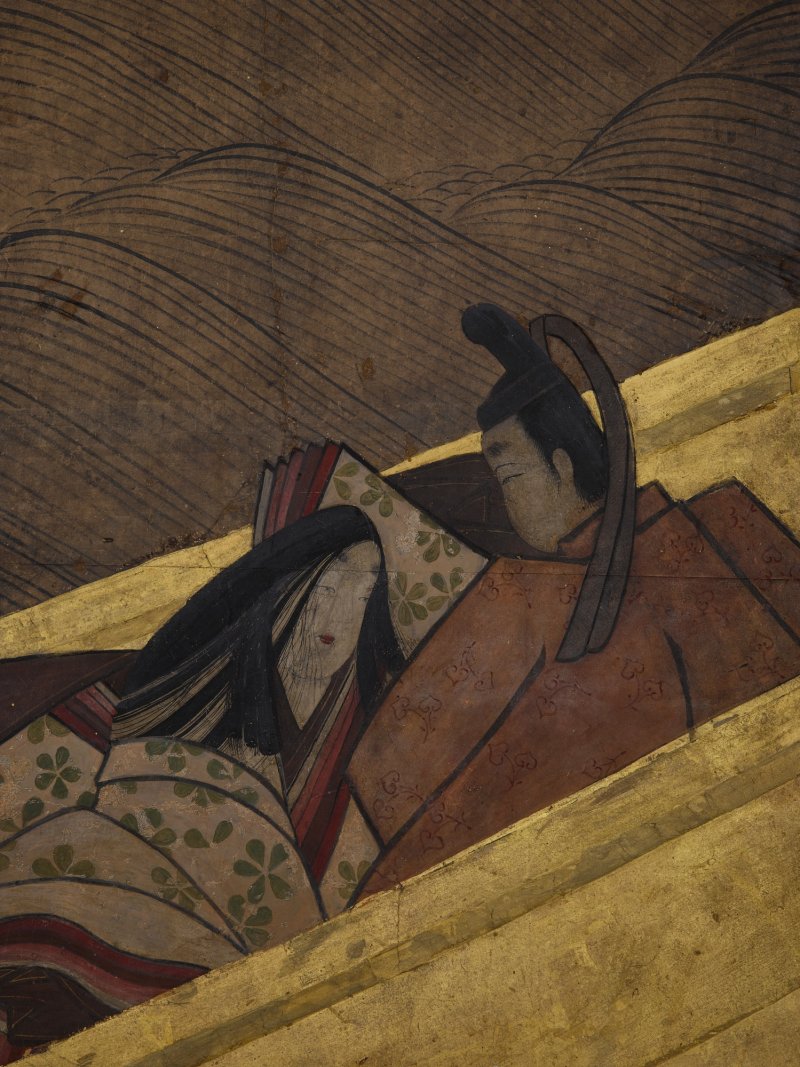
Lot 2006 Attributed to the Hasegawa school, A Boat Cast Adrift (Ukifune), Momoyama - Edo period, early 17th century | 長谷川派 浮舟図屏風 桃山時代末期~江戸時代初期 17世紀初頭
落槌价
****
成交价
****
拍品信息
拍品名称
Attributed to the Hasegawa school, A Boat Cast Adrift (Ukifune), Momoyama - Edo period, early 17th century | 長谷川派 浮舟図屏風 桃山時代末期~江戸時代初期 17世紀初頭
起拍价
HKD 150,000
估值区间
150,000 - 250,000 HKD
尺寸
未知
品相
Overall, the screen is in good condition, most Japanese screens have some restoration by the nature of their use being opened and closed repeatedly, there is some wear around the hinges consistent with age and use, some uneven toning particularly to the rightmost panel, oxidisation to the silver pigment consistent with age, there are some slight splits and tears overall with associated restorations, some small paper losses with associated repairs, some small tears and wormage repaired with gold pigment and some re-touching to the gold ground on the boat, the gold clouds emerging from the upper left of the composition possibly later decorated, some general surface wear overall and particularly around the hinges, some slight wear to the traces of gofun, some soiling and rubbing, minor wear to pigments overall.
If a condition report is provided to assist you with assessing the condition of the lot, it is for guidance purposes only. Such condition report may not refer to all faults, restoration, alterations, or adaptations because Sotheby's is not a professional conservator or restorer but rather a condition report is a statement of subjective, qualified opinion genuinely held by Sotheby's. For these reasons, any such condition report is not an alternative to taking your own professional advice regarding the condition of the lot. Prospective buyers should also refer to the Guide for Buyers at Auction which includes important notices concerning the type of property in this sale.
If a condition report is provided to assist you with assessing the condition of the lot, it is for guidance purposes only. Such condition report may not refer to all faults, restoration, alterations, or adaptations because Sotheby's is not a professional conservator or restorer but rather a condition report is a statement of subjective, qualified opinion genuinely held by Sotheby's. For these reasons, any such condition report is not an alternative to taking your own professional advice regarding the condition of the lot. Prospective buyers should also refer to the Guide for Buyers at Auction which includes important notices concerning the type of property in this sale.
更多信息
six-panel folding screen: ink, colour, gold and gofun on paper, silk brocade borders, black lacquer mounts, engraved copper-gilt fittings
169 x 370.2 cm. (when unfolded)
169 x 61.7 cm. (when folded)
展览:Momoyama kaiga sanka ogon no toki yume no jidai [The Age of Gold, The Days of Dreams: In Praise of the Paintings of the Momoyama Period], Kyoto National Museum, Kyoto, 1997, cat. no. 48.
Rimpa meihinten [Rimpa: The Debut of Essential Rimpa Masterpieces from the Okada Museum of Art Collection], Mitsukoshi (Nihonbashi), Tokyo, 2015, cat. no. 1.
Bi no suta-tachi Korin Jakuchu Hokusai joyo nado meihin zoroi [5th Anniversary Exhibition. All-Stars of the Okada Collection: Masterworks of Korin, Jakuchu, Hokusai and the Ru Ware Kilns], Okada Museum of Art, Hakone, 2018-19, exh. no. 373 (unillustrated).
著录:Yuzo Yamane, ‘An Ukifune Screen by Hasegawa Toshu’ in Kokka [Flower of the Nation], vol. 1241, Tokyo, February 1999, pp. 21-22.
Kobayashi Tadashi ed., Masterpieces of the Okada Museum of Art, vol. 1, Tokyo, 2019, no. 88.
图录
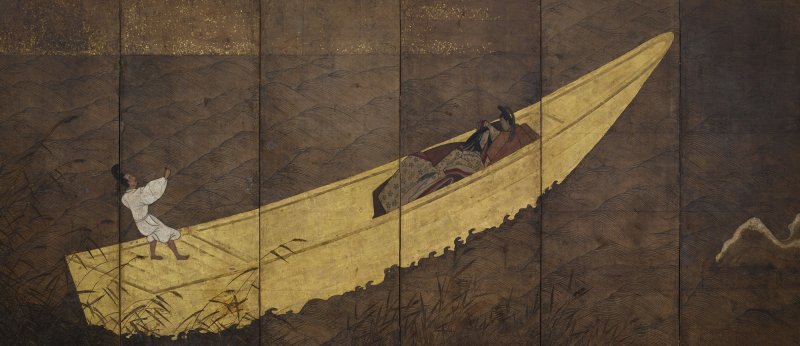
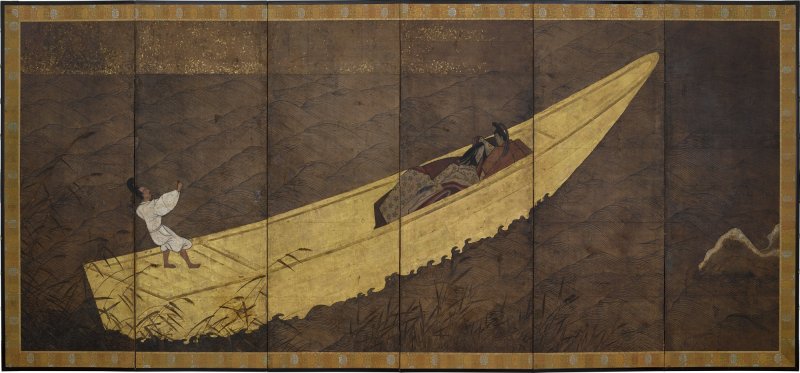
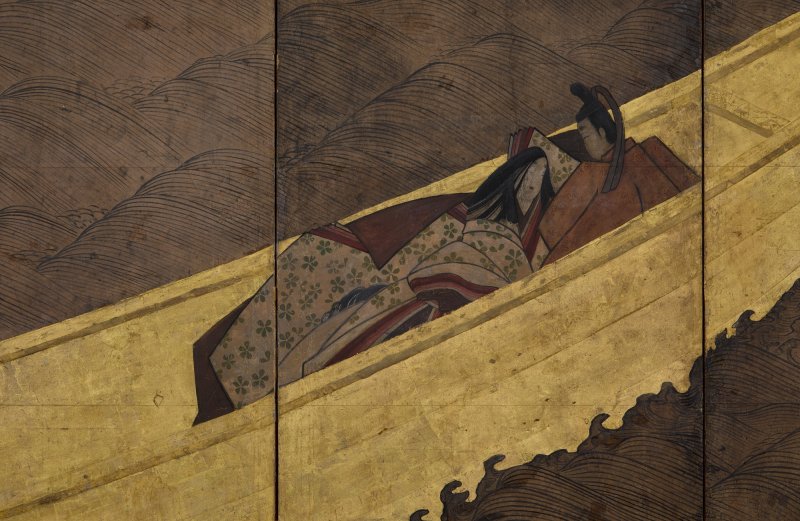
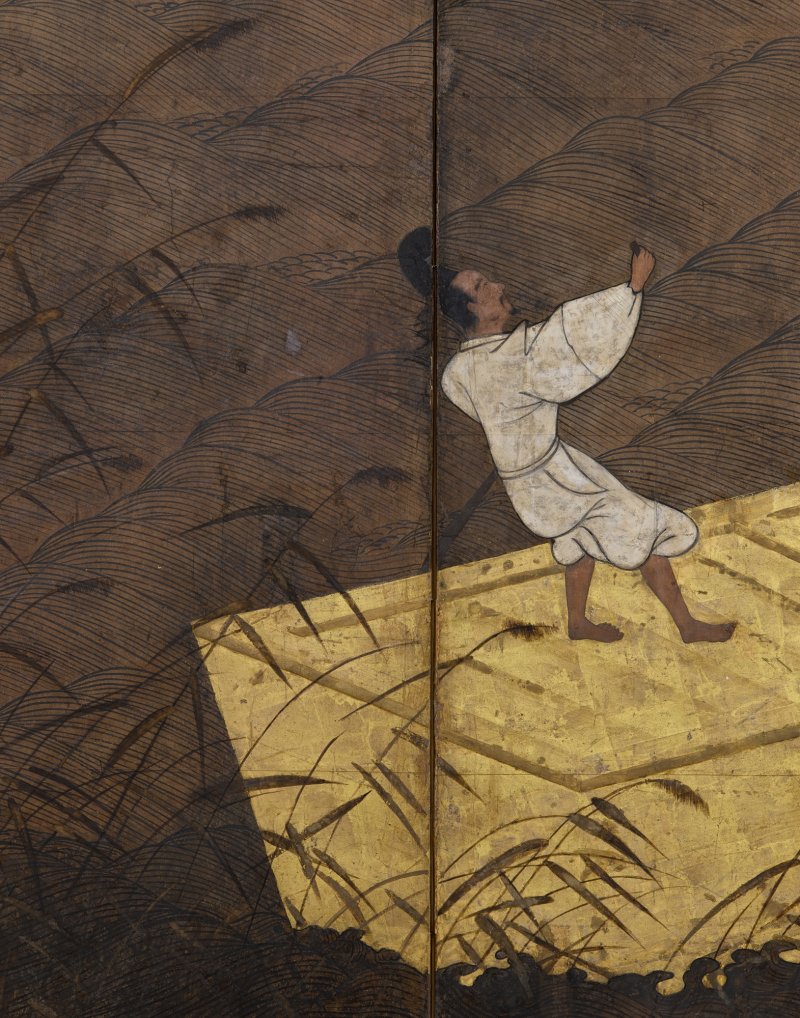
说明:The length of a single boat set at an angle stretches across the panels of this folding screen, depicting Chapter 51, ‘A Boat Cast Adrift’ (the Ukifune chapter), from the so-called ‘Ten Uji Chapters’ of The Tale of Genji (Genji monogatari). Prince Niou, third son of the reigning emperor, and Ukifune, daughter of Uji no Hachinomiya, are shown together in a boat on the Uji River steered by a boatman in white robes. Snow is visible atop the rocks at the lower right. Torn between the affections of Prince Niou and Kaoru, Ukifune would later attempt to drown herself in the Uji River to escape the triangle. A band of cut gold leaf trails across from the upper left. The gold ground of the boat appears luminous against the oxidised silver waves. The lovers huddle close together; reeds grow wild along the riverbank. There is a sense of foreboding melancholy and isolation befitting the fate of the two lovers.
The work is thought to be by an artist of the Hasegawa school. Art historian Yamane Yuzo (1919-2001) attributes the painting to Hasegawa Toshu, son-in-law of Hasegawa Tohaku (1539-1610), citing the gold sunago mist, the subdued depiction of waves covering the majority of the composition, the precise rendering of the reeds and the restrained use of raised gofun beneath gold leaf on the boat. Yamane dates the screen to circa 1605-06, tracing a progression from the Willow Bridge and Waterwheel screen bearing Tohaku's seal (Kosetsu Museum of Art, circa 1603-04) to Toshu's later application of the same raised gofun technique to brushwood fences in the Willow and Brushwood Fence screen (Bairin-ji, circa 1607). He further notes the screen's significance as early evidence of the Hasegawa school producing large-scale Genji narrative screens, contemporary with comparable treatments of the same subject by the Tosa school painter Tosa Mitsuyoshi (1539–1613).¹
1. Yamane Yuzo, ‘An Ukifune Screen by Hasegawa Toshu’ in Kokka [Flower of the Nation], vol. 1241, Tokyo, February 1999, pp. 21-22.
展覽
《桃山絵画賛歌 黄金のときゆめの時代》,京都国立博物館,京都,1997年,編號48
《琳派名品展》,三越(日本橋),東京,2015年,編號1
《美のスターたち-光琳・若冲・北斎・汝窯など名品ぞろい-》,岡田美術館, 箱根,2018-19年, 展覽編號373(沒載圖)
出版
山根有三,《浮舟図屏風 長谷川等秀》,《國華》,卷1241,東京,1999年2月,頁21至22
小林忠編,《岡田美術館名品撰》,卷1,東京,2019年,編號88
此屏風的畫一葉孤舟斜跨各曲,描繪了《源氏物語》「宇治十帖」中第五十一帖〈浮舟〉的場景。當朝皇帝的三皇子匂宮與宇治八之宮之女浮舟同乘一船,由一名白衣船夫在宇治川上撐篙。右下方的岩石頂部可見積雪。浮舟在匂宮與薰君的情感之間痛苦掙扎,為了逃避這段三角戀,她後來試圖投宇治川自盡。畫面左上方有一道碎金箔帶。在氧化發黑的銀泥波浪襯托下,金色的船身顯得格外明亮。這對戀人緊緊依偎,河岸邊蘆葦叢生。畫面中瀰漫著一種不祥的憂鬱與孤寂感,正暗示了這對戀人未來的命運。
此作被認為是長谷川派畫師之手筆。藝術史學家山根有三(1919-2001年)將此畫歸於長谷川等伯(1539-1610年)之女婿長谷川等秀名下,其依據包括金砂子雲霧的運用、佔據構圖大半的柔和波浪描繪、蘆葦的精細刻畫,以及船隻金箔下克制地使用了凸起的胡粉(亦稱盛上技法)。山根將此屏風的年代定為約1605至1606年,並追溯了其技法發展的脈絡:從帶有等伯印章的《柳橋水車圖屏風》(香雪美術館藏,約1603-1604年),到等秀後來在《柳柴垣圖屏風》(梅林寺藏,約1607年)中對柴垣運用相同的胡粉盛上技法。他進一步指出,此屏風具有重要意義,它是長谷川派製作大型《源氏物語》故事屏風的早期證據,其年代早於土佐派畫家土佐光吉(1539-1613年)對同一題材的類似創作。¹
山根有三,〈浮舟圖屏風 長谷川等秀〉,《國華》,卷1241,東京,1999年2月,頁21-22。
169 x 370.2 cm. (when unfolded)
169 x 61.7 cm. (when folded)
展览:Momoyama kaiga sanka ogon no toki yume no jidai [The Age of Gold, The Days of Dreams: In Praise of the Paintings of the Momoyama Period], Kyoto National Museum, Kyoto, 1997, cat. no. 48.
Rimpa meihinten [Rimpa: The Debut of Essential Rimpa Masterpieces from the Okada Museum of Art Collection], Mitsukoshi (Nihonbashi), Tokyo, 2015, cat. no. 1.
Bi no suta-tachi Korin Jakuchu Hokusai joyo nado meihin zoroi [5th Anniversary Exhibition. All-Stars of the Okada Collection: Masterworks of Korin, Jakuchu, Hokusai and the Ru Ware Kilns], Okada Museum of Art, Hakone, 2018-19, exh. no. 373 (unillustrated).
著录:Yuzo Yamane, ‘An Ukifune Screen by Hasegawa Toshu’ in Kokka [Flower of the Nation], vol. 1241, Tokyo, February 1999, pp. 21-22.
Kobayashi Tadashi ed., Masterpieces of the Okada Museum of Art, vol. 1, Tokyo, 2019, no. 88.
图录
说明:The length of a single boat set at an angle stretches across the panels of this folding screen, depicting Chapter 51, ‘A Boat Cast Adrift’ (the Ukifune chapter), from the so-called ‘Ten Uji Chapters’ of The Tale of Genji (Genji monogatari). Prince Niou, third son of the reigning emperor, and Ukifune, daughter of Uji no Hachinomiya, are shown together in a boat on the Uji River steered by a boatman in white robes. Snow is visible atop the rocks at the lower right. Torn between the affections of Prince Niou and Kaoru, Ukifune would later attempt to drown herself in the Uji River to escape the triangle. A band of cut gold leaf trails across from the upper left. The gold ground of the boat appears luminous against the oxidised silver waves. The lovers huddle close together; reeds grow wild along the riverbank. There is a sense of foreboding melancholy and isolation befitting the fate of the two lovers.
The work is thought to be by an artist of the Hasegawa school. Art historian Yamane Yuzo (1919-2001) attributes the painting to Hasegawa Toshu, son-in-law of Hasegawa Tohaku (1539-1610), citing the gold sunago mist, the subdued depiction of waves covering the majority of the composition, the precise rendering of the reeds and the restrained use of raised gofun beneath gold leaf on the boat. Yamane dates the screen to circa 1605-06, tracing a progression from the Willow Bridge and Waterwheel screen bearing Tohaku's seal (Kosetsu Museum of Art, circa 1603-04) to Toshu's later application of the same raised gofun technique to brushwood fences in the Willow and Brushwood Fence screen (Bairin-ji, circa 1607). He further notes the screen's significance as early evidence of the Hasegawa school producing large-scale Genji narrative screens, contemporary with comparable treatments of the same subject by the Tosa school painter Tosa Mitsuyoshi (1539–1613).¹
1. Yamane Yuzo, ‘An Ukifune Screen by Hasegawa Toshu’ in Kokka [Flower of the Nation], vol. 1241, Tokyo, February 1999, pp. 21-22.
展覽
《桃山絵画賛歌 黄金のときゆめの時代》,京都国立博物館,京都,1997年,編號48
《琳派名品展》,三越(日本橋),東京,2015年,編號1
《美のスターたち-光琳・若冲・北斎・汝窯など名品ぞろい-》,岡田美術館, 箱根,2018-19年, 展覽編號373(沒載圖)
出版
山根有三,《浮舟図屏風 長谷川等秀》,《國華》,卷1241,東京,1999年2月,頁21至22
小林忠編,《岡田美術館名品撰》,卷1,東京,2019年,編號88
此屏風的畫一葉孤舟斜跨各曲,描繪了《源氏物語》「宇治十帖」中第五十一帖〈浮舟〉的場景。當朝皇帝的三皇子匂宮與宇治八之宮之女浮舟同乘一船,由一名白衣船夫在宇治川上撐篙。右下方的岩石頂部可見積雪。浮舟在匂宮與薰君的情感之間痛苦掙扎,為了逃避這段三角戀,她後來試圖投宇治川自盡。畫面左上方有一道碎金箔帶。在氧化發黑的銀泥波浪襯托下,金色的船身顯得格外明亮。這對戀人緊緊依偎,河岸邊蘆葦叢生。畫面中瀰漫著一種不祥的憂鬱與孤寂感,正暗示了這對戀人未來的命運。
此作被認為是長谷川派畫師之手筆。藝術史學家山根有三(1919-2001年)將此畫歸於長谷川等伯(1539-1610年)之女婿長谷川等秀名下,其依據包括金砂子雲霧的運用、佔據構圖大半的柔和波浪描繪、蘆葦的精細刻畫,以及船隻金箔下克制地使用了凸起的胡粉(亦稱盛上技法)。山根將此屏風的年代定為約1605至1606年,並追溯了其技法發展的脈絡:從帶有等伯印章的《柳橋水車圖屏風》(香雪美術館藏,約1603-1604年),到等秀後來在《柳柴垣圖屏風》(梅林寺藏,約1607年)中對柴垣運用相同的胡粉盛上技法。他進一步指出,此屏風具有重要意義,它是長谷川派製作大型《源氏物語》故事屏風的早期證據,其年代早於土佐派畫家土佐光吉(1539-1613年)對同一題材的類似創作。¹
山根有三,〈浮舟圖屏風 長谷川等秀〉,《國華》,卷1241,東京,1999年2月,頁21-22。
常见问题
拍品的品相状况如何?
Overall, the screen is in good condition, most Japanese screens have some restoration by the nature of their use being opened and closed repeatedly, there is some wear around the hinges consistent with age and use, some uneven toning particularly to the rightmost panel, oxidisation to the silver pigment consistent with age, there are some slight splits and tears overall with associated restorations, some small paper losses with associated repairs, some small tears and wormage repaired with gold pigment and some re-touching to the gold ground on the boat, the gold clouds emerging from the upper left of the composition possibly later decorated, some general surface wear overall and particularly around the hinges, some slight wear to the traces of gofun, some soiling and rubbing, minor wear to pigments overall.
If a condition report is provided to assist you with assessing the condition of the lot, it is for guidance purposes only. Such condition report may not refer to all faults, restoration, alterations, or adaptations because Sotheby's is not a professional conservator or restorer but rather a condition report is a statement of subjective, qualified opinion genuinely held by Sotheby's. For these reasons, any such condition report is not an alternative to taking your own professional advice regarding the condition of the lot. Prospective buyers should also refer to the Guide for Buyers at Auction which includes important notices concerning the type of property in this sale.
If a condition report is provided to assist you with assessing the condition of the lot, it is for guidance purposes only. Such condition report may not refer to all faults, restoration, alterations, or adaptations because Sotheby's is not a professional conservator or restorer but rather a condition report is a statement of subjective, qualified opinion genuinely held by Sotheby's. For these reasons, any such condition report is not an alternative to taking your own professional advice regarding the condition of the lot. Prospective buyers should also refer to the Guide for Buyers at Auction which includes important notices concerning the type of property in this sale.
这件拍品曾在哪些展览中展出过?
Momoyama kaiga sanka ogon no toki yume no jidai [The Age of Gold, The Days of Dreams: In Praise of the Paintings of the Momoyama Period], Kyoto National Museum, Kyoto, 1997, cat. no. 48.
Rimpa meihinten [Rimpa: The Debut of Essential Rimpa Masterpieces from the Okada Museum of Art Collection], Mitsukoshi (Nihonbashi), Tokyo, 2015, cat. no. 1.
Bi no suta-tachi Korin Jakuchu Hokusai joyo nado meihin zoroi [5th Anniversary Exhibition. All-Stars of the Okada Collection: Masterworks of Korin, Jakuchu, Hokusai and the Ru Ware Kilns], Okada Museum of Art, Hakone, 2018-19, exh. no. 373 (unillustrated).
Rimpa meihinten [Rimpa: The Debut of Essential Rimpa Masterpieces from the Okada Museum of Art Collection], Mitsukoshi (Nihonbashi), Tokyo, 2015, cat. no. 1.
Bi no suta-tachi Korin Jakuchu Hokusai joyo nado meihin zoroi [5th Anniversary Exhibition. All-Stars of the Okada Collection: Masterworks of Korin, Jakuchu, Hokusai and the Ru Ware Kilns], Okada Museum of Art, Hakone, 2018-19, exh. no. 373 (unillustrated).
这件拍品被哪些著录书籍记载?
Yuzo Yamane, ‘An Ukifune Screen by Hasegawa Toshu’ in Kokka [Flower of the Nation], vol. 1241, Tokyo, February 1999, pp. 21-22.
Kobayashi Tadashi ed., Masterpieces of the Okada Museum of Art, vol. 1, Tokyo, 2019, no. 88.
图录
Kobayashi Tadashi ed., Masterpieces of the Okada Museum of Art, vol. 1, Tokyo, 2019, no. 88.
图录