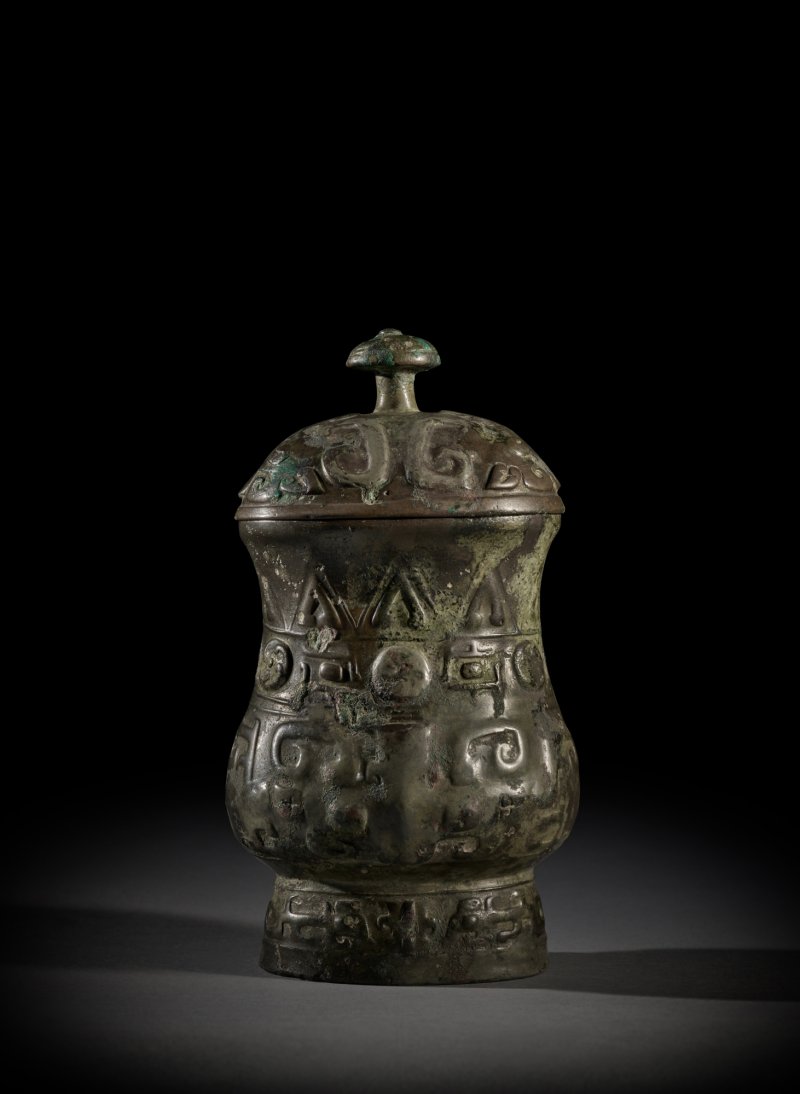

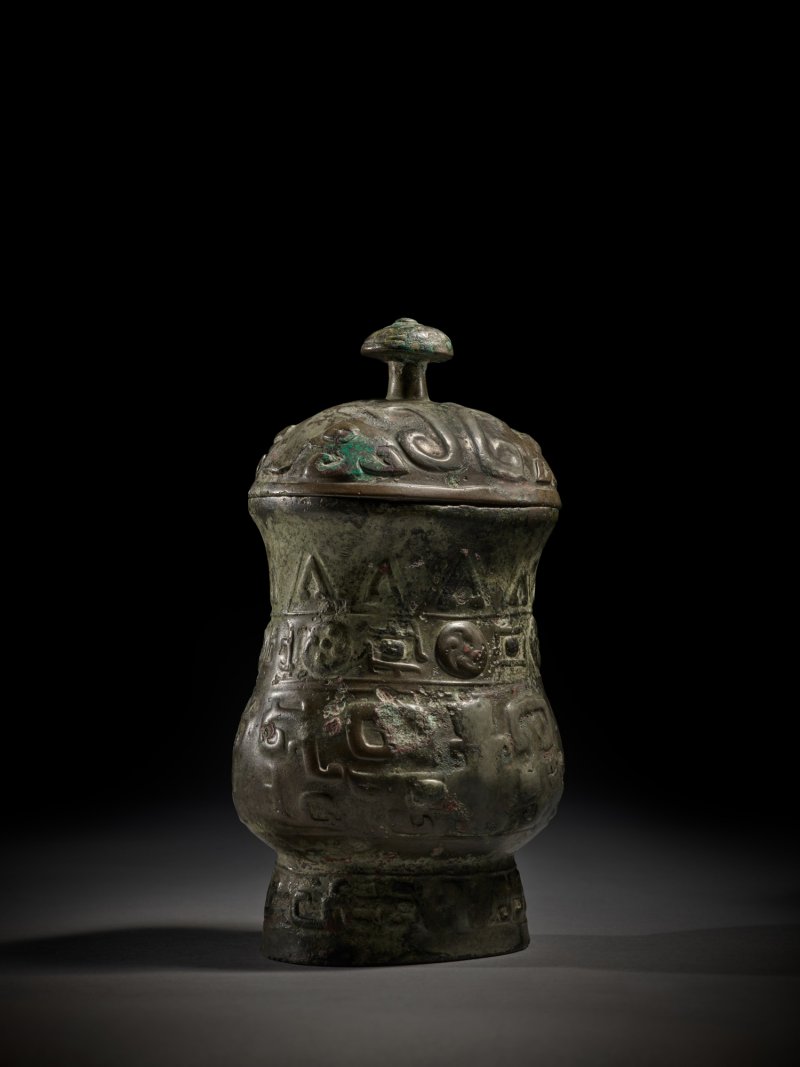
Lot 8052 The Ding Mu Zhi, An extremely rare imperially documented archaic bronze royal ritual wine vessel and cover, Late Shang – Early Western Zhou dynasty | 商末周初 清乾隆御藏丁母觶
落槌价
预展中
成交价
预展中
| 拍卖公司 | 苏富比 |
|---|---|
| 拍卖时间 | 2026年10月30日 |
拍品信息
拍品名称
The Ding Mu Zhi, An extremely rare imperially documented archaic bronze royal ritual wine vessel and cover, Late Shang – Early Western Zhou dynasty | 商末周初 清乾隆御藏丁母觶
起拍价
HKD 4,000,000
估值区间
4,000,000 - 8,000,000 HKD
尺寸
未知
品相
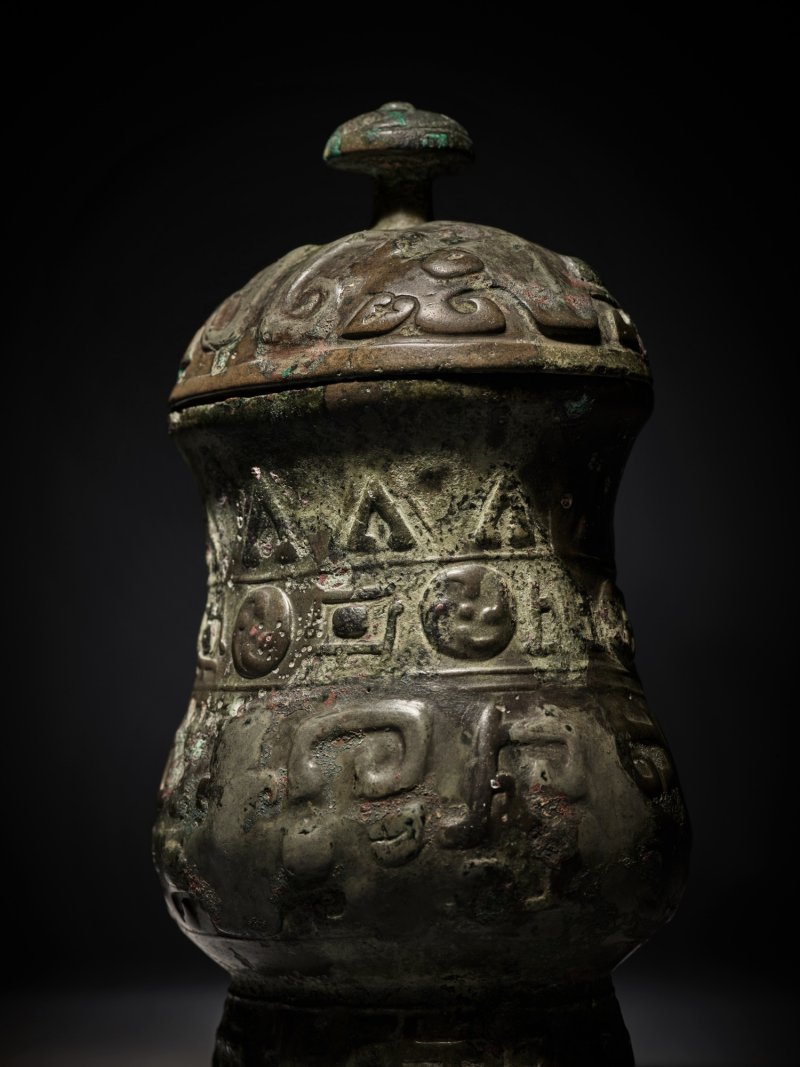
Boasting a highly attractive, smooth black patina, this vessel bears the distinguished characteristics of having been part of the Qing Court Collection. As is characteristic of archaic bronzes curated for the imperial collection, the original burial encrustations were cleaned in antiquity. The surface features some expected minor touch-ups to the design that blend harmoniously with its historical patina. X-Ray images available upon request.
Vessel:
A restored section (approx. 6x1 cm) to the foot rim.
A small restored chip (approx. 1.3 cm wide) to the mouth rim.
A faint crack (approx. 1.5 cm long) to the lower body on one side.
Cover:
A faint crack (approx. 1.8 cm long) to the rim.
黑漆古包漿,與其清宮舊藏來源一致。器表紋飾有預期之輕微修飾,與其歷史包漿自然交融。X光照片備索。
器身:
圈足有一處經修復之區域(約 6 x 1 公分)。
口沿有一處經修復之小磕缺(寬約 1.3 公分)。
下腹一側有一道微沖(長約 1.5 公分)。
紋飾有多處預期之表面修飾,與其早年之清理及宮廷遞藏歷史相符。
器蓋:
口沿有一道微沖(長約 1.8 公分)。
紋飾有幾處預期之表面修飾。
If a condition report is provided to assist you with assessing the condition of the lot, it is for guidance purposes only. Such condition report may not refer to all faults, restoration, alterations, or adaptations because Sotheby's is not a professional conservator or restorer but rather a condition report is a statement of subjective, qualified opinion genuinely held by Sotheby's. For these reasons, any such condition report is not an alternative to taking your own professional advice regarding the condition of the lot. Prospective buyers should also refer to the Guide for Buyers at Auction which includes important notices concerning the type of property in this sale.
更多信息
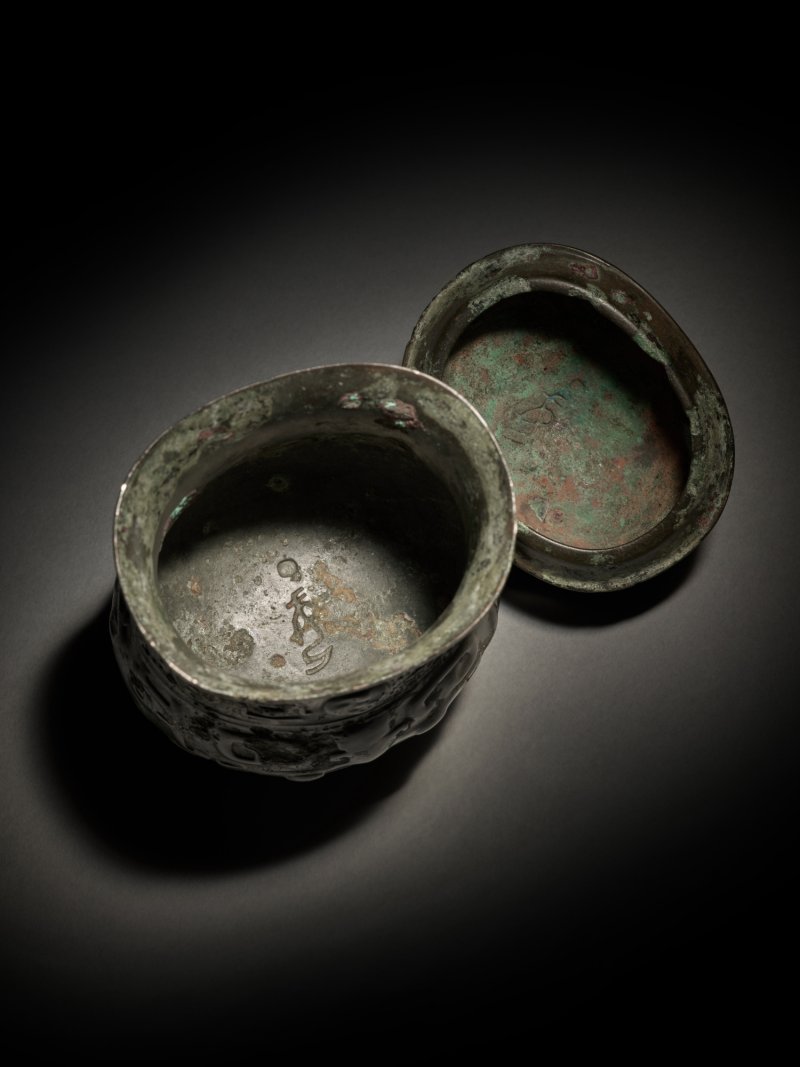
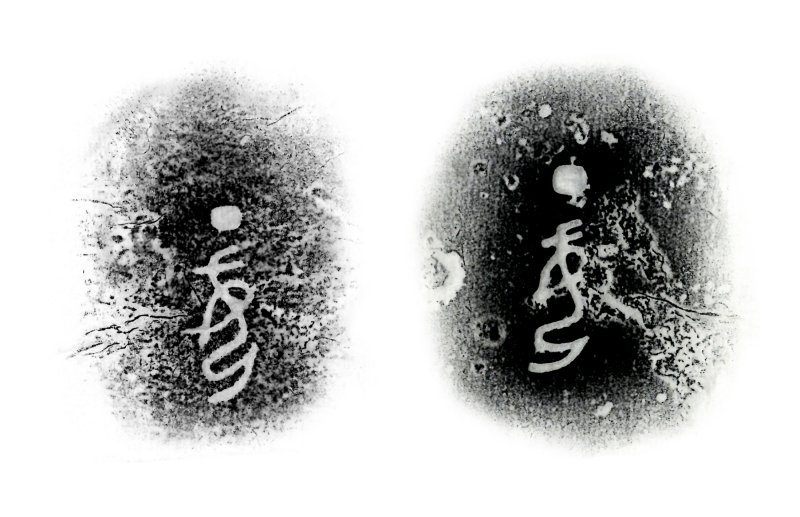
cast to the interior of the vessel and cover with a two-character inscription reading Ding Mu
銘文:
丁母
17 cm
来源:Collection of Qing Gaozong, Aisin Gioro Hongli, the Qianlong Emperor (r. 1736-1795).
Qing Court Collection.
Collection of Fang Junyi (1836-1899).
Collection of Li Hongyi (1831-1885).
Collection of Zhang Shiming (1872-1927), Wuxing, Zhejiang, thence by descent to Zhang Heng (1915-1963), grandson of Zhang Shiming.
Ton-Ying & Co., New York.
Parke-Bernet Galleries, New York, 30th March 1955, lot 55.
New York Private Collection.
Sotheby’s New York, 20th September 2022, lot 1
著录:Liang Shizheng et al., Xiqing gujian [Catalogue of antiques in the Xiqing pavilion], vol. 26, 1755, p. 14; vol. 26, pp. 27-28 for the edition of the Complete Library of the Four Treasuries.
Zou An, Zhou jinwen cun [Surviving bronze inscriptions from the Zhou dynasty], vol. 5, Shanghai, 1916, p. 134.
Fang Junyi, Guzhouyi jijin yiqi kuanzhi [Archaic bronze inscriptions from the Guzhouyi], manuscript completed before 1899, Shanghai, 1925, p. 8.
Rong Geng, "Xiqing jinwen zhenwei cunyi biao (fubiao)" [Table of authentic, forged, extant, and lost bronze inscriptions in the Xiqing (appendix)], Yanjing xuebao, no. 5, 1929, p. 862.
Chen Chengxiu, Yiwenge jinwen [Bronze inscriptions from the Yiwen Pavilion], unpublished manuscript, compiled by 1931.
Bao Ding, Qingchao jinwen zhulubiao buyi [Addendum to the catalogue of bronze inscriptions from the Qing dynasty], vol. 1, 1931, p. 69.
Wang Guowei, with corrections and additions by Luo Fuyi, Sandai Qin Han jinwen zhulubiao [Catalogue of bronze inscriptions from the Three Dynasties, Qin, and Han], vol. 5, 1933, p. 4.
Luo Zhenyu, Zhensongtang jigu yiwen xubian [Sequel to the gathering of ancient writings in the Zhensongtang], vol. 2, 1934, p. 33.
Fang Junyi, Zhuiyizhai yiqi kuanzhi kaoshi [Study of the archaic bronze inscriptions from the Zhuiyi Studio], manuscript completed in 1894, vol. 23, 1935, p. 30.
Liu Tizhi, Xiaojiaojingge jinwen taben [Rubbings of archaic bronze inscriptions in the Xiaojiaojingge], vol. 5, 1935, p. 73.
Wang Chen, Xuyinwencun [Continuation of the surviving writings from the Yin dynasty], vol. 2, 1935, p. 53.
Luo Zhenyu, Sandai jijin wencun [Surviving bronze inscriptions from the Three Dynasties], vol. 14, Beijing, 1937, p. 37.
John Calvin Ferguson, Lidai zhulu jijin mu [Catalogue of recorded bronzes through the dynasties], Changsha, 1939, p. 393.
Luo Fuyi, Sandai jijin wencun shiwen [Interpretations of the surviving bronze inscriptions from the Three Dynasties], vol. 14, 1941, p. 30.
Parke-Bernet Galleries, From the Collection of Ton-ying & Co., New York, 30th March 1955, pp. 7-8.
Li Hsuan-po, Shih-yu-sho t'sang-chiu t'o-pen ts'e-yeh tsung-ho p'ien [A collection of old rubbings in the Fu Ssu-nien Library, Institute of History and Philology, Academia Sinica], Taipei, 1975.
Zhou Fagao, Sandai jijin wencun zhulubiao [Catalogue of the surviving bronze inscriptions from the Three Dynasties], vol. 2, Taipei, 1977, p. 575.
Noel Barnard and Cheung Kwong-Yue, Rubbings and Hand Copies of Bronze Inscriptions in Chinese, Japanese, European, American and Australasian Collections, vol. 7, Taipei, 1978, no. 1192.
Sun Zhichu, Jinwen zhulu jianmu [Records of Bronze Inscriptions], Beijing, 1981, p. 330, no. 5796 (vessel recorded).
Yan Yiping, Jinwen zongji [Corpus of bronze inscriptions], vol. 8, Taipei, 1983, no. 6370.
Liu Yu et al., Qianlong sijian zonglibiao [Comprehensive table of the four Qianlong catalogues], Beijing, 1989, p. 102, no. 1015.
The Institute of Archaeology, Chinese Academy of Social Sciences, ed., Yinzhou jinwen jichengshiwen [Interpretations of the compendium of Yin and Zhou bronze inscriptions], vol. 4, Hong Kong, 2001, no. 6135.
The Institute of Archaeology, Chinese Academy of Social Sciences, ed., Yinzhou jinwen jicheng [Compendium of Bronze Inscriptions from Yin and Zhou Dynasties], Beijing, 2007, no. 06135. (Note: Retained your 2007 edition citation here as the primary reference for this work).
Liu Yu et. al., Shangzhou jinwen zong zhulubiao [Comprehensive list of recorded Shang and Zhou bronze inscriptions], Beijing, 2008, p. 924, no. 6690 (vessel recorded).
Wu Zhenfeng, Shang Zhou qingtong qi mingwen ji tuxiang jicheng [Compendium of important inscriptions and images of bronzes from the Shang and Zhou dynasties], vol. 19, Shanghai, 2012, no. 10273.
Chen Yingjie, ed., Rong Geng qingtongqi xue [Rong Geng's study of bronzes], Beijing, 2015, p. 688.
图录
说明:來源
清高宗愛新覺羅弘曆收藏(1736-1795在位)
清宮舊藏
安徽定遠方濬益(1836-1899)收藏
四川中江李鴻裔(1831-1885)收藏
浙江吳興張石銘(1872-1927)家族收藏,由其孫張珩 (1915-1963) 遞藏
紐約通運公司(Ton-ying & Co.)舊藏
紐約帕克-博內藝廊 (Parke-Bernet Galleries,1964年被蘇富比收購),1955 年 3 月 30 日,編號 55
紐約重要私人收藏
紐約蘇富比,2022 年 9 月 20 日,編號1
出版
梁詩正等:《西清古鑑》,清刻本,1755 年,卷 26,頁 14;四庫本作卷26,頁27-28
方濬益:《詁籀誃吉金彝器款識》,上海,1899年以前定稿,1925 年出版,頁 8
方濬益:《綴遺齋彝器款識考釋》,1894年定稿,1935 年出版,卷 23,頁 30
鄒安:《周金文存》,上海,1916 年,卷 5,頁 134
容庚:〈西清金文真僞存佚表(附表)〉,《燕京學報》,1929年第5期,頁862
陳承修:《猗文閣金文》,未印稿本, 至 1931 年已集成
鮑鼎:《清朝金文著錄表補遺》,1931 年,卷上,頁 69
王國維撰、羅福頤校補:《三代秦漢金文著錄表》,1933 年,卷 5,頁 4
羅振玉:《貞松堂集古遺文續編》,1934 年,卷中,頁 33
劉體智:《小校經閣金文拓本》,1935 年,卷 5,頁 73
王辰:《續殷文存》,1935 年,卷下,頁 53
羅振玉:《三代吉金文存》,北京,1937 年,卷 14,頁 37
福開森:《歷代著錄吉金目》,長沙,1939 年,頁 393。
羅福頤:《三代吉金文存釋文》,1941 年,卷 14,頁 30
紐約帕克-博內藝廊 (Parke-Bernet Galleries):《通運公司珍藏拍賣》(From the Collection of Ton-ying & Co.),紐約,1955 年 3 月 30 日,第55號,頁7-8
李玄伯:《史語所藏舊拓冊頁綜合編》,台北,1975 年
周法高:《三代吉金文存著錄表》,台北,1977 年,下冊,頁 575
巴納及張光裕:《中日歐美澳紐所見所拓所摹金文彙編》,台北,1978 年,卷7,編號1192
孫稚雛:《金文著錄簡目》,北京,1981 年,頁 330,編號 5796
嚴一萍:《金文總集》,台北,1983 年,卷8,編號 6370
中國社會科學院考古研究所編:《殷周金文集成》,北京,1984-1994 年,卷11,編號06135
劉雨等:《乾隆四鑒綜理表》,北京,1989 年,頁 102,編號 1015
中國社會科學院考古研究所編:《殷周金文集成釋文》,香港,2001 年,卷 4,編號 6135
劉雨等:《商周金文總著錄表》,北京,2008 年,頁924,編號 6690
吳鎮烽:《商周青銅器銘文暨圖像集成》,上海,2012 年,卷 19,編號 10273
陳英傑編:《容庚青銅器學》,北京,2015 年,頁 688
Imperial Legacy: The Ding Mu Zhi from the Qianlong Emperor's Collection
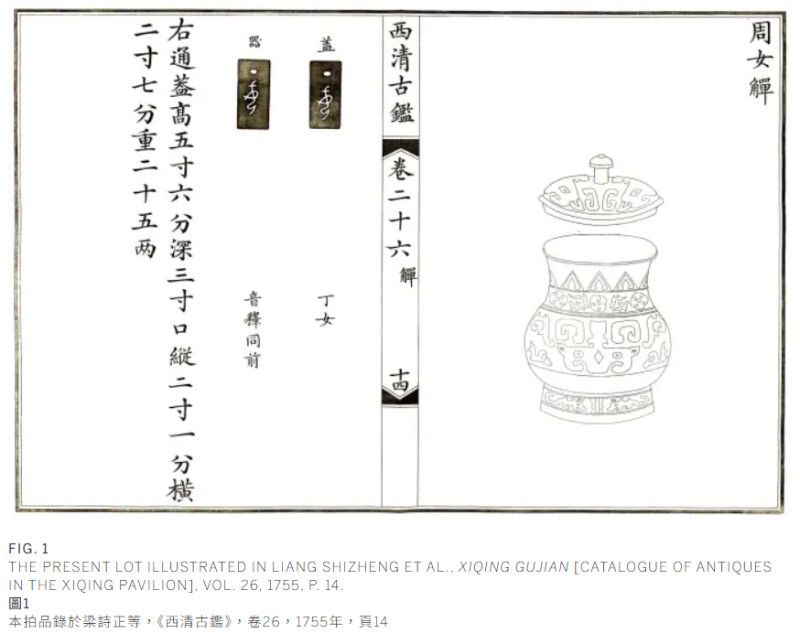
Known as the Ding Mu Zhi, this rare archaic bronze vessel was once in the collection of the Qianlong Emperor (r. 1736-1795) and was first published in Xiqing gujian 西清古鑑 (Catalogue of antiques in the Xiqing pavilion) (vol. 26: zhi vessels, p. 14), one of the Emperor’s bronze catalogues compiled by court artists between the 14th and 20th year of his reign (1749-55). The catalogue comprised line drawings of some 1,500 bronzes in the imperial collection. The present vessel is entitled Zhou Nü Zhi 周女觶 (zhi of a lady from the Zhou dynasty) in the catalogue, illustrated alongside rubbings of the pictograms cast on its lid and body and detailed with its overall measurements (fig. 1). The two-character inscription is now read as Ding Mu, 'Mother (from) Ding', with Ding possibly being either the name of a clan or a location at the time.
Vessels of this form appeared around the late Shang dynasty (c. 1600-1046 BC) and continued to be popular throughout the Western Zhou dynasty (c. 1046-771 BC). Zhi are ritual vessels used by high-ranking people for wine. The Liji 禮記 (The Book of Rites), a collection of texts compiled in the Warring States period (475-221 BC) describing social norms, governmental organization and ritual conduct during the Zhou dynasty (c.1046-221 BC), states: "During the ceremonies held in ancestral temples, the superior men raise zhi, and the inferior men raise jiao" (宗廟之祭,尊者舉觶,卑者舉角) – signifying the prestigious social status of the original owner of the present vessel.
There are at least three known examples of zhi cast with similar registers of design and with a 'dog-tooth' band below the rim: Yu Fu Xin Zhi 魚父辛觶, a vessel bearing a three-character inscription, lacking a cover, excavated in 1984 from the ruins of Shijia, Huantai county, Shandong province, now in the Zibo Museum, Shandong province; another cast with related taotie masks on its body, also lacking a cover, illustrated in Jessica Rawson, Western Zhou Ritual Bronzes from the Arthur M. Sackler Collections, Washington D.C., 1990, pl. 99, and sold in these rooms, 5th May 1972, lot 433; and a taller zhi with cover, of more slender form and without an inscription, formerly in the collection of Addie W. Kahn, now in the Metropolitan Museum of Art, New York (accession no. 49.135.13).
御藏傳世:清宮舊藏丁母觶
此青銅重器名為「丁母觶」,曾為清高宗乾隆帝(1736-1795年在位)御覽舊藏,並首錄於乾隆十四年至二十年間(1749-1755年)由內廷詞臣奉敕編纂之金石圖錄《西清古鑑》(卷二十六:觶,頁十四)。該書以白描手法繪錄清宮所藏青銅器約一千五百件。本品於該圖錄中定名為「周女觶」,並附有器蓋與器身銘文拓片及詳細尺寸(圖一)。其兩字銘文現釋作「丁母」,「丁」或為當時之氏族名或地名。
此類器形始見於商代晚期(約公元前1600-1046年),並盛行於整個西周時期(約公元前1046-771年)。觶乃高等貴族所用之飲酒禮器。戰國時期(公元前475-221年)記述周代社會規範、政府制度及禮儀之典籍《禮記》載:「宗廟之祭,尊者舉觶,卑者舉角」,足證本器原主身分之顯赫。
現存至少有三例紋飾佈局相近、且口沿下飾鋸齒紋的青銅觶可資比較:其一為「魚父辛觶」,鑄三字銘文,缺蓋,1984年出土於山東省桓台縣史家遺址,現藏山東淄博市博物館;其二器身飾相類饕餮紋,亦缺蓋,錄於傑西卡·羅森(Jessica Rawson),《Western Zhou Ritual Bronzes from the Arthur M. Sackler Collections》,華盛頓,1990年,圖版99,後售於紐約蘇富比1972年5月5日,編號433;其三連蓋,器形較高且修長,無銘文,曾為 Addie W. Kahn 舊藏,現存紐約大都會藝術博物館(館藏編號49.135.13)。
常见问题
这件The Ding Mu Zhi, An extremely rare imperially documented archaic bronze royal ritual wine vessel and cover, Late Shang – Early Western Zhou dynasty | 商末周初 清乾隆御藏丁母觶的成交价是多少?
落槌价为 预展中。 成交价为 预展中。
拍品的品相状况如何?
Boasting a highly attractive, smooth black patina, this vessel bears the distinguished characteristics of having been part of the Qing Court Collection. As is characteristic of archaic bronzes curated for the imperial collection, the original burial encrustations were cleaned in antiquity. The surface features some expected minor touch-ups to the design that blend harmoniously with its historical patina. X-Ray images available upon request.
Vessel:
A restored section (approx. 6x1 cm) to the foot rim.
A small restored chip (approx. 1.3 cm wide) to the mouth rim.
A faint crack (approx. 1.5 cm long) to the lower body on one side.
Cover:
A faint crack (approx. 1.8 cm long) to the rim.
黑漆古包漿,與其清宮舊藏來源一致。器表紋飾有預期之輕微修飾,與其歷史包漿自然交融。X光照片備索。
器身:
圈足有一處經修復之區域(約 6 x 1 公分)。
口沿有一處經修復之小磕缺(寬約 1.3 公分)。
下腹一側有一道微沖(長約 1.5 公分)。
紋飾有多處預期之表面修飾,與其早年之清理及宮廷遞藏歷史相符。
器蓋:
口沿有一道微沖(長約 1.8 公分)。
紋飾有幾處預期之表面修飾。
If a condition report is provided to assist you with assessing the condition of the lot, it is for guidance purposes only. Such condition report may not refer to all faults, restoration, alterations, or adaptations because Sotheby's is not a professional conservator or restorer but rather a condition report is a statement of subjective, qualified opinion genuinely held by Sotheby's. For these reasons, any such condition report is not an alternative to taking your own professional advice regarding the condition of the lot. Prospective buyers should also refer to the Guide for Buyers at Auction which includes important notices concerning the type of property in this sale.
Vessel:
A restored section (approx. 6x1 cm) to the foot rim.
A small restored chip (approx. 1.3 cm wide) to the mouth rim.
A faint crack (approx. 1.5 cm long) to the lower body on one side.
Cover:
A faint crack (approx. 1.8 cm long) to the rim.
黑漆古包漿,與其清宮舊藏來源一致。器表紋飾有預期之輕微修飾,與其歷史包漿自然交融。X光照片備索。
器身:
圈足有一處經修復之區域(約 6 x 1 公分)。
口沿有一處經修復之小磕缺(寬約 1.3 公分)。
下腹一側有一道微沖(長約 1.5 公分)。
紋飾有多處預期之表面修飾,與其早年之清理及宮廷遞藏歷史相符。
器蓋:
口沿有一道微沖(長約 1.8 公分)。
紋飾有幾處預期之表面修飾。
If a condition report is provided to assist you with assessing the condition of the lot, it is for guidance purposes only. Such condition report may not refer to all faults, restoration, alterations, or adaptations because Sotheby's is not a professional conservator or restorer but rather a condition report is a statement of subjective, qualified opinion genuinely held by Sotheby's. For these reasons, any such condition report is not an alternative to taking your own professional advice regarding the condition of the lot. Prospective buyers should also refer to the Guide for Buyers at Auction which includes important notices concerning the type of property in this sale.
这件拍品的流传来源是什么?
Collection of Qing Gaozong, Aisin Gioro Hongli, the Qianlong Emperor (r. 1736-1795).
Qing Court Collection.
Collection of Fang Junyi (1836-1899).
Collection of Li Hongyi (1831-1885).
Collection of Zhang Shiming (1872-1927), Wuxing, Zhejiang, thence by descent to Zhang Heng (1915-1963), grandson of Zhang Shiming.
Ton-Ying & Co., New York.
Parke-Bernet Galleries, New York, 30th March 1955, lot 55.
New York Private Collection.
Sotheby’s New York, 20th September 2022, lot 1
这件拍品被哪些著录书籍记载?
Liang Shizheng et al., Xiqing gujian [Catalogue of antiques in the Xiqing pavilion], vol. 26, 1755, p. 14; vol. 26, pp. 27-28 for the edition of the Complete Library of the Four Treasuries.
Zou An, Zhou jinwen cun [Surviving bronze inscriptions from the Zhou dynasty], vol. 5, Shanghai, 1916, p. 134.
Fang Junyi, Guzhouyi jijin yiqi kuanzhi [Archaic bronze inscriptions from the Guzhouyi], manuscript completed before 1899, Shanghai, 1925, p. 8.
Rong Geng, "Xiqing jinwen zhenwei cunyi biao (fubiao)" [Table of authentic, forged, extant, and lost bronze inscriptions in the Xiqing (appendix)], Yanjing xuebao, no. 5, 1929, p. 862.
Chen Chengxiu, Yiwenge jinwen [Bronze inscriptions from the Yiwen Pavilion], unpublished manuscript, compiled by 1931.
Bao Ding, Qingchao jinwen zhulubiao buyi [Addendum to the catalogue of bronze inscriptions from the Qing dynasty], vol. 1, 1931, p. 69.
Wang Guowei, with corrections and additions by Luo Fuyi, Sandai Qin Han jinwen zhulubiao [Catalogue of bronze inscriptions from the Three Dynasties, Qin, and Han], vol. 5, 1933, p. 4.
Luo Zhenyu, Zhensongtang jigu yiwen xubian [Sequel to the gathering of ancient writings in the Zhensongtang], vol. 2, 1934, p. 33.
Fang Junyi, Zhuiyizhai yiqi kuanzhi kaoshi [Study of the archaic bronze inscriptions from the Zhuiyi Studio], manuscript completed in 1894, vol. 23, 1935, p. 30.
Liu Tizhi, Xiaojiaojingge jinwen taben [Rubbings of archaic bronze inscriptions in the Xiaojiaojingge], vol. 5, 1935, p. 73.
Wang Chen, Xuyinwencun [Continuation of the surviving writings from the Yin dynasty], vol. 2, 1935, p. 53.
Luo Zhenyu, Sandai jijin wencun [Surviving bronze inscriptions from the Three Dynasties], vol. 14, Beijing, 1937, p. 37.
John Calvin Ferguson, Lidai zhulu jijin mu [Catalogue of recorded bronzes through the dynasties], Changsha, 1939, p. 393.
Luo Fuyi, Sandai jijin wencun shiwen [Interpretations of the surviving bronze inscriptions from the Three Dynasties], vol. 14, 1941, p. 30.
Parke-Bernet Galleries, From the Collection of Ton-ying & Co., New York, 30th March 1955, pp. 7-8.
Li Hsuan-po, Shih-yu-sho t'sang-chiu t'o-pen ts'e-yeh tsung-ho p'ien [A collection of old rubbings in the Fu Ssu-nien Library, Institute of History and Philology, Academia Sinica], Taipei, 1975.
Zhou Fagao, Sandai jijin wencun zhulubiao [Catalogue of the surviving bronze inscriptions from the Three Dynasties], vol. 2, Taipei, 1977, p. 575.
Noel Barnard and Cheung Kwong-Yue, Rubbings and Hand Copies of Bronze Inscriptions in Chinese, Japanese, European, American and Australasian Collections, vol. 7, Taipei, 1978, no. 1192.
Sun Zhichu, Jinwen zhulu jianmu [Records of Bronze Inscriptions], Beijing, 1981, p. 330, no. 5796 (vessel recorded).
Yan Yiping, Jinwen zongji [Corpus of bronze inscriptions], vol. 8, Taipei, 1983, no. 6370.
Liu Yu et al., Qianlong sijian zonglibiao [Comprehensive table of the four Qianlong catalogues], Beijing, 1989, p. 102, no. 1015.
The Institute of Archaeology, Chinese Academy of Social Sciences, ed., Yinzhou jinwen jichengshiwen [Interpretations of the compendium of Yin and Zhou bronze inscriptions], vol. 4, Hong Kong, 2001, no. 6135.
The Institute of Archaeology, Chinese Academy of Social Sciences, ed., Yinzhou jinwen jicheng [Compendium of Bronze Inscriptions from Yin and Zhou Dynasties], Beijing, 2007, no. 06135. (Note: Retained your 2007 edition citation here as the primary reference for this work).
Liu Yu et. al., Shangzhou jinwen zong zhulubiao [Comprehensive list of recorded Shang and Zhou bronze inscriptions], Beijing, 2008, p. 924, no. 6690 (vessel recorded).
Wu Zhenfeng, Shang Zhou qingtong qi mingwen ji tuxiang jicheng [Compendium of important inscriptions and images of bronzes from the Shang and Zhou dynasties], vol. 19, Shanghai, 2012, no. 10273.
Chen Yingjie, ed., Rong Geng qingtongqi xue [Rong Geng's study of bronzes], Beijing, 2015, p. 688.
图录