
拍品信息
拍品名称
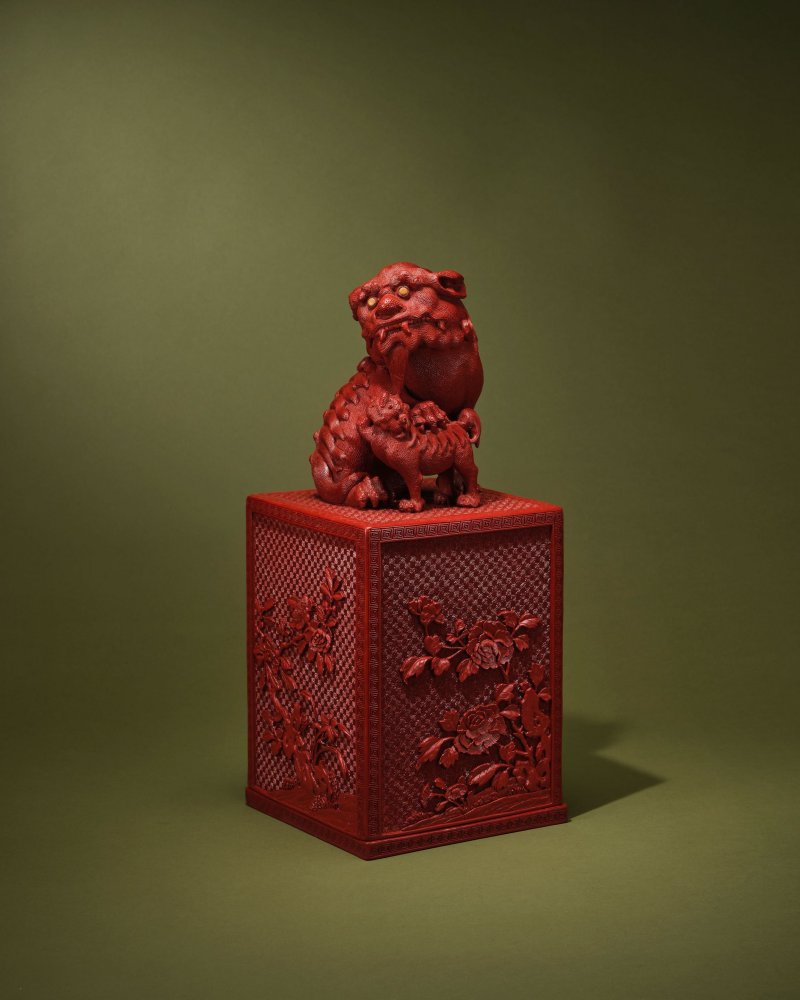
清乾隆 剔紅佛獅鈕罩盒 | AN EXCEPTIONALLY RARE CARVED CINNABAR AND PAINTED LACQUER 'BUDDHIST LION' TREASURE BOX AND COVER
年代
Qianlong
起拍价
HKD 1,500,000
估值区间
HKD 1500000 - 2000000
尺寸
未知
品相
未知
更多信息
Qianlong
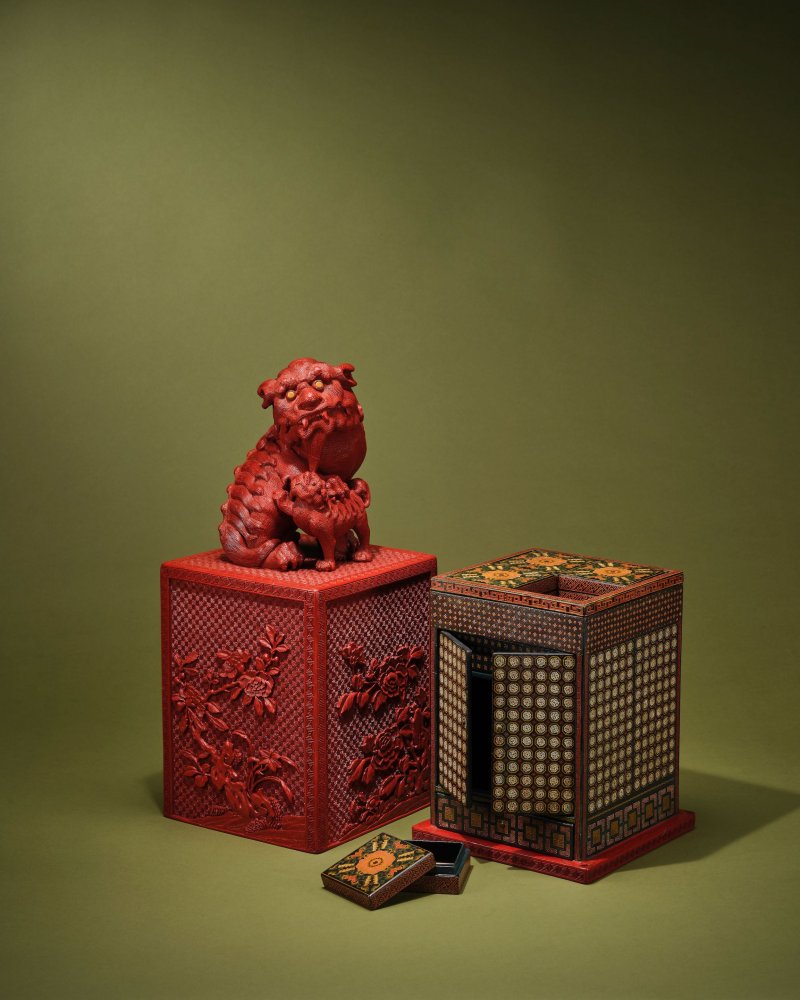
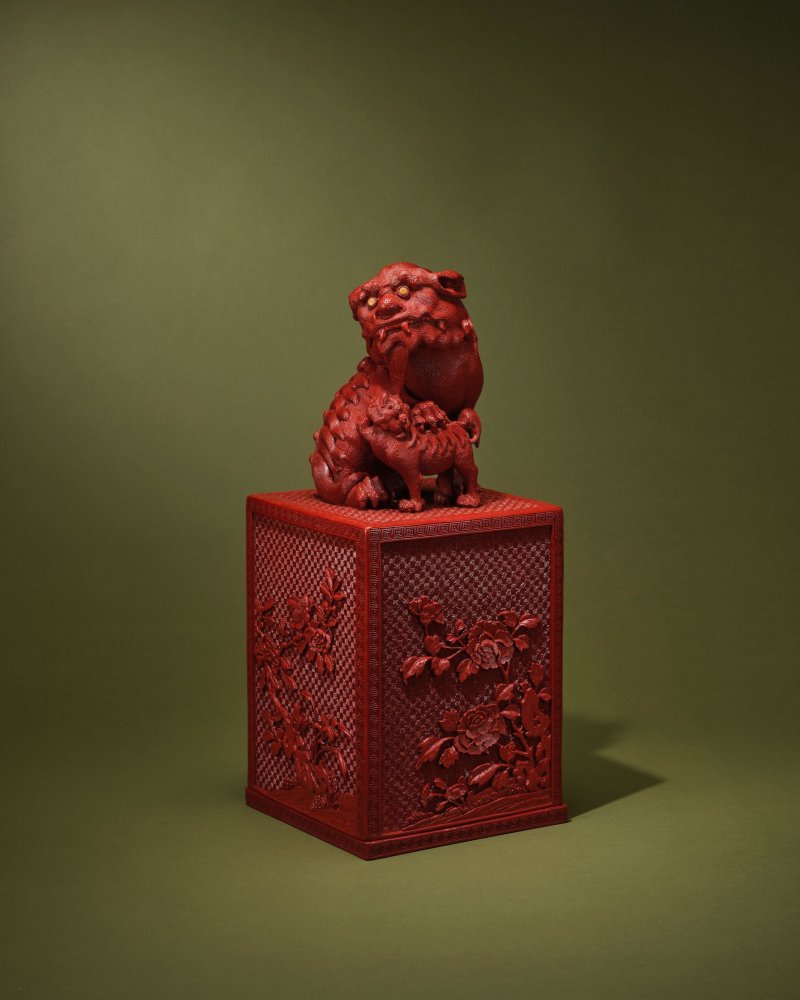
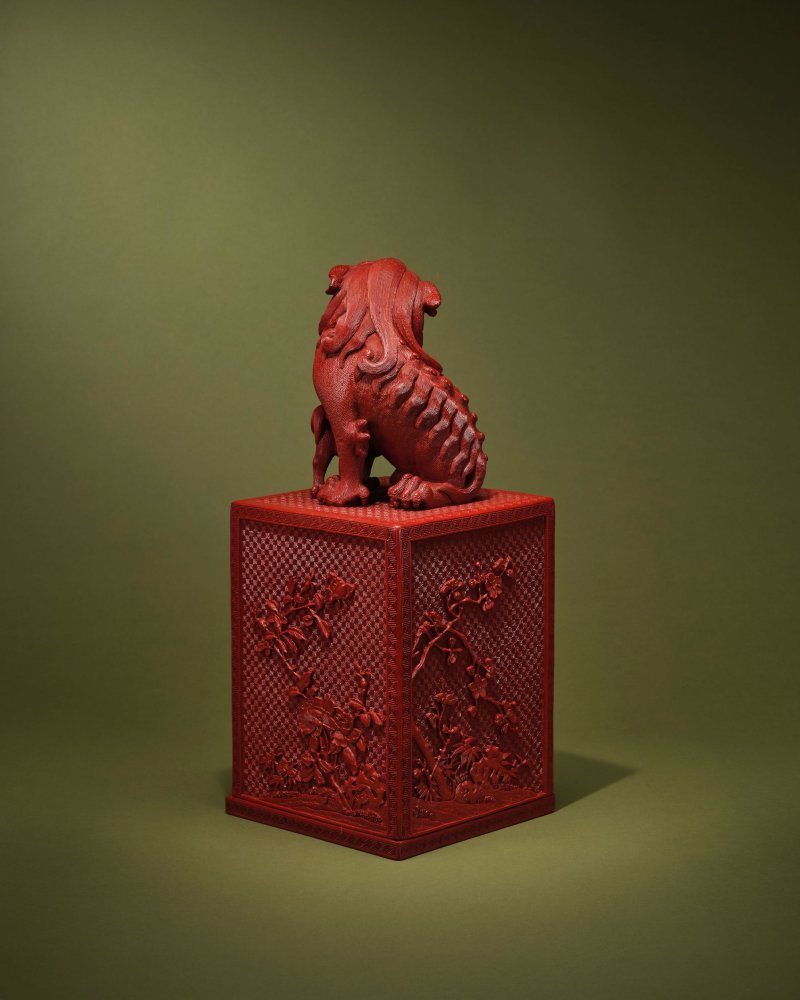
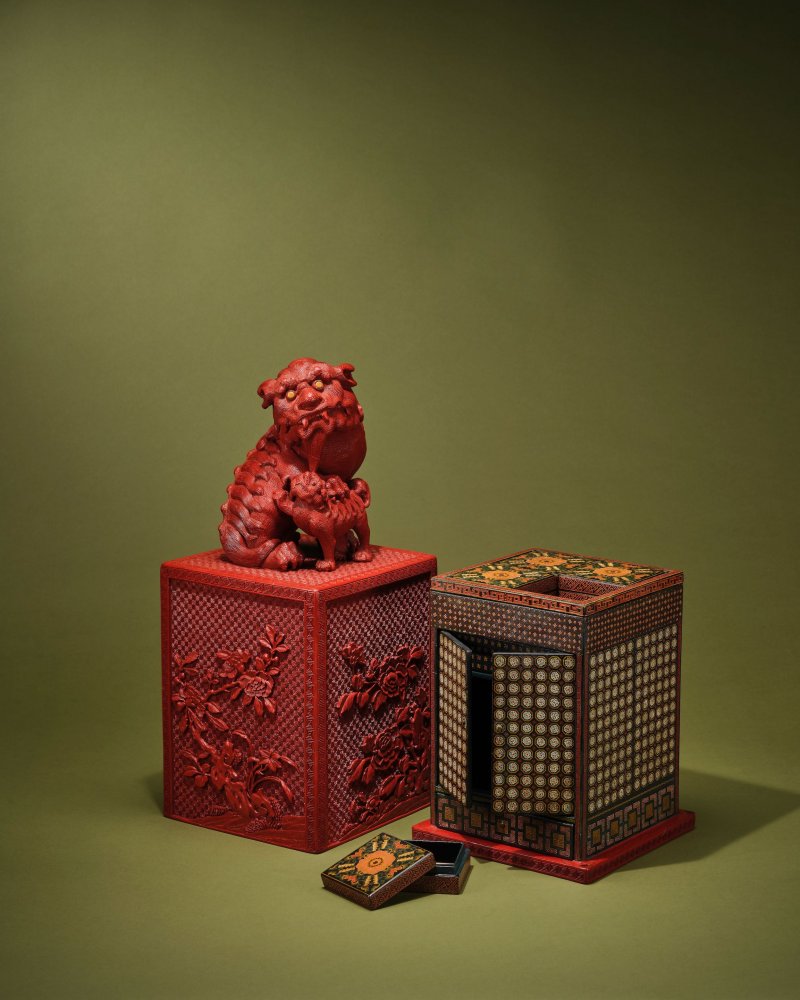
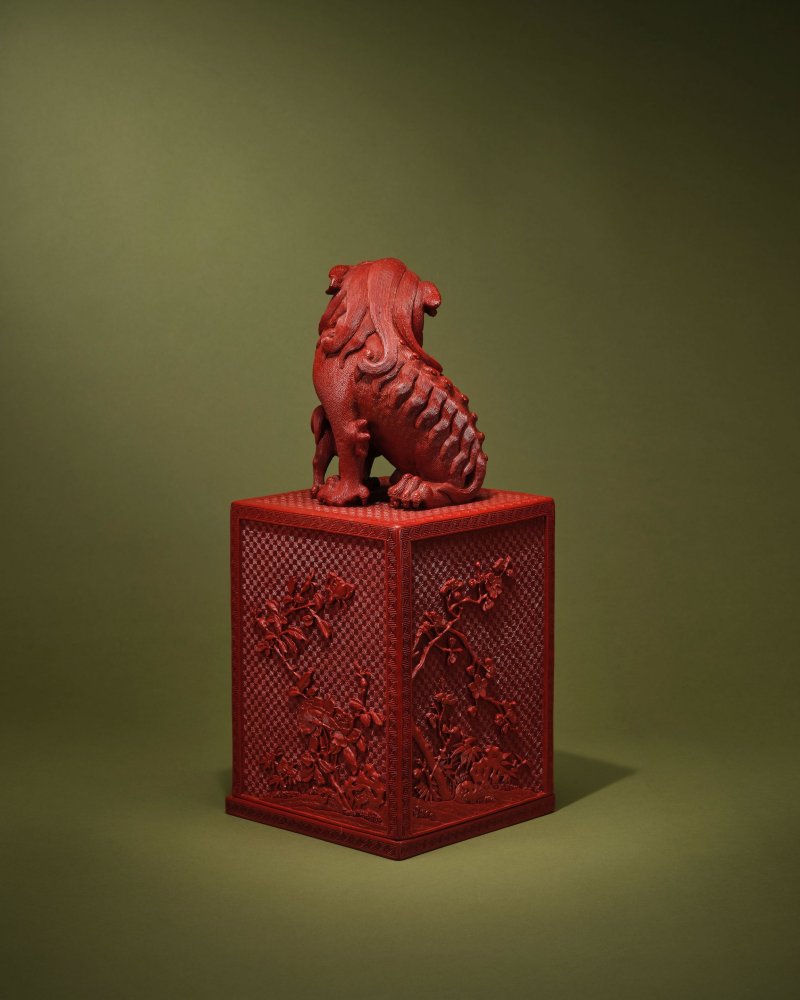
The rectangular box comprising a fitted polychrome lacquer interior enclosed within a detachable cinnabar lacquer cover, the cover surmounted by a large Buddhist lion seated beside its cub with paw resting on the larger's finely incised back, the sides deeply carved through layers of rich cinnabar with flowering peony branches issuing from pierced rocks against a diaper-pattern ground, all within key-fret borders, the interior box decorated in coloured and gilt lacquer with dense geometric and floral designs, fitted with a pair of hinged doors opening to reveal a shelved compartment, the lower section with a small drawer, together with four removable square boxes and covers similarly decorated and placed above.
37cm (14 5/8in) high (13).
Footnotes
清乾隆 剔紅佛獅鈕罩盒
Provenance:
John Sparks Ltd., London, by June 1947
An English private collection, acquired from the above on 26 July 1947, and thence by descent
:
Grosvenor House, , Park Lane, London, 11-27 June 1947. This was the first fair after a six-year break during the Second World War, and held under the patronage of Her Majesty Queen Mary.
倫敦古董商John Sparks Ltd.,至1947年6月
英國私人收藏,於1947年7月26日購自上者,後由家族傳承
格羅夫納大宅,《The Seventh Antique Dealers' Fair and Exhibition》,帕克巷,倫敦,1947年6月11日至27日(這是第二次世界大戰期間中斷六年後,首次再度舉辦的博覽會,並由瑪麗女王陛下親自贊助)
The present box and cover is distinguished by the remarkable sculptural treatment of its cover, which is surmounted by a fully modelled Buddhist lion protectively attending its cub, resembling a large seal. It is possible therefore that the present lot was intended to store various seals. Compare with two related cinnabar lacquer seal boxes and covers with Buddhist lion finials, part of a cinnabar lacquer writing set, Qianlong, in the Qing Court Collection, illustrated by E.Rawski and J.Rawson, , London, 2005, p.303. For the same sculptural quality, see a pair of carved cinnabar lacquer elephants, Qianlong, illustrated in , London, 2021, p.110, no.24. Compare also a carved cinnabar lacquer stationary box with three-dimensional lacquer dragon finials, Qianlong, in the Palace Museum, Taipei (acc.no.中漆000071N000000000). See also a carved cinnabar lacquer vase with deer handles, 18th/19th century, in the Palace Museum, Taipei, illustrated in , Taipei, 2008, p.157, no.169.
The present box and cover belongs to a small group of highly elaborate lacquer furnishings produced for the Qing Imperial Court, in which richly carved cinnabar lacquer exteriors conceal finely decorated interiors. Such pieces demonstrate the Qing taste for visual surprise and layered luxury, whereby contrasting decorative techniques were combined within a single object. See for example, a cinnabar lacquer octagonal box with polychrome lacquer interior boxes, Qing dynasty, in the Palace Museum, Taipei (acc.no.中漆000096N).
The cover is surmounted by a Buddhist lion, shown protectively attending its cub. Derived ultimately from the lion imagery transmitted to China through Buddhism, the motif became one of the most popular auspicious decorative subjects of the Ming and Qing periods. The lion symbolised power, guardianship and Imperial authority, while the depiction of an adult lion with its offspring conveyed wishes for prosperity and the continuation of the family line.
The carved decoration of peony blossoms emerging from ornamental rocks further reinforces the auspicious symbolism. Peonies were celebrated as the 'King of Flowers' and served as symbols of wealth, rank and honour, while scholar's rocks evoked cultivated taste and the refined pursuits of the literati. The exceptionally deep carving, achieved through the accumulation and subsequent carving of numerous layers of cinnabar lacquer, reflects the technical sophistication associated with the finest lacquer workshops of the Qing dynasty.
The interior presents a marked contrast to the monochrome exterior. Decorated in coloured and gilt lacquer with repeating floral and geometric motifs, the fitted shelves, doors and removable boxes recall the elaborate interiors of contemporary ('cabinets of curiosities'), designed to house treasured objects and collectibles. The combination of sculptural carved lacquer and meticulously painted lacquer decoration illustrates the Qing Court's appreciation for technical virtuosity and sumptuous ornament. See a three-tiered octagonal box inlaid with jade finial and decorated with a very similar 'brocade' pattern made of polychrome lacquer filled with gold, mid Qing dynasty, in the Qing Court Collection, illustrated in , Shenzhen, 2006, p.134, no.96.
此蓋盒以蓋面雕塑工藝尤為特出,蓋頂立體圓雕一瑞獅,作護犢之狀,形制碩大,宛若印章。據此或可推測本品原為貯藏印章之用。可比對清宮舊藏一件乾隆剔紅文房套盒,其蓋面亦飾瑞獅,見E.Rawski與J.Rawson合編《China: The Three Emperors 1662–1795》,倫敦,2005年,頁303。同類雕塑風格可參見一對乾隆剔紅象,刊載於《Collectors, Curators, Connoisseurs: A Century of the Oriental Ceramic Society 1921–2021》,倫敦,2021年,頁110,編號24。另可参见臺北故宮博物院所藏一乾隆朝剔紅雲龍紋長方匣,頂面立雕二龍鈕,藏品編號:中漆000071N000000000。 另見台北故宮博物院藏一件十八/十九世紀剔紅鹿耳瓶,見《和光剔彩:故宮藏漆》,台北,2008年,頁157,編號169。
本品屬清宮御製漆器中之精品,外壁剔紅精雕,內裡另飾彩繪,內外迥異,體現清代宮廷喜愛視覺變化與層層奢華之品味,同一器物中融合不同裝飾技法。可比對一件清代剔紅八方罩盒,內置彩漆小盒,藏於台北故宮博物院(館藏編號:中漆000096N)。
蓋頂瑞獅作護犢狀,其形象源自佛教傳入中國之獅子圖像,至明清時期已成為最受歡迎之吉祥裝飾題材之一。獅子象徵力量、守護與皇權威嚴,而成獅與幼獅相伴,則寄寓家業繁榮、子嗣綿延之願。器身雕飾牡丹自湖石間盛放,進一步強化吉祥寓意。牡丹素有「花王」之譽,象徵富貴與榮華;文人賞石則代表雅緻品味與文士修養。此蓋盒雕工深邃,乃髹漆厚積後精雕細琢而成,展現清代漆作工藝之精湛。
盒內裝飾與外壁單色雕漆形成鮮明對比,以彩漆兼金漆繪飾花卉與幾何紋樣,內置層架、小門及可取出之小盒,結構精巧,令人聯想多寶格之內裝設計,原為貯藏珍玩雅物而設。雕塑式剔紅與精繪彩漆之結合,反映清宮對工藝技巧與華美裝飾之欣賞。可比對清宮舊藏一件清中期填彩漆錦紋八角形三層盒,嵌玉鈕,飾相似錦地紋,見《故宮博物院藏文物珍品全集:清代漆器》,深圳,2006年,頁134,編號96。
The rectangular box comprising a fitted polychrome lacquer interior enclosed within a detachable cinnabar lacquer cover, the cover surmounted by a large Buddhist lion seated beside its cub with paw resting on the larger's finely incised back, the sides deeply carved through layers of rich cinnabar with flowering peony branches issuing from pierced rocks against a diaper-pattern ground, all within key-fret borders, the interior box decorated in coloured and gilt lacquer with dense geometric and floral designs, fitted with a pair of hinged doors opening to reveal a shelved compartment, the lower section with a small drawer, together with four removable square boxes and covers similarly decorated and placed above.
37cm (14 5/8in) high (13).
Footnotes
清乾隆 剔紅佛獅鈕罩盒
Provenance:
John Sparks Ltd., London, by June 1947
An English private collection, acquired from the above on 26 July 1947, and thence by descent
:
Grosvenor House, , Park Lane, London, 11-27 June 1947. This was the first fair after a six-year break during the Second World War, and held under the patronage of Her Majesty Queen Mary.
倫敦古董商John Sparks Ltd.,至1947年6月
英國私人收藏,於1947年7月26日購自上者,後由家族傳承
格羅夫納大宅,《The Seventh Antique Dealers' Fair and Exhibition》,帕克巷,倫敦,1947年6月11日至27日(這是第二次世界大戰期間中斷六年後,首次再度舉辦的博覽會,並由瑪麗女王陛下親自贊助)
The present box and cover is distinguished by the remarkable sculptural treatment of its cover, which is surmounted by a fully modelled Buddhist lion protectively attending its cub, resembling a large seal. It is possible therefore that the present lot was intended to store various seals. Compare with two related cinnabar lacquer seal boxes and covers with Buddhist lion finials, part of a cinnabar lacquer writing set, Qianlong, in the Qing Court Collection, illustrated by E.Rawski and J.Rawson, , London, 2005, p.303. For the same sculptural quality, see a pair of carved cinnabar lacquer elephants, Qianlong, illustrated in , London, 2021, p.110, no.24. Compare also a carved cinnabar lacquer stationary box with three-dimensional lacquer dragon finials, Qianlong, in the Palace Museum, Taipei (acc.no.中漆000071N000000000). See also a carved cinnabar lacquer vase with deer handles, 18th/19th century, in the Palace Museum, Taipei, illustrated in , Taipei, 2008, p.157, no.169.
The present box and cover belongs to a small group of highly elaborate lacquer furnishings produced for the Qing Imperial Court, in which richly carved cinnabar lacquer exteriors conceal finely decorated interiors. Such pieces demonstrate the Qing taste for visual surprise and layered luxury, whereby contrasting decorative techniques were combined within a single object. See for example, a cinnabar lacquer octagonal box with polychrome lacquer interior boxes, Qing dynasty, in the Palace Museum, Taipei (acc.no.中漆000096N).
The cover is surmounted by a Buddhist lion, shown protectively attending its cub. Derived ultimately from the lion imagery transmitted to China through Buddhism, the motif became one of the most popular auspicious decorative subjects of the Ming and Qing periods. The lion symbolised power, guardianship and Imperial authority, while the depiction of an adult lion with its offspring conveyed wishes for prosperity and the continuation of the family line.
The carved decoration of peony blossoms emerging from ornamental rocks further reinforces the auspicious symbolism. Peonies were celebrated as the 'King of Flowers' and served as symbols of wealth, rank and honour, while scholar's rocks evoked cultivated taste and the refined pursuits of the literati. The exceptionally deep carving, achieved through the accumulation and subsequent carving of numerous layers of cinnabar lacquer, reflects the technical sophistication associated with the finest lacquer workshops of the Qing dynasty.
The interior presents a marked contrast to the monochrome exterior. Decorated in coloured and gilt lacquer with repeating floral and geometric motifs, the fitted shelves, doors and removable boxes recall the elaborate interiors of contemporary ('cabinets of curiosities'), designed to house treasured objects and collectibles. The combination of sculptural carved lacquer and meticulously painted lacquer decoration illustrates the Qing Court's appreciation for technical virtuosity and sumptuous ornament. See a three-tiered octagonal box inlaid with jade finial and decorated with a very similar 'brocade' pattern made of polychrome lacquer filled with gold, mid Qing dynasty, in the Qing Court Collection, illustrated in , Shenzhen, 2006, p.134, no.96.
此蓋盒以蓋面雕塑工藝尤為特出,蓋頂立體圓雕一瑞獅,作護犢之狀,形制碩大,宛若印章。據此或可推測本品原為貯藏印章之用。可比對清宮舊藏一件乾隆剔紅文房套盒,其蓋面亦飾瑞獅,見E.Rawski與J.Rawson合編《China: The Three Emperors 1662–1795》,倫敦,2005年,頁303。同類雕塑風格可參見一對乾隆剔紅象,刊載於《Collectors, Curators, Connoisseurs: A Century of the Oriental Ceramic Society 1921–2021》,倫敦,2021年,頁110,編號24。另可参见臺北故宮博物院所藏一乾隆朝剔紅雲龍紋長方匣,頂面立雕二龍鈕,藏品編號:中漆000071N000000000。 另見台北故宮博物院藏一件十八/十九世紀剔紅鹿耳瓶,見《和光剔彩:故宮藏漆》,台北,2008年,頁157,編號169。
本品屬清宮御製漆器中之精品,外壁剔紅精雕,內裡另飾彩繪,內外迥異,體現清代宮廷喜愛視覺變化與層層奢華之品味,同一器物中融合不同裝飾技法。可比對一件清代剔紅八方罩盒,內置彩漆小盒,藏於台北故宮博物院(館藏編號:中漆000096N)。
蓋頂瑞獅作護犢狀,其形象源自佛教傳入中國之獅子圖像,至明清時期已成為最受歡迎之吉祥裝飾題材之一。獅子象徵力量、守護與皇權威嚴,而成獅與幼獅相伴,則寄寓家業繁榮、子嗣綿延之願。器身雕飾牡丹自湖石間盛放,進一步強化吉祥寓意。牡丹素有「花王」之譽,象徵富貴與榮華;文人賞石則代表雅緻品味與文士修養。此蓋盒雕工深邃,乃髹漆厚積後精雕細琢而成,展現清代漆作工藝之精湛。
盒內裝飾與外壁單色雕漆形成鮮明對比,以彩漆兼金漆繪飾花卉與幾何紋樣,內置層架、小門及可取出之小盒,結構精巧,令人聯想多寶格之內裝設計,原為貯藏珍玩雅物而設。雕塑式剔紅與精繪彩漆之結合,反映清宮對工藝技巧與華美裝飾之欣賞。可比對清宮舊藏一件清中期填彩漆錦紋八角形三層盒,嵌玉鈕,飾相似錦地紋,見《故宮博物院藏文物珍品全集:清代漆器》,深圳,2006年,頁134,編號96。
常见问题
这件清乾隆 剔紅佛獅鈕罩盒 | AN EXCEPTIONALLY RARE CARVED CINNABAR AND PAINTED LACQUER 'BUDDHIST LION' TREASURE BOX AND COVER的成交价是多少?
落槌价为 预展中。 成交价为 预展中。