
拍品信息
拍品名称
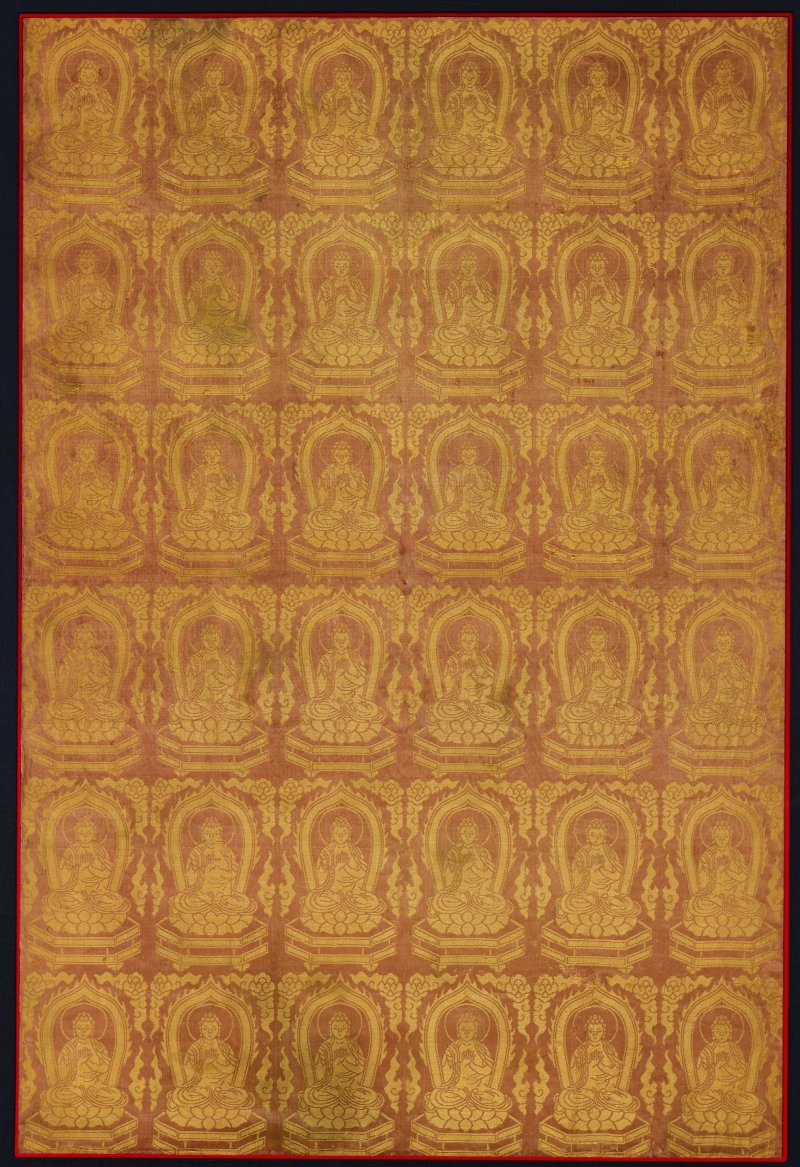
元/明初 十三/十四世紀 大日如來佛紋紅地織金錦 | A SILK PANEL OF VAIROCANA
年代
YUAN/EARLY MING, 13TH/14TH CENTURY
起拍价
HKD 180,000
估值区间
HKD 180000 - 220000
尺寸
未知
品相
未知
更多信息
YUAN/EARLY MING, 13TH/14TH CENTURY
100 x 68 cm (39 3/8 x 26 3/4 in.)
Footnotes
元/明初 十三/十四世紀 大日如來佛紋紅地織金錦
Provenance
Teresa Coleman Fine Arts Ltd., 1994
Vairocana ("the Shining One" or "Solar Buddha") occupies a central position in Mahayana and Vajrayana Buddhist thought and iconography. As the embodiment of the Dharmakaya, the Buddha's ultimate truth body, he represents the all-pervading reality from which enlightenment arises and is typically depicted at the center of the Five Tathagatas (Five Wisdom Buddhas). While traditionally depicted in white, he appears here in a rich golden hue, a chromatic choice that explicitly aligns him with his solar aspect.
Vairocana is shown seated in vajraparyankasana, upon a double lotus base, supported by a hexagonal throne, encircled by a flaming mandorla. His hands are configured in the dharmachakra mudra, the gesture of turning the Wheel of the Law. The figure is repeated in six vertical registers, this deliberate arrangement may symbolise either the six transcendental powers () or the six realms of existence in Buddhist cosmology.
This silk panel would originally have formed part of a larger bolt commissioned by a Tibetan Buddhist monastery. Such bolts, sometimes reaching up to thirteen meters in length and were highly prized possessions, often presented as gifts from the imperial court or bestowed by wealthy patrons. To date, no comparable example with this subject matter or color scheme is documented. The panel would most likely have served as an interior decoration within a monastery, perhaps in a chapel dedicated specifically to Vairocana, where it may have functioned as a floor‑to‑ceiling hanging banner or an altar frontal. A comparable blue silk panel with a similar composition was sold at Bonhams, Hong Kong, on 30 October 2025, lot 811.
100 x 68 cm (39 3/8 x 26 3/4 in.)
Footnotes
元/明初 十三/十四世紀 大日如來佛紋紅地織金錦
Provenance
Teresa Coleman Fine Arts Ltd., 1994
Vairocana ("the Shining One" or "Solar Buddha") occupies a central position in Mahayana and Vajrayana Buddhist thought and iconography. As the embodiment of the Dharmakaya, the Buddha's ultimate truth body, he represents the all-pervading reality from which enlightenment arises and is typically depicted at the center of the Five Tathagatas (Five Wisdom Buddhas). While traditionally depicted in white, he appears here in a rich golden hue, a chromatic choice that explicitly aligns him with his solar aspect.
Vairocana is shown seated in vajraparyankasana, upon a double lotus base, supported by a hexagonal throne, encircled by a flaming mandorla. His hands are configured in the dharmachakra mudra, the gesture of turning the Wheel of the Law. The figure is repeated in six vertical registers, this deliberate arrangement may symbolise either the six transcendental powers () or the six realms of existence in Buddhist cosmology.
This silk panel would originally have formed part of a larger bolt commissioned by a Tibetan Buddhist monastery. Such bolts, sometimes reaching up to thirteen meters in length and were highly prized possessions, often presented as gifts from the imperial court or bestowed by wealthy patrons. To date, no comparable example with this subject matter or color scheme is documented. The panel would most likely have served as an interior decoration within a monastery, perhaps in a chapel dedicated specifically to Vairocana, where it may have functioned as a floor‑to‑ceiling hanging banner or an altar frontal. A comparable blue silk panel with a similar composition was sold at Bonhams, Hong Kong, on 30 October 2025, lot 811.
常见问题
这件元/明初 十三/十四世紀 大日如來佛紋紅地織金錦 | A SILK PANEL OF VAIROCANA的成交价是多少?
落槌价为 预展中。 成交价为 预展中。