
拍品信息
拍品名称
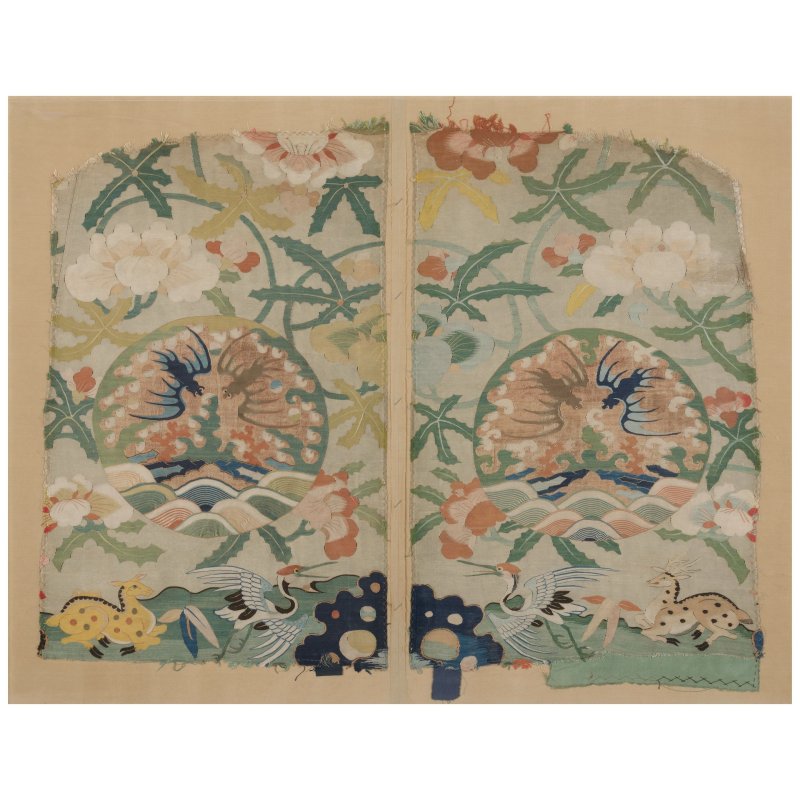
十七/十八世紀 緙絲福祿壽紋織片一對 | A PAIR OF KESI 'BATS, DEER AND CRANE' PANELS
年代
17th/18th century
起拍价
USD 10,000
估值区间
未知
尺寸
未知
品相
未知
更多信息
17th/18th century
Each finely woven in polychrome silk threads, centered with a circular medallion enclosing bats in flight amidst scrolling stylized ruyi-form clouds above rockwork and multi-colored waves, surrounded by luxuriant flowering branches with large lobed leaves, the lower register of one panel depicting a red-crowned crane accompanied by a stag, and the other similarly decorated with a crane and a doe, each standing beside a pierced rock amidst a grassy ground, all reserved on a pale bluish-gray ground.
37 x 28 3/8in (94 × 72.1cm)
(acrylic frame).
Footnotes
十七/十八世紀 緙絲福祿壽紋織片一對
The present pair is finely woven with an auspicious combination of bats, deer and cranes, together forming a rebus for the Three Blessings of fu, lu and shou (福祿壽), representing fortune, prosperity and longevity. The bat (fu, 蝠) is a homophone for fortune or happiness (fu, 福), while the deer (lu, 鹿) evokes lu (祿), the official emoluments associated with rank and prosperity. The crane, traditionally associated with immortality and long life, completes the tripartite imagery of the Three Blessings. The deliberate depiction of a stag on one panel and a doe on the other further underscores the complementary nature of the pair.
The distinctive treatment of the animals, particularly the spotted deer and cranes, finds close parallels in textiles dating from the late Ming through the early Qing dynasty. Compare the similarly rendered spotted animal on a silk 'Celestial Horse' panel, dated to the late Ming dynasty, sold at Sotheby's London, 5 November 2008, lot 387. The cranes may also be compared with those depicted on a 17th-century panel, sold at Sotheby's London, 7 November 2012, lot 302, as well as on a related late Ming panel sold at Sotheby's London, 15 May 2007, lot 419.
The broader composition, in which auspicious animals are set amidst stylized clouds, rockwork and waves, likewise belongs to a decorative vocabulary established during the late Ming period and continued into the Qing dynasty. Compare, for example, a 'Shou' panel dated to the Wanli period, sold at Bonhams London, 5 November 2020, lot 67.
Each finely woven in polychrome silk threads, centered with a circular medallion enclosing bats in flight amidst scrolling stylized ruyi-form clouds above rockwork and multi-colored waves, surrounded by luxuriant flowering branches with large lobed leaves, the lower register of one panel depicting a red-crowned crane accompanied by a stag, and the other similarly decorated with a crane and a doe, each standing beside a pierced rock amidst a grassy ground, all reserved on a pale bluish-gray ground.
37 x 28 3/8in (94 × 72.1cm)
(acrylic frame).
Footnotes
十七/十八世紀 緙絲福祿壽紋織片一對
The present pair is finely woven with an auspicious combination of bats, deer and cranes, together forming a rebus for the Three Blessings of fu, lu and shou (福祿壽), representing fortune, prosperity and longevity. The bat (fu, 蝠) is a homophone for fortune or happiness (fu, 福), while the deer (lu, 鹿) evokes lu (祿), the official emoluments associated with rank and prosperity. The crane, traditionally associated with immortality and long life, completes the tripartite imagery of the Three Blessings. The deliberate depiction of a stag on one panel and a doe on the other further underscores the complementary nature of the pair.
The distinctive treatment of the animals, particularly the spotted deer and cranes, finds close parallels in textiles dating from the late Ming through the early Qing dynasty. Compare the similarly rendered spotted animal on a silk 'Celestial Horse' panel, dated to the late Ming dynasty, sold at Sotheby's London, 5 November 2008, lot 387. The cranes may also be compared with those depicted on a 17th-century panel, sold at Sotheby's London, 7 November 2012, lot 302, as well as on a related late Ming panel sold at Sotheby's London, 15 May 2007, lot 419.
The broader composition, in which auspicious animals are set amidst stylized clouds, rockwork and waves, likewise belongs to a decorative vocabulary established during the late Ming period and continued into the Qing dynasty. Compare, for example, a 'Shou' panel dated to the Wanli period, sold at Bonhams London, 5 November 2020, lot 67.