
拍品信息
拍品名称
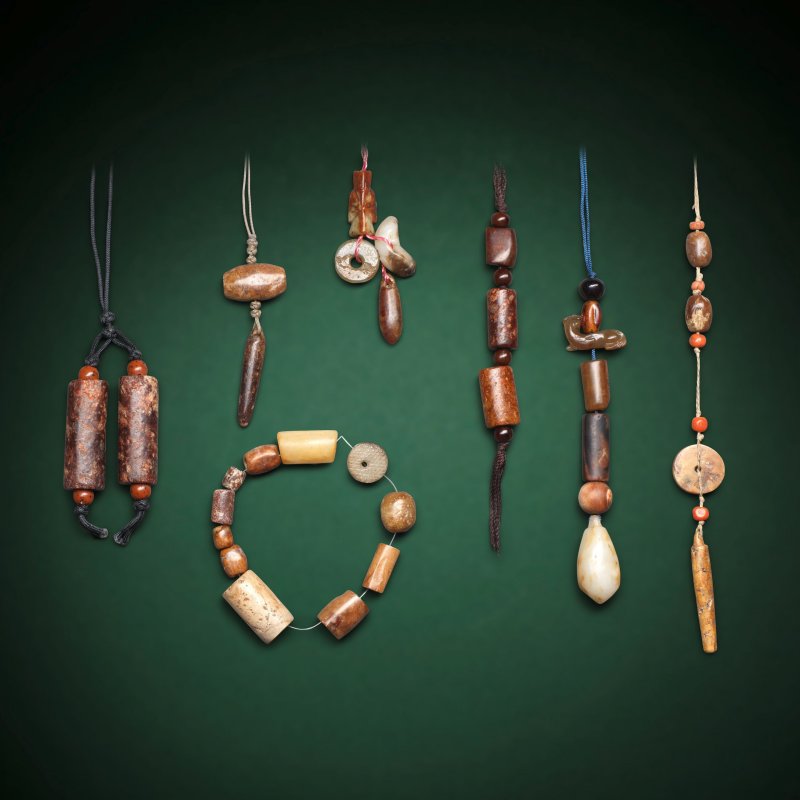
新石器時代及其後 各式玉飾一組 | A GROUP OF VARIOUS JADE BEADS
年代
Neolithic Period and later
起拍价
GBP 2,000
估值区间
GBP 2000 - 3000
尺寸
未知
品相
未知
更多信息
Neolithic Period and later
Comprising: a string with two jade tubular beads, a pear-shaped jade pendant, a jade carving of a badger, and three smaller beads of jet, amber and mother-of-pearl; a string with three jade tubular beads and four further small rounded beads; a string with two brownish jade tubular and four small jasper beads; a string with two ovoid jade beads, a jade disc, a jade awl-shaped ornament, and five small coral beads; strand with an ovoid jade bead and an awl-shaped ornament; a string with a jade standing figure, a jade disc, a jade awl-shaped ornament and a jade carving of a crouching rat; and a strand with ten jade tubular ornaments and a jade disc. The largest, 4.8cm (1 7/8in) long. (7).
Footnotes
新石器時代及其後 各式玉飾一組
The awl-shaped jade ornaments as seen in the present lot may originally have been tools used to scrape the acupuncture points of the human body for therapeutic purposes, gradually developing into ornaments imbued with the significance of communicating with the divine. In Liangzhu burials, these awl-shaped jade ornaments are often found with their pointed ends facing upward above the head of the deceased. They may have been sewn onto or fastened to a headdress through the small perforations. See further discussion and four related awl-shaped jade ornaments, Liangzhu Culture, c.3300-2300 BC, in the collection of the Palace Museum, Taipei, illustrated in (故宮玉器精選全集:玉之靈I), Taipei, 2019, p.373.
Compare the jade tubular beads with a jade tube, Liangzhu Culture, in the Qing Court Collection, the Palace Museum, Beijing, illustrated in (故宮博物院藏品大系:玉器編 1), Hefei, 2011, p.93, pl.51.
See a group of seven jade beads, a conical pendant, and a , Neolithic period, Liangzhu Culture, which was sold at Sotheby's Hong Kong, 5 December 2023, lot 714.
Comprising: a string with two jade tubular beads, a pear-shaped jade pendant, a jade carving of a badger, and three smaller beads of jet, amber and mother-of-pearl; a string with three jade tubular beads and four further small rounded beads; a string with two brownish jade tubular and four small jasper beads; a string with two ovoid jade beads, a jade disc, a jade awl-shaped ornament, and five small coral beads; strand with an ovoid jade bead and an awl-shaped ornament; a string with a jade standing figure, a jade disc, a jade awl-shaped ornament and a jade carving of a crouching rat; and a strand with ten jade tubular ornaments and a jade disc. The largest, 4.8cm (1 7/8in) long. (7).
Footnotes
新石器時代及其後 各式玉飾一組
The awl-shaped jade ornaments as seen in the present lot may originally have been tools used to scrape the acupuncture points of the human body for therapeutic purposes, gradually developing into ornaments imbued with the significance of communicating with the divine. In Liangzhu burials, these awl-shaped jade ornaments are often found with their pointed ends facing upward above the head of the deceased. They may have been sewn onto or fastened to a headdress through the small perforations. See further discussion and four related awl-shaped jade ornaments, Liangzhu Culture, c.3300-2300 BC, in the collection of the Palace Museum, Taipei, illustrated in (故宮玉器精選全集:玉之靈I), Taipei, 2019, p.373.
Compare the jade tubular beads with a jade tube, Liangzhu Culture, in the Qing Court Collection, the Palace Museum, Beijing, illustrated in (故宮博物院藏品大系:玉器編 1), Hefei, 2011, p.93, pl.51.
See a group of seven jade beads, a conical pendant, and a , Neolithic period, Liangzhu Culture, which was sold at Sotheby's Hong Kong, 5 December 2023, lot 714.
常见问题
这件新石器時代及其後 各式玉飾一組 | A GROUP OF VARIOUS JADE BEADS的成交价是多少?
落槌价为 预展中。 成交价为 预展中。


