
拍品信息
拍品名称
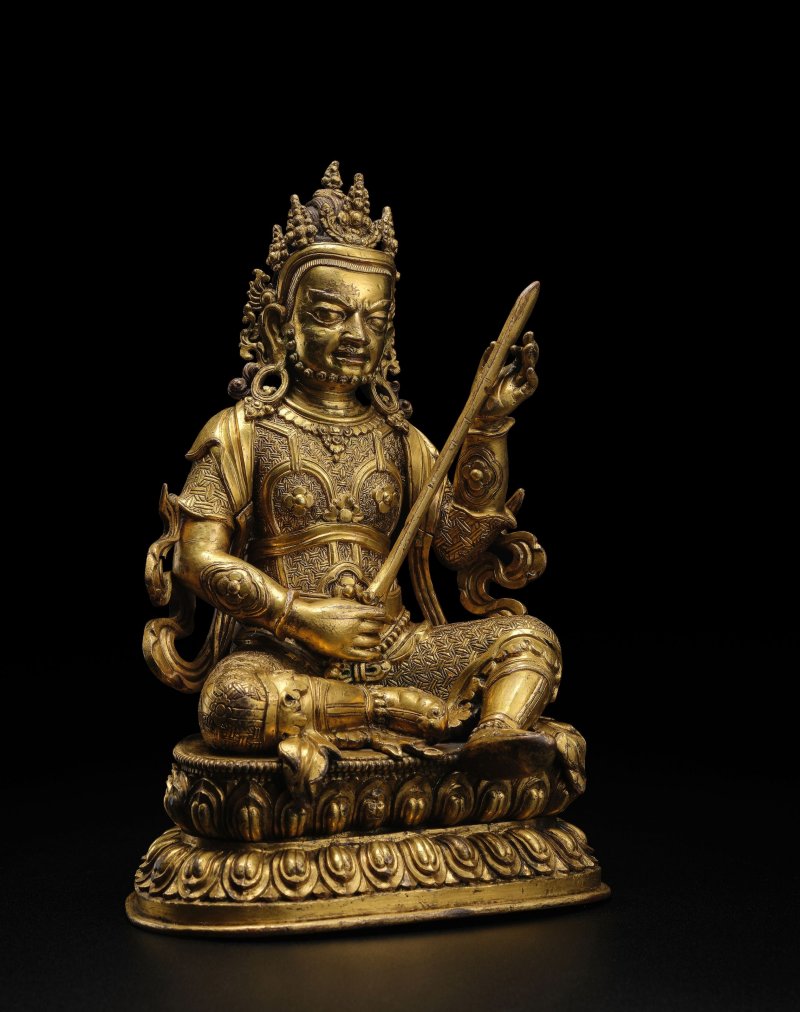
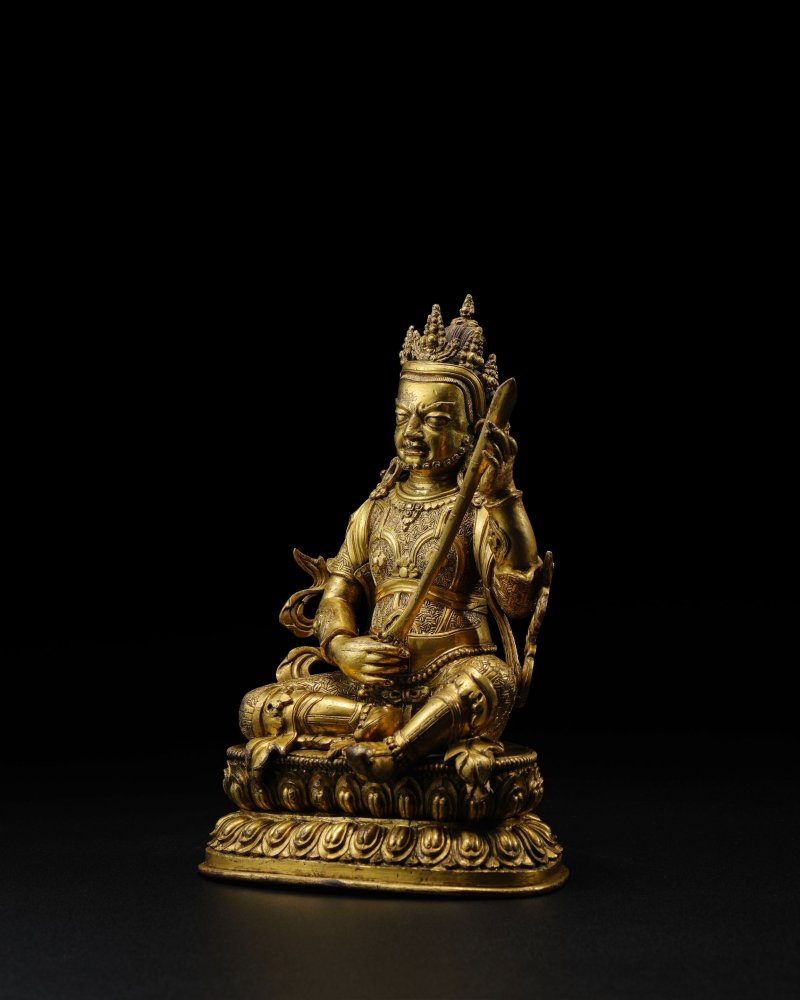
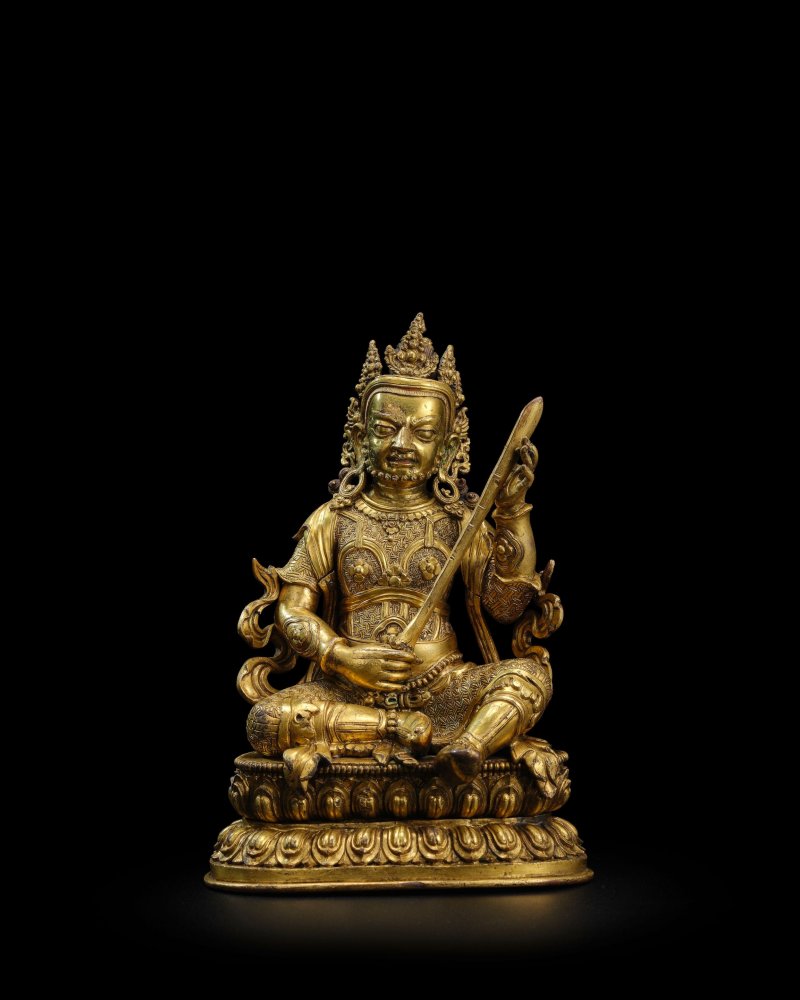
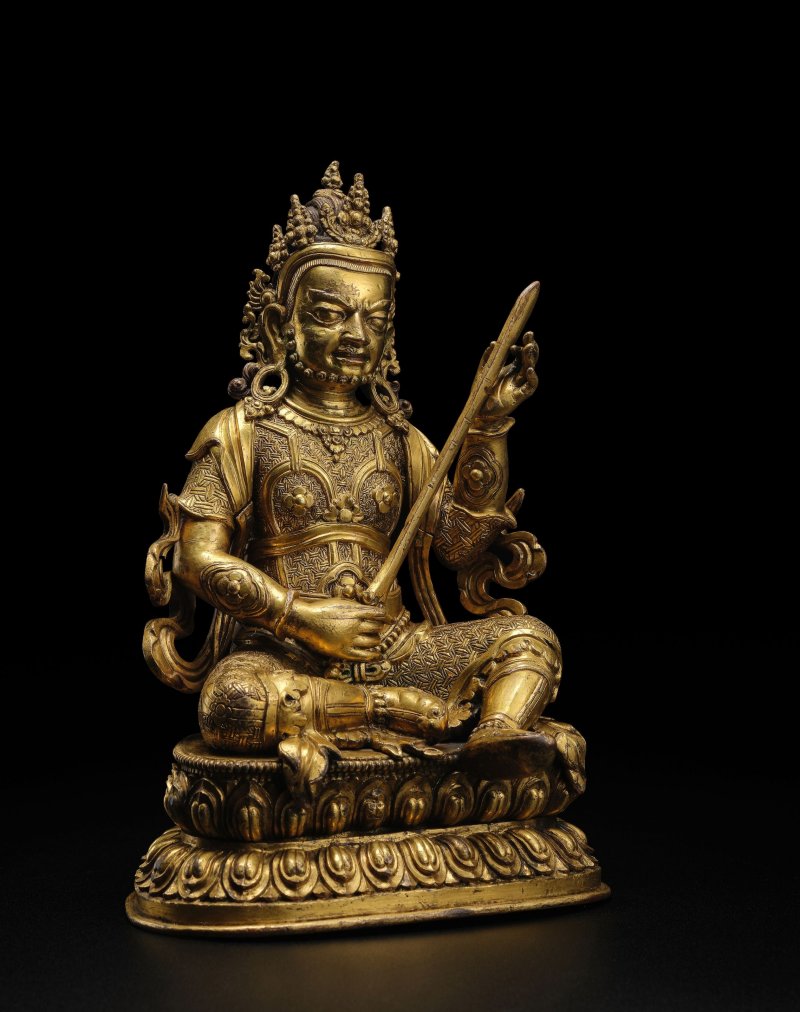
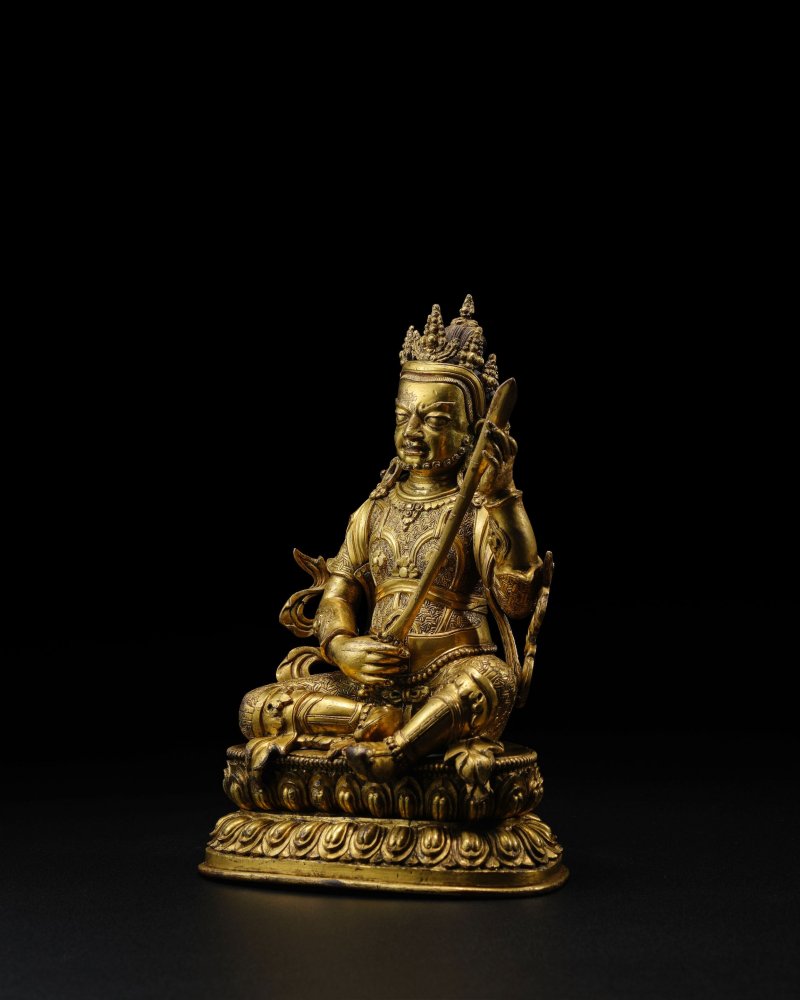
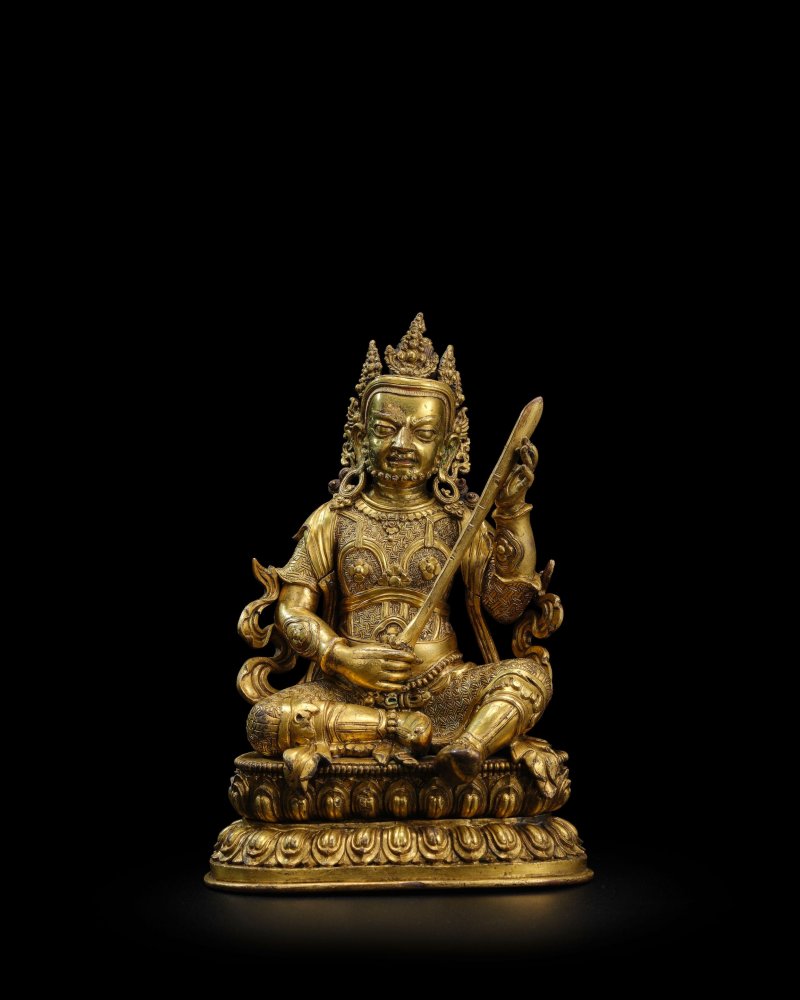
西藏 十六世紀 銅鎏金南方增長天王像 | A GILT COPPER ALLOY FIGURE OF VIRUDHAKA
年代
TIBET, 16TH CENTURY
起拍价
HKD 800,000
估值区间
HKD 800000 - 1200000
尺寸
未知
品相
未知
更多信息
TIBET, 16TH CENTURY
Himalayan Art Resources item no. 8897
25 cm (9 7/8 in.) high
Footnotes
西藏 十六世紀 銅鎏金南方增長天王像
Provenance
Acquired from Yan Wing Company, Hong Kong, 1990s
Virudhaka is one of the Four Heavenly Kings in Buddhist tradition and also ranks fifth among the Twenty Devas (the protective deities of the Dharma). His name means "increase" or "growth," referring to his role in fostering the growth of virtue and wholesome qualities in sentient beings. As the Guardian of the Southern Direction, Virudhaka resides on the southern side of Mount Sumeru and commands the kumbhanda and pretas.
Virudhaka is depicted here seated in lalitasana posture upon a double lotus base, holding a sword in his right hand. The raised sword symbolizes wisdom and protection. Its sharp blade cuts through ignorance and delusion while safeguarding the Dharma from harmful forces.
The Heavenly King is clad in elaborate, multi-layered armour in a distinct Central Plains style, carefully crafted to reflect the functional design of lamellar plates and chainmail. The cuirass is made of two curved breastplates, each adorned with a raised floral motif at the centre and bordered by a finely detailed chainmail pattern. A similar decorative treatment appears on a 15th‑century Tibetan figure of Vaishravana sold at Bonhams, Hong Kong, 5 May 2025, lot 1.
A narrow belt is fastened just below the cuirass, with a single embossed flower at the front. A second, broader belt sits at the lower abdomen, also decorated with a floral motif and edged with a string of beads. These two belts secure the armour components and add a sense of rhythm to the overall design. The vambraces on the forearms each bear a matching floral ornament. In clear contrast to the rigid, protective surface of the armour, long silk sashes wrap around the elbows and sweep outward in dynamic, flame-like curves along the base. This juxtaposition of hard metal and soft fabric animates the sculpture, lending the figure a sense of movement and ceremonial presence.
The lotus base of this sculpture is cast in openwork, a technique characteristic of Newar craftsmanship. Each inner petal is divided into two symmetrical halves, rendered thick and fleshy, with a pronounced central ridge. The lotus base reflects a long tradition of lotus-pedestal design that became prominent in Gandharan and Kashmiri Buddhist art by the 2nd to 3rd century CE (see a Gandhara Buddha on a lotus base sold at Christie's New York, 23 September 2004, lot 32), and later underwent a Sinicising transformation during the Northern Wei period, becoming a commonly seen pedestal form for Chinese Buddhist sculptures (see Huang, , 2010, p. 33, fig. 14; p. 45, figs. 27-1, 27-2). In the present work, this centuries-old tradition is reinterpreted by Newar craftsmen working in Tibet, synthesizing ancient Indian prototypes, Central Plains sculptural conventions, and Newar metalworking techniques.
The facial features and jewelled ornaments are rendered in the distinctive Newari style, and closely correspond to those of the companion figure of Virupaksha (lot 1030), strongly suggesting that the two sculptures were conceived as a matched pair.
Himalayan Art Resources item no. 8897
25 cm (9 7/8 in.) high
Footnotes
西藏 十六世紀 銅鎏金南方增長天王像
Provenance
Acquired from Yan Wing Company, Hong Kong, 1990s
Virudhaka is one of the Four Heavenly Kings in Buddhist tradition and also ranks fifth among the Twenty Devas (the protective deities of the Dharma). His name means "increase" or "growth," referring to his role in fostering the growth of virtue and wholesome qualities in sentient beings. As the Guardian of the Southern Direction, Virudhaka resides on the southern side of Mount Sumeru and commands the kumbhanda and pretas.
Virudhaka is depicted here seated in lalitasana posture upon a double lotus base, holding a sword in his right hand. The raised sword symbolizes wisdom and protection. Its sharp blade cuts through ignorance and delusion while safeguarding the Dharma from harmful forces.
The Heavenly King is clad in elaborate, multi-layered armour in a distinct Central Plains style, carefully crafted to reflect the functional design of lamellar plates and chainmail. The cuirass is made of two curved breastplates, each adorned with a raised floral motif at the centre and bordered by a finely detailed chainmail pattern. A similar decorative treatment appears on a 15th‑century Tibetan figure of Vaishravana sold at Bonhams, Hong Kong, 5 May 2025, lot 1.
A narrow belt is fastened just below the cuirass, with a single embossed flower at the front. A second, broader belt sits at the lower abdomen, also decorated with a floral motif and edged with a string of beads. These two belts secure the armour components and add a sense of rhythm to the overall design. The vambraces on the forearms each bear a matching floral ornament. In clear contrast to the rigid, protective surface of the armour, long silk sashes wrap around the elbows and sweep outward in dynamic, flame-like curves along the base. This juxtaposition of hard metal and soft fabric animates the sculpture, lending the figure a sense of movement and ceremonial presence.
The lotus base of this sculpture is cast in openwork, a technique characteristic of Newar craftsmanship. Each inner petal is divided into two symmetrical halves, rendered thick and fleshy, with a pronounced central ridge. The lotus base reflects a long tradition of lotus-pedestal design that became prominent in Gandharan and Kashmiri Buddhist art by the 2nd to 3rd century CE (see a Gandhara Buddha on a lotus base sold at Christie's New York, 23 September 2004, lot 32), and later underwent a Sinicising transformation during the Northern Wei period, becoming a commonly seen pedestal form for Chinese Buddhist sculptures (see Huang, , 2010, p. 33, fig. 14; p. 45, figs. 27-1, 27-2). In the present work, this centuries-old tradition is reinterpreted by Newar craftsmen working in Tibet, synthesizing ancient Indian prototypes, Central Plains sculptural conventions, and Newar metalworking techniques.
The facial features and jewelled ornaments are rendered in the distinctive Newari style, and closely correspond to those of the companion figure of Virupaksha (lot 1030), strongly suggesting that the two sculptures were conceived as a matched pair.
常见问题
这件西藏 十六世紀 銅鎏金南方增長天王像 | A GILT COPPER ALLOY FIGURE OF VIRUDHAKA的成交价是多少?
落槌价为 预展中。 成交价为 预展中。