
拍品信息
拍品名称
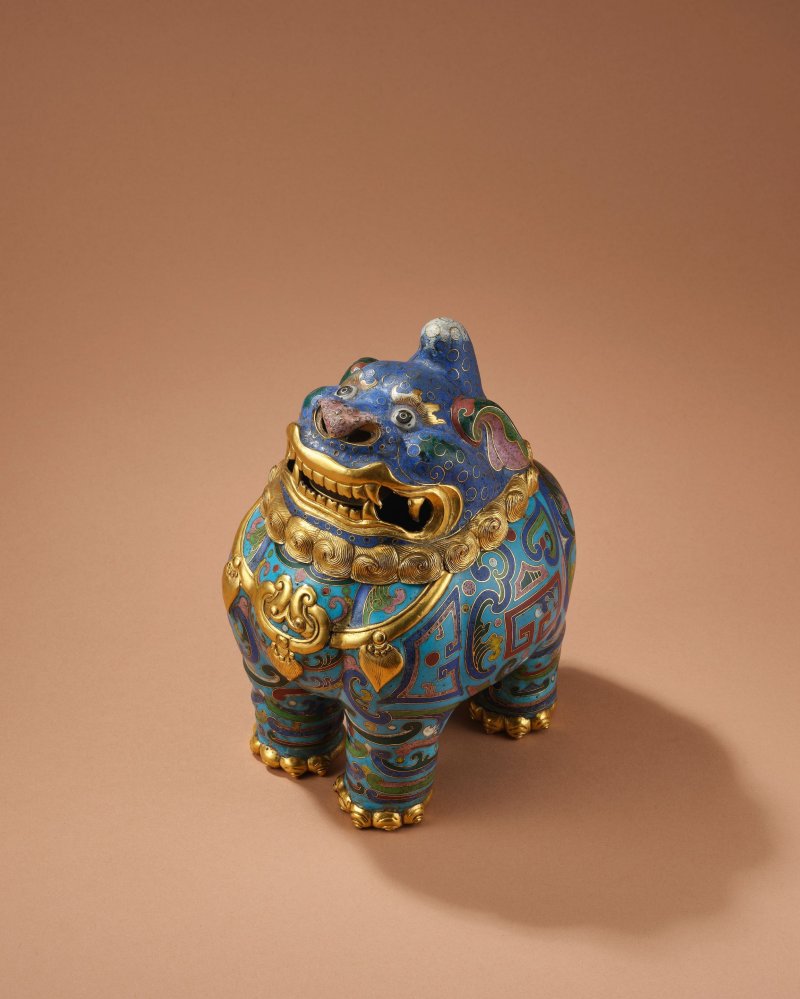
清乾隆/嘉慶 銅鎏金掐絲琺瑯甪端薰爐 | A CLOISONNÉ ENAMEL AND GILT-BRONZE 'LUDUAN' INCENSE BURNER AND COVER
年代
Qianlong/Jiaqing
起拍价
HKD 120,000
估值区间
HKD 120000 - 150000
尺寸
未知
品相
未知
更多信息
Qianlong/Jiaqing
Finely cast as a powerful mythical beast standing foursquare on sturdy legs with charmingly modelled gilt-bronze toes supporting a rotund body colourfully decorated in pink, yellow, green, blue and white enamels with archaistic curvilinear and geometric patterns, the single horned head rendered with great character, the bulging eyes beneath bushy brows, a flaring snout and open jaws revealing tongue and fangs, the rounded cheeks lending the creature an endearing grotesquerie, lined with gilt-bronze curly mane and connected with a hinged-joint to the body.
18.5cm (7 1/4in) high.
Footnotes
清乾隆/嘉慶 銅鎏金掐絲琺瑯甪端薰爐
Provenance:
Brigitte Mavromichalis (1926-2015), Geneva
來源:
Brigitte Mavromichalis(1926-2015),日內瓦
Born into a prominent Stockholm family in 1926, Brigitte Mavromichalis cultivated an early sensitivity to culture that would shape her life as a collector. Sent to Lausanne at the age of twenty to pursue academic studies, she met her future husband of Greek origin, with whom she maintained a Swiss residence while travelling widely and visiting museums across the world. Following his death in 1982, Mavromichalis continued to devote herself to art, music and sport, competing in bridge at an international level and remaining a discreet yet steadfast patron of the arts until her death in 2015. Her collection, assembled over several decades with complete independence of taste and without hierarchy of medium or style, embraced paintings, drawings and prints of striking variety. In 2023, the Musée d'Art du Valais in Sion received a bequest of forty-five works from her estate.
The form of the present cloisonné enamel incense burner, modelled as a , has a long history in Chinese Imperial decorative arts, with prototypes appearing as early as the Ming dynasty. See, for example, a Ming dynasty prototype of a cloisonné incense burner in the form of a , illustrated in the , Beijing, 2011, p.209, no.103.
Related cloisonné enamel incense burners in the shape of , mid Qing dynasty, in the Qing Court Collection, are illustrated in the , Beijing, 2011, p.121, no.73. See also a related gilt-bronze and cloisonné enamel incense burner, Qianlong, illustrated in , Suzhou, 2007, pp.60–61.
The is a legendary auspicious creature, generally depicted with the body of a lion, the head of a dragon, and a single horn. According to traditional Chinese belief, it was said to appear in times of peace and prosperity, and its presence heralded good governance and the avoidance of conflict. In Imperial art, the was employed as a motif for incense burners, ritual objects and architectural decoration, embodying auspiciousness, justice and vigilance. Its use as an incense burner was particularly apt, as smoke emerging from the creature's mouth could animate the fantastical form. The creature's association with good government and harmonious order made it an especially appropriate motif for objects produced for the Imperial Court.
Compare with a related Imperial cloisonné enamel incense burner in the form of a , incised Qianlong six-character mark and of the period, which was sold at Bonhams Hong Kong, 29 May 2023, lot 846.
Brigitte Mavromichalis(1926-2015)出身斯德哥爾摩名門,自幼耳濡目染,涵養出對文化藝術的敏銳感知,此後一生以收藏為志業。二十歲時赴洛桑求學,其間結識希臘裔之夫婿,婚後長居瑞士,常周遊列國,遍覽各地博物館。1982年夫婿辭世後,Brigitte仍傾心於藝術、音樂與運動,橋牌技藝達國際競賽水準,畢生低調而持續地贊助藝術,直至2015年離世。其收藏歷數十年積累而成,不受媒材或流派之限,全憑個人品味,涵蓋繪畫、素描與版畫,種類繁多,風格多元。2023年,錫永瓦萊美術館獲其遺贈四十五件藏品,蔚為珍藏。
此甪端香爐之形制,在中國宮廷裝飾藝術中淵源有自,其雛形可上溯至明代。參考一明代例子,著錄於《故宮博物院藏品大系:琺瑯器編1:元明掐絲琺瑯》,北京,2011年,頁209,編號103。
清宮舊藏數件清中期掐絲琺瑯甪端薰爐,錄於《故宮博物院藏品大系:琺瑯器編4:清掐絲琺瑯》,北京,2011年,頁121,編號73。另見乾隆時期一例,載於《絢麗.華貴.至尊:香港張宗憲先生珍藏御製宮廷掐絲琺瑯器特展》,蘇州,2007年,頁60及61。
甪端乃傳說中之瑞獸,其形常作獅身、龍首、獨角,最早見於中國古典文獻。相傳此獸唯現於太平盛世,其出現預示國泰民安、戰亂不起。在宮廷中,甪端常作為香爐、禮器及建築裝飾之題材,象徵吉祥、公正與警覺。以之製爐尤為適宜,蓋煙自口出,平添生動逼真之趣。此瑞獸象徵道德正直與國家和諧,與傳統儒家理想相繫,故廣見於宮廷用器。
比較香港邦瀚斯所售一件乾隆時期御製銅鎏金掐絲琺瑯纏枝番蓮紋甪端薰爐,「大清乾隆年製」楷書刻款,2023年5月29日,拍品編號846。
Finely cast as a powerful mythical beast standing foursquare on sturdy legs with charmingly modelled gilt-bronze toes supporting a rotund body colourfully decorated in pink, yellow, green, blue and white enamels with archaistic curvilinear and geometric patterns, the single horned head rendered with great character, the bulging eyes beneath bushy brows, a flaring snout and open jaws revealing tongue and fangs, the rounded cheeks lending the creature an endearing grotesquerie, lined with gilt-bronze curly mane and connected with a hinged-joint to the body.
18.5cm (7 1/4in) high.
Footnotes
清乾隆/嘉慶 銅鎏金掐絲琺瑯甪端薰爐
Provenance:
Brigitte Mavromichalis (1926-2015), Geneva
來源:
Brigitte Mavromichalis(1926-2015),日內瓦
Born into a prominent Stockholm family in 1926, Brigitte Mavromichalis cultivated an early sensitivity to culture that would shape her life as a collector. Sent to Lausanne at the age of twenty to pursue academic studies, she met her future husband of Greek origin, with whom she maintained a Swiss residence while travelling widely and visiting museums across the world. Following his death in 1982, Mavromichalis continued to devote herself to art, music and sport, competing in bridge at an international level and remaining a discreet yet steadfast patron of the arts until her death in 2015. Her collection, assembled over several decades with complete independence of taste and without hierarchy of medium or style, embraced paintings, drawings and prints of striking variety. In 2023, the Musée d'Art du Valais in Sion received a bequest of forty-five works from her estate.
The form of the present cloisonné enamel incense burner, modelled as a , has a long history in Chinese Imperial decorative arts, with prototypes appearing as early as the Ming dynasty. See, for example, a Ming dynasty prototype of a cloisonné incense burner in the form of a , illustrated in the , Beijing, 2011, p.209, no.103.
Related cloisonné enamel incense burners in the shape of , mid Qing dynasty, in the Qing Court Collection, are illustrated in the , Beijing, 2011, p.121, no.73. See also a related gilt-bronze and cloisonné enamel incense burner, Qianlong, illustrated in , Suzhou, 2007, pp.60–61.
The is a legendary auspicious creature, generally depicted with the body of a lion, the head of a dragon, and a single horn. According to traditional Chinese belief, it was said to appear in times of peace and prosperity, and its presence heralded good governance and the avoidance of conflict. In Imperial art, the was employed as a motif for incense burners, ritual objects and architectural decoration, embodying auspiciousness, justice and vigilance. Its use as an incense burner was particularly apt, as smoke emerging from the creature's mouth could animate the fantastical form. The creature's association with good government and harmonious order made it an especially appropriate motif for objects produced for the Imperial Court.
Compare with a related Imperial cloisonné enamel incense burner in the form of a , incised Qianlong six-character mark and of the period, which was sold at Bonhams Hong Kong, 29 May 2023, lot 846.
Brigitte Mavromichalis(1926-2015)出身斯德哥爾摩名門,自幼耳濡目染,涵養出對文化藝術的敏銳感知,此後一生以收藏為志業。二十歲時赴洛桑求學,其間結識希臘裔之夫婿,婚後長居瑞士,常周遊列國,遍覽各地博物館。1982年夫婿辭世後,Brigitte仍傾心於藝術、音樂與運動,橋牌技藝達國際競賽水準,畢生低調而持續地贊助藝術,直至2015年離世。其收藏歷數十年積累而成,不受媒材或流派之限,全憑個人品味,涵蓋繪畫、素描與版畫,種類繁多,風格多元。2023年,錫永瓦萊美術館獲其遺贈四十五件藏品,蔚為珍藏。
此甪端香爐之形制,在中國宮廷裝飾藝術中淵源有自,其雛形可上溯至明代。參考一明代例子,著錄於《故宮博物院藏品大系:琺瑯器編1:元明掐絲琺瑯》,北京,2011年,頁209,編號103。
清宮舊藏數件清中期掐絲琺瑯甪端薰爐,錄於《故宮博物院藏品大系:琺瑯器編4:清掐絲琺瑯》,北京,2011年,頁121,編號73。另見乾隆時期一例,載於《絢麗.華貴.至尊:香港張宗憲先生珍藏御製宮廷掐絲琺瑯器特展》,蘇州,2007年,頁60及61。
甪端乃傳說中之瑞獸,其形常作獅身、龍首、獨角,最早見於中國古典文獻。相傳此獸唯現於太平盛世,其出現預示國泰民安、戰亂不起。在宮廷中,甪端常作為香爐、禮器及建築裝飾之題材,象徵吉祥、公正與警覺。以之製爐尤為適宜,蓋煙自口出,平添生動逼真之趣。此瑞獸象徵道德正直與國家和諧,與傳統儒家理想相繫,故廣見於宮廷用器。
比較香港邦瀚斯所售一件乾隆時期御製銅鎏金掐絲琺瑯纏枝番蓮紋甪端薰爐,「大清乾隆年製」楷書刻款,2023年5月29日,拍品編號846。
常见问题
这件清乾隆/嘉慶 銅鎏金掐絲琺瑯甪端薰爐 | A CLOISONNÉ ENAMEL AND GILT-BRONZE 'LUDUAN' INCENSE BURNER AND COVER的成交价是多少?
落槌价为 预展中。 成交价为 预展中。