
拍品信息
拍品名称
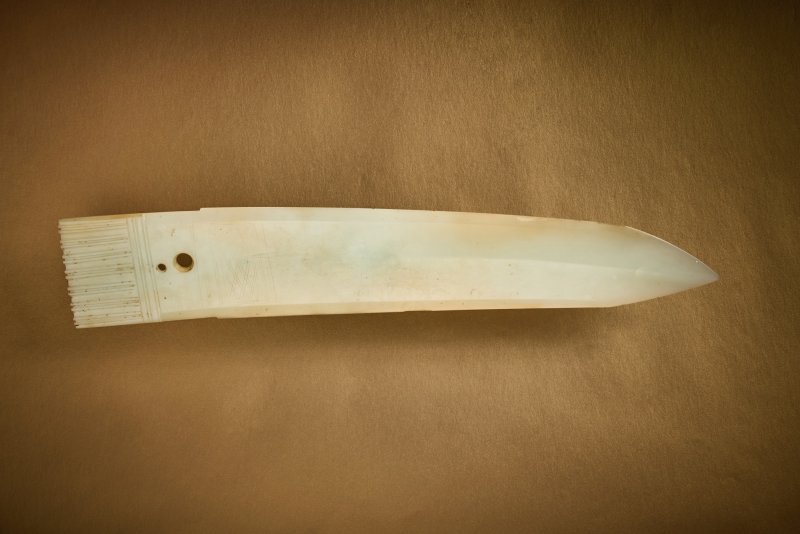
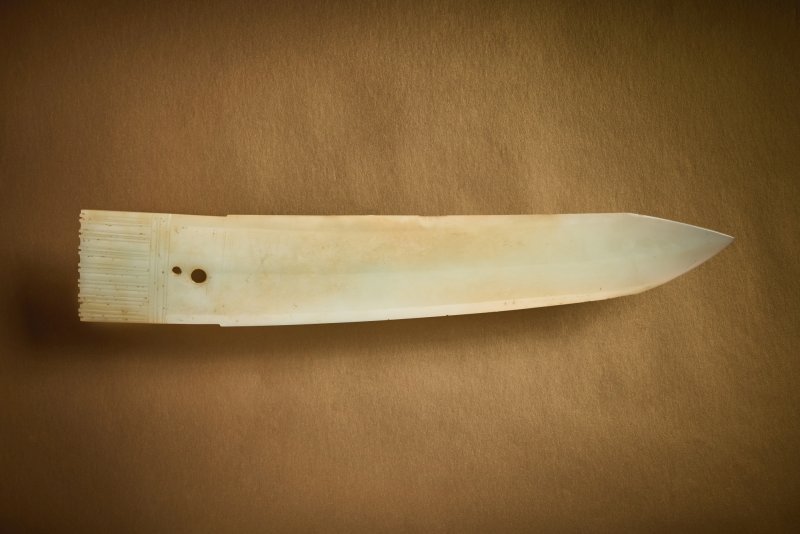
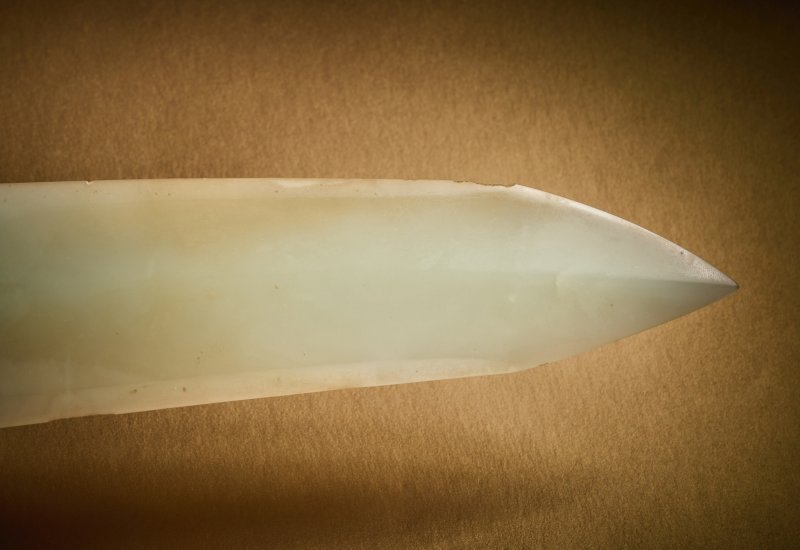
二里頭文化 玉戈
起拍价
USD 100,000
估值区间
100,000 - 150,000 USD
尺寸
未知
品相
如欲了解本拍品狀況的更多資訊,請聯絡 Drew.Lerner@sothebys.com
更多信息
Length 14⅝ in., 37 cm
来源:Angus Forsyth 收藏
Anthony Carter Ltd.,倫敦
展览:Angus Forsyth 及 Brian McElney,《Jades from China》,東亞藝術博物館,巴斯,1994年,編號75
著录:Roger Keverne,《Jade》, 倫敦,1991年,圖49
图录
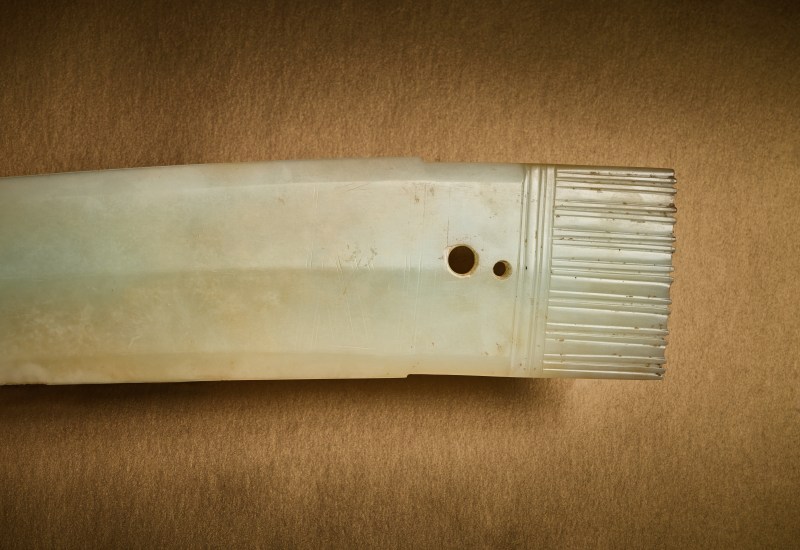
说明:The present blade is particularly noteworthy in the complexity of its handle design, with a finely incised lozenge design above a pair of drilled holes on a horizontal ground, and seven hafting flanges at the end of the tang. These flanges, based on — or produced concurrently with — bronze prototypes were presumably carved to accept a wooden handle but serve a dual function accentuating the beauty of the stone and the skill of the carver. While a small number of closely comparable blades survive, examples of this quality and size with seven divisions in the tang appear to be exceedingly rare.
Compare a closely related blade with a seven-flange tang from the Nelson-Atkins Museum, Kansas City, in Alfred Salmony, Chinese Jade Through the Wei Dynasty, New York, 1963, pl. 2 (Fig. 1), its handle also decorated with lozenge shapes but rendered in the more heavy Shang fashion; and another apparently very closely related blade uncovered from Shangguocun, Wenxi, Shanxi province, illustrated by line drawing in Jessica Rawson, Chinese Jade from the Neolithic to the Qing, London, 1995, p. 58, fig. 41, alongside a blade of more conventional five-flanged tang in the collection of the British Museum, London (accession no. 1945.10-17.74), p. 193, fig. 3; and a four-flanged example from the Hotung Collection of similar length but more typical Anyang style carving, pl. 10:23.
A related blade of slightly curved form but similarly slender with a hatched design and grooved tang from the Grenville L. Winthrop Collection is preserved at the Harvard Art Museums and illustrated in Max Loehr, Ancient Chinese Jades, Cambridge, 1975, pl. 45; another of very similar stone with its five-flange tang slightly more reserved from the curved blade is in the Victoria and Albert Museum, London (accession no. 71-1936) in Stanley Charles Nott, Chinese Jade throughout the Ages, London, 1936, pl. VI; and a miniature variation of this design with hafted tang and diamond pattern above the handle was uncovered from Tomb 120 at Qianzhangdan, Tengzhou, Shandong in Gu Fang, The Complete Collection of Jades Unearthed in China, vol. 4: Shandong, Beijing, 2005, p. 102.
来源:Angus Forsyth 收藏
Anthony Carter Ltd.,倫敦
展览:Angus Forsyth 及 Brian McElney,《Jades from China》,東亞藝術博物館,巴斯,1994年,編號75
著录:Roger Keverne,《Jade》, 倫敦,1991年,圖49
图录
说明:The present blade is particularly noteworthy in the complexity of its handle design, with a finely incised lozenge design above a pair of drilled holes on a horizontal ground, and seven hafting flanges at the end of the tang. These flanges, based on — or produced concurrently with — bronze prototypes were presumably carved to accept a wooden handle but serve a dual function accentuating the beauty of the stone and the skill of the carver. While a small number of closely comparable blades survive, examples of this quality and size with seven divisions in the tang appear to be exceedingly rare.
Compare a closely related blade with a seven-flange tang from the Nelson-Atkins Museum, Kansas City, in Alfred Salmony, Chinese Jade Through the Wei Dynasty, New York, 1963, pl. 2 (Fig. 1), its handle also decorated with lozenge shapes but rendered in the more heavy Shang fashion; and another apparently very closely related blade uncovered from Shangguocun, Wenxi, Shanxi province, illustrated by line drawing in Jessica Rawson, Chinese Jade from the Neolithic to the Qing, London, 1995, p. 58, fig. 41, alongside a blade of more conventional five-flanged tang in the collection of the British Museum, London (accession no. 1945.10-17.74), p. 193, fig. 3; and a four-flanged example from the Hotung Collection of similar length but more typical Anyang style carving, pl. 10:23.
A related blade of slightly curved form but similarly slender with a hatched design and grooved tang from the Grenville L. Winthrop Collection is preserved at the Harvard Art Museums and illustrated in Max Loehr, Ancient Chinese Jades, Cambridge, 1975, pl. 45; another of very similar stone with its five-flange tang slightly more reserved from the curved blade is in the Victoria and Albert Museum, London (accession no. 71-1936) in Stanley Charles Nott, Chinese Jade throughout the Ages, London, 1936, pl. VI; and a miniature variation of this design with hafted tang and diamond pattern above the handle was uncovered from Tomb 120 at Qianzhangdan, Tengzhou, Shandong in Gu Fang, The Complete Collection of Jades Unearthed in China, vol. 4: Shandong, Beijing, 2005, p. 102.
常见问题
拍品的品相状况如何?
如欲了解本拍品狀況的更多資訊,請聯絡 Drew.Lerner@sothebys.com
这件拍品的流传来源是什么?
Angus Forsyth 收藏
Anthony Carter Ltd.,倫敦
Anthony Carter Ltd.,倫敦
这件拍品曾在哪些展览中展出过?
Angus Forsyth 及 Brian McElney,《Jades from China》,東亞藝術博物館,巴斯,1994年,編號75
这件拍品被哪些著录书籍记载?
Roger Keverne,《Jade》, 倫敦,1991年,圖49
图录
图录