
Lot 420 宋 汝窯、官窯及張公巷瓷片三件 | Three Chinese Celadon Glazed Fragments, Song Dynasty
落槌价
****
成交价
****
拍品信息
拍品名称
宋 汝窯、官窯及張公巷瓷片三件 | Three Chinese Celadon Glazed Fragments, Song Dynasty
年代
Song Dynasty (960-1279)
起拍价
未知
估值区间
$1,500 - $2,000
尺寸
The largest length 2 7/8 in., 7.3 cm.
品相
Overall good visual condition, with minor to moderate signs of wear and earth degradation as expected; no restoration found under UV light.
更多信息
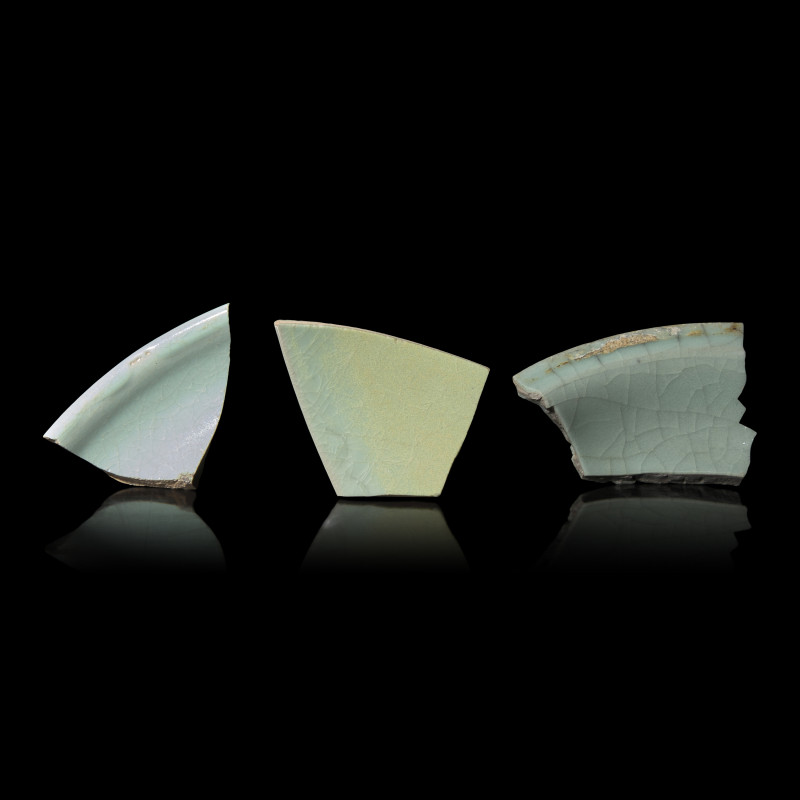
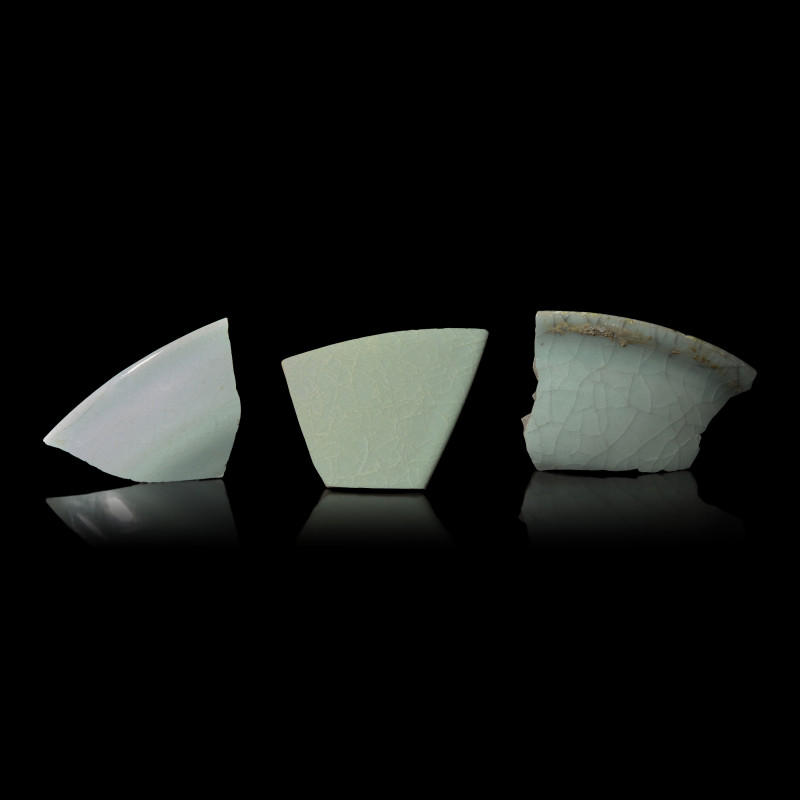
The group consists of three finely potted rim fragments with creamy glaze—one from a Ru ware dish, a Guan ware folded-rim basin, and a Zhanggongxiang ware piece, each displaying a distinct range of celadon tones, accompanied by a fitted brocade box.
Note:
This group comprises fragments of the three foremost celadon wares of the Song dynasty. The Ru ware fragment—characterized by a warm, thin glaze and a gently curving rim—finds its parallel in a complete example bearing the "Shouchengdian Huanghou Ge" inscription (Palace Museum, Beijing, 故-瓷-00145438).
The Guan ware fragment, covered in a crackled glaze over a dark, coarse body, preserves traces of an original wide silver mount, comparable to the silver-rimmed Jingdezhen liudouwen bowl excavated at Lu'an, Anhui, and now held in the Anhui Museum.
The Zhanggongxiang ware, brought to light in the early twenty-first century, has produced over thirty vessel types corresponding to those illustrated in the Xuanhe Bogu Tulu; its body is whiter and more refined than that of Qingliangsi Ru, while its glazes range from celadon-green to bean-green. In January 2026, a consensus of over fifty leading scholars formally recognized the Zhanggongxiang kiln as an imperial-status official kiln of the Song–Jin period.
注:
此組中汝窯殘釉色溫潤,胎薄體輕,口沿微弧,可與北京故宮博物院藏「壽成殿皇后閣」款完整器(故-瓷-00145438)相照。官窯殘片開片青釉覆於深灰粗胎之上,口緣存宋代原裝寬銀釦遺痕,參見安徽博物院藏六安東門外護城河出土的景德鎮窯柳斗紋銀釦小缽。張公巷窯發掘於本世紀初,迄今出土器形逾三十種,多與《宣和博古圖錄》所載相符。其胎質較清涼寺汝窯更為白細,釉色以青綠、豆青為主。2026年1月,經「汝州張公巷窯學術研討會」正式認定為宋金時期御用性質官窯。
Provenance:
Property from an American private collection.
來源:
美國私人收藏。
以下内容由AI翻译:
【名称】
宋 汝窯、官窯及張公巷瓷片三件
【年代】
宋 (960-1279)
【描述】
该组由三块精细制作的口沿碎片组成,釉色呈奶油色——一块来自汝窑盘,一块来自官窑折沿盆,还有一块来自张公巷窑,每块碎片都显示出不同的青釉色调,配有锦盒。
【品相】
整体视觉状况良好,有轻微至中等程度的磨损和土蚀现象,符合预期;在紫外光下未发现修复痕迹。
Note:
This group comprises fragments of the three foremost celadon wares of the Song dynasty. The Ru ware fragment—characterized by a warm, thin glaze and a gently curving rim—finds its parallel in a complete example bearing the "Shouchengdian Huanghou Ge" inscription (Palace Museum, Beijing, 故-瓷-00145438).
The Guan ware fragment, covered in a crackled glaze over a dark, coarse body, preserves traces of an original wide silver mount, comparable to the silver-rimmed Jingdezhen liudouwen bowl excavated at Lu'an, Anhui, and now held in the Anhui Museum.
The Zhanggongxiang ware, brought to light in the early twenty-first century, has produced over thirty vessel types corresponding to those illustrated in the Xuanhe Bogu Tulu; its body is whiter and more refined than that of Qingliangsi Ru, while its glazes range from celadon-green to bean-green. In January 2026, a consensus of over fifty leading scholars formally recognized the Zhanggongxiang kiln as an imperial-status official kiln of the Song–Jin period.
注:
此組中汝窯殘釉色溫潤,胎薄體輕,口沿微弧,可與北京故宮博物院藏「壽成殿皇后閣」款完整器(故-瓷-00145438)相照。官窯殘片開片青釉覆於深灰粗胎之上,口緣存宋代原裝寬銀釦遺痕,參見安徽博物院藏六安東門外護城河出土的景德鎮窯柳斗紋銀釦小缽。張公巷窯發掘於本世紀初,迄今出土器形逾三十種,多與《宣和博古圖錄》所載相符。其胎質較清涼寺汝窯更為白細,釉色以青綠、豆青為主。2026年1月,經「汝州張公巷窯學術研討會」正式認定為宋金時期御用性質官窯。
Provenance:
Property from an American private collection.
來源:
美國私人收藏。
以下内容由AI翻译:
【名称】
宋 汝窯、官窯及張公巷瓷片三件
【年代】
宋 (960-1279)
【描述】
该组由三块精细制作的口沿碎片组成,釉色呈奶油色——一块来自汝窑盘,一块来自官窑折沿盆,还有一块来自张公巷窑,每块碎片都显示出不同的青釉色调,配有锦盒。
【品相】
整体视觉状况良好,有轻微至中等程度的磨损和土蚀现象,符合预期;在紫外光下未发现修复痕迹。
常见问题
拍品的品相状况如何?
Overall good visual condition, with minor to moderate signs of wear and earth degradation as expected; no restoration found under UV light.
拍品的尺寸是多少?
The largest length 2 7/8 in., 7.3 cm.