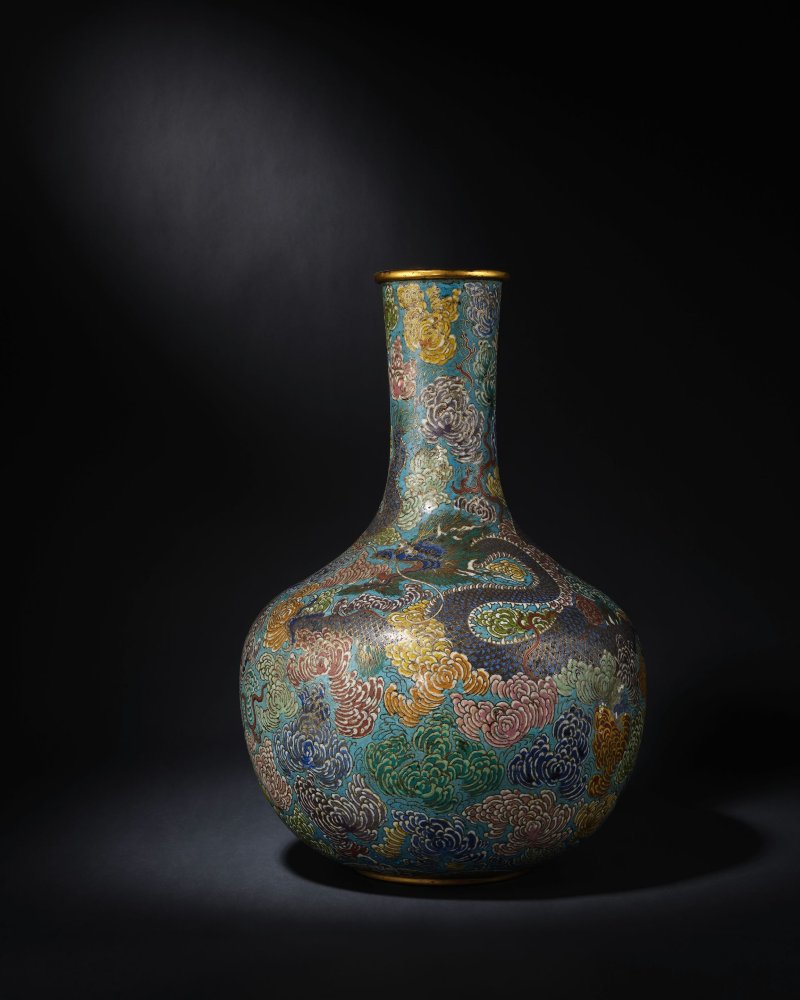

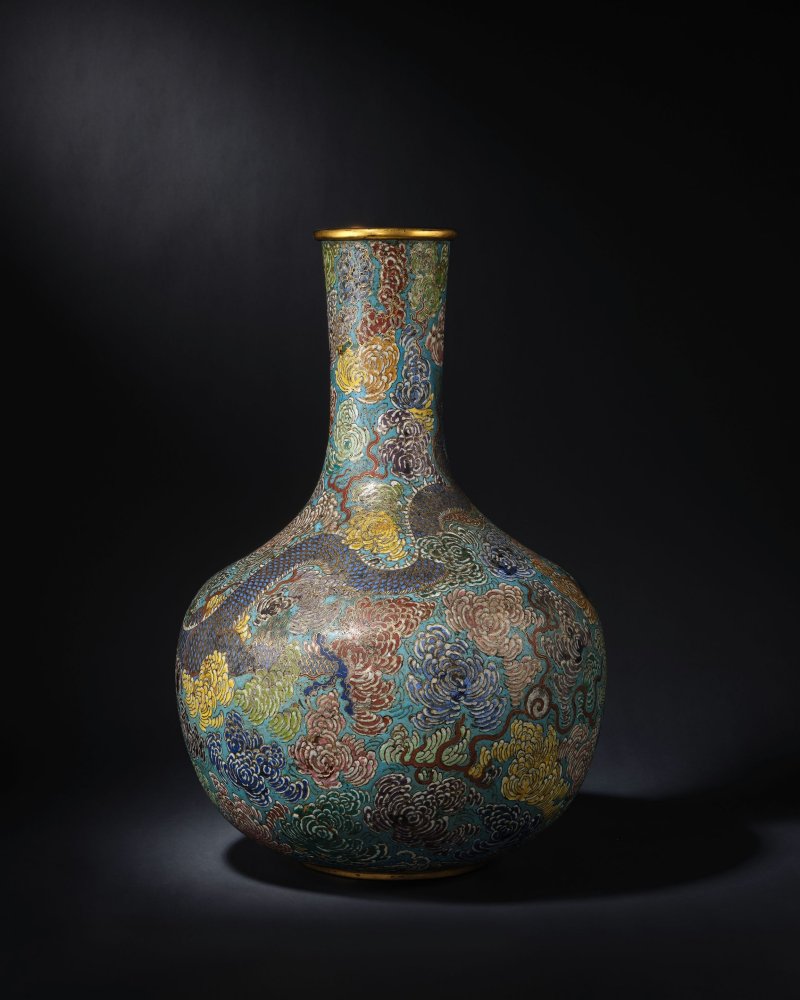
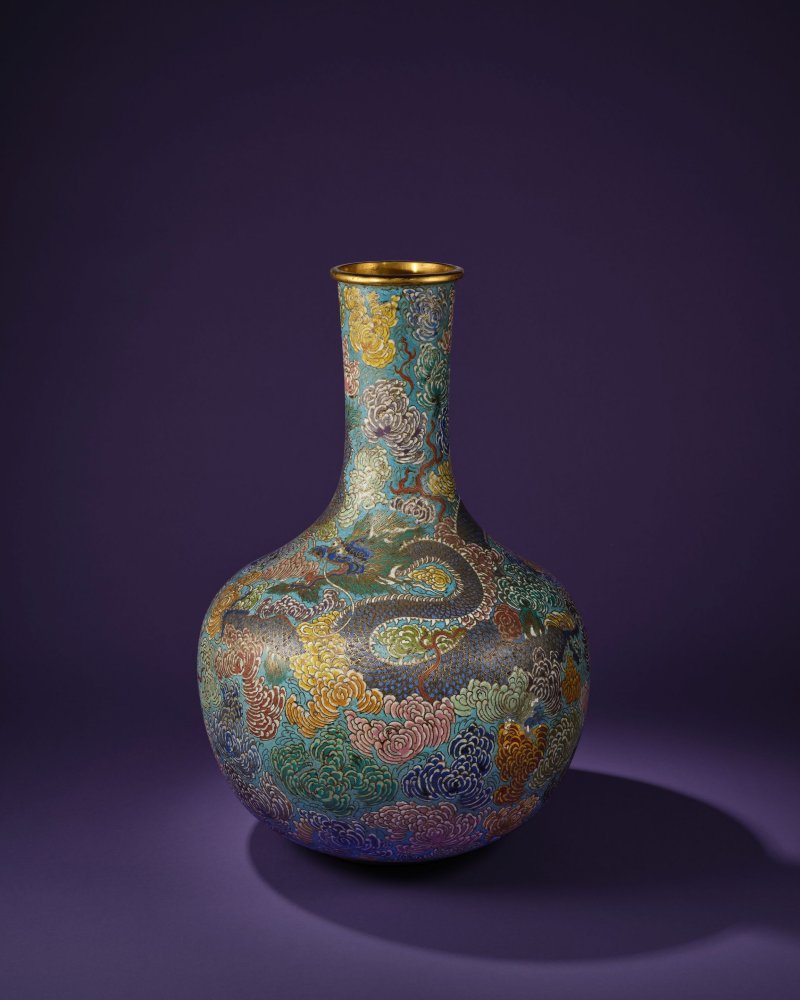
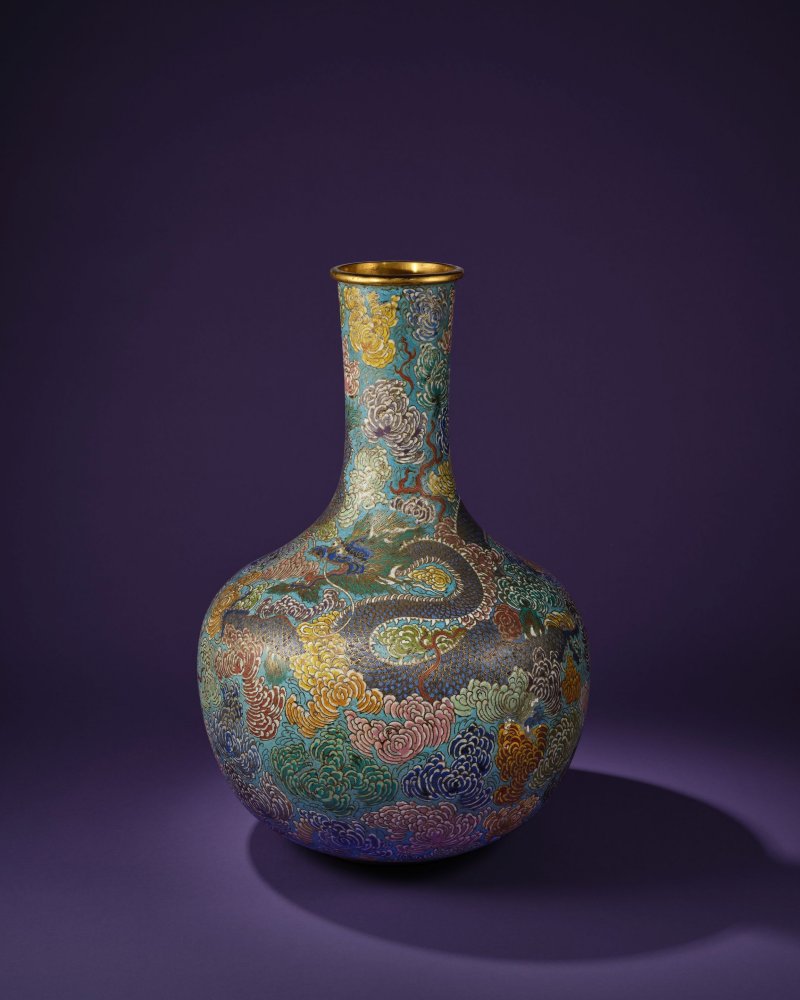
Lot 38 清雍正/乾隆 掐絲琺瑯逐珠雲龍紋天球瓶 | AN EXTREMELY RARE AND LARGE CLOISONNÉ ENAMEL 'DRAGON AND CLOUD' TIANQIUPING
落槌价
预展中
成交价
预展中
| 拍卖公司 | 邦瀚斯 |
|---|---|
| 拍卖时间 | 2026年10月28日 |
拍品信息
拍品名称
清雍正/乾隆 掐絲琺瑯逐珠雲龍紋天球瓶 | AN EXTREMELY RARE AND LARGE CLOISONNÉ ENAMEL 'DRAGON AND CLOUD' TIANQIUPING
年代
Yongzheng/Qianlong
起拍价
HKD 7,000,000
估值区间
HKD 7000000 - 10000000
尺寸
未知
品相
未知
更多信息
Yongzheng/Qianlong
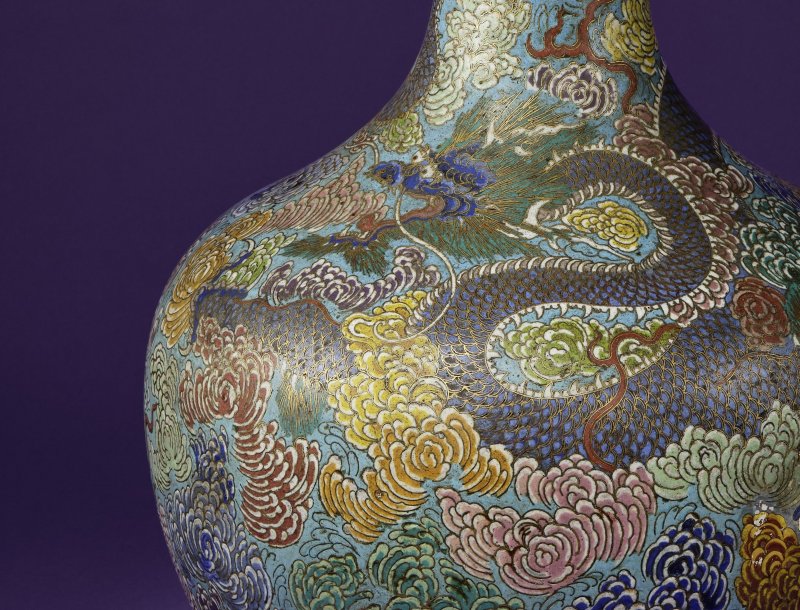
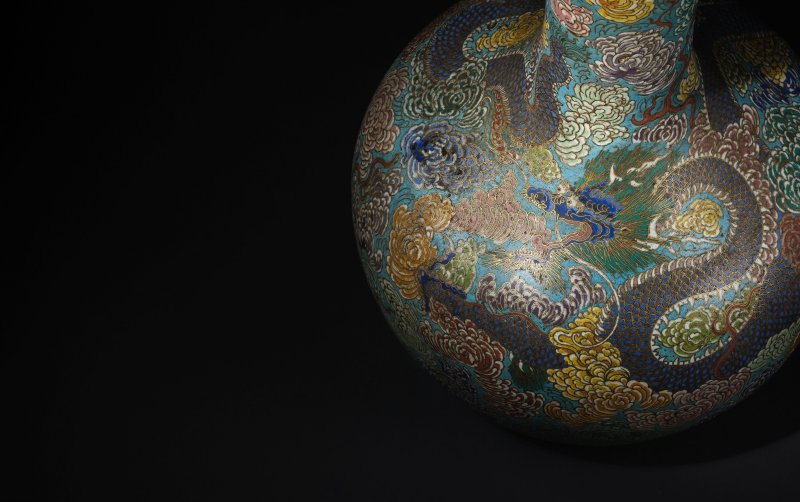
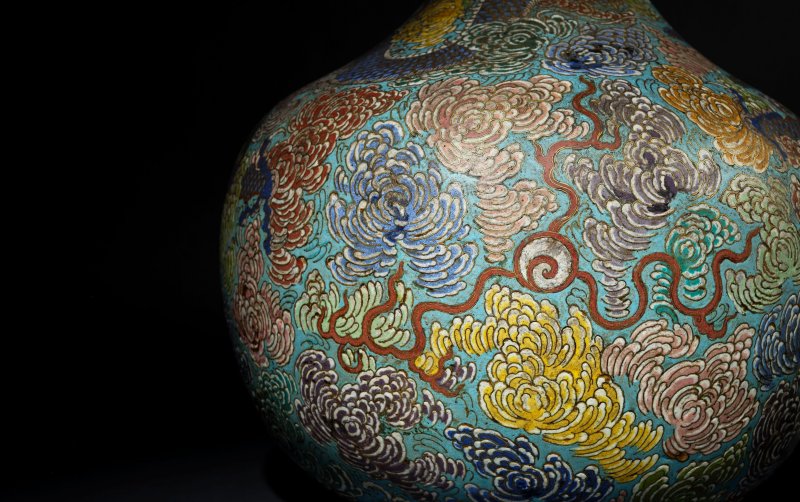
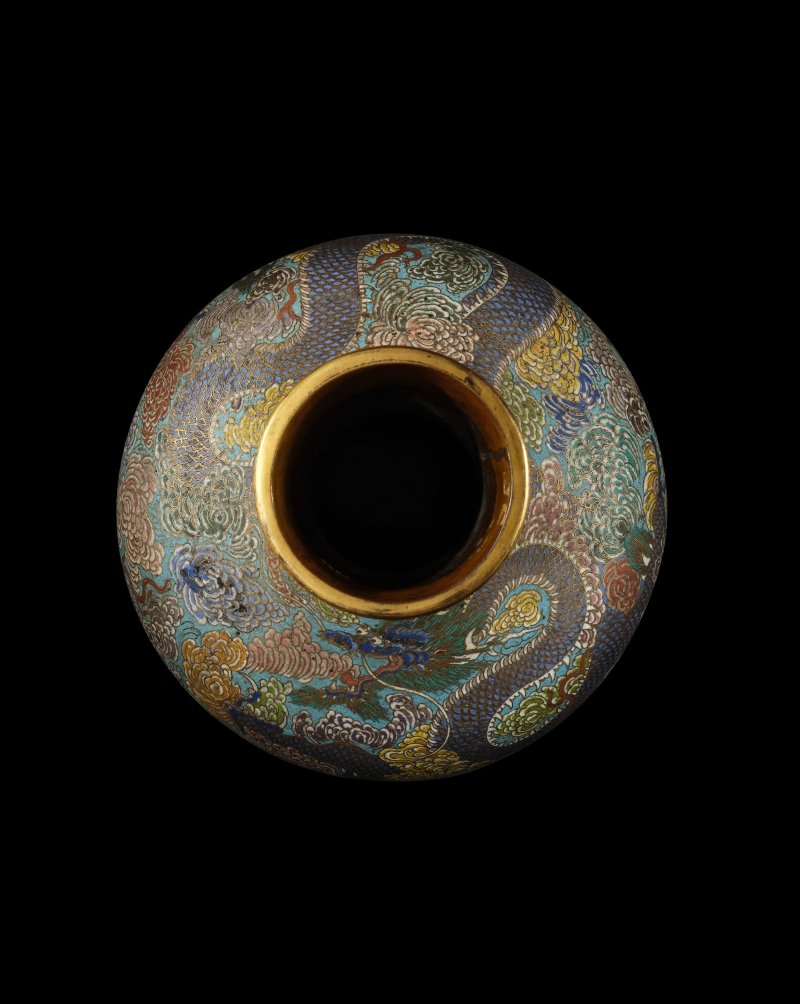
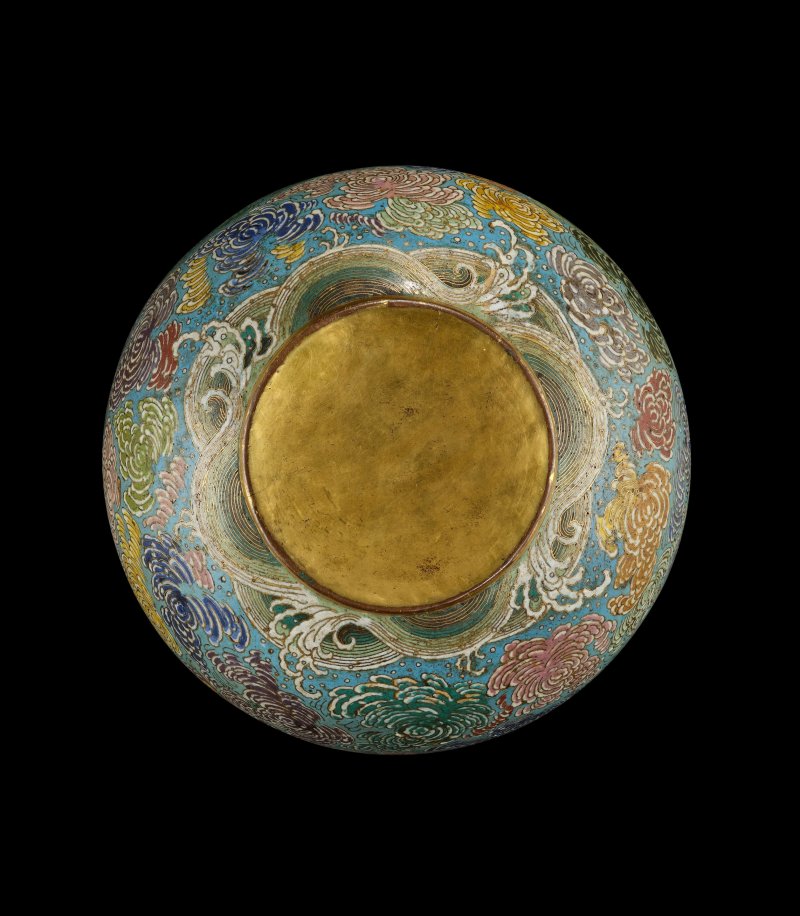
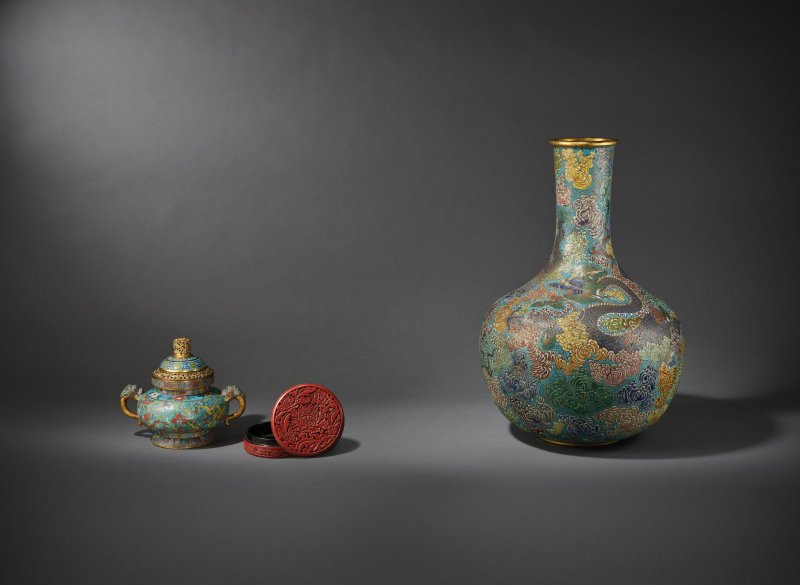
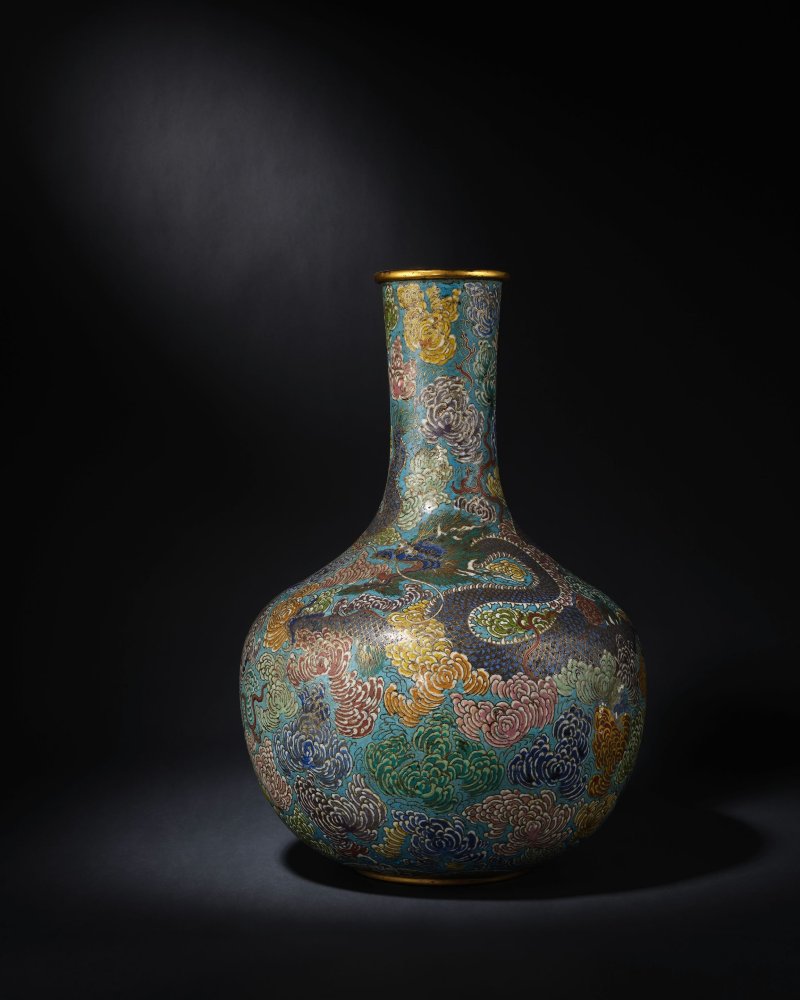
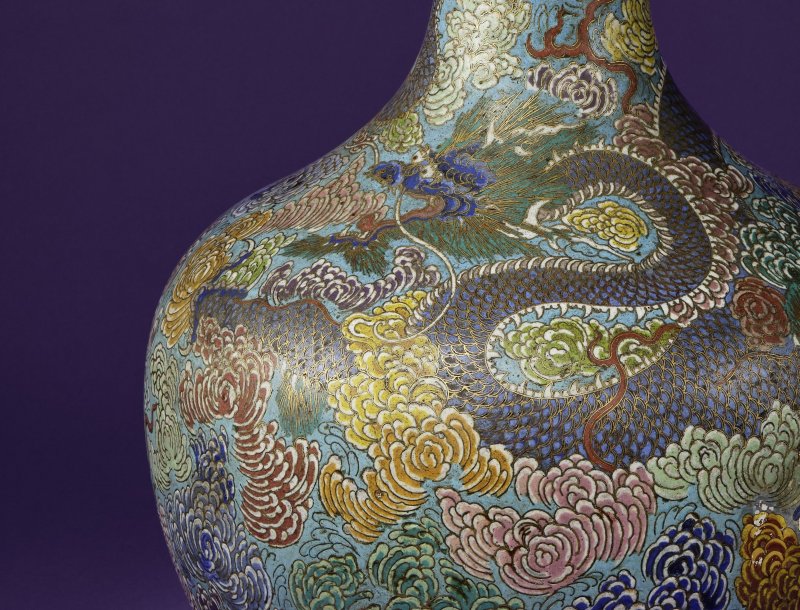
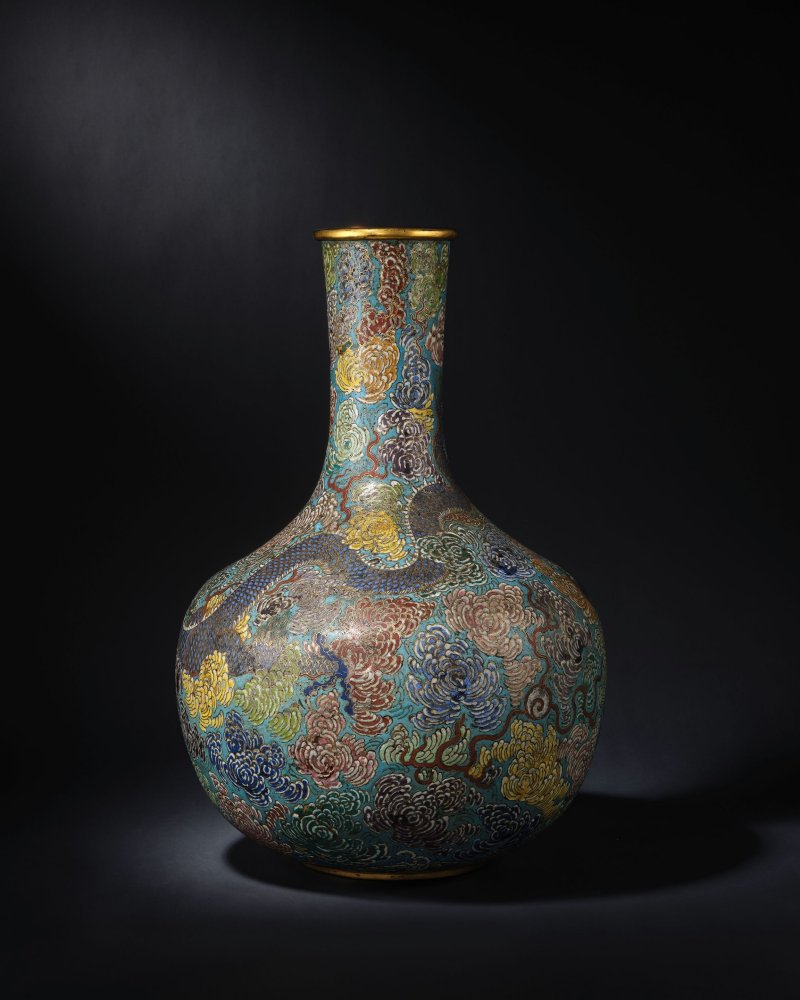
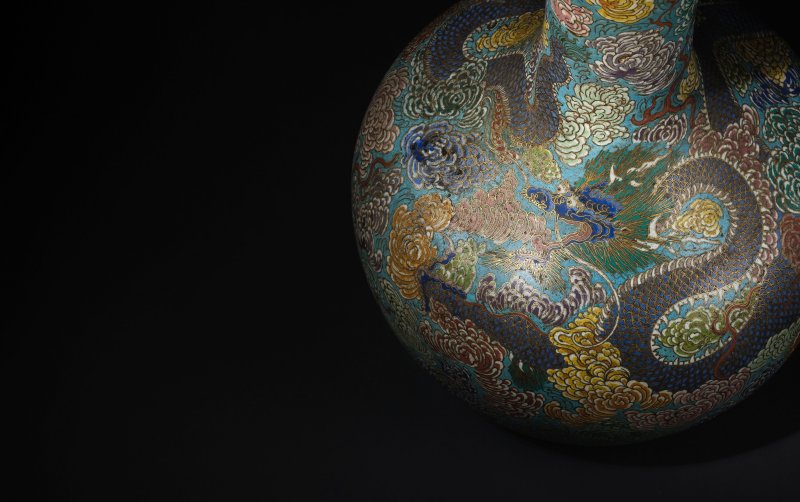
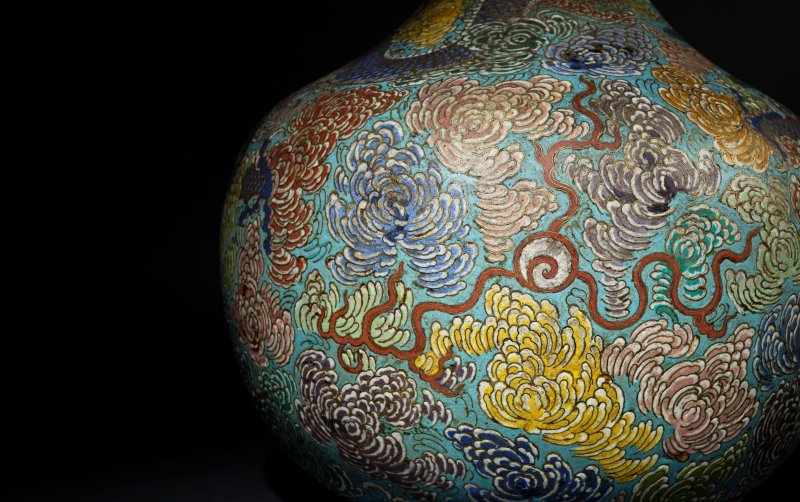
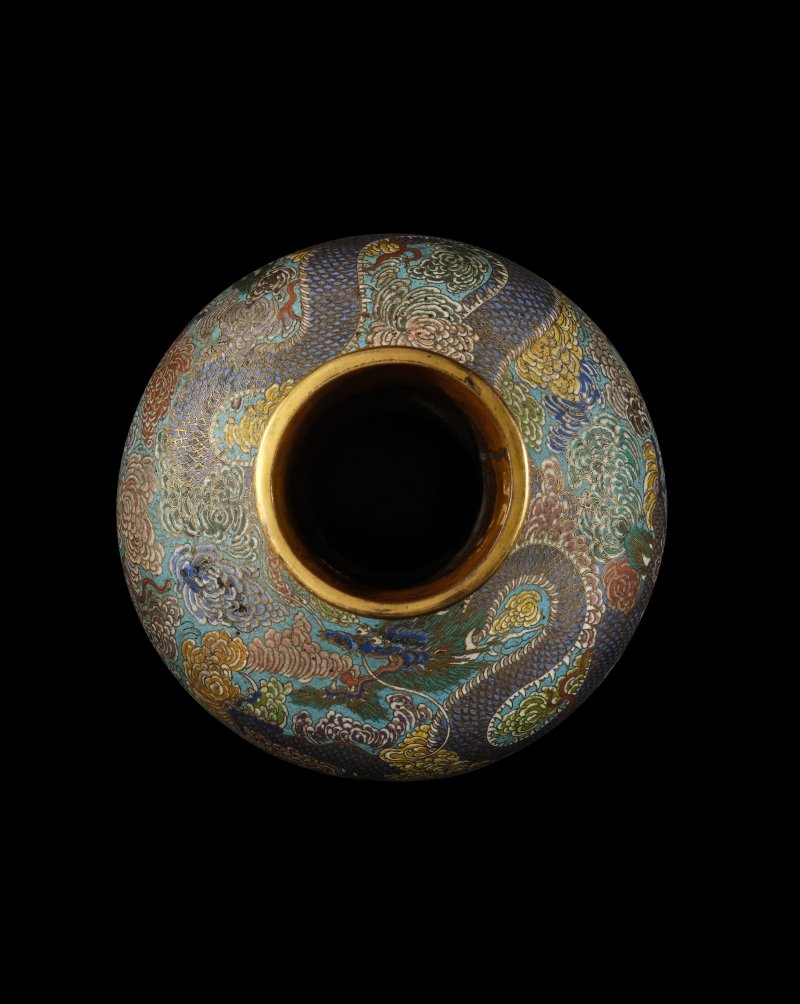
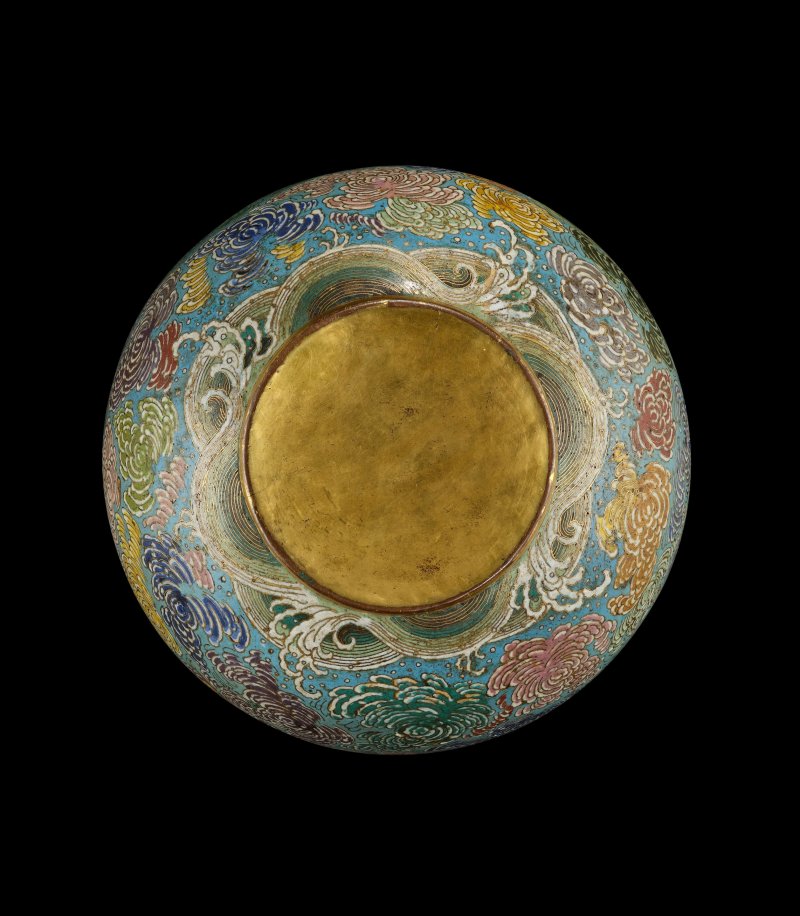
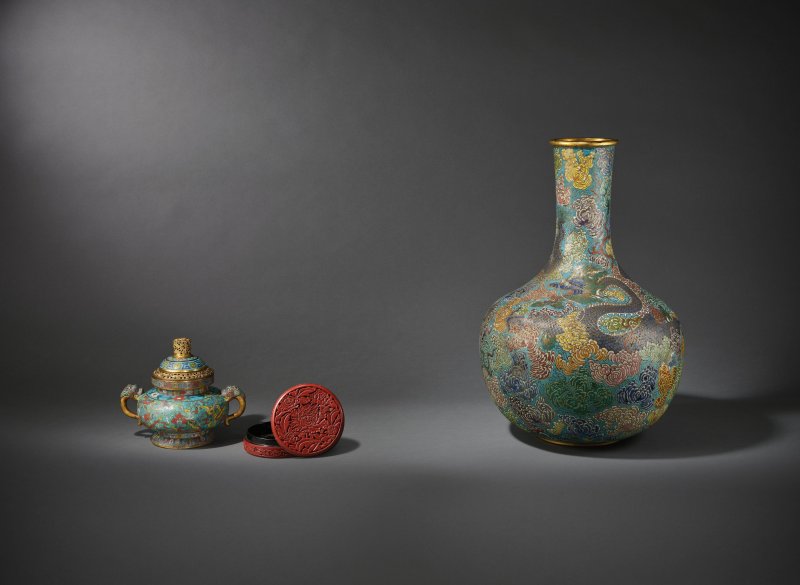
Monumental in scale, this exceptional tianqiuping with a globular body resting on a countersunk gilt-decorated base, generously cast with broad shoulders gracefully sweeping up a tall cylindrical neck with a gilt-lipped mouth rim, the exterior masterfully decorated in vivid enamels with a ferocious dragon, its sapphire-blue face framed by a well-defined emerald-green mane, its muscular body covered with double-outlined azure scales, the beast sinuously striding through an expanse of radiant variegated clouds enamelled in red, pink, yellow, orange, green, blue and purple, with layering swirls resembling petals of blooming peonies, above a band of swelling waves encircling the foot, all meticulously accentuated with thin gilt-bronze cloisons.
57.4cm (22 1/2in) high.
Footnotes
清雍正/乾隆 掐絲琺瑯逐珠雲龍紋天球瓶
Provenance:
Sotheby's London, 12 June 1990, lot 52
Sir Peter Moores (1932-2016), Parbold Hall, United Kingdom
Sotheby's London, 9 November 2011, lot 401
倫敦蘇富比,1990年6月12日,拍品編號52
彼得.摩爾爵士(Sir Peter Moores,1932-2016),Parbold Hall,英國
倫敦蘇富比,2011年11月9日,拍品編號401
This vase was formerly in the collection of Sir Peter Moores (1932-2016) in the United Kingdom. A prominent British businessman and philanthropist, Moores served as chairman of Littlewoods, the Liverpool-based retail and football pools empire founded by his father. His philanthropic legacy includes the notable acquisition and restoration of Compton Verney House in Warwickshire – the eventual public home for his Chinese bronze collection. Driven by a deep appreciation for Chinese art sparked during a visit to Washington, Moores has spent half a century gathering these treasures, which include the present magnificent , which was kept at his private residence, Parbold Hall.
Monumental in scale, richly decorated with a ferocious dragon, this exceptional vase is a testament to the Imperial grandeur and technical brilliance of the Qing dynasty at its height. The masterful interplay of vibrant enamels and meticulously rendered cloisons brings to life the dynamic spirit of the mythical beast, striding through an expanse of radiant clouds above surging waves. The radiating gilt-enhanced mane, as well as the double-outlined scales on the muscular body, is particularly noteworthy. It underscores the unparalleled craftsmanship of the Imperial workshop during the Yongzheng and Qianlong periods.
This vase is possibly unique, and only one other cloisonné enamel vessel of similar size and design is known (57.3cm). It is, however, decorated chiefly in red, white, and blue, presumably adhering more closely to the Yongzheng period porcelain prototype, and thus attributed to the earlier reign. However, aside from the difference in colour palette, the two vases are almost identical in terms of composition and detail rendering. From the treatment of the mane and meticulously double-outlined scales, to the fluffy clouds resembling blooming peonies, the close similarities strongly suggest that these two monumental vessels were conceived by the same artisan and produced within the same atelier, likely around the same time. The Yongzheng vase was exhibited at Grosvenor House in London in 1988, and was later sold from an English private collection at Sotheby's Hong Kong, 2 October 2017, lot 102.
Decorated with a crimson dragon against blue-and-white fluffy clouds above foaming waves, the other vase evokes the visual effect of contemporaneous underglazed red-and-blue vessels. Closely related Yongzheng mark and period porcelain vases of this form are known. See one inscribed with a reign mark under its mouth, painted with a similar three-clawed dragon in copper red against cobalt-blue scrolling clouds, which is illustrated in G.Eskenazi and H.Elias, , London, 2012, p.166, fig.158, and which was sold three times at Sotheby's Hong Kong: 2 May 1995, lot 118, 7 May 2002, lot 580 and 31 October 2004, lot 25.
Cloisonné enamel vessels of this shape and motif were popular throughout the Qing dynasty. Compare with a slightly shorter (46cm), decorated with a red dragon amongst blue clouds, Qianlong, sold at Bonhams Hong Kong, 29 May 2022, lot 137. A related mid-Qing large with a red dragon among blue clouds on a white ground (41.9cm), from the Qing Court Collection, is illustrated in , Hong Kong, 2001, pl.146.
The scrolling clouds on this vase are brilliantly rendered in multicoloured enamels including red, pink, yellow, orange, green, and purple. In cosmology and omen lore, the appearance of multicoloured clouds was taken as a sign of heavenly favour, the presence of Immortals, or the birth of a sage ruler. Their hues also signify the harmonious balance of the cosmos. Yang Yong states that the motif of a dominant dragon writhing among scrolling clouds could also be read as a reference to an Emperor being surrounded by virtuous and competent officials, therefore forming a good omen for a peaceful and prosperous reign. The shimmering enamels, with their jewel-like palette, were particularly suited to evoke this effect, making the vessel itself radiate an aura of celestial blessing.
Having ascended the throne amid rumours of usurpation, the Yongzheng Emperor was known as a firm believer in portents of good fortune to bolster his legitimacy. His fondness for multicoloured clouds was most apparent between the 7th and the 10th years of his reign (1729-1732), when such auspicious scenes were recorded several times in the Palace memorials presented to the Emperor. The Imperial archives also recorded that paintings depicting such a particular type of clouds were ordered by the Yongzheng Emperor in 1730; see Lin Lina, 'Auspicious symbols and scenes of the Yongzheng period', in Feng Mingzhu, , Taipei, 2009, pp.374-399.
Rainbow-coloured clouds remained favoured in the subsequent reign. A Qianlong mark and period cloisonné waterpot decorated with stylised striding through multicoloured clouds (acc.no.gufa000549), and a heated inkstone set with five-clawed dragons amidst vividly coloured clouds (acc.no.gufa001022), both from the Qing Court Collection and now preserved in the Palace Museum, Taipei, are illustrated in , Taipei, 2022, nos. I-29 and II-25.
此瓶來源顯赫,乃英國企業及慈善大家彼得.摩爾爵士(Sir Peter Moores)故藏。摩爾之父創立利物浦零售及足球彩票帝國 Littlewoods,赫赫有名,子從父業,青出於藍。他購入沃里克郡(Warwickshire)康普頓莊園(Compton Verney House),修葺改作藝術館之用,陳列包括其中國青銅藏品。多年前摩爾在一趟華盛頓旅程中,深受中國藝術之美感動,遂窮半世紀之功蒐集珍品,此天球瓶即為當中佳例,多年來珍存府邸 Parbold Hall,至摩爾臨近耋耄之年方始釋出。
此天球瓶宏碩雄渾,見證盛清宮廷氣派,其工藝精湛卓絕之至,無出其右。鎏金絲勾勒精細,工藝一絲不苟,彩料絢麗多變,行龍穿雲一剎,栩栩如生,彷彿大權在握,天威盡顯。龍首寶藍,配上髮冠翠青,鎏金掐絲呈放射之狀,威風凜凜。軀體矯健,身披天青色鱗片,盡皆雙線勾勒,細膩入微。蜿蜒卓姿,逐珠穿梭絢麗彩雲間,紅粉競豔,黃橙爭鮮,青藍相輔,紫藕共妍,煙卷雲繞之間,宛若疊瓣牡丹,傲然綻放。瓶腹下方環添波濤洶湧,更顯磅礴。凡此種種,無不彰顯雍乾年間之匠心神技。
如此絕作,或為孤品。論尺寸、構圖,近例僅一(57.3厘米),卻只採紅、白、藍三色,與雍正年製署款青花釉裏紅相似,遂斷年略早。然細觀兩器,儘管用色有別,兩件天球瓶在構圖與細節處理上卻如出一轍。從龍首濃密鬃毛、身軀雙勾鱗片,以至宛如盛綻牡丹之祥雲,皆與此類,故推測其源應極為相近,應出自同一作坊,或同稿同匠,製作時間相若。斷代雍正之天球瓶,曾於1988年在倫敦格羅夫納別墅(Grosvenor House)展出,後從英國私人收藏釋出,於2017年10月2日在香港蘇富比易手(拍品編號102)。
該瓶飾以紅龍傲遊藍白雲海間,應乃模擬同期之青花釉裏紅。參考清雍正御製天球瓶例,口沿下署六字年款,器腹以釉下銅紅三爪行龍,青花祥雲縈繞,構圖與此近,收入埃斯卡納齊,薛好佩整理,《中國藝術品經眼錄:埃斯卡納齊的回憶》,倫敦,2012年,頁166,圖158;該器曾三度售於香港蘇富比:1995年5月2日,拍品編號118、2002年5月7日,拍品編號580,以及2004年10月31日,拍品編號25。
有清一朝,掐絲琺瑯龍紋天球瓶續為風行。比較一尺寸略小之天球瓶(46厘米),紅龍藍雲,斷代乾隆,2022年5月29日售於香港邦瀚斯,拍品編號137。清宮舊藏另有一件清中期之白地青雲紅龍天球瓶(41.9厘米),載於《故宮博物院藏文物珍品全集:金屬胎琺瑯器》,香港,2001年,圖版146。
此品上之祥雲,敷以紅、粉、黃、橙、綠、藍、紫等彩料,絢麗多姿奪目。傳說五彩祥雲乍現,乃天降祥瑞、仙人降臨或聖君誕生之吉兆,代表孝德豐稔之瑞應。色彩相輝映,萬物衡和諧。楊勇指出,蒼龍祥雲伴,可解讀為君王得賢臣輔佐之象,預示盛世清平。以琺瑯彩料展示如此禎祥佳兆,麗色斑駁,如寶石閃耀,尤為宜適。
雍正帝登基,奪嫡之說四起,故其深信祥瑞之兆,藉以強調其承襲正統。雍正七至十年間(1729-1732),世宗對慶雲的青睞尤為顯著,時有奏報慶雲疊現之瑞象。清宮檔案載,雍正八年(1730)更詔旨著唐岱繪製慶雲獻瑞手卷;參見林莉娜,〈雍正朝之祥瑞符應〉,收錄於馮明珠編,《雍正:清世宗文物大展》,台北,2009年,頁374至399,尤頁392。
彩雲紋飾,乾隆續興。參考台北故宮博物院清宮舊藏清乾隆掐絲琺瑯彩雲摩竭紋雙喜鉢盂(故琺000549)及掐絲琺瑯五爪雲龍紋暖硯(故琺001022),俱載於《謎樣景泰藍》,台北,2022年,編號 I-29 及 II-25。
Monumental in scale, this exceptional tianqiuping with a globular body resting on a countersunk gilt-decorated base, generously cast with broad shoulders gracefully sweeping up a tall cylindrical neck with a gilt-lipped mouth rim, the exterior masterfully decorated in vivid enamels with a ferocious dragon, its sapphire-blue face framed by a well-defined emerald-green mane, its muscular body covered with double-outlined azure scales, the beast sinuously striding through an expanse of radiant variegated clouds enamelled in red, pink, yellow, orange, green, blue and purple, with layering swirls resembling petals of blooming peonies, above a band of swelling waves encircling the foot, all meticulously accentuated with thin gilt-bronze cloisons.
57.4cm (22 1/2in) high.
Footnotes
清雍正/乾隆 掐絲琺瑯逐珠雲龍紋天球瓶
Provenance:
Sotheby's London, 12 June 1990, lot 52
Sir Peter Moores (1932-2016), Parbold Hall, United Kingdom
Sotheby's London, 9 November 2011, lot 401
倫敦蘇富比,1990年6月12日,拍品編號52
彼得.摩爾爵士(Sir Peter Moores,1932-2016),Parbold Hall,英國
倫敦蘇富比,2011年11月9日,拍品編號401
This vase was formerly in the collection of Sir Peter Moores (1932-2016) in the United Kingdom. A prominent British businessman and philanthropist, Moores served as chairman of Littlewoods, the Liverpool-based retail and football pools empire founded by his father. His philanthropic legacy includes the notable acquisition and restoration of Compton Verney House in Warwickshire – the eventual public home for his Chinese bronze collection. Driven by a deep appreciation for Chinese art sparked during a visit to Washington, Moores has spent half a century gathering these treasures, which include the present magnificent , which was kept at his private residence, Parbold Hall.
Monumental in scale, richly decorated with a ferocious dragon, this exceptional vase is a testament to the Imperial grandeur and technical brilliance of the Qing dynasty at its height. The masterful interplay of vibrant enamels and meticulously rendered cloisons brings to life the dynamic spirit of the mythical beast, striding through an expanse of radiant clouds above surging waves. The radiating gilt-enhanced mane, as well as the double-outlined scales on the muscular body, is particularly noteworthy. It underscores the unparalleled craftsmanship of the Imperial workshop during the Yongzheng and Qianlong periods.
This vase is possibly unique, and only one other cloisonné enamel vessel of similar size and design is known (57.3cm). It is, however, decorated chiefly in red, white, and blue, presumably adhering more closely to the Yongzheng period porcelain prototype, and thus attributed to the earlier reign. However, aside from the difference in colour palette, the two vases are almost identical in terms of composition and detail rendering. From the treatment of the mane and meticulously double-outlined scales, to the fluffy clouds resembling blooming peonies, the close similarities strongly suggest that these two monumental vessels were conceived by the same artisan and produced within the same atelier, likely around the same time. The Yongzheng vase was exhibited at Grosvenor House in London in 1988, and was later sold from an English private collection at Sotheby's Hong Kong, 2 October 2017, lot 102.
Decorated with a crimson dragon against blue-and-white fluffy clouds above foaming waves, the other vase evokes the visual effect of contemporaneous underglazed red-and-blue vessels. Closely related Yongzheng mark and period porcelain vases of this form are known. See one inscribed with a reign mark under its mouth, painted with a similar three-clawed dragon in copper red against cobalt-blue scrolling clouds, which is illustrated in G.Eskenazi and H.Elias, , London, 2012, p.166, fig.158, and which was sold three times at Sotheby's Hong Kong: 2 May 1995, lot 118, 7 May 2002, lot 580 and 31 October 2004, lot 25.
Cloisonné enamel vessels of this shape and motif were popular throughout the Qing dynasty. Compare with a slightly shorter (46cm), decorated with a red dragon amongst blue clouds, Qianlong, sold at Bonhams Hong Kong, 29 May 2022, lot 137. A related mid-Qing large with a red dragon among blue clouds on a white ground (41.9cm), from the Qing Court Collection, is illustrated in , Hong Kong, 2001, pl.146.
The scrolling clouds on this vase are brilliantly rendered in multicoloured enamels including red, pink, yellow, orange, green, and purple. In cosmology and omen lore, the appearance of multicoloured clouds was taken as a sign of heavenly favour, the presence of Immortals, or the birth of a sage ruler. Their hues also signify the harmonious balance of the cosmos. Yang Yong states that the motif of a dominant dragon writhing among scrolling clouds could also be read as a reference to an Emperor being surrounded by virtuous and competent officials, therefore forming a good omen for a peaceful and prosperous reign. The shimmering enamels, with their jewel-like palette, were particularly suited to evoke this effect, making the vessel itself radiate an aura of celestial blessing.
Having ascended the throne amid rumours of usurpation, the Yongzheng Emperor was known as a firm believer in portents of good fortune to bolster his legitimacy. His fondness for multicoloured clouds was most apparent between the 7th and the 10th years of his reign (1729-1732), when such auspicious scenes were recorded several times in the Palace memorials presented to the Emperor. The Imperial archives also recorded that paintings depicting such a particular type of clouds were ordered by the Yongzheng Emperor in 1730; see Lin Lina, 'Auspicious symbols and scenes of the Yongzheng period', in Feng Mingzhu, , Taipei, 2009, pp.374-399.
Rainbow-coloured clouds remained favoured in the subsequent reign. A Qianlong mark and period cloisonné waterpot decorated with stylised striding through multicoloured clouds (acc.no.gufa000549), and a heated inkstone set with five-clawed dragons amidst vividly coloured clouds (acc.no.gufa001022), both from the Qing Court Collection and now preserved in the Palace Museum, Taipei, are illustrated in , Taipei, 2022, nos. I-29 and II-25.
此瓶來源顯赫,乃英國企業及慈善大家彼得.摩爾爵士(Sir Peter Moores)故藏。摩爾之父創立利物浦零售及足球彩票帝國 Littlewoods,赫赫有名,子從父業,青出於藍。他購入沃里克郡(Warwickshire)康普頓莊園(Compton Verney House),修葺改作藝術館之用,陳列包括其中國青銅藏品。多年前摩爾在一趟華盛頓旅程中,深受中國藝術之美感動,遂窮半世紀之功蒐集珍品,此天球瓶即為當中佳例,多年來珍存府邸 Parbold Hall,至摩爾臨近耋耄之年方始釋出。
此天球瓶宏碩雄渾,見證盛清宮廷氣派,其工藝精湛卓絕之至,無出其右。鎏金絲勾勒精細,工藝一絲不苟,彩料絢麗多變,行龍穿雲一剎,栩栩如生,彷彿大權在握,天威盡顯。龍首寶藍,配上髮冠翠青,鎏金掐絲呈放射之狀,威風凜凜。軀體矯健,身披天青色鱗片,盡皆雙線勾勒,細膩入微。蜿蜒卓姿,逐珠穿梭絢麗彩雲間,紅粉競豔,黃橙爭鮮,青藍相輔,紫藕共妍,煙卷雲繞之間,宛若疊瓣牡丹,傲然綻放。瓶腹下方環添波濤洶湧,更顯磅礴。凡此種種,無不彰顯雍乾年間之匠心神技。
如此絕作,或為孤品。論尺寸、構圖,近例僅一(57.3厘米),卻只採紅、白、藍三色,與雍正年製署款青花釉裏紅相似,遂斷年略早。然細觀兩器,儘管用色有別,兩件天球瓶在構圖與細節處理上卻如出一轍。從龍首濃密鬃毛、身軀雙勾鱗片,以至宛如盛綻牡丹之祥雲,皆與此類,故推測其源應極為相近,應出自同一作坊,或同稿同匠,製作時間相若。斷代雍正之天球瓶,曾於1988年在倫敦格羅夫納別墅(Grosvenor House)展出,後從英國私人收藏釋出,於2017年10月2日在香港蘇富比易手(拍品編號102)。
該瓶飾以紅龍傲遊藍白雲海間,應乃模擬同期之青花釉裏紅。參考清雍正御製天球瓶例,口沿下署六字年款,器腹以釉下銅紅三爪行龍,青花祥雲縈繞,構圖與此近,收入埃斯卡納齊,薛好佩整理,《中國藝術品經眼錄:埃斯卡納齊的回憶》,倫敦,2012年,頁166,圖158;該器曾三度售於香港蘇富比:1995年5月2日,拍品編號118、2002年5月7日,拍品編號580,以及2004年10月31日,拍品編號25。
有清一朝,掐絲琺瑯龍紋天球瓶續為風行。比較一尺寸略小之天球瓶(46厘米),紅龍藍雲,斷代乾隆,2022年5月29日售於香港邦瀚斯,拍品編號137。清宮舊藏另有一件清中期之白地青雲紅龍天球瓶(41.9厘米),載於《故宮博物院藏文物珍品全集:金屬胎琺瑯器》,香港,2001年,圖版146。
此品上之祥雲,敷以紅、粉、黃、橙、綠、藍、紫等彩料,絢麗多姿奪目。傳說五彩祥雲乍現,乃天降祥瑞、仙人降臨或聖君誕生之吉兆,代表孝德豐稔之瑞應。色彩相輝映,萬物衡和諧。楊勇指出,蒼龍祥雲伴,可解讀為君王得賢臣輔佐之象,預示盛世清平。以琺瑯彩料展示如此禎祥佳兆,麗色斑駁,如寶石閃耀,尤為宜適。
雍正帝登基,奪嫡之說四起,故其深信祥瑞之兆,藉以強調其承襲正統。雍正七至十年間(1729-1732),世宗對慶雲的青睞尤為顯著,時有奏報慶雲疊現之瑞象。清宮檔案載,雍正八年(1730)更詔旨著唐岱繪製慶雲獻瑞手卷;參見林莉娜,〈雍正朝之祥瑞符應〉,收錄於馮明珠編,《雍正:清世宗文物大展》,台北,2009年,頁374至399,尤頁392。
彩雲紋飾,乾隆續興。參考台北故宮博物院清宮舊藏清乾隆掐絲琺瑯彩雲摩竭紋雙喜鉢盂(故琺000549)及掐絲琺瑯五爪雲龍紋暖硯(故琺001022),俱載於《謎樣景泰藍》,台北,2022年,編號 I-29 及 II-25。
常见问题
这件清雍正/乾隆 掐絲琺瑯逐珠雲龍紋天球瓶 | AN EXTREMELY RARE AND LARGE CLOISONNÉ ENAMEL 'DRAGON AND CLOUD' TIANQIUPING的成交价是多少?
落槌价为 预展中。 成交价为 预展中。