
拍品信息
拍品名称
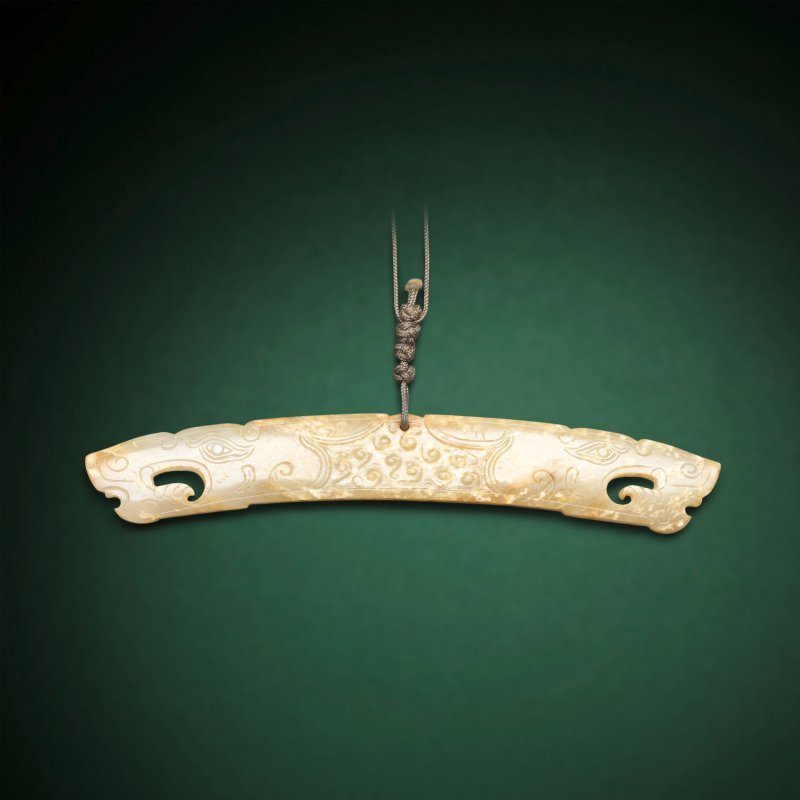
東周 青玉龍紋璜 | A RARE PALE GREEN JADE PLAQUE, HUANG
年代
Eastern Zhou Dynasty
起拍价
GBP 4,000
估值区间
GBP 4000 - 6000
尺寸
未知
品相
未知
更多信息
Eastern Zhou Dynasty
Of gently arched form, each terminal carved as a dragon head, the central section decorated with spiral bosses, the stone of pale green tone with russet and beige inclusions, fitted box. 11.2cm (4 3/8in) wide. (2).
Footnotes
東周 青玉龍紋璜
Prior to the Warring States period, jade huang pendants were generally worn as individual ornaments. They were perforated only at the two ends, with the concave side of the arc facing upward when worn. After the Warring States period, however, many jade huang were worn as components of composite jade pendants. To facilitate this new mode of suspension, an additional perforation was drilled into the convex edge as seen in the present lot, enabling the pendant to be mounted with the convex side uppermost as part of a larger assemblage. For further discussion, see Zhou Nanquan, 'Yuhuang zonglun' (玉璜綜論), in Palace Museum Journal, 1996(3), pp.8-22, p.14.
While many scholars continue to identify pieces like the present lot as huang, others classify the ones suspended with the convex side uppermost as heng (珩), regarding them as a later development of the (璜). See a composite jade pendant set including a , Han dynasty, in the collection of the Xuzhou Museum, illustrated in (玉潤中華:中國玉器的萬年史詩圖卷), Nanjing, 2023, p.247.
See a related pair of 'twin dragon head' pendants, , Warring States period, which was sold at Sotheby's Paris, 12 December 2025, lot 134.
Of gently arched form, each terminal carved as a dragon head, the central section decorated with spiral bosses, the stone of pale green tone with russet and beige inclusions, fitted box. 11.2cm (4 3/8in) wide. (2).
Footnotes
東周 青玉龍紋璜
Prior to the Warring States period, jade huang pendants were generally worn as individual ornaments. They were perforated only at the two ends, with the concave side of the arc facing upward when worn. After the Warring States period, however, many jade huang were worn as components of composite jade pendants. To facilitate this new mode of suspension, an additional perforation was drilled into the convex edge as seen in the present lot, enabling the pendant to be mounted with the convex side uppermost as part of a larger assemblage. For further discussion, see Zhou Nanquan, 'Yuhuang zonglun' (玉璜綜論), in Palace Museum Journal, 1996(3), pp.8-22, p.14.
While many scholars continue to identify pieces like the present lot as huang, others classify the ones suspended with the convex side uppermost as heng (珩), regarding them as a later development of the (璜). See a composite jade pendant set including a , Han dynasty, in the collection of the Xuzhou Museum, illustrated in (玉潤中華:中國玉器的萬年史詩圖卷), Nanjing, 2023, p.247.
See a related pair of 'twin dragon head' pendants, , Warring States period, which was sold at Sotheby's Paris, 12 December 2025, lot 134.
常见问题
这件東周 青玉龍紋璜 | A RARE PALE GREEN JADE PLAQUE, HUANG的成交价是多少?
落槌价为 预展中。 成交价为 预展中。


