
拍品信息
拍品名称
西藏 十八/十九世紀 寶帳大黑天黑唐卡 | A LARGE BLACKGROUND THANGKA OF PANJARNATA MAHAKALA
年代
TIBET, 18TH/19TH CENTURY
起拍价
HKD 400,000
估值区间
HKD 400000 - 600000
尺寸
未知
品相
未知
更多信息
TIBET, 18TH/19TH CENTURY
Distemper and gold on cloth.
Himalayan Art Resources item no. 41048
102 x 110 cm (40 1/8 x 43 1/4 in.)
Footnotes
西藏 十八/十九世紀 寶帳大黑天黑唐卡
Provenance
Private Swiss Collection, acquired in Nepal, 1966, by repute
Private Collection, 2000s
Arnold Lieberman, New York, c. 2007
John Eskenazi Ltd, London
Olympia Auctions, London, 4 June 2025, lot 156
John and Karina Stewart Collection
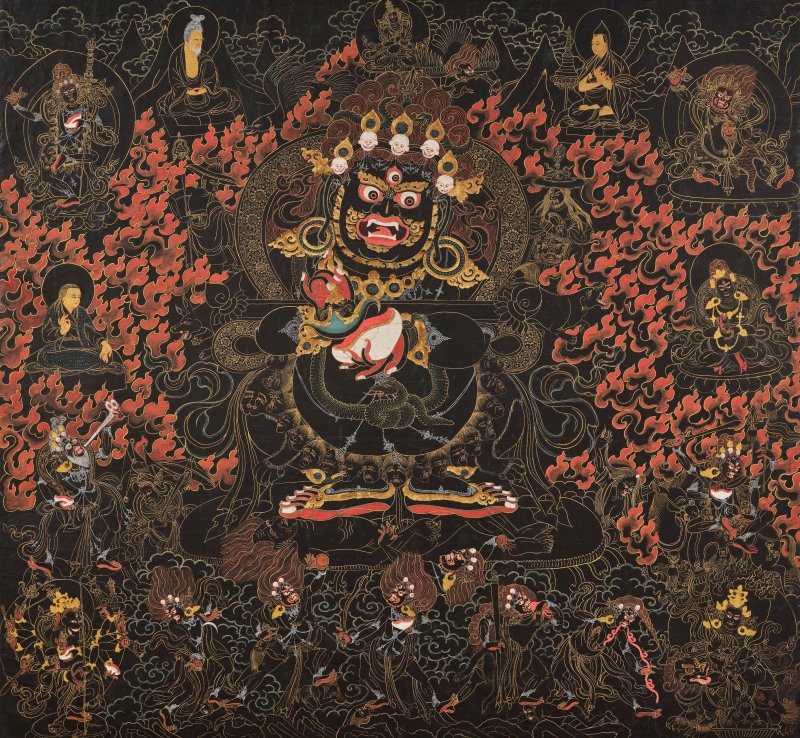
The present black ground (nag thang) depicts Panjarnata Mahakala, the principal protector of the Hevajra Tantra cycle, standing in pratyalidha upon a prostrate corpse symbolizing the subjugation of ignorance and worldly obstacles. The wrathful deity brandishes a curved knife and a filled with blood while supporting a against his shoulder. His fearsome countenance, animated by three bulging eyes, bared fangs, and a flaming yellow mane, rises beneath a crown of five skulls, while his body is adorned with heavy jeweled ornaments, a garland of freshly severed heads, and entwined serpents. He is surrounded by his emanated attendants—including a crow, dog, Garuda, wolf, black woman, monk, warrior, and mantradharin—all enveloped within a dense aureole of finely modeled vermilion flames that contrast dramatically with the lustrous black ground.
The upper register is centered by Vajradhara flanked by two lineage masters, affirming the transmission of the Hevajra teachings. To the left appear Hevajra Heruka above Brahmanarupa Mahakala, while Vajrapani, Ekajati, and Shri Devi Dudsolma occupy the opposite side. Maharakta Ganapati is depicted in the lower left, balanced by Vaishravana riding a lion at the lower right, while the Five Karma Activity Deities stride across the foreground beneath the central protector, completing the protector retinue associated with the Hevajra tradition.
Executed with exceptional refinement, the painting is an example of the sophistication of the Tibetan black ground tradition. Delicate gold linework defines the figures with remarkable clarity, while the jewelry, aureoles, and ornamental motifs are enriched with generous applications of gold. The scrolling vermilion flames are subtly shaded to create movement and depth throughout the composition, while the restrained palette, finely controlled gold outlines, and carefully modeled flames emphasize the commanding presence of the central deity.
An earlier stylistic comparison may be drawn with a 17th-century Panjarnata Mahakala (HAR 12361), which shares the present work's scrolling vermilion flames with subtle tonal modeling, richly ornamented gold linework, cloud formation and closely related iconographic program. For similar works, see an 18th-century blackground (HAR 2187) and an 18th-century example sold at Christie's, New York, 19 March 2013, lot 392.
Distemper and gold on cloth.
Himalayan Art Resources item no. 41048
102 x 110 cm (40 1/8 x 43 1/4 in.)
Footnotes
西藏 十八/十九世紀 寶帳大黑天黑唐卡
Provenance
Private Swiss Collection, acquired in Nepal, 1966, by repute
Private Collection, 2000s
Arnold Lieberman, New York, c. 2007
John Eskenazi Ltd, London
Olympia Auctions, London, 4 June 2025, lot 156
John and Karina Stewart Collection
The present black ground (nag thang) depicts Panjarnata Mahakala, the principal protector of the Hevajra Tantra cycle, standing in pratyalidha upon a prostrate corpse symbolizing the subjugation of ignorance and worldly obstacles. The wrathful deity brandishes a curved knife and a filled with blood while supporting a against his shoulder. His fearsome countenance, animated by three bulging eyes, bared fangs, and a flaming yellow mane, rises beneath a crown of five skulls, while his body is adorned with heavy jeweled ornaments, a garland of freshly severed heads, and entwined serpents. He is surrounded by his emanated attendants—including a crow, dog, Garuda, wolf, black woman, monk, warrior, and mantradharin—all enveloped within a dense aureole of finely modeled vermilion flames that contrast dramatically with the lustrous black ground.
The upper register is centered by Vajradhara flanked by two lineage masters, affirming the transmission of the Hevajra teachings. To the left appear Hevajra Heruka above Brahmanarupa Mahakala, while Vajrapani, Ekajati, and Shri Devi Dudsolma occupy the opposite side. Maharakta Ganapati is depicted in the lower left, balanced by Vaishravana riding a lion at the lower right, while the Five Karma Activity Deities stride across the foreground beneath the central protector, completing the protector retinue associated with the Hevajra tradition.
Executed with exceptional refinement, the painting is an example of the sophistication of the Tibetan black ground tradition. Delicate gold linework defines the figures with remarkable clarity, while the jewelry, aureoles, and ornamental motifs are enriched with generous applications of gold. The scrolling vermilion flames are subtly shaded to create movement and depth throughout the composition, while the restrained palette, finely controlled gold outlines, and carefully modeled flames emphasize the commanding presence of the central deity.
An earlier stylistic comparison may be drawn with a 17th-century Panjarnata Mahakala (HAR 12361), which shares the present work's scrolling vermilion flames with subtle tonal modeling, richly ornamented gold linework, cloud formation and closely related iconographic program. For similar works, see an 18th-century blackground (HAR 2187) and an 18th-century example sold at Christie's, New York, 19 March 2013, lot 392.
常见问题
这件西藏 十八/十九世紀 寶帳大黑天黑唐卡 | A LARGE BLACKGROUND THANGKA OF PANJARNATA MAHAKALA的成交价是多少?
落槌价为 预展中。 成交价为 预展中。