


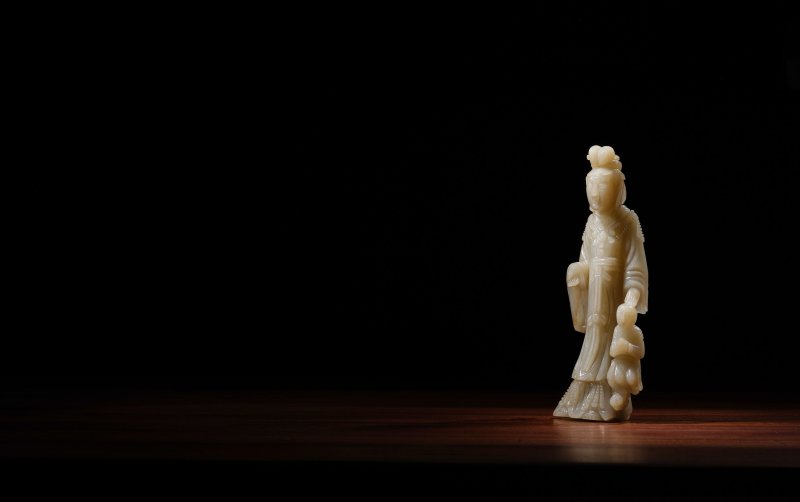


Lot 109 宋/金 青玉觀音及善財童子立像 | A RARE CELADON JADE FIGURE OF GUANYIN AND SUDHANA
落槌价
预展中
成交价
预展中
| 拍卖公司 | 邦瀚斯 |
|---|---|
| 拍卖时间 | 2026年10月28日 |
拍品信息
拍品名称
宋/金 青玉觀音及善財童子立像 | A RARE CELADON JADE FIGURE OF GUANYIN AND SUDHANA
年代
Song/Jin Dynasty
起拍价
HKD 400,000
估值区间
HKD 400000 - 600000
尺寸
未知
品相
未知
更多信息
Song/Jin Dynasty
Carved standing in a stately posture with a serene facial expression characterised by downcast, almond-shaped eyes set beneath softly arched brows, the head surmounted by hair gathered high into a twin-lobed chignon, clad in long, layered robes falling in fluid folds, the chest adorned with an intricate beaded collar and festoons, the right arm raised inside a broad sleeve while the left hand extends downwards to rest gently on the head of the youthful pilgrim Sudhana, who stands at her left side with hands devoutly clasped before his chest, the lower hem of the robes decorated with crisp, incised diaper and linear patterns, the stone of an attractive pale celadon tone. fitted box.
17cm (6 3/4in) high (2).
Footnotes
宋/金 青玉觀音及善財童子立像
Provenance:
Acquired in 2004
來源:
2004年購藏
Buddhist jade figures dating to the Song/Jin dynasty are exceptionally rare. Distinguished by sharp, decisive incisions in the drapery and sashes, this figure displays stylistic traits typical of late Song to Jin dynasty jade carving (12th–13th century). The bold execution of the crown—adorned with cloud scrolls is complemented by expressive, linear detailing across the face and elongated earlobes. Compare a jade figure of Mahāsthāmaprāpta, circa 13th/14th century, which was sold at Bonhams London, 7 November 2019, lot 113. See also a celadon jade figure of Bodhisattva Avalokiteshvara, formerly with C.C. Teng & Co., Taipei, which was sold at Sotheby's Hong Kong, 29 November 2017, lot 66.
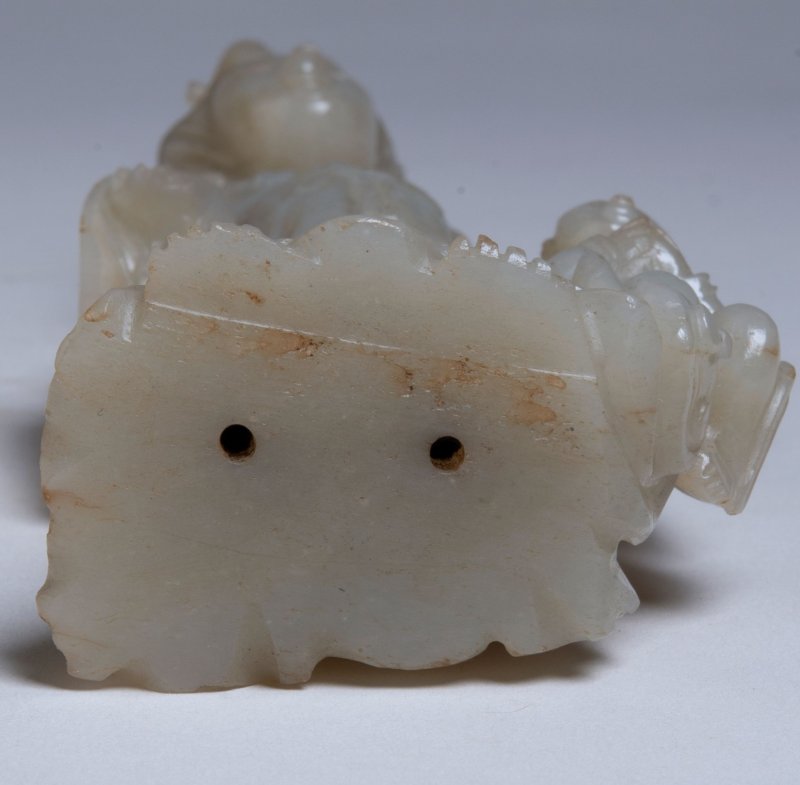
Rather than relying on simple incised lines for decorative patterns, this figure exemplifies the (減地留脊) technique—a method where the surrounding stone area is meticulously grounded away to allow the primary lines to emerge as low, three-dimensional ridges. Through this technique, the beaded ornaments, drapery folds, and rear decorative elements are brought out in low relief, imparting a pronounced plastic spatiality to the torso and facial contours. This approach embodies the Song dynasty principle of 'defining lines through form' (), prioritising sculptural modelling over line-cutting to achieve structural clarity and visual depth. Furthermore, the figure exemplifes the Song aesthetic principles of 'working according to form' () and 'crafting according to material' (). Song craftsmen typically refrained from heavily trimming raw jade boulders, choosing instead to maximise the natural contours of the raw material to create refined works that characterised the high aesthetic standards of the period. This methodology reflects both the historic scarcity of jade rough during the Song dynasty and the ingenuity of its craftsmen. As a consequence of this material-driven carving philosophy, freestanding Song jade sculptures often lack perfect balance and vertical stability, necessitating auxiliary support; here, two small apertures preserved at the base were most likely utilized for securing or mounting the figure—a structural feature characteristic of standing jade sculptures from this era.
Sudhana, known in Chinese as Shancai Tongzi, is the iconic youthful pilgrim of the Sutra (Flower Garland Sutra), one of the foundational texts of Mahayana Buddhism. His narrative forms the culmination of the sutra, recounting his spiritual quest initiated under the guidance of the Bodhisattva Manjushri. Travelling widely in search of ultimate enlightenment, Sudhana studies under fifty-three spiritual teachers () from all strata of society—including monks, merchants, monarchs, and courtesans—each imparting a distinct aspect of Buddhist truth. His journey reaches its zenith in a visionary encounter with the Bodhisattva Samantabhadra, symbolising the ultimate union of wisdom and practice. In the present figure, Shancai Tongzi is depicted in his classic East Asian iconographic role as an attendant to Guanyin (Avalokiteshvara). Rendered as a youthful boy standing with hands clasped before his chest in (the gesture of prayer and respect), he embodies the ideal spiritual seeker who approaches the path toward awakening with profound humility, sincerity, and devotion.
宋金時期之玉佛造像極為罕見。本尊造像衣褶與衣帶雕刻線條俐落剛勁,呈 現宋末至金代(十二至十三世紀)玉雕之典型風格 。 頭髮線條大膽流暢,與面 部線條刻畫及修長之耳垂相得益彰。可比較一尊十三/十四世紀之青玉大勢 至菩薩像,售於倫敦邦瀚斯,2019年11月7日,拍品編號113。另可參考一尊青玉 觀音菩薩像,同爲出自台北慎德堂,售於香港蘇富比,2017年11月29日,拍品 編號66。
本品不拘於以簡單陰線刻劃紋飾,而是極盡「減地留脊」工藝之妙——即將紋樣旁之玉面細緻削磨刮平,使主線呈現為微凸之三維脊線。經此工法,珠珮瓔珞、衣褶紋理及背面飾紋皆呈淺浮雕之效,賦予身軀與面部輪廓極為鮮明之立體空間感。此種創作語彙深刻體現了宋代「以形勾線」之美學精髓,即以雕塑塑形為先、線刻次之,藉此臻至結構清晰與視覺縱深之境界。此外,本品亦完美詮釋了宋代「因形而作」與「以材施藝」之治玉理念。宋代工匠通常不盲目大幅裁截玉料原石,而是順應材質之天然輪廓因材施藝,創製出代表彼時極高審美標準之雅致傑作。此法既折射出宋代玉料匱乏之歷史背景,亦彰顯了巧匠之奇思妙想。因受此「順應材質」雕琢理念之影響,宋代圓雕玉器往往缺乏完美之重心平衡與垂直穩定性,需藉助輔助支撐;本品底部留存之兩處微孔,極可能即用於固定或鑲嵌造像——此亦為該時期立姿玉造像之典型結構特徵。
善財童子(梵文:Sudhana),於華嚴宗核心經典《華嚴經》中為標誌性之求法求道少年。其歷程構成《華嚴經》之終極高潮,講述其於文殊師利菩薩指引下開啟之求法之旅。善財童子為求無上正等正覺廣參遠遊,先後參訪了五十一位(通稱五十三參)來自社會各階層之善知識(包括僧侶、商人、帝王及妓女等),每位善知識皆傳授其獨特之佛法真諦。其求法之旅最終於親見普賢菩薩之壯麗境界中臻至頂峰,象徵著智慧與實踐之完美圓融。於本尊造像中,善財童子以東亞傳統圖像學中觀音菩薩脅侍之經典形象呈現。造像塑造成少年童子之姿,雙手合掌於胸前,表虔敬祈願之印相,完美具象化了以極致謙遜、真誠與虔敬之心踏上菩提覺悟之路的理想求法者形象。
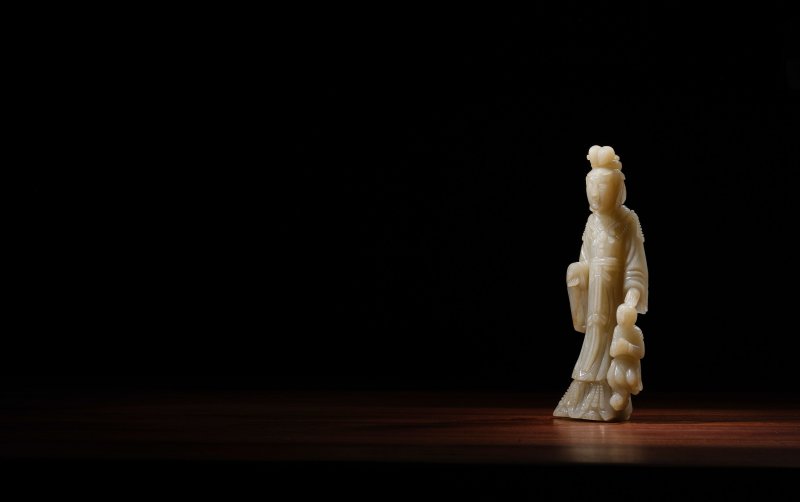
Carved standing in a stately posture with a serene facial expression characterised by downcast, almond-shaped eyes set beneath softly arched brows, the head surmounted by hair gathered high into a twin-lobed chignon, clad in long, layered robes falling in fluid folds, the chest adorned with an intricate beaded collar and festoons, the right arm raised inside a broad sleeve while the left hand extends downwards to rest gently on the head of the youthful pilgrim Sudhana, who stands at her left side with hands devoutly clasped before his chest, the lower hem of the robes decorated with crisp, incised diaper and linear patterns, the stone of an attractive pale celadon tone. fitted box.
17cm (6 3/4in) high (2).
Footnotes
宋/金 青玉觀音及善財童子立像
Provenance:
Acquired in 2004
來源:
2004年購藏
Buddhist jade figures dating to the Song/Jin dynasty are exceptionally rare. Distinguished by sharp, decisive incisions in the drapery and sashes, this figure displays stylistic traits typical of late Song to Jin dynasty jade carving (12th–13th century). The bold execution of the crown—adorned with cloud scrolls is complemented by expressive, linear detailing across the face and elongated earlobes. Compare a jade figure of Mahāsthāmaprāpta, circa 13th/14th century, which was sold at Bonhams London, 7 November 2019, lot 113. See also a celadon jade figure of Bodhisattva Avalokiteshvara, formerly with C.C. Teng & Co., Taipei, which was sold at Sotheby's Hong Kong, 29 November 2017, lot 66.
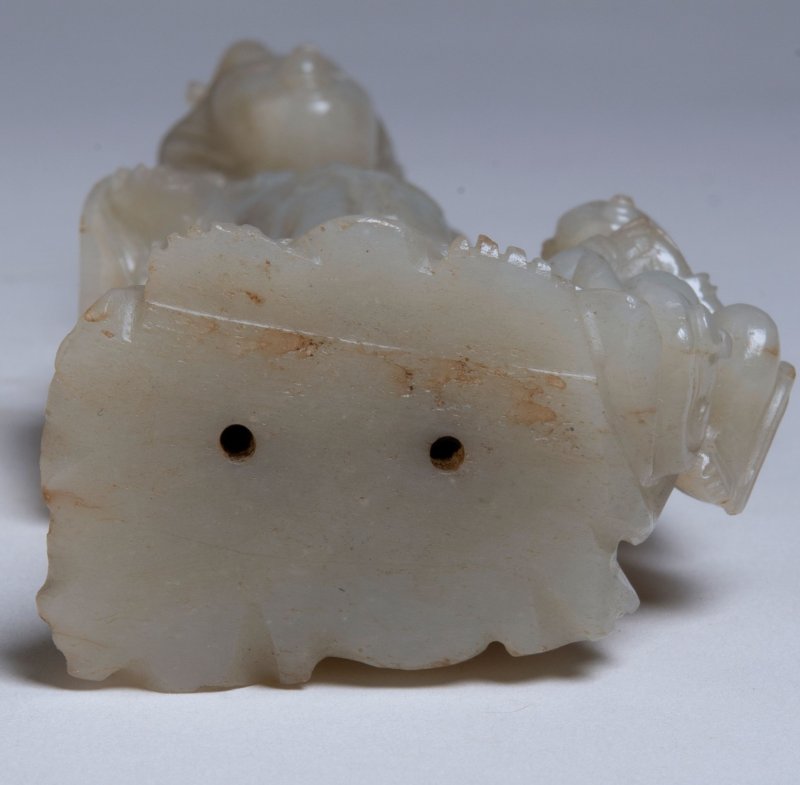
Rather than relying on simple incised lines for decorative patterns, this figure exemplifies the (減地留脊) technique—a method where the surrounding stone area is meticulously grounded away to allow the primary lines to emerge as low, three-dimensional ridges. Through this technique, the beaded ornaments, drapery folds, and rear decorative elements are brought out in low relief, imparting a pronounced plastic spatiality to the torso and facial contours. This approach embodies the Song dynasty principle of 'defining lines through form' (), prioritising sculptural modelling over line-cutting to achieve structural clarity and visual depth. Furthermore, the figure exemplifes the Song aesthetic principles of 'working according to form' () and 'crafting according to material' (). Song craftsmen typically refrained from heavily trimming raw jade boulders, choosing instead to maximise the natural contours of the raw material to create refined works that characterised the high aesthetic standards of the period. This methodology reflects both the historic scarcity of jade rough during the Song dynasty and the ingenuity of its craftsmen. As a consequence of this material-driven carving philosophy, freestanding Song jade sculptures often lack perfect balance and vertical stability, necessitating auxiliary support; here, two small apertures preserved at the base were most likely utilized for securing or mounting the figure—a structural feature characteristic of standing jade sculptures from this era.
Sudhana, known in Chinese as Shancai Tongzi, is the iconic youthful pilgrim of the Sutra (Flower Garland Sutra), one of the foundational texts of Mahayana Buddhism. His narrative forms the culmination of the sutra, recounting his spiritual quest initiated under the guidance of the Bodhisattva Manjushri. Travelling widely in search of ultimate enlightenment, Sudhana studies under fifty-three spiritual teachers () from all strata of society—including monks, merchants, monarchs, and courtesans—each imparting a distinct aspect of Buddhist truth. His journey reaches its zenith in a visionary encounter with the Bodhisattva Samantabhadra, symbolising the ultimate union of wisdom and practice. In the present figure, Shancai Tongzi is depicted in his classic East Asian iconographic role as an attendant to Guanyin (Avalokiteshvara). Rendered as a youthful boy standing with hands clasped before his chest in (the gesture of prayer and respect), he embodies the ideal spiritual seeker who approaches the path toward awakening with profound humility, sincerity, and devotion.
宋金時期之玉佛造像極為罕見。本尊造像衣褶與衣帶雕刻線條俐落剛勁,呈 現宋末至金代(十二至十三世紀)玉雕之典型風格 。 頭髮線條大膽流暢,與面 部線條刻畫及修長之耳垂相得益彰。可比較一尊十三/十四世紀之青玉大勢 至菩薩像,售於倫敦邦瀚斯,2019年11月7日,拍品編號113。另可參考一尊青玉 觀音菩薩像,同爲出自台北慎德堂,售於香港蘇富比,2017年11月29日,拍品 編號66。
本品不拘於以簡單陰線刻劃紋飾,而是極盡「減地留脊」工藝之妙——即將紋樣旁之玉面細緻削磨刮平,使主線呈現為微凸之三維脊線。經此工法,珠珮瓔珞、衣褶紋理及背面飾紋皆呈淺浮雕之效,賦予身軀與面部輪廓極為鮮明之立體空間感。此種創作語彙深刻體現了宋代「以形勾線」之美學精髓,即以雕塑塑形為先、線刻次之,藉此臻至結構清晰與視覺縱深之境界。此外,本品亦完美詮釋了宋代「因形而作」與「以材施藝」之治玉理念。宋代工匠通常不盲目大幅裁截玉料原石,而是順應材質之天然輪廓因材施藝,創製出代表彼時極高審美標準之雅致傑作。此法既折射出宋代玉料匱乏之歷史背景,亦彰顯了巧匠之奇思妙想。因受此「順應材質」雕琢理念之影響,宋代圓雕玉器往往缺乏完美之重心平衡與垂直穩定性,需藉助輔助支撐;本品底部留存之兩處微孔,極可能即用於固定或鑲嵌造像——此亦為該時期立姿玉造像之典型結構特徵。
善財童子(梵文:Sudhana),於華嚴宗核心經典《華嚴經》中為標誌性之求法求道少年。其歷程構成《華嚴經》之終極高潮,講述其於文殊師利菩薩指引下開啟之求法之旅。善財童子為求無上正等正覺廣參遠遊,先後參訪了五十一位(通稱五十三參)來自社會各階層之善知識(包括僧侶、商人、帝王及妓女等),每位善知識皆傳授其獨特之佛法真諦。其求法之旅最終於親見普賢菩薩之壯麗境界中臻至頂峰,象徵著智慧與實踐之完美圓融。於本尊造像中,善財童子以東亞傳統圖像學中觀音菩薩脅侍之經典形象呈現。造像塑造成少年童子之姿,雙手合掌於胸前,表虔敬祈願之印相,完美具象化了以極致謙遜、真誠與虔敬之心踏上菩提覺悟之路的理想求法者形象。
常见问题
这件宋/金 青玉觀音及善財童子立像 | A RARE CELADON JADE FIGURE OF GUANYIN AND SUDHANA的成交价是多少?
落槌价为 预展中。 成交价为 预展中。