
拍品信息
拍品名称
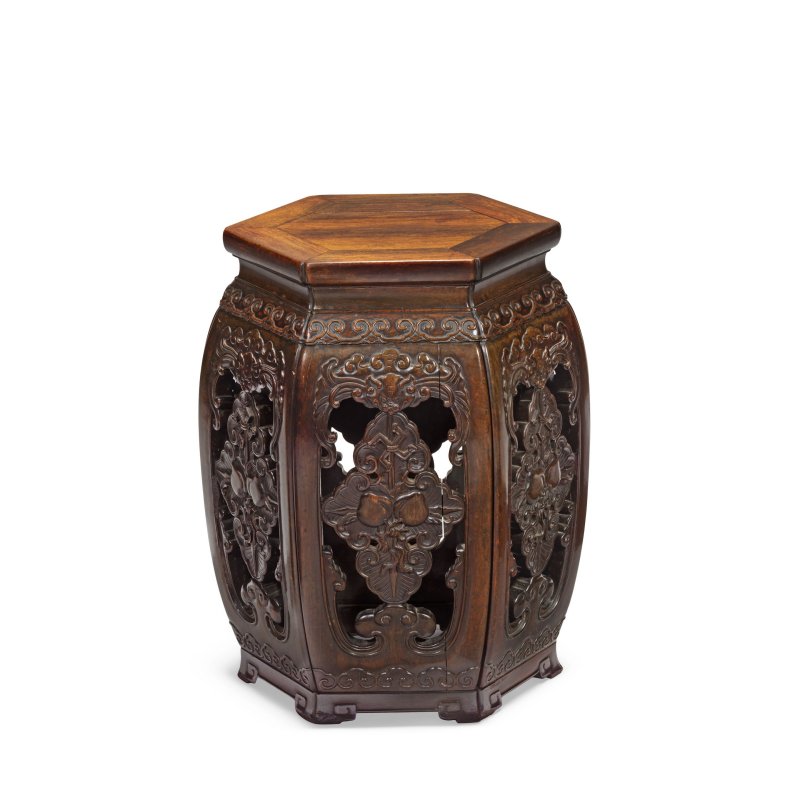
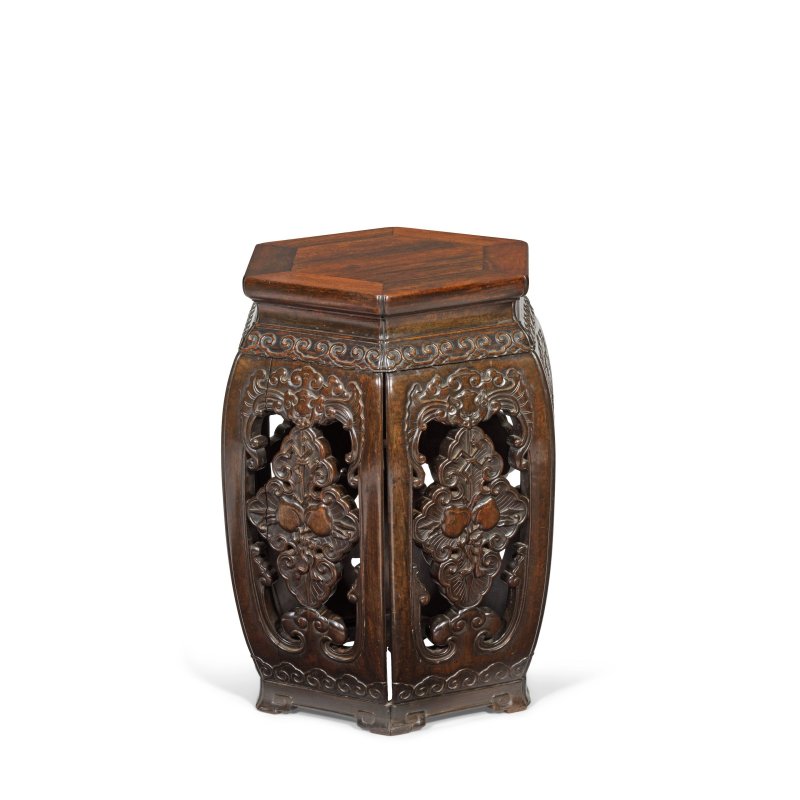
清乾隆/嘉慶 紫檀福壽紋六方綉墩 | AN IMPERIAL ZITAN HEXAGONAL STOOL, ZUODUN
年代
Qianlong/Jiaqing
起拍价
GBP 50,000
估值区间
GBP 50000 - 80000
尺寸
未知
品相
未知
更多信息
Qianlong/Jiaqing
The stool of hexagonal shape with a top panel set within a frame above a narrow waist, each side expertly carved in relief and openwork with a panel depicting a bat with outstretched wings, clutching in its mouth a large leaf bearing a wan and a leafy spray of peaches, between two bands of stylised ruyi motifs, all supported on six bracket feet, the wood of rich dark brown tone. 52cm (20 1/2in) high.
Footnotes
清乾隆/嘉慶 紫檀福壽紋六方綉墩
Provenance: a British private collection, acquired circa 1901-1902, and thence by descent
來源:英國私人收藏,約獲得于1901-1902年,並由後人保存迄今
The present lot is a superb example of the aesthetic taste of Palace furnishings produced during the Qianlong reign. In contrast to the Yongzheng Emperor's preference for nanmu, the Qianlong Emperor demonstrated a marked affinity for zitan, whose dense grain, rich purplish-brown tonality and exceptional durability made it particularly suited to the creation of lavish Imperial furnishings. The intricate ornamentation and elaborate carvings seen in the present lot reflect the Qianlong Emperor's love for opulence and exemplify the elaborate style of Qing Court furniture. By no later than the tenth year of the Qianlong period (1745), furniture had become increasingly prevalent at the Qing Court. After the Qianlong reign, however, the production of furniture for the Imperial Court underwent a marked decline. For further discussion, see Ge Fang, 'An Exploration of the Rise and Decline of Zitan Furniture in the Imperial Court during the Mid-Qing Period' (清中期宮廷紫檀家具之興衰探析), (美術學報), 2018(6), 96-102.
The motifs on the present lot form a compound of auspicious symbolism. The Chinese word for bat, (蝠), is a homophone of (福), meaning 'blessing,' while the peach is traditionally associated with longevity. Together, bats and peaches express the wish for blessings and longevity, known as (福壽雙全). The swastika emblem, also known as (萬 which means 'ten thousand') character motif, a Buddhist auspicious symbol, further enhances this symbolism. The combination of bats, peaches, and the motif conveys the auspicious wish for 'Ten Thousand Blessings and Ten Thousand Years of Longevity' (萬福萬壽).
Compare with a related hexagonal 'phoenix and dragon' stool, Qianlong period, in the Qing Court Collection, illustrated in (故宮博物館藏文物珍品全集:明清家具下), Hong Kong, 2002, p.92, no.81. Another related hexagonal stool, but with straight sides, mid-Qing dynasty, in the Qing Court Collection, is illustrated in ., no.71.
See a related Imperial zitan stool, Qianlong period, which was sold at Christie's Hong Kong, 4 October 2016, lot 61.
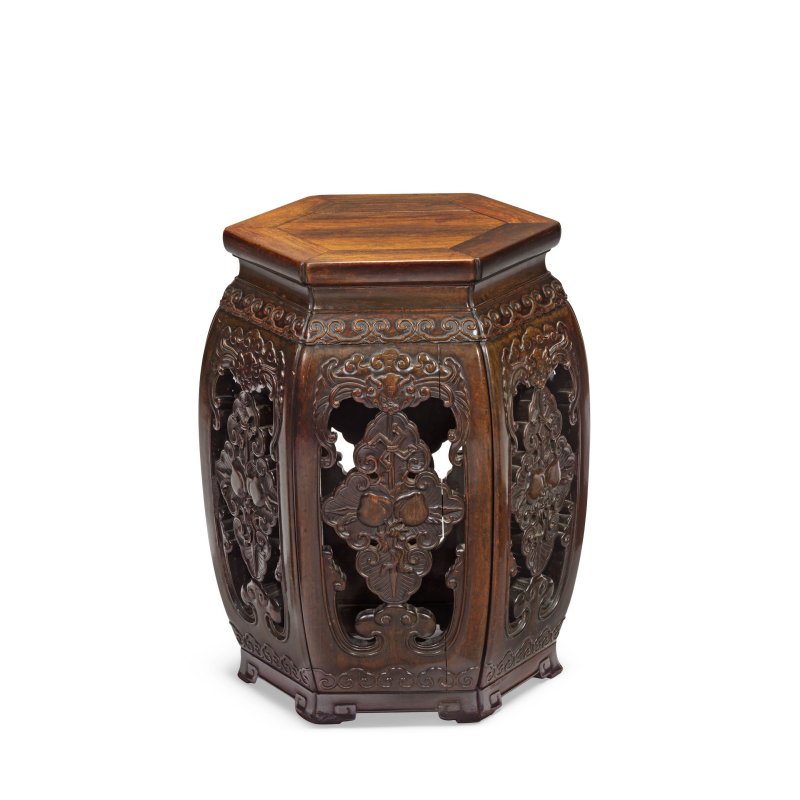
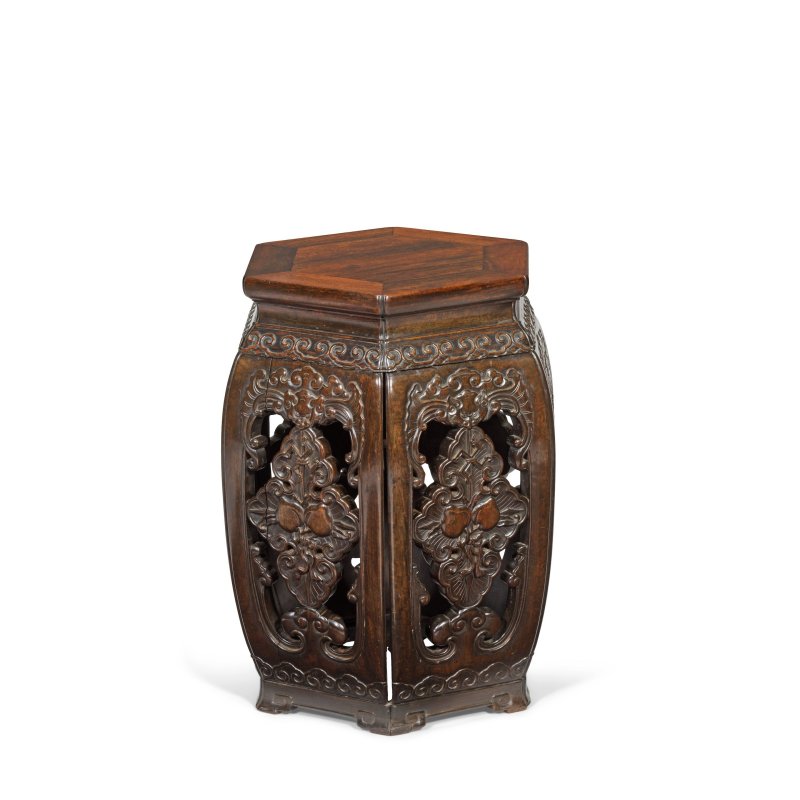
The stool of hexagonal shape with a top panel set within a frame above a narrow waist, each side expertly carved in relief and openwork with a panel depicting a bat with outstretched wings, clutching in its mouth a large leaf bearing a wan and a leafy spray of peaches, between two bands of stylised ruyi motifs, all supported on six bracket feet, the wood of rich dark brown tone. 52cm (20 1/2in) high.
Footnotes
清乾隆/嘉慶 紫檀福壽紋六方綉墩
Provenance: a British private collection, acquired circa 1901-1902, and thence by descent
來源:英國私人收藏,約獲得于1901-1902年,並由後人保存迄今
The present lot is a superb example of the aesthetic taste of Palace furnishings produced during the Qianlong reign. In contrast to the Yongzheng Emperor's preference for nanmu, the Qianlong Emperor demonstrated a marked affinity for zitan, whose dense grain, rich purplish-brown tonality and exceptional durability made it particularly suited to the creation of lavish Imperial furnishings. The intricate ornamentation and elaborate carvings seen in the present lot reflect the Qianlong Emperor's love for opulence and exemplify the elaborate style of Qing Court furniture. By no later than the tenth year of the Qianlong period (1745), furniture had become increasingly prevalent at the Qing Court. After the Qianlong reign, however, the production of furniture for the Imperial Court underwent a marked decline. For further discussion, see Ge Fang, 'An Exploration of the Rise and Decline of Zitan Furniture in the Imperial Court during the Mid-Qing Period' (清中期宮廷紫檀家具之興衰探析), (美術學報), 2018(6), 96-102.
The motifs on the present lot form a compound of auspicious symbolism. The Chinese word for bat, (蝠), is a homophone of (福), meaning 'blessing,' while the peach is traditionally associated with longevity. Together, bats and peaches express the wish for blessings and longevity, known as (福壽雙全). The swastika emblem, also known as (萬 which means 'ten thousand') character motif, a Buddhist auspicious symbol, further enhances this symbolism. The combination of bats, peaches, and the motif conveys the auspicious wish for 'Ten Thousand Blessings and Ten Thousand Years of Longevity' (萬福萬壽).
Compare with a related hexagonal 'phoenix and dragon' stool, Qianlong period, in the Qing Court Collection, illustrated in (故宮博物館藏文物珍品全集:明清家具下), Hong Kong, 2002, p.92, no.81. Another related hexagonal stool, but with straight sides, mid-Qing dynasty, in the Qing Court Collection, is illustrated in ., no.71.
See a related Imperial zitan stool, Qianlong period, which was sold at Christie's Hong Kong, 4 October 2016, lot 61.
常见问题
这件清乾隆/嘉慶 紫檀福壽紋六方綉墩 | AN IMPERIAL ZITAN HEXAGONAL STOOL, ZUODUN的成交价是多少?
落槌价为 预展中。 成交价为 预展中。


