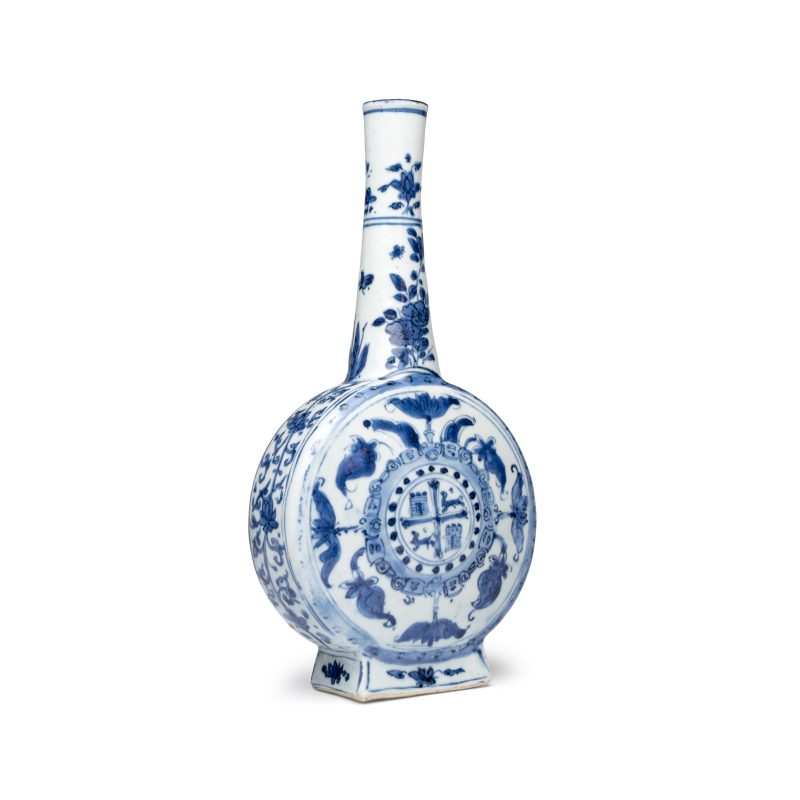

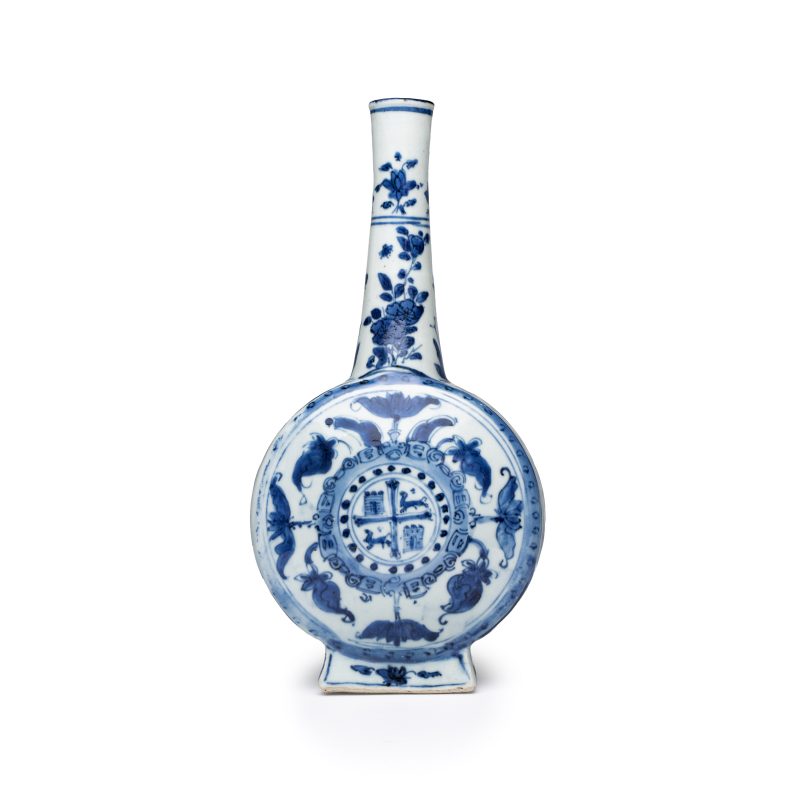
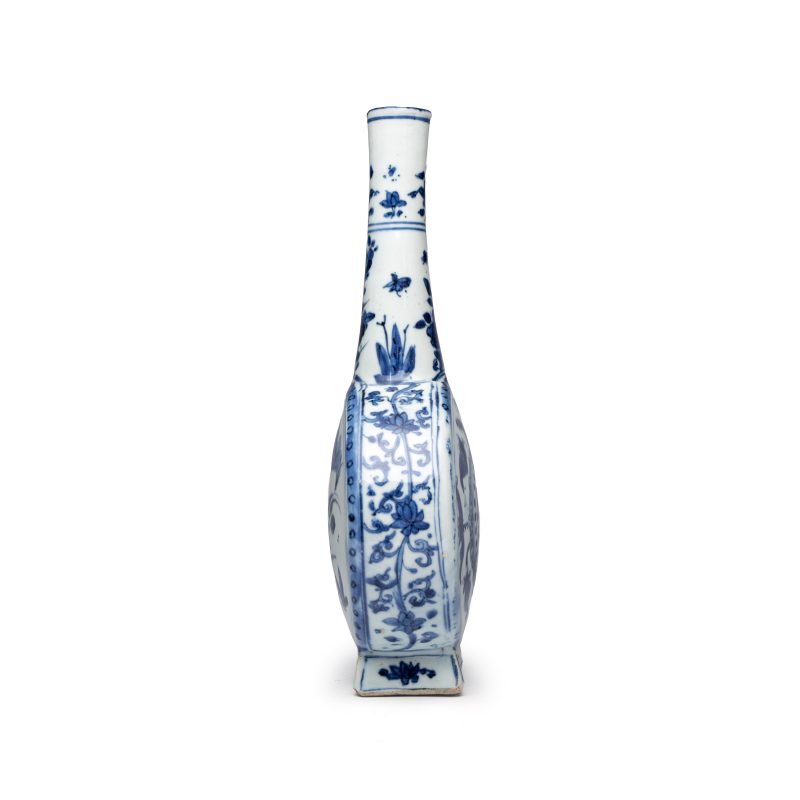
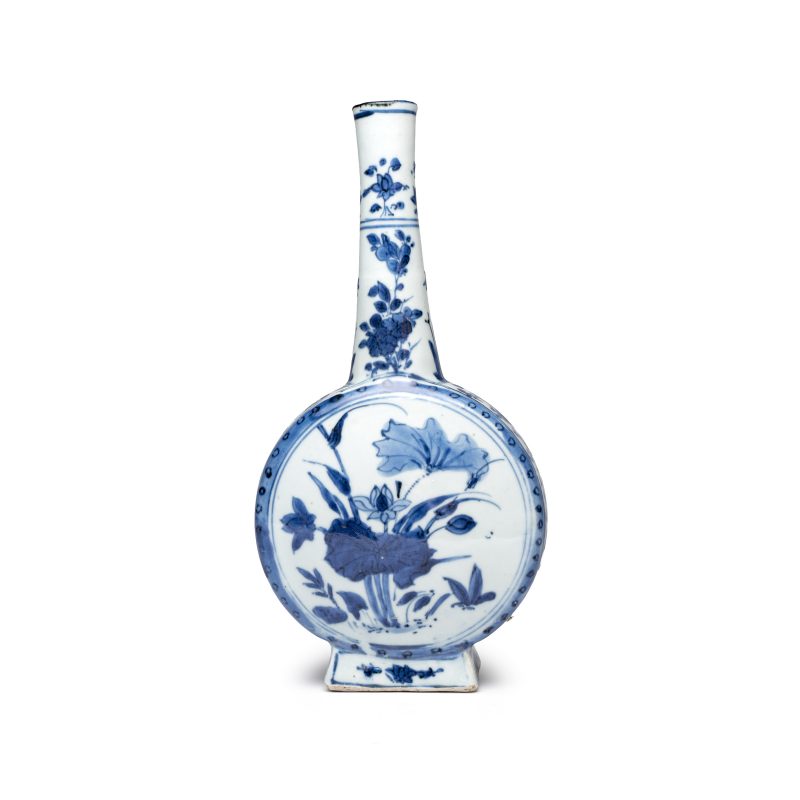
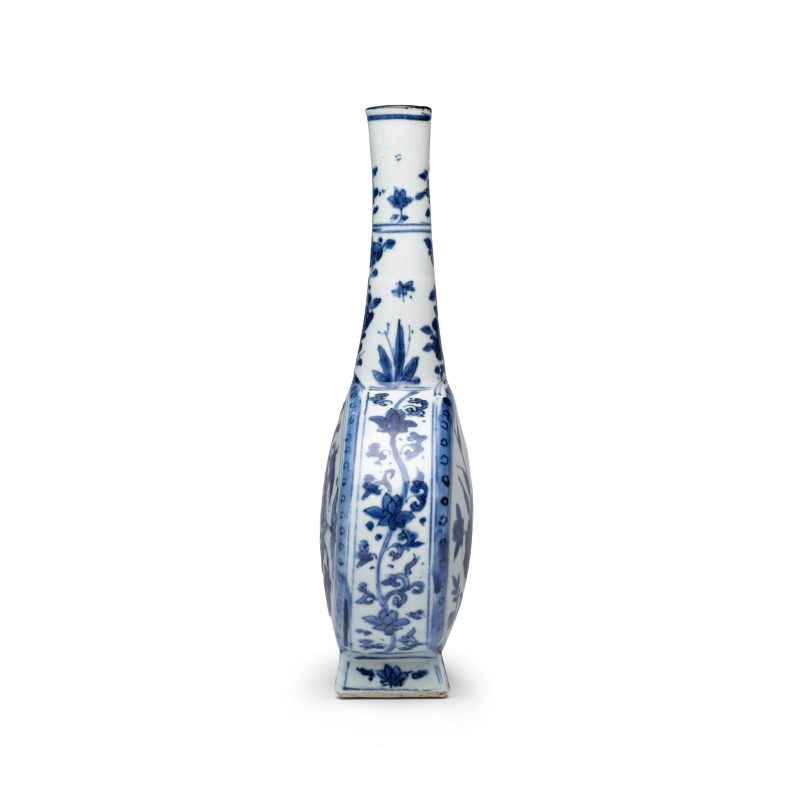
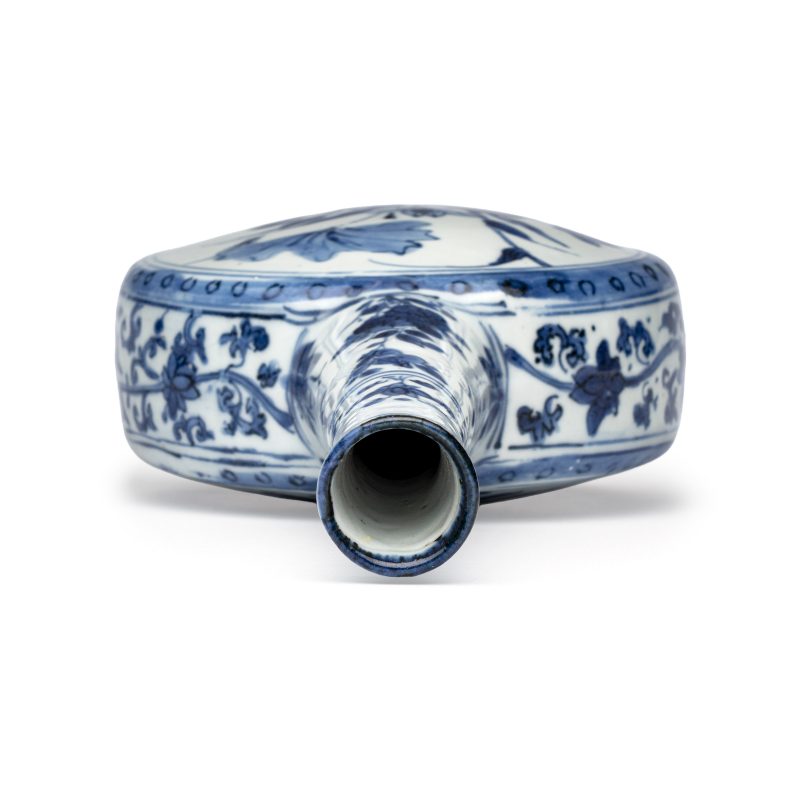
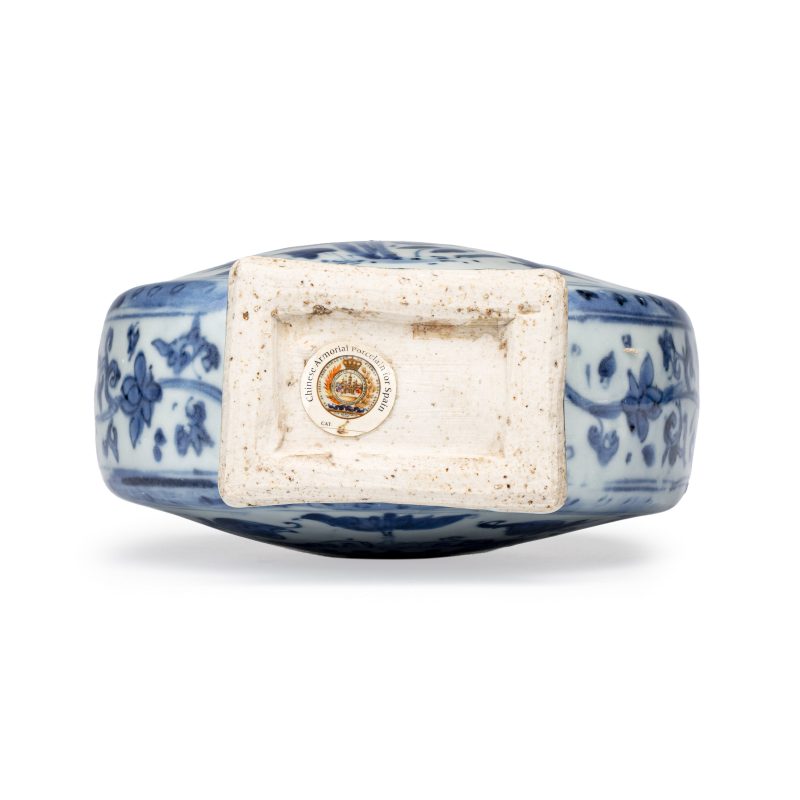
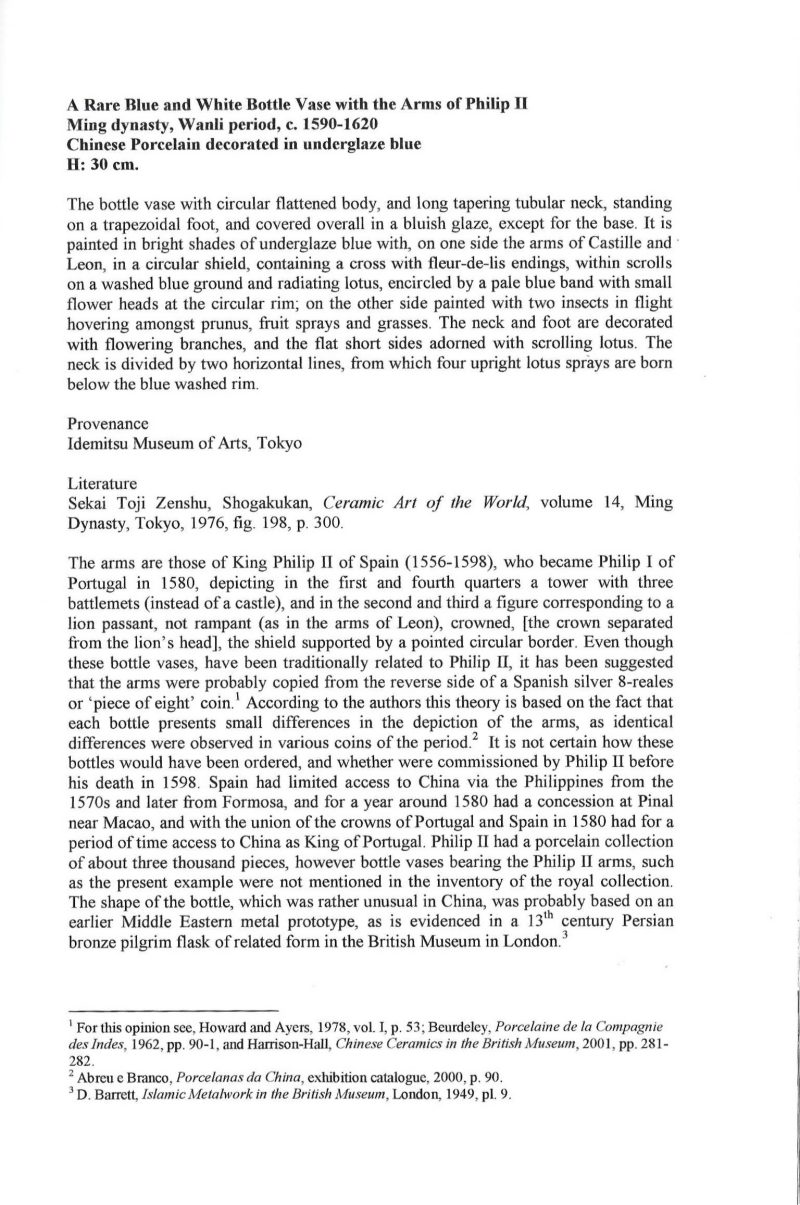
Lot 170 A rare and important Chinese armorial blue and white bottle vase with Royal Spanish arms
落槌价
****
成交价
****
拍品信息
拍品名称
A rare and important Chinese armorial blue and white bottle vase with Royal Spanish arms
年代
Wanli
起拍价
未知
估值区间
€ 80.000 – € 120.000
尺寸
H: H. 29,7 cm, W. 15,4 cm, D. 5 cm
品相
未知
更多信息
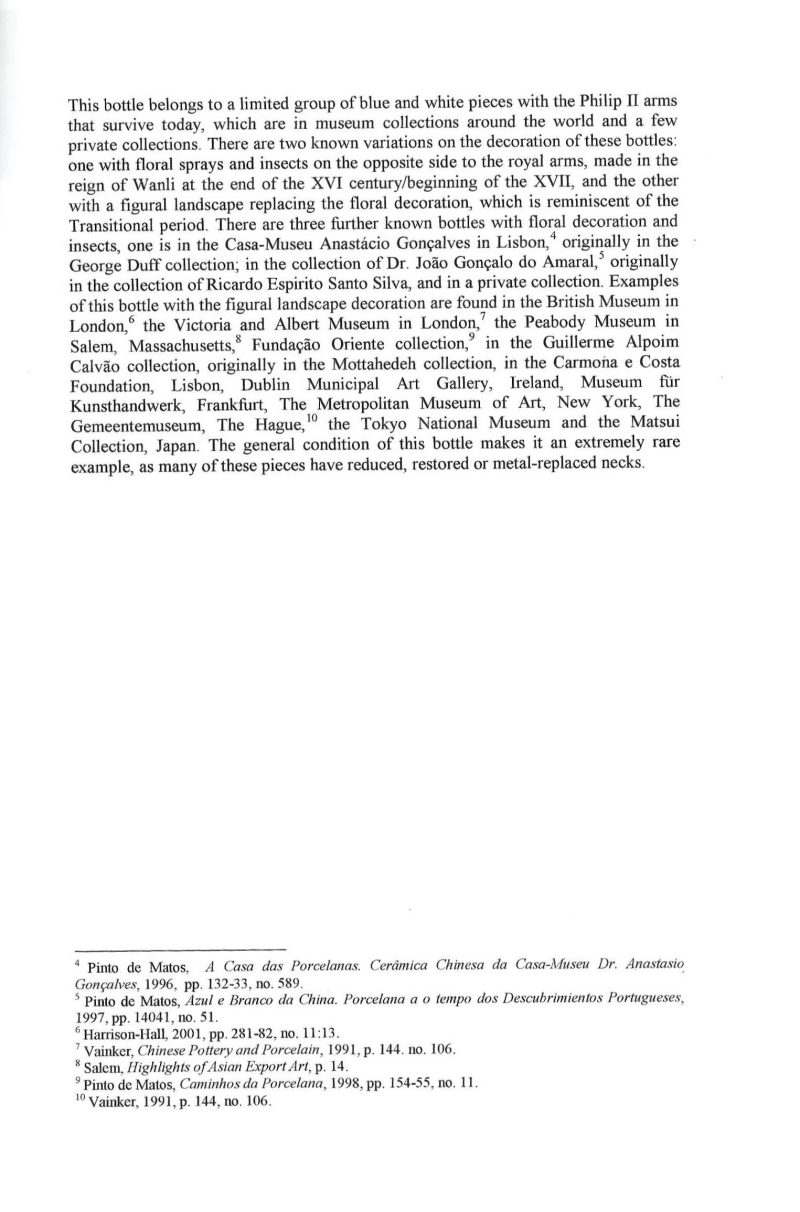
These bottle flasks belong to a rare and important group of Chinese export porcelains produced at Jingdezhen during the late Ming dynasty, most likely in the Wanli period (ca. 1590–1620). Their distinctive flattened, circular body with a long tubular neck derives from earlier Middle Eastern metalwork prototypes, particularly Islamic pilgrim flasks, a form that was adapted in porcelain for the export market.
A notable feature of this group is the inclusion of European heraldry, most prominently the arms associated with Philip II of Spain. These arms, typically showing the quartered shield of Castile and León, were likely copied from contemporary Spanish silver coinage rather than from an official commission, as slight variations occur between known examples.
More recent scholarship has questioned the traditional attribution of these armorial bottles to a direct commission for Philip II of Spain. While the heraldic devices were long believed to derive from Spanish silver coinage of the reign of Philip II, other scholars have suggested they may instead have been copied from contemporary maps or book illustrations, reflecting the intertwined Portuguese and Spanish trade networks in Asia following the Iberian Union of 1580. In the absence of firm documentary evidence, stylistic comparison remains crucial in dating this rare group of porcelains, with the finest examples - including the present piece - generally attributed to the Wanli period.
Such pieces were produced specifically for export and were transported via Portuguese trade routes from Macau to Europe. They are often associated with so-called “Kraak” porcelain, though their unusual form sets them apart from the more common wares of that category. Surviving examples are rare and are today preserved in major museum collections worldwide, including the British Museum and the Metropolitan Museum of Art.
Two principal decorative variations are known: one with floral sprays and insects to the rear, and another incorporating figural landscape scenes with scholars in a Transitional style. The rarity of intact examples is further underscored by the fact that many surviving flasks have suffered damage or later metal-mounted restorations to the neck.
These flasks stand as exceptional testimony to early global trade and cross-cultural exchange, combining Chinese ceramic expertise with European iconography in a form ultimately derived from Islamic metalwork traditions.
此類扁壺屬明晚期景德鎮燒造的一組珍罕而重要的中國外銷瓷,年代多定於萬曆時期,約1590至1620年。其器身扁圓,配細長筒頸,造型源自早期中東金屬器,尤其與伊斯蘭世界的朝聖者水壺關係密切,後被景德鎮窯工轉化為瓷器,專供海外市場。
此類器物的一大特色,是帶有歐洲紋章,其中最常見的為西班牙國王腓力二世的王室徽章,通常可見卡斯蒂利亞與萊昂的四分盾徽。由於現存各例在細節上略有差異,這些紋章可能並非出自王室直接訂製,而是由中國畫工依照當時流通的西班牙銀幣摹繪而成。
近年的研究對此類扁壺為腓力二世直接訂製的傳統說法提出了質疑。雖然器身紋章長期被認為取自腓力二世時期的西班牙銀幣,但亦有學者認為,其圖樣可能源自當時的地圖或書籍插圖。1580年伊比利亞聯盟成立後,葡萄牙與西班牙在亞洲的貿易網絡彼此交織,這亦為相關圖像的傳播提供了可能。由於目前尚缺乏確切的文獻記載,此類瓷器的斷代仍主要依靠風格比較;其中製作最精良者,包括本器在內,一般均被定為萬曆時期。
此類扁壺專為外銷而製,經澳門沿葡萄牙貿易航線運往歐洲。它們常被歸入所謂的「克拉克瓷」,但其特殊器形與常見的克拉克瓷器明顯不同。完整傳世者極為稀少,現今主要收藏於世界各地的重要博物館,包括大英博物館及紐約大都會藝術博物館。
目前已知主要有兩種裝飾形式,一類背面繪折枝花卉與昆蟲,另一類則繪帶有明清過渡期風格的文士山水人物圖。許多傳世實例的頸部均曾受損,或經後世加裝金屬鑲件修復,更顯完整器物之珍罕。
此類扁壺融合中國製瓷工藝、歐洲紋章圖像與源自伊斯蘭金屬器的造型,是早期全球貿易及跨文化藝術交流的重要見證。
Reference:
Identical bottles with floral decoration on the reverse are in the Casa-Museu Anastacio Goncalves, Lisbon, in the collection of Dr. Joao Goncalo do Amaral Cabral, on permant loan to the Museum and Library of the House of Braganza (link) and in a private collection, originally in the Idemitsu Museum of Arts, Tokyo.
Bottles with landscape and scholars decoration on the reverse are in The Albuquerque Foundation, Sintra, Portugal, from the Renata Albuquerque Collection, inv. no. 5, in The British Museum, London (museum number Franks.778.+), The Peabody Essex Museum, Salem (inventory number E82416), The Yale University Art Gallery, USA (acc. no. 2024.4.1), The Frelinghuysen Collection (illustrated in B. Macguire, 2023, no. 20), the Fundação Carmona e Costa, (acc. No. CER 56), Kunstmuseum Den Haag, The Netherlands (inv. OCVO-18-65) and in the Fundacao Oriente, Museu do Oriente (no. 456).
Christie's London, 12 November 2002, lot 140. (sold GBP 138.650,00) (link)
Sotheby's New York, 19 April 2023, 'The Spirit of America: The Wolf Family Collection', lot 45 for a near-identical example, with landscape decoration on the reverse. (sold USD 114.300,00) (link)
Selected literature:
William R. Sargent, 'Treasure of Chinese Export Ceramics from the Peabody Essex Museum', pp. 348-351, no. 185.
Maria Antónia Pinto de Matos, 'Global by Design. Chinese Ceramics from the R. Albuquerque Collection', Jorge Welsh Research & Publishing, 2016, pp. 106-111, no. 17.
J. Ayers and D. Howard, 'China for the West', vol. I, p. 53, no. 8.
Rocio Diaz, 'Chinese Armorial Porcelain for Spain', Jorge Welsh Books, Lisbon/London, cat. 1.
M. Beurdeley, 'Porcelaine de la Compagnie des Indes', 1962, pp. 90-91, fig. 61.
Becky Macquire, 'Four Centuries of Blue and White. The Frelinghuysen Collection of Chinese and Japanese Export Porcelain', p. 58, no. 20.
Provenance:
Idemitsu Museum of Arts, Tokyo.
Jorge Welsh Works of Art, London/Lisbon, with their label to the base.
The Mr. and Mrs. Baert-Devos Collection, Belgium. Acquired from the above in 2013 and accompanied by a copy of their documentation folder.
Published:
Rocio Diaz, 'Chinese Armorial Porcelain for Spain', Jorge Welsh Books, cat. 1.
Nishida Hiroko, ‘Meiji no Seihou Yushutsu (Ming Export Porcelain for the West 明磁の西方輸出)’, Sekai Toji Zenshu: Mei (Ceramic Art of the World: Ming Dynasty)', vol. 14, pp 300-301.
A notable feature of this group is the inclusion of European heraldry, most prominently the arms associated with Philip II of Spain. These arms, typically showing the quartered shield of Castile and León, were likely copied from contemporary Spanish silver coinage rather than from an official commission, as slight variations occur between known examples.
More recent scholarship has questioned the traditional attribution of these armorial bottles to a direct commission for Philip II of Spain. While the heraldic devices were long believed to derive from Spanish silver coinage of the reign of Philip II, other scholars have suggested they may instead have been copied from contemporary maps or book illustrations, reflecting the intertwined Portuguese and Spanish trade networks in Asia following the Iberian Union of 1580. In the absence of firm documentary evidence, stylistic comparison remains crucial in dating this rare group of porcelains, with the finest examples - including the present piece - generally attributed to the Wanli period.
Such pieces were produced specifically for export and were transported via Portuguese trade routes from Macau to Europe. They are often associated with so-called “Kraak” porcelain, though their unusual form sets them apart from the more common wares of that category. Surviving examples are rare and are today preserved in major museum collections worldwide, including the British Museum and the Metropolitan Museum of Art.
Two principal decorative variations are known: one with floral sprays and insects to the rear, and another incorporating figural landscape scenes with scholars in a Transitional style. The rarity of intact examples is further underscored by the fact that many surviving flasks have suffered damage or later metal-mounted restorations to the neck.
These flasks stand as exceptional testimony to early global trade and cross-cultural exchange, combining Chinese ceramic expertise with European iconography in a form ultimately derived from Islamic metalwork traditions.
此類扁壺屬明晚期景德鎮燒造的一組珍罕而重要的中國外銷瓷,年代多定於萬曆時期,約1590至1620年。其器身扁圓,配細長筒頸,造型源自早期中東金屬器,尤其與伊斯蘭世界的朝聖者水壺關係密切,後被景德鎮窯工轉化為瓷器,專供海外市場。
此類器物的一大特色,是帶有歐洲紋章,其中最常見的為西班牙國王腓力二世的王室徽章,通常可見卡斯蒂利亞與萊昂的四分盾徽。由於現存各例在細節上略有差異,這些紋章可能並非出自王室直接訂製,而是由中國畫工依照當時流通的西班牙銀幣摹繪而成。
近年的研究對此類扁壺為腓力二世直接訂製的傳統說法提出了質疑。雖然器身紋章長期被認為取自腓力二世時期的西班牙銀幣,但亦有學者認為,其圖樣可能源自當時的地圖或書籍插圖。1580年伊比利亞聯盟成立後,葡萄牙與西班牙在亞洲的貿易網絡彼此交織,這亦為相關圖像的傳播提供了可能。由於目前尚缺乏確切的文獻記載,此類瓷器的斷代仍主要依靠風格比較;其中製作最精良者,包括本器在內,一般均被定為萬曆時期。
此類扁壺專為外銷而製,經澳門沿葡萄牙貿易航線運往歐洲。它們常被歸入所謂的「克拉克瓷」,但其特殊器形與常見的克拉克瓷器明顯不同。完整傳世者極為稀少,現今主要收藏於世界各地的重要博物館,包括大英博物館及紐約大都會藝術博物館。
目前已知主要有兩種裝飾形式,一類背面繪折枝花卉與昆蟲,另一類則繪帶有明清過渡期風格的文士山水人物圖。許多傳世實例的頸部均曾受損,或經後世加裝金屬鑲件修復,更顯完整器物之珍罕。
此類扁壺融合中國製瓷工藝、歐洲紋章圖像與源自伊斯蘭金屬器的造型,是早期全球貿易及跨文化藝術交流的重要見證。
Reference:
Identical bottles with floral decoration on the reverse are in the Casa-Museu Anastacio Goncalves, Lisbon, in the collection of Dr. Joao Goncalo do Amaral Cabral, on permant loan to the Museum and Library of the House of Braganza (link) and in a private collection, originally in the Idemitsu Museum of Arts, Tokyo.
Bottles with landscape and scholars decoration on the reverse are in The Albuquerque Foundation, Sintra, Portugal, from the Renata Albuquerque Collection, inv. no. 5, in The British Museum, London (museum number Franks.778.+), The Peabody Essex Museum, Salem (inventory number E82416), The Yale University Art Gallery, USA (acc. no. 2024.4.1), The Frelinghuysen Collection (illustrated in B. Macguire, 2023, no. 20), the Fundação Carmona e Costa, (acc. No. CER 56), Kunstmuseum Den Haag, The Netherlands (inv. OCVO-18-65) and in the Fundacao Oriente, Museu do Oriente (no. 456).
Christie's London, 12 November 2002, lot 140. (sold GBP 138.650,00) (link)
Sotheby's New York, 19 April 2023, 'The Spirit of America: The Wolf Family Collection', lot 45 for a near-identical example, with landscape decoration on the reverse. (sold USD 114.300,00) (link)
Selected literature:
William R. Sargent, 'Treasure of Chinese Export Ceramics from the Peabody Essex Museum', pp. 348-351, no. 185.
Maria Antónia Pinto de Matos, 'Global by Design. Chinese Ceramics from the R. Albuquerque Collection', Jorge Welsh Research & Publishing, 2016, pp. 106-111, no. 17.
J. Ayers and D. Howard, 'China for the West', vol. I, p. 53, no. 8.
Rocio Diaz, 'Chinese Armorial Porcelain for Spain', Jorge Welsh Books, Lisbon/London, cat. 1.
M. Beurdeley, 'Porcelaine de la Compagnie des Indes', 1962, pp. 90-91, fig. 61.
Becky Macquire, 'Four Centuries of Blue and White. The Frelinghuysen Collection of Chinese and Japanese Export Porcelain', p. 58, no. 20.
Provenance:
Idemitsu Museum of Arts, Tokyo.
Jorge Welsh Works of Art, London/Lisbon, with their label to the base.
The Mr. and Mrs. Baert-Devos Collection, Belgium. Acquired from the above in 2013 and accompanied by a copy of their documentation folder.
Published:
Rocio Diaz, 'Chinese Armorial Porcelain for Spain', Jorge Welsh Books, cat. 1.
Nishida Hiroko, ‘Meiji no Seihou Yushutsu (Ming Export Porcelain for the West 明磁の西方輸出)’, Sekai Toji Zenshu: Mei (Ceramic Art of the World: Ming Dynasty)', vol. 14, pp 300-301.
常见问题
拍品的尺寸是多少?
H: H. 29,7 cm, W. 15,4 cm, D. 5 cm