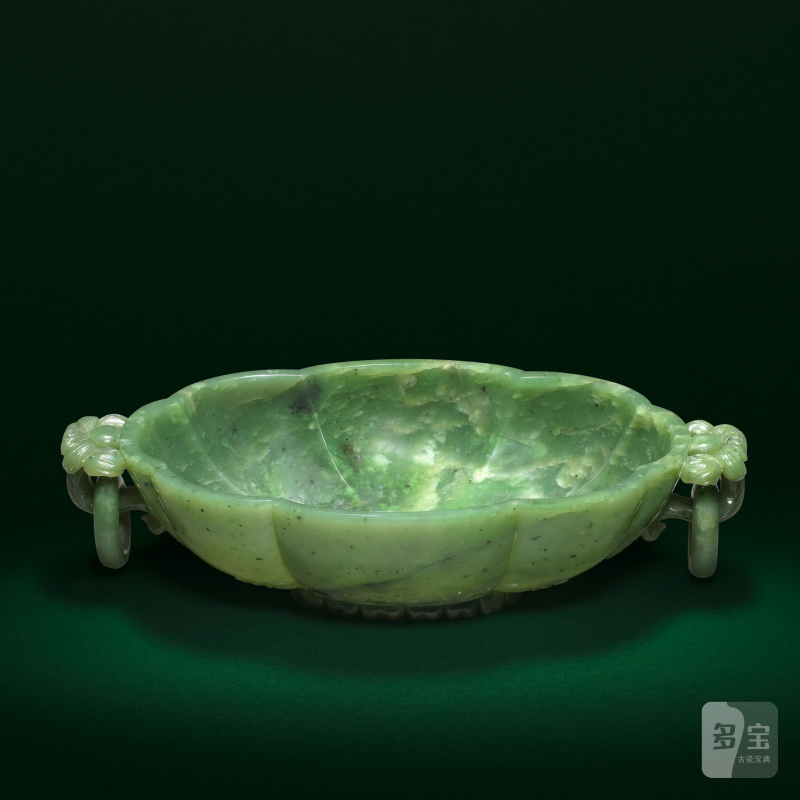

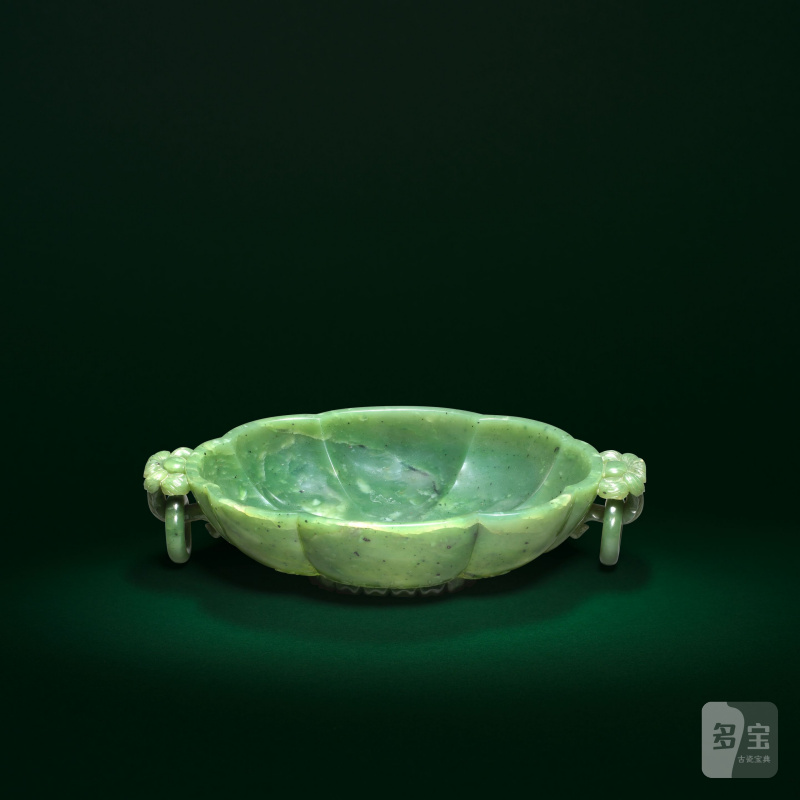


Lot 371Y 清乾隆/嘉慶 痕都斯坦式碧玉活環耳洗 | A MUGHAL-STYLE SPINACH-GREEN JADE TWO-HANDLED BOWL
落槌价
****
成交价
****
| 拍卖公司 | 邦瀚斯 |
|---|---|
| 拍卖时间 | 2026年05月18日 |
请安装多宝古瓷宝典APP,查看高清无损大图
拍品信息
拍品名称
清乾隆/嘉慶 痕都斯坦式碧玉活環耳洗 | A MUGHAL-STYLE SPINACH-GREEN JADE TWO-HANDLED BOWL
起拍价
GBP 4,000
估值区间
未知
尺寸
未知
品相
未知
更多信息
Qianlong/Jiaqing
Exquisitely carved of oval form with eight lobes rising from a short foot in the form of a chrysanthemum radiating with four rows of petals, the sides flanked by a pair of lotus flowers issuing curling acanthus leaves suspending loose rings, the stone of dark-green tone with black speckles, with a wood stand. 19cm (7 1/2in) wide. (2).
Footnotes
清乾隆/嘉慶 痕都斯坦式碧玉活環耳洗
Provenance: Bill Spiers
Trudy and John Cohen, collection no.H9
來源: Bill Spiers
Trudy及John Cohen伉儷,收藏編號H9
Mughal jade vessels are celebrated for their remarkably thin walls and refined naturalistic decoration. Finely worked examples from Mughal India, Xinjiang, and Mongolia entered the Qing Court as tribute, with the first recorded arrival in 1758 and further pieces presented from 1760 onwards, following the consolidation of Qing control over Xinjiang. The Qianlong Emperor deeply admired their craftsmanship, even composing poems praising their delicacy as 'thin as paper.' Inspired by these works, Chinese lapidaries emulated and arguably surpassed the Mughal style in technical finesse.
Compare with a related white jade Mughal-style lobed bowl of similar shape, but engraved with grass on the exterior, Qing dynasty, illustrated in , Taipei, 1990, p.27. The jade Indian prototype, 17th century, for this shape is illustrated by J.C.Y.Watt, , New York, 1980, p.174, no.148.
See a related Mughal-style spinach green jade 'chrysanthemum' bowl with openwork handles, Qing dynasty, which was sold at Sotheby's New York, 24 June 2020, lot 937. See also a related spinach-green jade 'dragon' lobed washer, 18th century, which was sold at Sotheby's Paris, 15 June 2023, lot 15.
Exquisitely carved of oval form with eight lobes rising from a short foot in the form of a chrysanthemum radiating with four rows of petals, the sides flanked by a pair of lotus flowers issuing curling acanthus leaves suspending loose rings, the stone of dark-green tone with black speckles, with a wood stand. 19cm (7 1/2in) wide. (2).
Footnotes
清乾隆/嘉慶 痕都斯坦式碧玉活環耳洗
Provenance: Bill Spiers
Trudy and John Cohen, collection no.H9
來源: Bill Spiers
Trudy及John Cohen伉儷,收藏編號H9
Mughal jade vessels are celebrated for their remarkably thin walls and refined naturalistic decoration. Finely worked examples from Mughal India, Xinjiang, and Mongolia entered the Qing Court as tribute, with the first recorded arrival in 1758 and further pieces presented from 1760 onwards, following the consolidation of Qing control over Xinjiang. The Qianlong Emperor deeply admired their craftsmanship, even composing poems praising their delicacy as 'thin as paper.' Inspired by these works, Chinese lapidaries emulated and arguably surpassed the Mughal style in technical finesse.
Compare with a related white jade Mughal-style lobed bowl of similar shape, but engraved with grass on the exterior, Qing dynasty, illustrated in , Taipei, 1990, p.27. The jade Indian prototype, 17th century, for this shape is illustrated by J.C.Y.Watt, , New York, 1980, p.174, no.148.
See a related Mughal-style spinach green jade 'chrysanthemum' bowl with openwork handles, Qing dynasty, which was sold at Sotheby's New York, 24 June 2020, lot 937. See also a related spinach-green jade 'dragon' lobed washer, 18th century, which was sold at Sotheby's Paris, 15 June 2023, lot 15.