
拍品信息
拍品名称
明初 銅鎏金掐絲琺瑯番蓮紋缽 | A VERY RARE CLOISONNÉ ENAMEL AND GILT-BRONZE ALMS BOWL
年代
Early Ming Dynasty
起拍价
HKD 1,500,000
估值区间
HKD 1500000 - 2000000
尺寸
未知
品相
未知
更多信息
Early Ming Dynasty
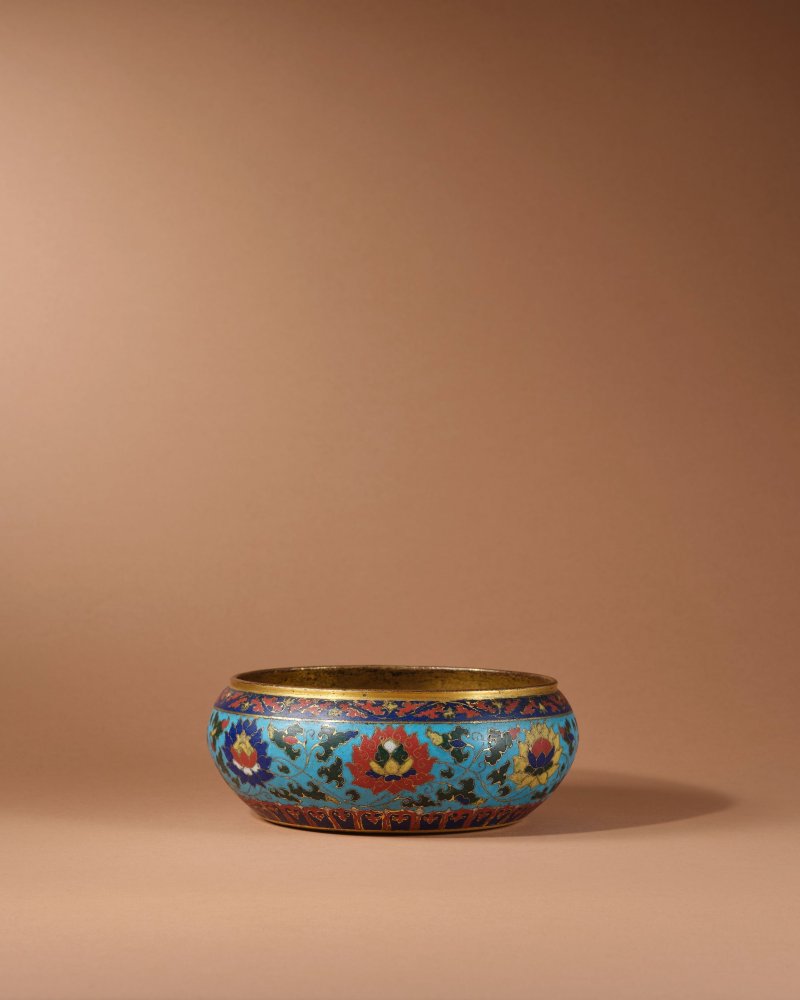
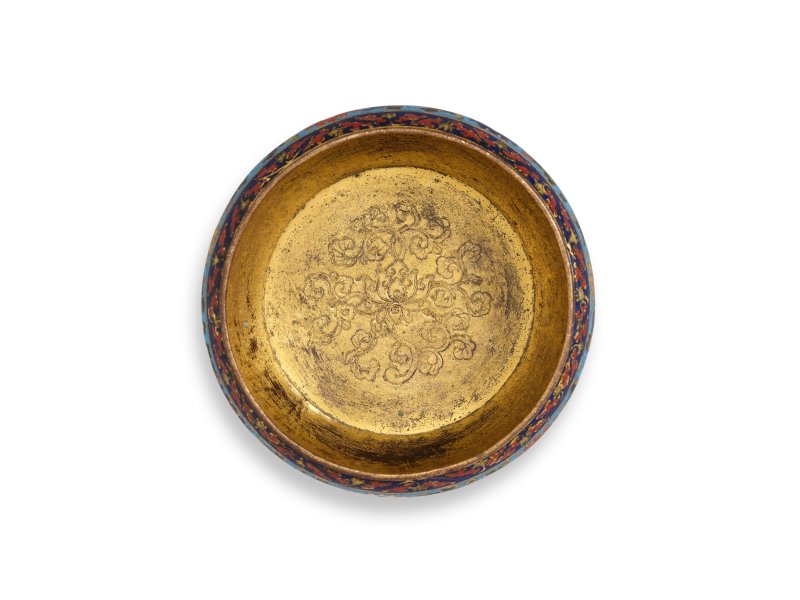
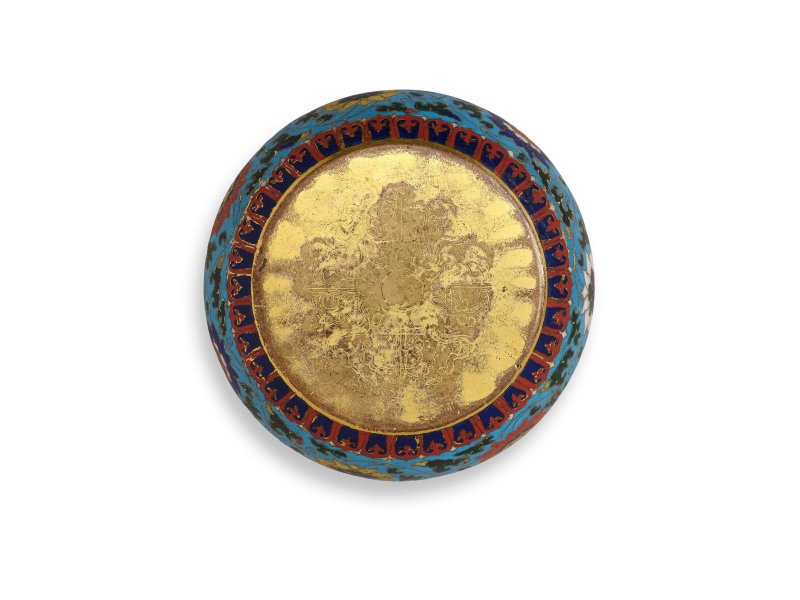
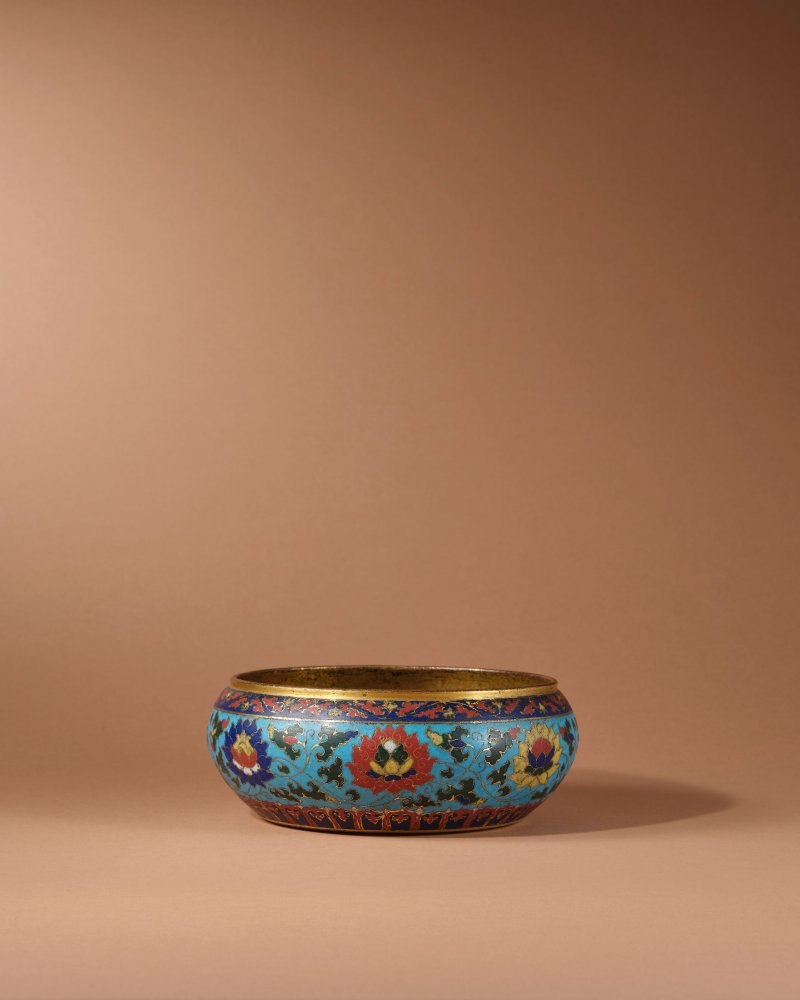
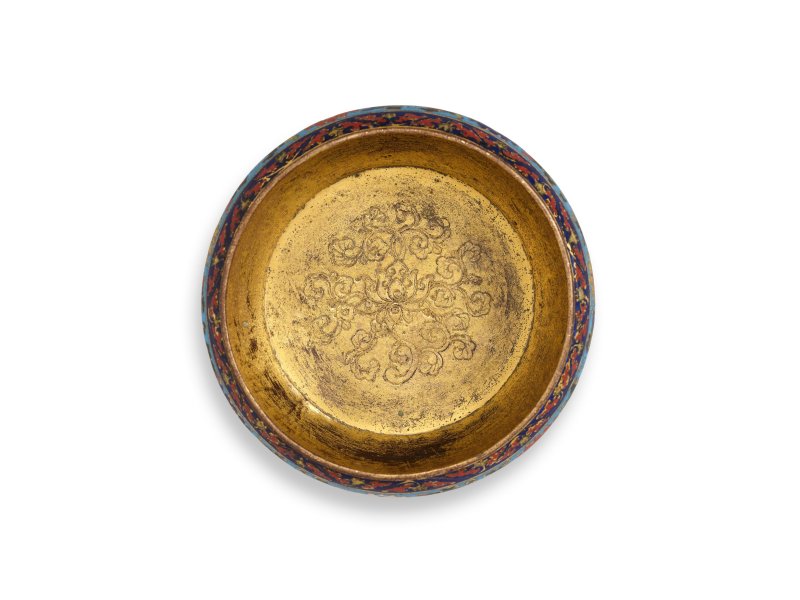
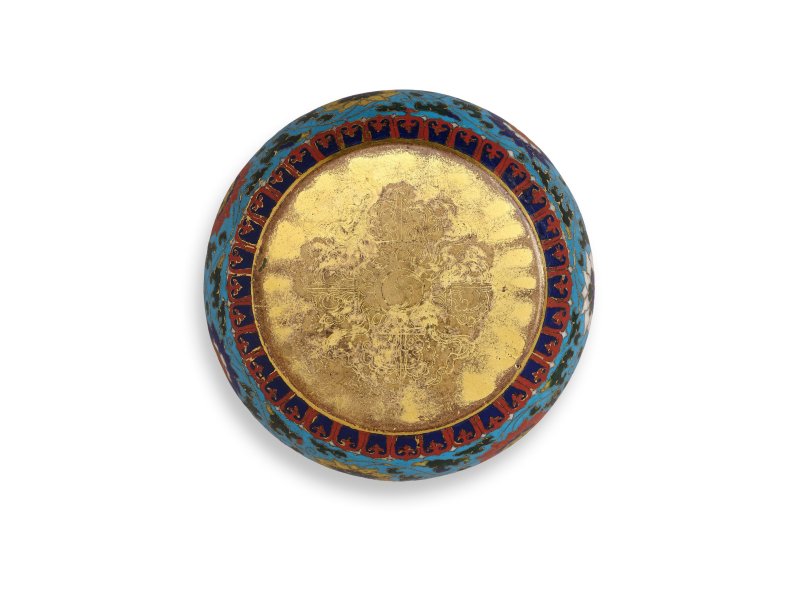
Of compressed globular form rising from a flat base to a lipped rim, finely enamelled around the exterior with large lotus blossoms borne on leafy scrolls, between bands of foliate scrolls beneath the mouth and lappets above the foot, the gilt interior incised with a lotus, the base incised with vajra cross with taiji symbol in the centre.
15.5cm (6 1/8in) diam.
Footnotes
明初 銅鎏金掐絲琺瑯番蓮紋缽
Provenance:
Bainbridge's, London, 1 May 2008, lot 450
來源:
Bainbridge's,倫敦,2008年5月1日,拍品編號450
See a similar cloisonné enamel bowl decorated with lotus, gilded underside and engraved with a double vajra, first half of the 15th century, illustrated by H.Brinker and A.Lutz, Chinese Cloisonné: The Pierre Uldry Collection, London, 1989, no.16. Another related cloisonné bowl with similar shape and decoration, but applied with spout and loop handle, is in the Victoria and Albert Museum, London (acc.no.296-1893). The present lot was almost certainly conceived for a ritual function. This is suggested both by its form, which closely echoes that of a traditional alms bowl, and by the engraved double motif on the underside. The Uldry example is closely comparable to a ritual vessel in the Victoria and Albert Museum, which differs only in the addition of a short beaked spout and a ring handle affixed to the rim. The correspondence in proportions, lotus ornament, decorative bands and the engraved vajra on the base is so precise that the present lot were likely produced in the same workshop and may originally have formed part of a single set.
The depicted on the base of the alms bowl is emblematic implements of Esoteric Buddhist ritual. Formed as a club with multiple prongs at each end, the functions as a ritual weapon embodying indestructible, irresistible power and symbolising the dynamic energy of enlightenment. Such imagery was actively promoted in Imperial workshops under the Yongle and Xuande Emperors who were strong supporters of Tibetan Buddhism.
Cloisonné enamel vessels decorated with the crossed and motif on the bases are recorded on wares of the Yuan and early Ming periods. See for example a cloisonné Tibetan Buddhist vase, Yuan dynasty and a cloisonné vessel, early Ming dynasty, in the Qing Court Collection, illustrated in the , Beijing, 2011, nos.2 and 19. A cloisonné enamel incense burner, 1400-1450, with a double- on the base, is in the British Museum, London, (acc.no.1945,1208.8). See also a cloisonné enamel vase, with double base plate, Xuande, in the Asian Art Museum, San Francisco, (acc.no.B60P288).
Compare with a rare cloisonné enamel 'lotus and double-vajra' dish, early Ming dynasty, also with double engraved in the base plate, which was sold at Bonhams Hong Kong, 2 December 2021, lot 28.
銅胎,圓口,碩腹。全器淺藍地,器内、器底及口沿鎏金,外壁飾番蓮紋,上下飾卷葉紋、蓮瓣紋各一圈。器內陰刻蓮紋,器底刻十字金剛杵,中心飾太極圖。
此缽形制古雅,紋飾華美,應為佛教儀軌用器。可參考一件十五世紀上半葉掐絲琺瑯蓮紋碗,其鎏金器底亦陰刻十字金剛杵紋,見H.Brinker及A.Lutz,《Chinese Cloisonné: The Pierre Uldry Collection》,倫敦,1989年,編號16。倫敦維多利亞與艾伯特博物館另藏一件形制、紋飾相似之例,然置有流嘴與環柄(館藏編號:296-1893)。本拍品之器形隨傳統缽盂,器底亦刻金剛杵紋,皆反映其為佛門供養之器。Uldry所藏之例,與維多利亞與艾伯特博物館藏例極為相似,惟後者加設短流及環柄。本拍品與兩者在器形、紋飾及器底金剛杵刻紋方面皆極為一致,極可能出自同一作坊,或原屬同一組器。
缽底所飾金剛杵,乃密宗法器,形如杖狀,兩端出鋒,象徵堅固不壞之力量與覺悟。此類紋飾於永樂、宣德朝宮廷作坊中頗受重視,因二帝皆崇敬藏傳佛教。器底飾十字金剛杵與太極紋之掐絲琺瑯器,可見於元至明初掐絲琺瑯器。參考清宮舊藏一件元代掐絲琺瑯纏枝蓮紋藏草瓶及一件明初掐絲琺瑯纏枝蓮紋出戟尊,著錄於《故宮博物院藏品大系:琺瑯器編1:元明掐絲琺瑯》,北京,2011年,編號2及19。另見大英博物館藏一件1400至1450年掐絲琺瑯香爐,器底亦飾十字金剛杵紋(館藏編號:1945,1208.8);及舊金山亞洲藝術博物館藏一件宣德時期掐絲琺瑯瓶(館藏編號B60P288)。
比較一件明初掐絲琺瑯蓮紋盤,器底飾有十字金剛杵紋,售於香港邦瀚斯,2021年12月2日,拍品編號28。
Of compressed globular form rising from a flat base to a lipped rim, finely enamelled around the exterior with large lotus blossoms borne on leafy scrolls, between bands of foliate scrolls beneath the mouth and lappets above the foot, the gilt interior incised with a lotus, the base incised with vajra cross with taiji symbol in the centre.
15.5cm (6 1/8in) diam.
Footnotes
明初 銅鎏金掐絲琺瑯番蓮紋缽
Provenance:
Bainbridge's, London, 1 May 2008, lot 450
來源:
Bainbridge's,倫敦,2008年5月1日,拍品編號450
See a similar cloisonné enamel bowl decorated with lotus, gilded underside and engraved with a double vajra, first half of the 15th century, illustrated by H.Brinker and A.Lutz, Chinese Cloisonné: The Pierre Uldry Collection, London, 1989, no.16. Another related cloisonné bowl with similar shape and decoration, but applied with spout and loop handle, is in the Victoria and Albert Museum, London (acc.no.296-1893). The present lot was almost certainly conceived for a ritual function. This is suggested both by its form, which closely echoes that of a traditional alms bowl, and by the engraved double motif on the underside. The Uldry example is closely comparable to a ritual vessel in the Victoria and Albert Museum, which differs only in the addition of a short beaked spout and a ring handle affixed to the rim. The correspondence in proportions, lotus ornament, decorative bands and the engraved vajra on the base is so precise that the present lot were likely produced in the same workshop and may originally have formed part of a single set.
The depicted on the base of the alms bowl is emblematic implements of Esoteric Buddhist ritual. Formed as a club with multiple prongs at each end, the functions as a ritual weapon embodying indestructible, irresistible power and symbolising the dynamic energy of enlightenment. Such imagery was actively promoted in Imperial workshops under the Yongle and Xuande Emperors who were strong supporters of Tibetan Buddhism.
Cloisonné enamel vessels decorated with the crossed and motif on the bases are recorded on wares of the Yuan and early Ming periods. See for example a cloisonné Tibetan Buddhist vase, Yuan dynasty and a cloisonné vessel, early Ming dynasty, in the Qing Court Collection, illustrated in the , Beijing, 2011, nos.2 and 19. A cloisonné enamel incense burner, 1400-1450, with a double- on the base, is in the British Museum, London, (acc.no.1945,1208.8). See also a cloisonné enamel vase, with double base plate, Xuande, in the Asian Art Museum, San Francisco, (acc.no.B60P288).
Compare with a rare cloisonné enamel 'lotus and double-vajra' dish, early Ming dynasty, also with double engraved in the base plate, which was sold at Bonhams Hong Kong, 2 December 2021, lot 28.
銅胎,圓口,碩腹。全器淺藍地,器内、器底及口沿鎏金,外壁飾番蓮紋,上下飾卷葉紋、蓮瓣紋各一圈。器內陰刻蓮紋,器底刻十字金剛杵,中心飾太極圖。
此缽形制古雅,紋飾華美,應為佛教儀軌用器。可參考一件十五世紀上半葉掐絲琺瑯蓮紋碗,其鎏金器底亦陰刻十字金剛杵紋,見H.Brinker及A.Lutz,《Chinese Cloisonné: The Pierre Uldry Collection》,倫敦,1989年,編號16。倫敦維多利亞與艾伯特博物館另藏一件形制、紋飾相似之例,然置有流嘴與環柄(館藏編號:296-1893)。本拍品之器形隨傳統缽盂,器底亦刻金剛杵紋,皆反映其為佛門供養之器。Uldry所藏之例,與維多利亞與艾伯特博物館藏例極為相似,惟後者加設短流及環柄。本拍品與兩者在器形、紋飾及器底金剛杵刻紋方面皆極為一致,極可能出自同一作坊,或原屬同一組器。
缽底所飾金剛杵,乃密宗法器,形如杖狀,兩端出鋒,象徵堅固不壞之力量與覺悟。此類紋飾於永樂、宣德朝宮廷作坊中頗受重視,因二帝皆崇敬藏傳佛教。器底飾十字金剛杵與太極紋之掐絲琺瑯器,可見於元至明初掐絲琺瑯器。參考清宮舊藏一件元代掐絲琺瑯纏枝蓮紋藏草瓶及一件明初掐絲琺瑯纏枝蓮紋出戟尊,著錄於《故宮博物院藏品大系:琺瑯器編1:元明掐絲琺瑯》,北京,2011年,編號2及19。另見大英博物館藏一件1400至1450年掐絲琺瑯香爐,器底亦飾十字金剛杵紋(館藏編號:1945,1208.8);及舊金山亞洲藝術博物館藏一件宣德時期掐絲琺瑯瓶(館藏編號B60P288)。
比較一件明初掐絲琺瑯蓮紋盤,器底飾有十字金剛杵紋,售於香港邦瀚斯,2021年12月2日,拍品編號28。
常见问题
这件明初 銅鎏金掐絲琺瑯番蓮紋缽 | A VERY RARE CLOISONNÉ ENAMEL AND GILT-BRONZE ALMS BOWL的成交价是多少?
落槌价为 预展中。 成交价为 预展中。