
拍品信息
拍品名称
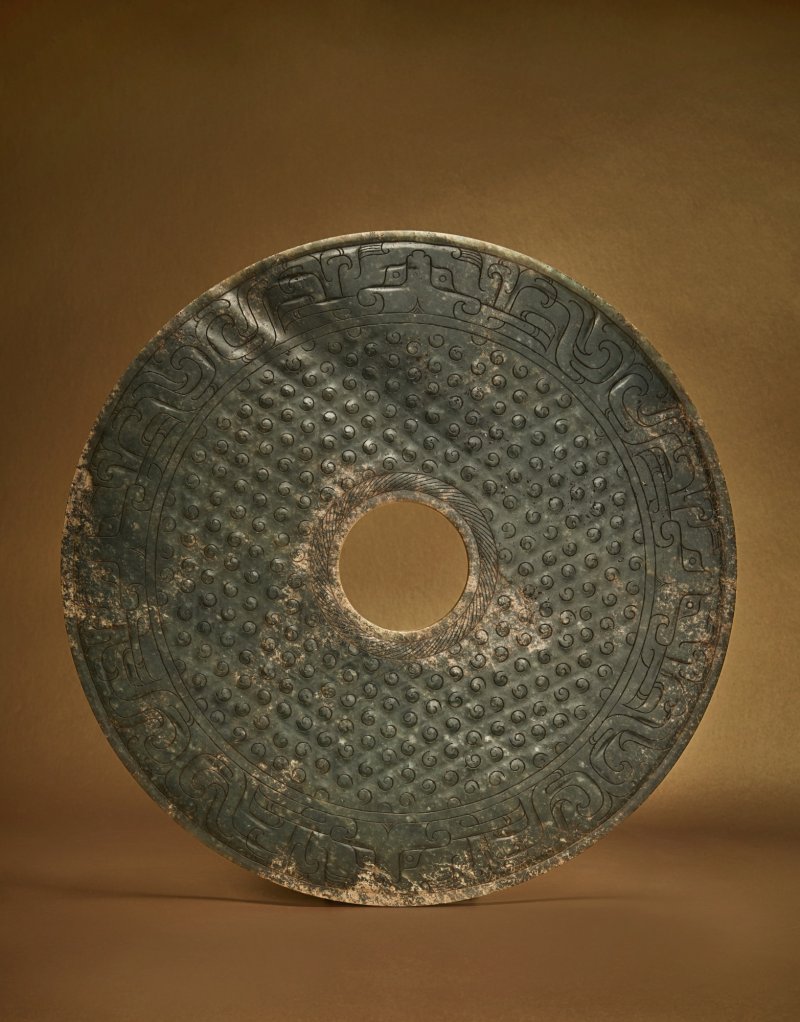
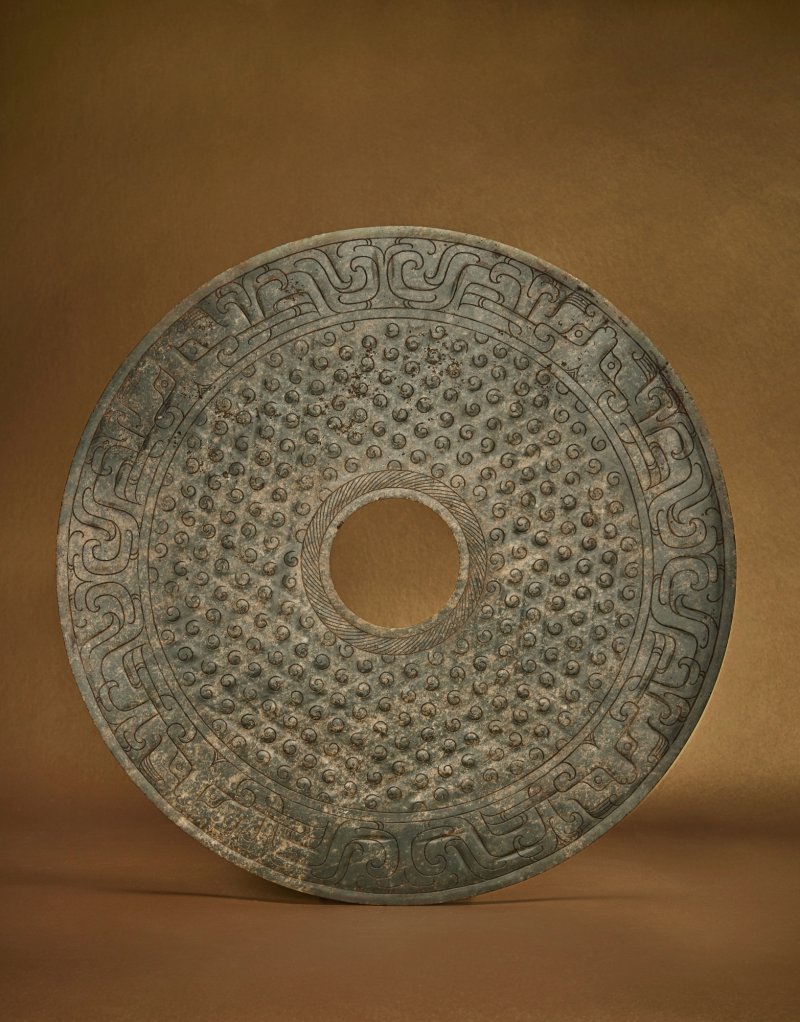
西漢 玉獸面谷紋璧
起拍价
USD 60,000
估值区间
60,000 - 80,000 USD
尺寸
未知
品相
如欲了解本拍品狀況的更多資訊,請聯絡 Drew.Lerner@sothebys.com
更多信息
Diameter 10⅜ in., 26.3 cm
来源:David David-Weill (1871-1952) 收藏,1937年之前
巴黎蘇富比2015年12月16日,編號48
展览:《Arts de La Chine Ancienne》,橘園美術館,巴黎,1937年,編號121
图录
说明:Large jade discs, known from the earliest Confucian texts as bi, represent one of the most important designs in archaic jadework. While their initial ritual function has been obscured by layers of historiography, the beauty of their stone; their ancient patina; and, by the Zhou dynasties, their sumptuous decoration have given bi an unrivalled place in the history of Chinese jade as symbols of ancient power and beauty.
By the late Eastern Zhou period, bi adorned with a relief pattern of spirals became a mainstay of elite funerary contexts, glistening in the light as one holds them in the hand. Though similar experimentation appears to have already been present in particularly wealthy Western Zhou contexts, it was during the Western Han period that these spirals and scrolls began to be frequently supplemented with hexagonal projections and complex border designs of which the present – a complex intermingling of zoomorphic bodies and bovine masks – appears to have been among the most common and beloved.
Related examples of this design schema, with slight variation in size, linework and surface quality include: those excavated from the famous Western Han mausoleum of the King of Nanyue, illustrated in Gu Fang, The Complete Collection of Jades Unearthed in China, vol. 11, Beijing, 2005, pp 42–55, the first two with further bands of bovine design surrounding the centre holes; one of a handful preserved in the National Palace Museum, Taipei included in Masterworks of Chinese Jade in the National Palace Museum, Taipei, 1970, pl. 5; another mounted in a Qing imperial zitan table screen in Masterworks of Chinese Jade in the National Palace Museum, supplement, Taipei, 1973, pl. 4; and others included in the Museum’s Special Exhibition of Circular Jade, Taipei, 1995, cat. nos 87, 88 (cover), 91, 92 and 93, the cover image generally finer than the others and bearing the closer resemblance to the present disc in its use of linework.
Further excavated examples include a slightly smaller disc attributed to the late Warring States period uncovered in 1977 from Yanggong township, Changfeng county, Anhui, preserved in the Palace Museum, Beijing in The Complete Collection of Treasures of the Palace Museum. Jadeware (I), Hong Kong, 1995, pl. 126, with the bovine design facing towards the interior and without rope-twist borders; and two outward-facing examples attributed to the Western Han dynasty, pls 213 and 214, the former particularly close to the present in terms of line treatment.
A surprisingly large number of bi of this dark stone appear to have been preserved in collections formed in the West during the 1920s and 1930s; the present, from the collection of David David-Weill (1871-1952), being no exception. Compare two discs from the collection of Grenville L. Winthrop (1864–1943), illustrated in Max Loehr, Ancient Chinese Jades, Cambridge, 1975, cat. nos 533 and 534; another from the Edward and Louise Sonnenschein Collection in Alfred Salmony, Archaic Jades from the Edward and Louise B. Sonnenschein Collection, Chicago, 1952, pl. LXX; and three other discs illustrated by the famous dealer C. T. Loo in An Exhibition of Chinese Archaic Jades, West Palm Beach, 1950, pls XXXVIII:2, 3 and 6.
来源:David David-Weill (1871-1952) 收藏,1937年之前
巴黎蘇富比2015年12月16日,編號48
展览:《Arts de La Chine Ancienne》,橘園美術館,巴黎,1937年,編號121
图录
说明:Large jade discs, known from the earliest Confucian texts as bi, represent one of the most important designs in archaic jadework. While their initial ritual function has been obscured by layers of historiography, the beauty of their stone; their ancient patina; and, by the Zhou dynasties, their sumptuous decoration have given bi an unrivalled place in the history of Chinese jade as symbols of ancient power and beauty.
By the late Eastern Zhou period, bi adorned with a relief pattern of spirals became a mainstay of elite funerary contexts, glistening in the light as one holds them in the hand. Though similar experimentation appears to have already been present in particularly wealthy Western Zhou contexts, it was during the Western Han period that these spirals and scrolls began to be frequently supplemented with hexagonal projections and complex border designs of which the present – a complex intermingling of zoomorphic bodies and bovine masks – appears to have been among the most common and beloved.
Related examples of this design schema, with slight variation in size, linework and surface quality include: those excavated from the famous Western Han mausoleum of the King of Nanyue, illustrated in Gu Fang, The Complete Collection of Jades Unearthed in China, vol. 11, Beijing, 2005, pp 42–55, the first two with further bands of bovine design surrounding the centre holes; one of a handful preserved in the National Palace Museum, Taipei included in Masterworks of Chinese Jade in the National Palace Museum, Taipei, 1970, pl. 5; another mounted in a Qing imperial zitan table screen in Masterworks of Chinese Jade in the National Palace Museum, supplement, Taipei, 1973, pl. 4; and others included in the Museum’s Special Exhibition of Circular Jade, Taipei, 1995, cat. nos 87, 88 (cover), 91, 92 and 93, the cover image generally finer than the others and bearing the closer resemblance to the present disc in its use of linework.
Further excavated examples include a slightly smaller disc attributed to the late Warring States period uncovered in 1977 from Yanggong township, Changfeng county, Anhui, preserved in the Palace Museum, Beijing in The Complete Collection of Treasures of the Palace Museum. Jadeware (I), Hong Kong, 1995, pl. 126, with the bovine design facing towards the interior and without rope-twist borders; and two outward-facing examples attributed to the Western Han dynasty, pls 213 and 214, the former particularly close to the present in terms of line treatment.
A surprisingly large number of bi of this dark stone appear to have been preserved in collections formed in the West during the 1920s and 1930s; the present, from the collection of David David-Weill (1871-1952), being no exception. Compare two discs from the collection of Grenville L. Winthrop (1864–1943), illustrated in Max Loehr, Ancient Chinese Jades, Cambridge, 1975, cat. nos 533 and 534; another from the Edward and Louise Sonnenschein Collection in Alfred Salmony, Archaic Jades from the Edward and Louise B. Sonnenschein Collection, Chicago, 1952, pl. LXX; and three other discs illustrated by the famous dealer C. T. Loo in An Exhibition of Chinese Archaic Jades, West Palm Beach, 1950, pls XXXVIII:2, 3 and 6.
常见问题
拍品的品相状况如何?
如欲了解本拍品狀況的更多資訊,請聯絡 Drew.Lerner@sothebys.com
这件拍品的流传来源是什么?
David David-Weill (1871-1952) 收藏,1937年之前
巴黎蘇富比2015年12月16日,編號48
巴黎蘇富比2015年12月16日,編號48
这件拍品曾在哪些展览中展出过?
《Arts de La Chine Ancienne》,橘園美術館,巴黎,1937年,編號121
图录
图录