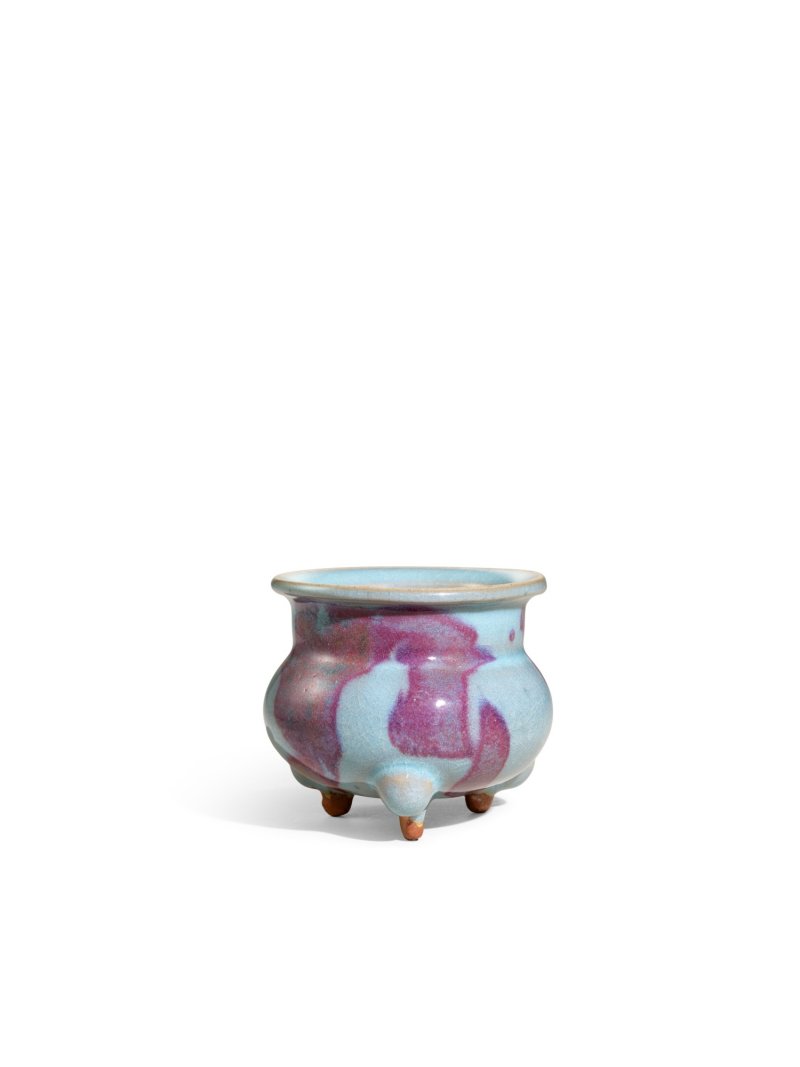

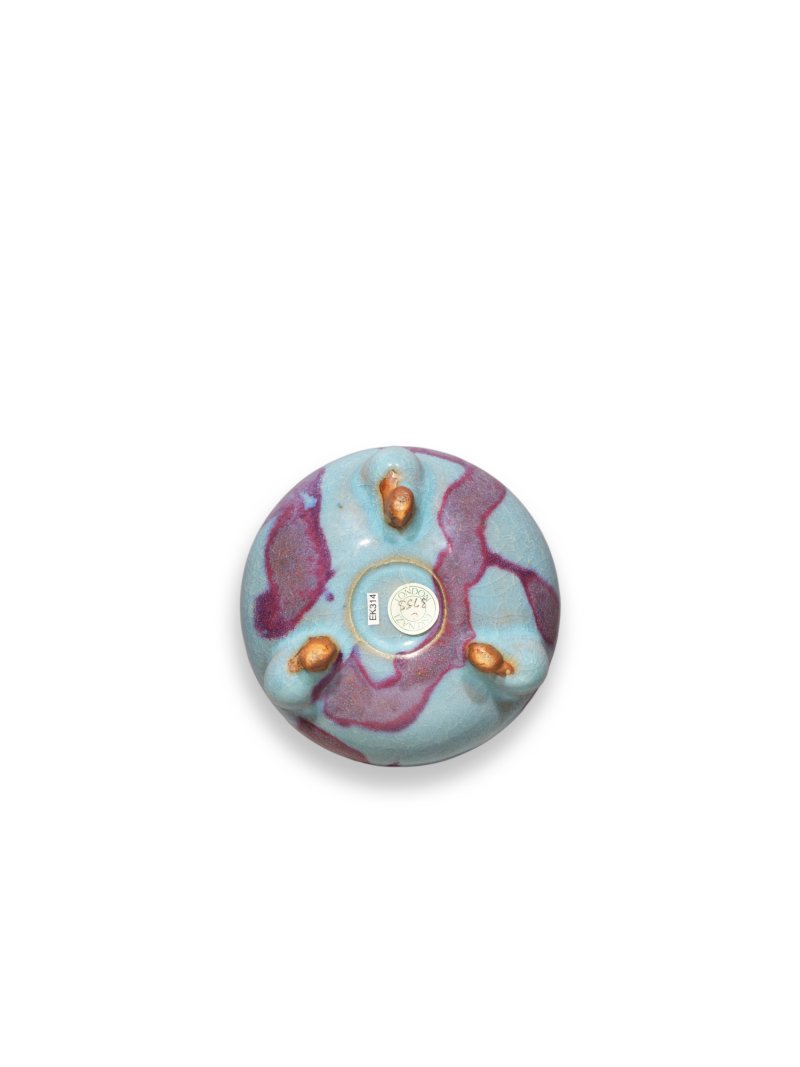

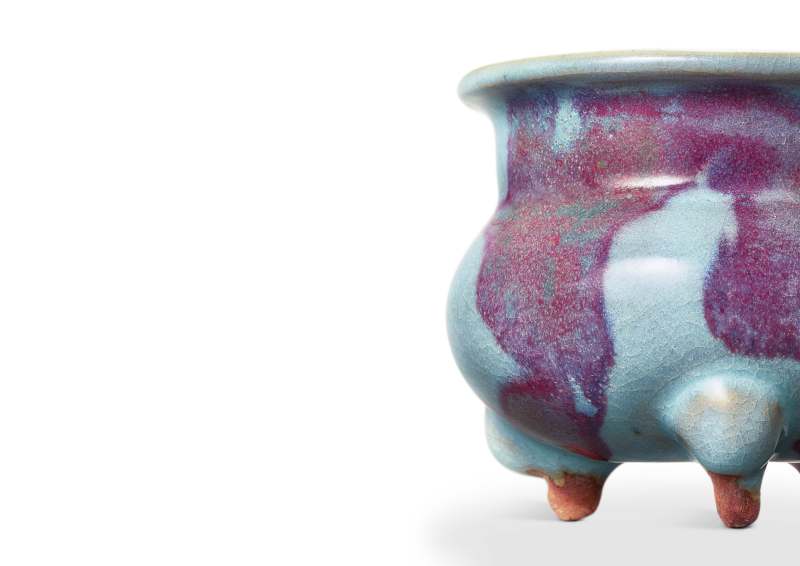
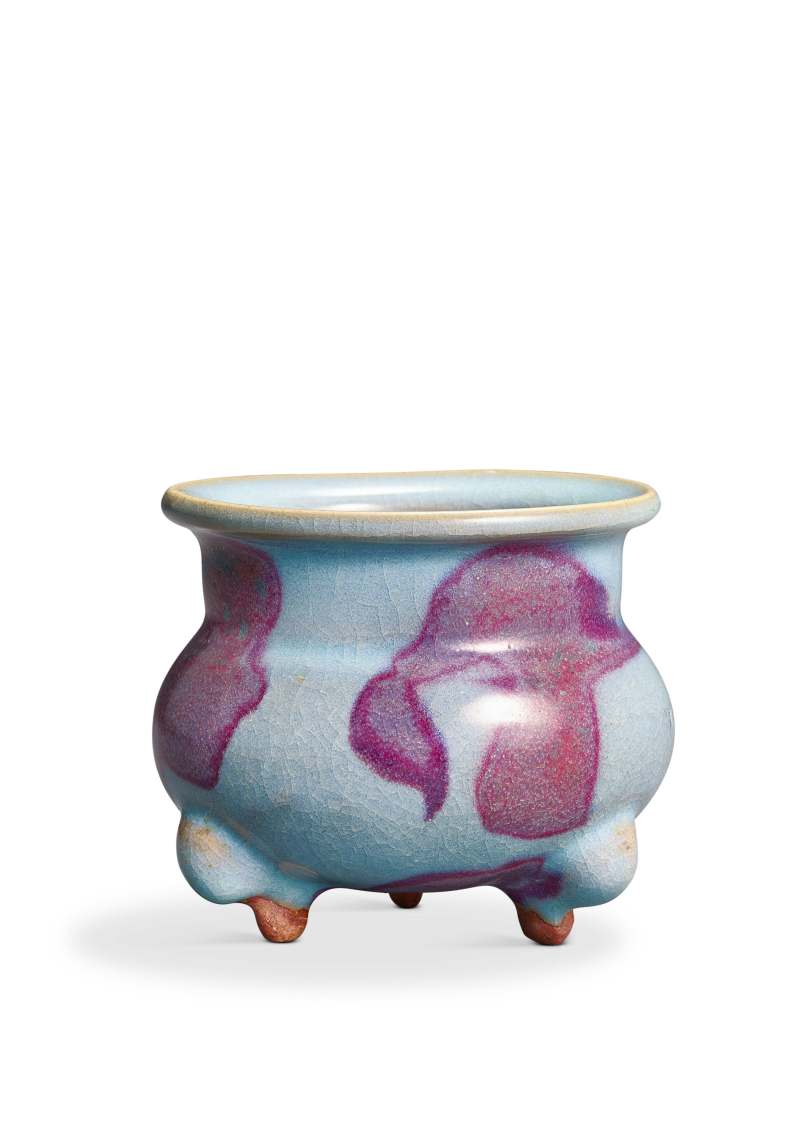
Lot 8048 A superb Junyao purple-splashed tripod incense burner, Northern Song - Jin dynasty | 北宋至金 鈞窰天藍釉玫瑰紫斑三足爐
落槌价
预展中
成交价
预展中
| 拍卖公司 | 苏富比 |
|---|---|
| 拍卖时间 | 2026年10月30日 |
拍品信息
拍品名称
A superb Junyao purple-splashed tripod incense burner, Northern Song - Jin dynasty | 北宋至金 鈞窰天藍釉玫瑰紫斑三足爐
起拍价
HKD 3,000,000
估值区间
3,000,000 - 6,000,000 HKD
尺寸
未知
品相
Very good overall condition. Possibly two small areas on the unglazed feet lightly flaked and retouched. One minuscule shallow glaze flake (approx. 0.3cm) to the exterior. The glaze is otherwise exceptionally well preserved with minimal surface wear.
整體品相良好。兩足露胎處稍經潤飾,或為微小剝痕。器身見一微淺剝釉(約0.3公分)。釉光瑩潤,器面磨痕甚微。
If a condition report is provided to assist you with assessing the condition of the lot, it is for guidance purposes only. Such condition report may not refer to all faults, restoration, alterations, or adaptations because Sotheby's is not a professional conservator or restorer but rather a condition report is a statement of subjective, qualified opinion genuinely held by Sotheby's. For these reasons, any such condition report is not an alternative to taking your own professional advice regarding the condition of the lot. Prospective buyers should also refer to the Guide for Buyers at Auction which includes important notices concerning the type of property in this sale.
更多信息
10.5cm
来源:Eskenazi Ltd, London, no. C3755.
The Ten-Views Lingbi Rock Retreat Collection, coll. no. EK314.
展览:Song: Chinese Ceramics, 10th to 13th Century, Eskenazi, New York, 2007, cat. no. 9.
著录:Jane Sze, The Rainbow Aloft: Jun Ware, Hong Kong, 2019, pl. 8.
Rose Kerr, Song Dynasty Ceramics, Victoria and Albert Museum, London, 2020, pl. 26.
Jane Sze, 'Some Forms and Uses of Jun Wares', Arts of Asia, November-December 2020, fig. 13.
Rose Kerr, Dazzling Official Jun Wares: From Museums and Collections Around the World, London, 2021, pl. 56.
图录
说明:來源
埃斯卡納齊,倫敦,編號 C3755
十面靈璧山居收藏,編號 EK314
展覽
《Song: Chinese Ceramics, 10th to 13th Century》,埃斯卡納齊,紐約,2007年,編號9
出版
施君玉,《The Rainbow Aloft: Jun Ware》,香港,2019年,圖版8
柯玫瑰,《宋瓷》,維多利亞和阿爾伯特博物館,倫敦,2020年,圖版26
施君玉, <Some Forms and Uses of Jun Wares>,《亞洲藝術》,2020年11/12月,圖13
柯玫瑰,《Dazzling Official Jun Wares: From Museums and Collections Around the World》,倫敦,2021年,圖版56
Enveloped in a thick, luminous turquoise-blue glaze and dramatically highlighted with vibrant purple and lavender splashes, the present censer perfectly encapsulates the celebrated aesthetic of Jun wares. Produced at the Juntai kilns in Yu county, Henan province, Jun wares are renowned for their opalescent glazes ranging from milky blue to deep radiant purple. From the early 12th century, innovative potters began applying copper-derived pigments to the unfired glaze, resulting in striking purplish-red splashes that contrast beautifully against the soft blue ground, creating a mesmerising, almost ethereal effect.
The popularity of incense during the Song period, which permeated both religious rituals and secular life, naturally spurred a demand for elegant censers. This era also witnessed a flourishing of antiquarianism, with scholars and the elite avidly collecting and studying archaic bronzes. Influenced by this archaistic trend, potters began modelling ceramic censers after ancient bronze li tripods, a form that was highly favoured for its classical elegance and historical resonance.
A closely related incense burner with similar purple splashes from the Sir Percival David Collection (accession no. PDF.50) is illustrated in Stacey Pierson, Illustrated catalogue of Ru, Guan, Jun, Guangdong and Yixing wares in the Percival David Foundation of Chinese Art, London, 1999, p. 36, no. 50; alongside another censer of similar form but without the purple splashes (accession no. PDF.95), illustrated ibid., p. 50, no. 95. Further comparable examples include one illustrated in Jane Sze, The Rainbow Aloft: Jun Ware, Hong Kong, 2020, pl. 8; one in the Baur Collection, Geneva, published in John Ayers, The Baur Collection Geneva. Chinese Ceramics, vol. 1, Geneva, 1968-74, pl. A 37; and a slightly smaller tripod censer in the Palace Museum, Beijing, included in Junci yaji. Gugong Bowuyuan zhencang ji chutu junyao ciqi huicui / Selection of Jun Ware. The Palace Museum’s Collection and Archaeological Excavation, Beijing, 2013, pl. 29. Compare also a piece from the Muwen Tang Collection, exhibited in Song Ceramics from the Kwan Collection, Hong Kong Museum of Art, Hong Kong, 1994, cat. no. 42, and later sold in our London rooms, 12th November 2003, lot 49; and another sold in our New York rooms, 18th March 2008, lot 90.
本品天藍釉厚潤瑩剔,紫斑如霞,絢麗奪目,盡顯鈞瓷卓絕之美。鈞台窰位於今河南省禹縣,古屬鈞州,其出產之鈞瓷以天藍至玫瑰紫之變幻釉色聞名天下。十二世紀初,陶工創燒新技,於入窰前在瓷坯上施以含銅色料,經還原氣氛燒造,遂於天藍底釉上綻放紫紅斑斕,釉光瑩潤,如夢似幻。
宋代香道盛行,無論宗教祭祀抑或文人雅集、日常起居,皆好焚香,故香爐之需求大增。與此同時,金石學興起,文人士大夫熱衷於搜求考證高古青銅器。受此尚古風氣影響,陶工遂以商周青銅鬲為藍本燒造香爐,其器形古雅,深受當時文人雅士所青睞。
大維德爵士珍藏中有一件紫斑相近之鈞窰三足爐(館藏編號 PDF.50),著錄於畢宗陶,《Illustrated catalogue of Ru, Guan, Jun, Guangdong and Yixing wares in the Percival David Foundation of Chinese Art》,倫敦,1999年,頁36,編號50;同書亦載一形制相近但無紫斑之作例(館藏編號 PDF.95),見頁50,編號95。其他相似作例包括一例,見施君玉《The Rainbow Aloft: Jun ware》,香港,2020年,圖版8;日內瓦鮑氏收藏一例,載於 John Ayers,《The Baur Collection, Geneva. Chinese Ceramics》,卷1,日內瓦,1968年,編號A37;北京故宮博物院藏一尺寸較小之作例,載於《鈞窰雅集:故宮博物院珍藏及出土鈞窰瓷器薈萃》,北京,2013年,圖版29。另可比較沐文堂舊藏一例,曾展於《關氏所藏宋代陶瓷》,香港藝術館,香港,1994年,編號42,後易手於倫敦蘇富比2003年11月12日,編號49;以及紐約蘇富比2008年3月18日拍出之一例,編號90。
常见问题
这件A superb Junyao purple-splashed tripod incense burner, Northern Song - Jin dynasty | 北宋至金 鈞窰天藍釉玫瑰紫斑三足爐的成交价是多少?
落槌价为 预展中。 成交价为 预展中。
拍品的品相状况如何?
Very good overall condition. Possibly two small areas on the unglazed feet lightly flaked and retouched. One minuscule shallow glaze flake (approx. 0.3cm) to the exterior. The glaze is otherwise exceptionally well preserved with minimal surface wear.
整體品相良好。兩足露胎處稍經潤飾,或為微小剝痕。器身見一微淺剝釉(約0.3公分)。釉光瑩潤,器面磨痕甚微。
If a condition report is provided to assist you with assessing the condition of the lot, it is for guidance purposes only. Such condition report may not refer to all faults, restoration, alterations, or adaptations because Sotheby's is not a professional conservator or restorer but rather a condition report is a statement of subjective, qualified opinion genuinely held by Sotheby's. For these reasons, any such condition report is not an alternative to taking your own professional advice regarding the condition of the lot. Prospective buyers should also refer to the Guide for Buyers at Auction which includes important notices concerning the type of property in this sale.
整體品相良好。兩足露胎處稍經潤飾,或為微小剝痕。器身見一微淺剝釉(約0.3公分)。釉光瑩潤,器面磨痕甚微。
If a condition report is provided to assist you with assessing the condition of the lot, it is for guidance purposes only. Such condition report may not refer to all faults, restoration, alterations, or adaptations because Sotheby's is not a professional conservator or restorer but rather a condition report is a statement of subjective, qualified opinion genuinely held by Sotheby's. For these reasons, any such condition report is not an alternative to taking your own professional advice regarding the condition of the lot. Prospective buyers should also refer to the Guide for Buyers at Auction which includes important notices concerning the type of property in this sale.
这件拍品的流传来源是什么?
Eskenazi Ltd, London, no. C3755.
The Ten-Views Lingbi Rock Retreat Collection, coll. no. EK314.
The Ten-Views Lingbi Rock Retreat Collection, coll. no. EK314.
这件拍品曾在哪些展览中展出过?
Song: Chinese Ceramics, 10th to 13th Century, Eskenazi, New York, 2007, cat. no. 9.
这件拍品被哪些著录书籍记载?
Jane Sze, The Rainbow Aloft: Jun Ware, Hong Kong, 2019, pl. 8.
Rose Kerr, Song Dynasty Ceramics, Victoria and Albert Museum, London, 2020, pl. 26.
Jane Sze, 'Some Forms and Uses of Jun Wares', Arts of Asia, November-December 2020, fig. 13.
Rose Kerr, Dazzling Official Jun Wares: From Museums and Collections Around the World, London, 2021, pl. 56.
图录
Rose Kerr, Song Dynasty Ceramics, Victoria and Albert Museum, London, 2020, pl. 26.
Jane Sze, 'Some Forms and Uses of Jun Wares', Arts of Asia, November-December 2020, fig. 13.
Rose Kerr, Dazzling Official Jun Wares: From Museums and Collections Around the World, London, 2021, pl. 56.
图录