
拍品信息
拍品名称
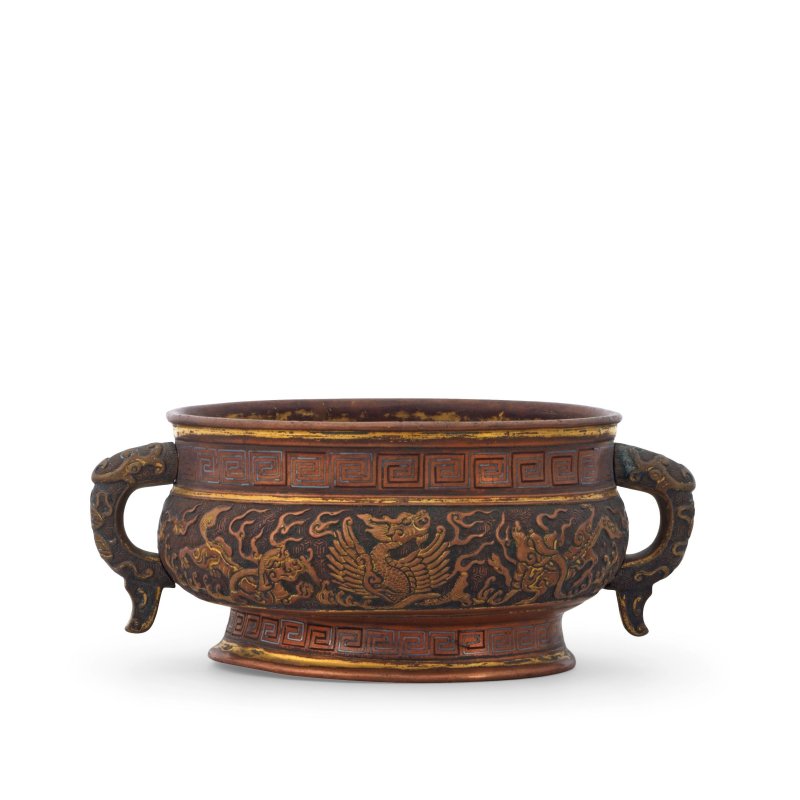
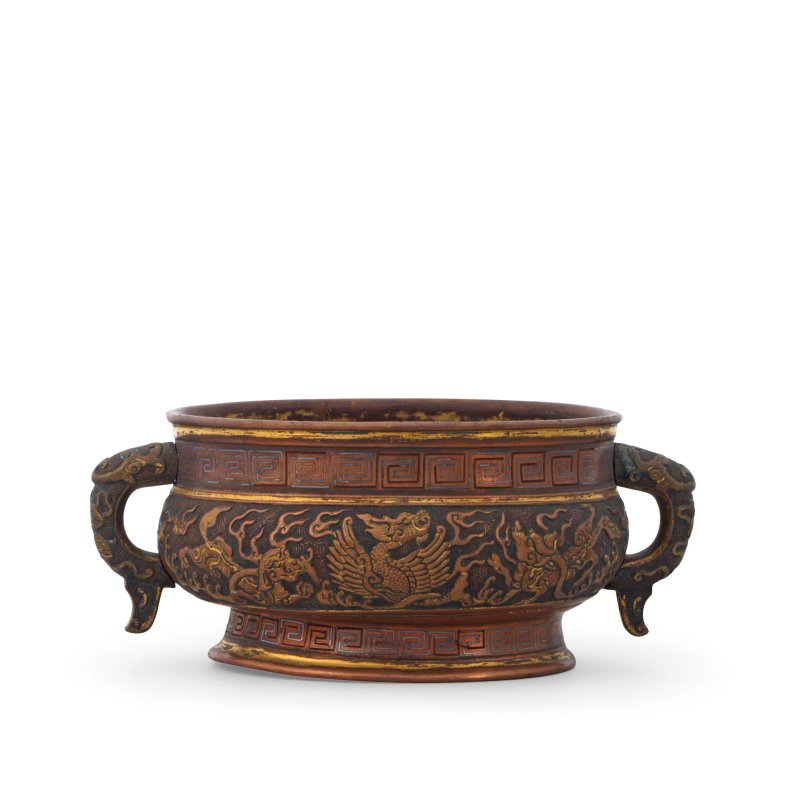
明晚期 局部鎏金嵌銀銅瑞獸紋簋式香爐 | A RARE PARCEL-GILT SILVER-WIRE-INLAID COPPER 'MYTHICAL BEASTS' INCENSE BURNER, GUI
年代
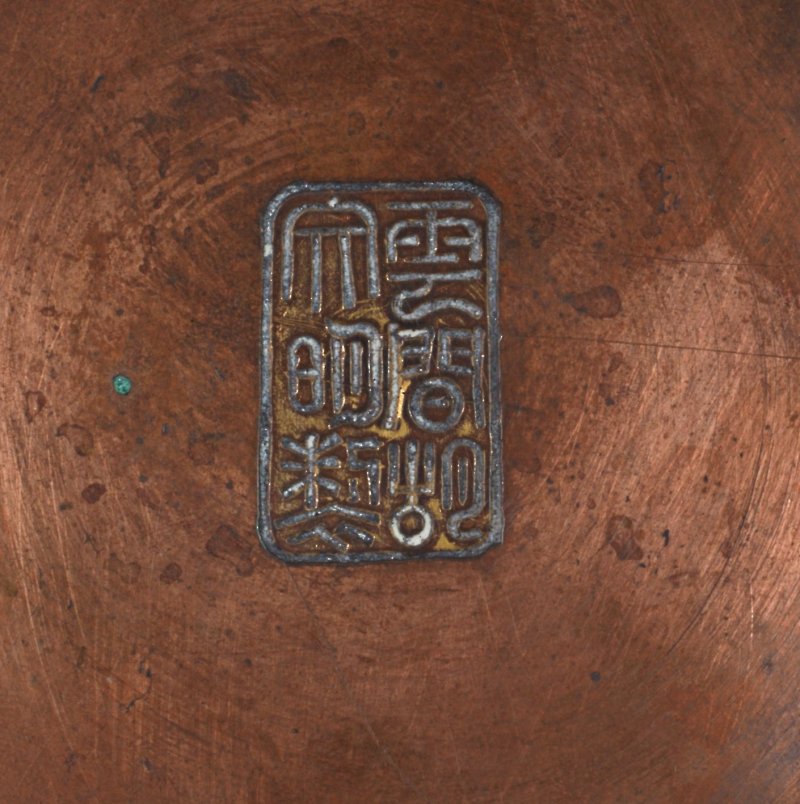
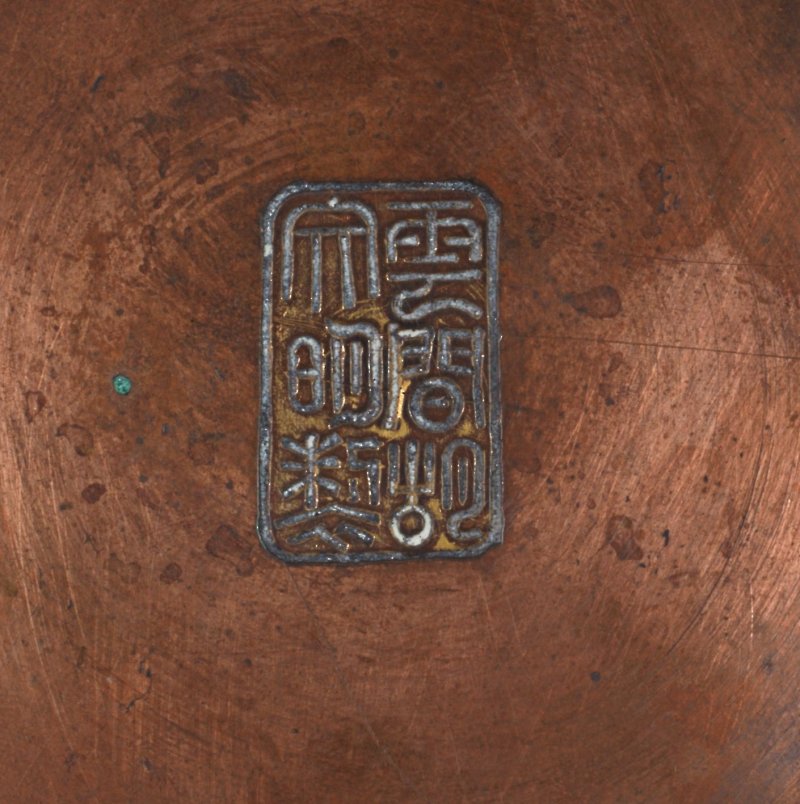
Yunjian Hu Wenming zhi seal mark, late Ming Dynasty
起拍价
GBP 4,000
估值区间
GBP 4000 - 6000
尺寸
未知
品相
未知
更多信息
Yunjian Hu Wenming zhi seal mark, late Ming Dynasty
Delicately cast in archaistic gui-form, the compressed globular body decorated with two groupings of three mythical beasts licked by flames and sprayed by breaking waves, within two bands of key-scroll, framed by two bands of silver-inlaid key-scroll, a pair of applied beast-head loop handles, the mark incised on a gilt rectangular plaque at the base. 16.5cm (6 1/2in) across the handles.
Footnotes
明晚期 局部鎏金嵌銀銅瑞獸紋簋式香爐
款識:「云間胡文明製」篆書款
Provenance: Evaristo Caretti (1879-1955), China and Italy, and thence by descent
Noted in a valuation conducted by Robert Kleiner in 1988
來源: Evaristo Caretti (1879-1955),中國及意大利,並由後人保存迄今
Robert Kleiner于1988年所作的評估中提及此件拍品
Hu Wenming is considered amongst the most accomplished artisans of the late Ming dynasty. The shape of the incense burner is based on an archaic prototype dating to the Shang or Zhou dynasties. The animated creatures, however, may have been drawn from the 'Classic of Mountains and Seas', , compiled between the 2nd or 3rd centuries BC.
A bronze incense burner signed by Hu Wenming and decorated with mythical creatures, approx. 1550-1600, is illustrated in , San Francisco, 2008, p.180, no.111. See also a parcel-gilt copper incense burner, , Yunjian Hu Wenming mark, late 16th/early 17th century, illustrated by R.Mowry, , Phoenix, 1993, p.67. The exceptional quality of the present vessel is demonstrated in the various techniques, from the silver-wire inlay, to the chasing and engraving, as well as the parcel gilding.
A similar parcel-gilt silver-inlaid bronze incense burner, , Yunjian Hu Wenming mark, late 16th/early 17th century, was sold at Christie's Hong Kong, 27 November 2017, lot 8117.
Delicately cast in archaistic gui-form, the compressed globular body decorated with two groupings of three mythical beasts licked by flames and sprayed by breaking waves, within two bands of key-scroll, framed by two bands of silver-inlaid key-scroll, a pair of applied beast-head loop handles, the mark incised on a gilt rectangular plaque at the base. 16.5cm (6 1/2in) across the handles.
Footnotes
明晚期 局部鎏金嵌銀銅瑞獸紋簋式香爐
款識:「云間胡文明製」篆書款
Provenance: Evaristo Caretti (1879-1955), China and Italy, and thence by descent
Noted in a valuation conducted by Robert Kleiner in 1988
來源: Evaristo Caretti (1879-1955),中國及意大利,並由後人保存迄今
Robert Kleiner于1988年所作的評估中提及此件拍品
Hu Wenming is considered amongst the most accomplished artisans of the late Ming dynasty. The shape of the incense burner is based on an archaic prototype dating to the Shang or Zhou dynasties. The animated creatures, however, may have been drawn from the 'Classic of Mountains and Seas', , compiled between the 2nd or 3rd centuries BC.
A bronze incense burner signed by Hu Wenming and decorated with mythical creatures, approx. 1550-1600, is illustrated in , San Francisco, 2008, p.180, no.111. See also a parcel-gilt copper incense burner, , Yunjian Hu Wenming mark, late 16th/early 17th century, illustrated by R.Mowry, , Phoenix, 1993, p.67. The exceptional quality of the present vessel is demonstrated in the various techniques, from the silver-wire inlay, to the chasing and engraving, as well as the parcel gilding.
A similar parcel-gilt silver-inlaid bronze incense burner, , Yunjian Hu Wenming mark, late 16th/early 17th century, was sold at Christie's Hong Kong, 27 November 2017, lot 8117.
常见问题
这件明晚期 局部鎏金嵌銀銅瑞獸紋簋式香爐 | A RARE PARCEL-GILT SILVER-WIRE-INLAID COPPER 'MYTHICAL BEASTS' INCENSE BURNER, GUI的成交价是多少?
落槌价为 预展中。 成交价为 预展中。


