
拍品信息
拍品名称
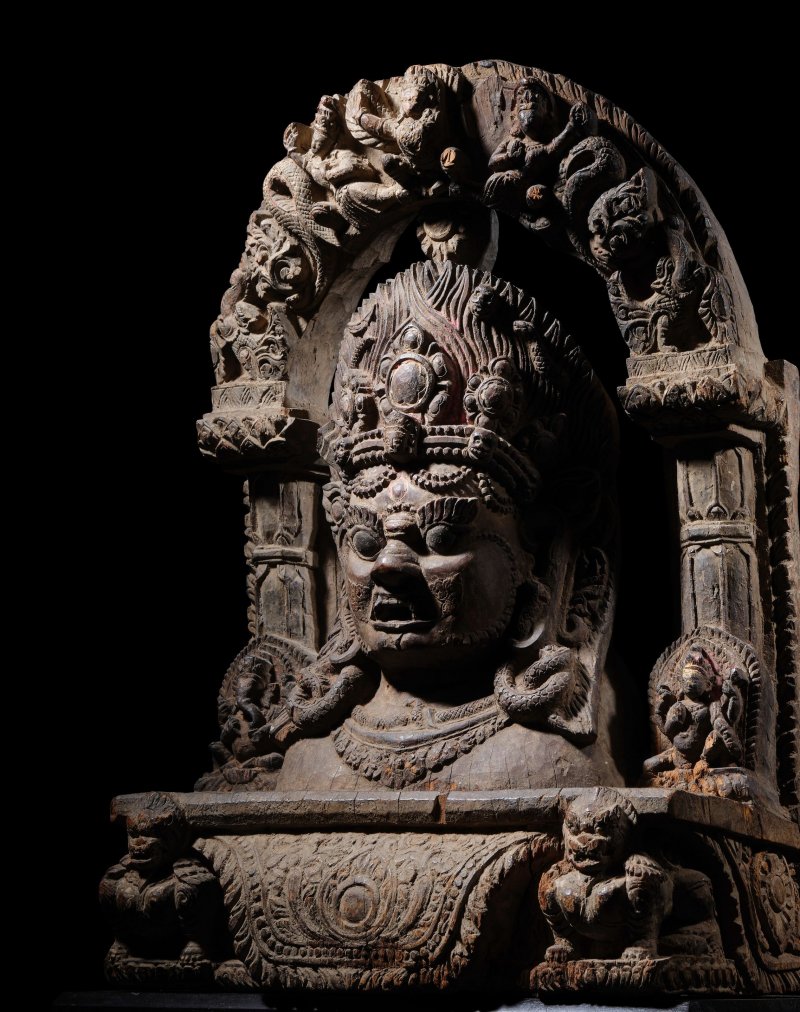
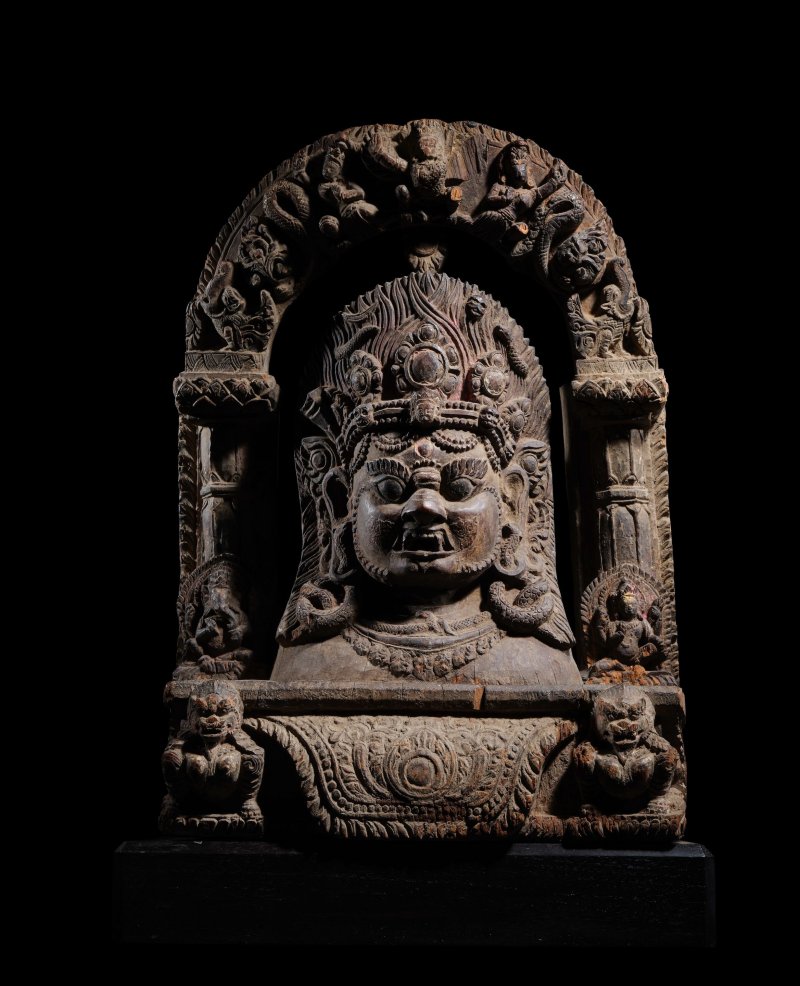
尼泊爾 十七/十八世紀 木雕陪臚神龕 | A WOOD SHRINE TO BHAIRAVA
年代
NEPAL, 17TH/18TH CENTURY
起拍价
HKD 80,000
估值区间
HKD 80000 - 120000
尺寸
未知
品相
未知
更多信息
NEPAL, 17TH/18TH CENTURY
With remains of polychromy.
Himalayan Art Resources item no. 61760
53 cm (20 7/8 in.) high
Footnotes
尼泊爾 十七/十八世紀 木雕陪臚神龕
Published
Hollywood Galleries, Himalayan Art: 2023 Aug-Sept Highlights, pp. 50-1, no. 10.
Exhibited
@N1MALX Non-Human Life, Bonhams, Hong Kong, 1-20 September 2025.
Provenance
Private Florida Collection, acquired in Nepal, 1967
Carved with a third eye, a crown of writhing snakes, and a crescent moon set within flaming hair, this imposing shrine presents the terrifying face of Bhairava, a wrathful manifestation of the Hindu god Shiva and the conceptual antecedent of Mahakala in Vajrayana Buddhism. A menagerie of creatures attends him, turning the shrine into a small realm over which the god presides. Garuda spreads his wings at the centre of the , flanked by nagas and makaras. Shiva's two sons sit to either side —Ganesha, who bestows wisdom and prosperity, and Kumara, who bestows courage. Two muscular lions stand guard at the base, their faces echoing the deity's own.
During the Indra Jatra and Pachali Bhairav Jatra festivals, held in the Kathmandu Valley at the onset of autumn, images of Bhairava such as this are displayed before temples and private dwellings. A jar of rice beer or liquor is set behind the mask, and a bamboo pipe carries the drink out through the god's open mouth, where devotees receive it as prasad, a blessing conferred by the ancestral sky god. The shrine's connection to autumnal harvest ritual is reinforced by the small, benign figure of Indra, god of rain, at the centre of the crown —a feature found on a number of Bhairava masks (for related discussion, see Vajracharya, , 2016, pp. 145-147, cat. no. 44).
Compare a closely related example sold at Bonhams, New York, 19 March 2012, lot 1094, and another from the Sartin Collection, sold at Bonhams, New York, 13 September 2011, lot 1008. A further shrine, with a standing Bhairava, is published in Pal, , 1985, pp. 130-131, no. S58.
With remains of polychromy.
Himalayan Art Resources item no. 61760
53 cm (20 7/8 in.) high
Footnotes
尼泊爾 十七/十八世紀 木雕陪臚神龕
Published
Hollywood Galleries, Himalayan Art: 2023 Aug-Sept Highlights, pp. 50-1, no. 10.
Exhibited
@N1MALX Non-Human Life, Bonhams, Hong Kong, 1-20 September 2025.
Provenance
Private Florida Collection, acquired in Nepal, 1967
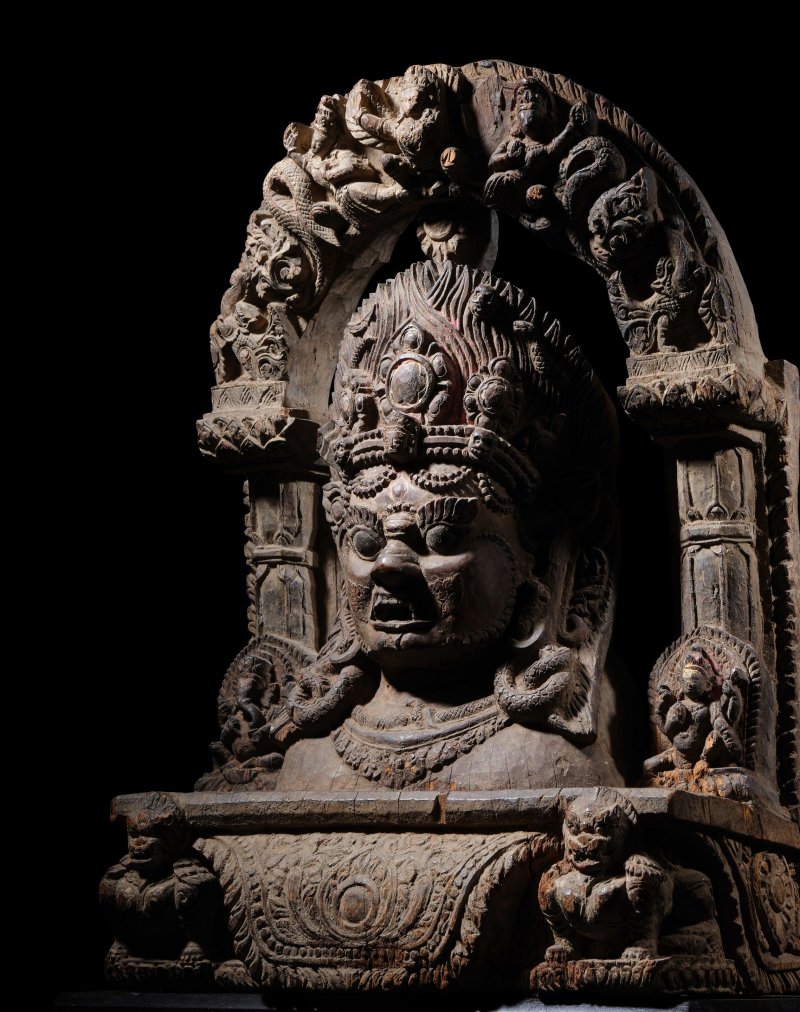
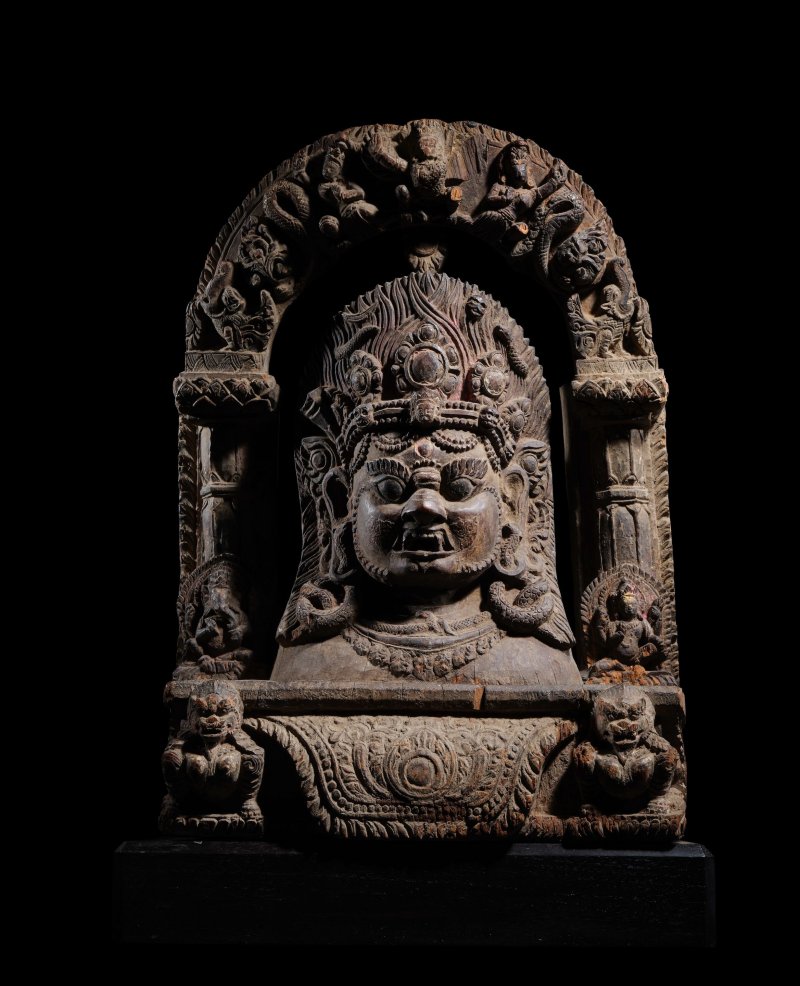
Carved with a third eye, a crown of writhing snakes, and a crescent moon set within flaming hair, this imposing shrine presents the terrifying face of Bhairava, a wrathful manifestation of the Hindu god Shiva and the conceptual antecedent of Mahakala in Vajrayana Buddhism. A menagerie of creatures attends him, turning the shrine into a small realm over which the god presides. Garuda spreads his wings at the centre of the , flanked by nagas and makaras. Shiva's two sons sit to either side —Ganesha, who bestows wisdom and prosperity, and Kumara, who bestows courage. Two muscular lions stand guard at the base, their faces echoing the deity's own.
During the Indra Jatra and Pachali Bhairav Jatra festivals, held in the Kathmandu Valley at the onset of autumn, images of Bhairava such as this are displayed before temples and private dwellings. A jar of rice beer or liquor is set behind the mask, and a bamboo pipe carries the drink out through the god's open mouth, where devotees receive it as prasad, a blessing conferred by the ancestral sky god. The shrine's connection to autumnal harvest ritual is reinforced by the small, benign figure of Indra, god of rain, at the centre of the crown —a feature found on a number of Bhairava masks (for related discussion, see Vajracharya, , 2016, pp. 145-147, cat. no. 44).
Compare a closely related example sold at Bonhams, New York, 19 March 2012, lot 1094, and another from the Sartin Collection, sold at Bonhams, New York, 13 September 2011, lot 1008. A further shrine, with a standing Bhairava, is published in Pal, , 1985, pp. 130-131, no. S58.
常见问题
这件尼泊爾 十七/十八世紀 木雕陪臚神龕 | A WOOD SHRINE TO BHAIRAVA的成交价是多少?
落槌价为 预展中。 成交价为 预展中。