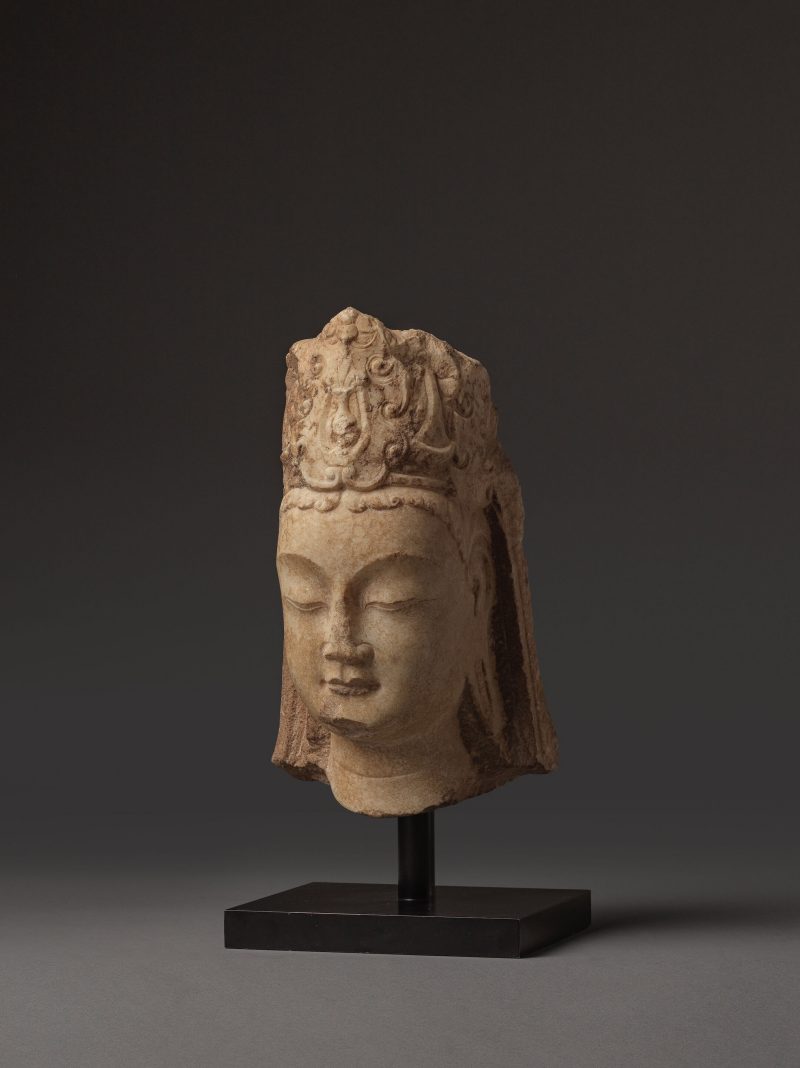

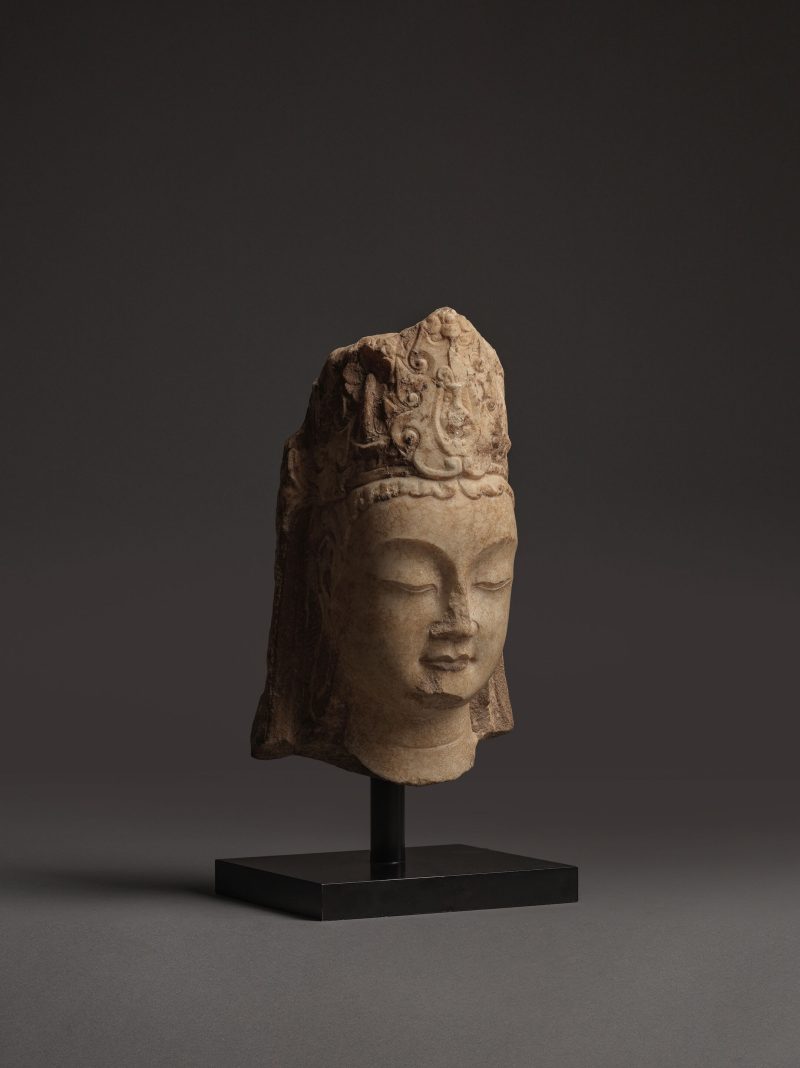
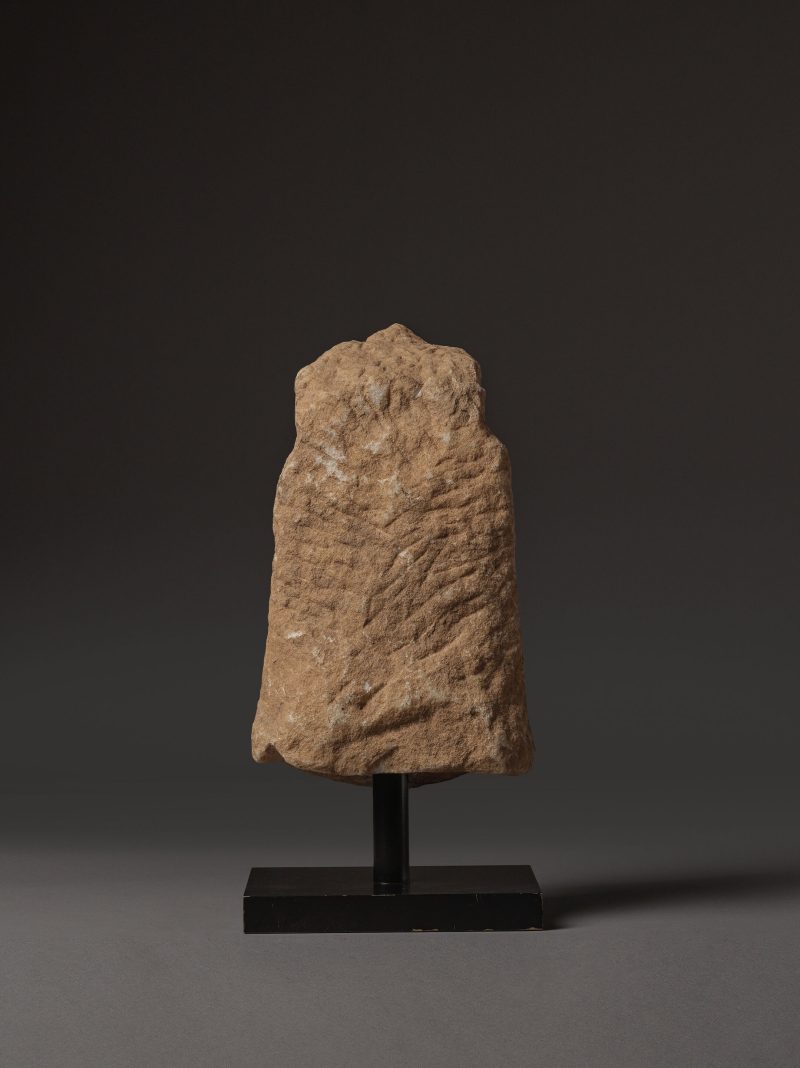
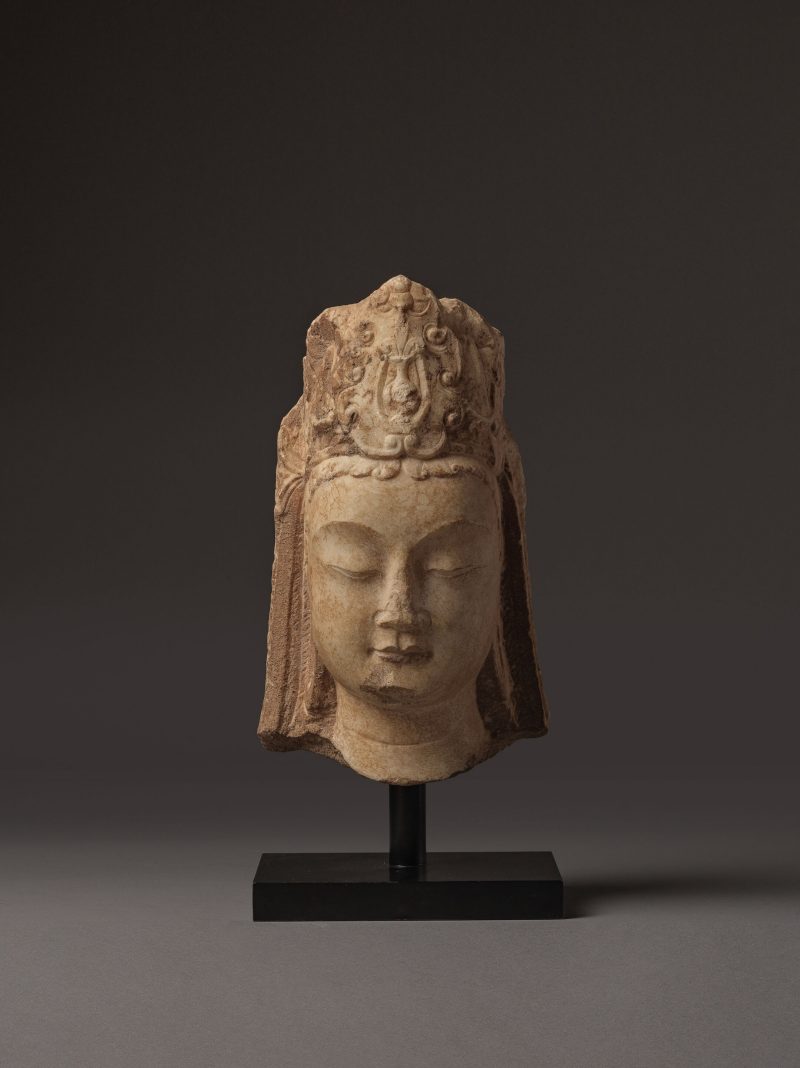
Lot 42 北齊 石雕大勢至菩薩頭像 | RARE TÊTE DE MAHASTAMAPRAPTA EN MARBRE BLANC
落槌价
预展中
成交价
预展中
| 拍卖公司 | 邦瀚斯 |
|---|---|
| 拍卖时间 | 2026年12月10日 |
拍品信息
拍品名称
北齊 石雕大勢至菩薩頭像 | RARE TÊTE DE MAHASTAMAPRAPTA EN MARBRE BLANC
年代
北齊
起拍价
未知
估值区间
EUR 150,000–200,000
尺寸
34 cm (13 3/8 in.) high
品相
未知
更多信息
RARE TÊTE DE MAHASTAMAPRAPTA EN MARBRE BLANC
Dynastie des Qi du Nord (550-557), Hebei
A RARE WHITE MARBLE HEAD OF MAHASTAMAPRAPTA
Northern Qi Dynasty, Hebei
Exquisitely carved, the oval face with gently rounded cheeks, the sensuous bud-shaped mouth below an aquiline nose, slender eyes half-closed in meditation below sharply arched, wide eyebrows, flanked by pendulous ears, the hair arranged into a tall chignon secured by a sumptuous headdress centering on a small vase or bottle and tied with ribbons at the sides, the smooth stone a creamy white colour.
34 cm (13 3/8 in.) high (2).
北齊 河北 石雕大勢至菩薩頭像
Provenance:
Gisèle Croës Arts d'Extrême Orient, 2002
Jean-Yves Ollivier, Paris, 2006
Bonhams London, The Ollivier Collection of Early Chinese Art. A Journey Through Time, 8 November 2018, lot 31
Gisèle Croës Arts d'Extrême Orient, Brussels
Published, Illustrated and Exhibited:
Gisèle Croës Arts d'Extrême Orient, Collection Jean-Yves Ollivier, Paul Nicoli. Chine: une Passion Partagée, Bruxelles, 2016, pp. 92-93 (Published and illustrated)
Gisèle Croës Arts d'Extrême Orient, Catalogue TEFAF Maastricht 2020, 7 - 15 March 2020, p. 119
來源:
Gisèle Croës Arts d'Extrême Orient,布魯塞爾,2002年
Jean-Yves Ollivier舊藏,2006年
倫敦邦瀚斯,"The Ollivier Collection of Early Chinese Art. A journey Through Time",2018年11月8日,拍品編號31
Gisèle Croës Arts d'Extrême Orient,布魯塞爾
展覽著錄:
Gisèle Croës Arts d'Extrême Orient,《Collection Jean-Yves Ollivier, Paul Nicoli. Chine: une Passion Partagée》,布魯塞爾,2016年,第92-93頁 (著錄)
Gisèle Croës Arts d'Extrême Orient, 歐洲藝術博覽會馬斯特裏赫特圖錄2020,2020年3月7-15日,第119頁
Jean-Yves Ollivier, is known not only as a successful businessman, but as the broker of the 1988 Brazzaville Protocol – and agreement which paved the way for the withdrawal of Cuban troops from Angola and led to South African troops leaving Namibia – allowing it to become independent. For his role he was honoured by P.W. Both and Nelson Mandella. Ollivier's interest in the arts can be traced back to when he worked as a young man at Strauss, Turnbull & Co., and was invited to the home of the fabled art collector, Robert Stauss. His interest in Chinese art sparked as early as 1969 when he visited the Palace Museum, Taipei. As a collector of early archaic bronzes and other works of art he said "If feel as if each piece is infused with a human spirit. It is as if the unknown human who made it has transmitted his soul into the material".
This head has been carved from highly translucent white marble which emphasises its ethereal grace. It is a remarkable example of Buddhist portraiture made during the Northern Qi period of the Six Dynasties period. The small vase at the centre of the crown identifies the figure as Mahasthamaprapta, the Bodhisattva of wisdom and spiritual energy, and one of the Eight Great Bodhisattvas of the Mahayana tradition of Buddhism. Images of Mahasthamaprapta were typically paired with those of Avalokiteshvara, the Bodhisattva of Compassion, in relation to the cult of Buddha Amitabha and the Pure Land which offered the ideal conditions for attaining awakening in a single lifetime.
At this time, Buddhism flourished in China. Shrines were constructed under the Emperor's personal auspices and eminent monks were appointed as state preceptors. Conspicuous financial resources were devoted to the construction of Buddhist caves whose marvellous sculptures combined sensuous modelling and subtlety of expression. These features were likely to have derived from the contemporary Indian style of the Gupta period, which was highly regarded by the Qi aristocracy for its exotic traits. In Buddhist faith, images of deities served as important foci of worship and also promoted significant devotional acts which contributed to the devotee's personal growth towards spiritual liberation.
According to Osvald Siren, marble figures modelled in gently rounded forms, such as the present example, were typically produced during the second half of the 6th century, see Osvald Siren, 'Chinese Marble Sculptures of the Transition Period', Bulletin of the Museum of Far Eastern Antiquities, no. 12, Stockholm, 1940, pp. 473-496.
Compare with a limestone head of a bodhisattva, Northern Qi dynasty, similarly modelled with arched brows and hair arranged in regular curls, coiling to each side from the centre, from the Nelson Atkins Museum, Kansas City (accession no.F99-1). Another stone example bearing similar features to the present example is illustrated in Shandong Boxing Longhua si yizhi diaocha jianbao (Reconnaissance of the Site of the Longhua Temple at Boxing, Shandong), Kaogu, Beijing, 1986, vol. 9, pl. 6, fig. 2. Also compare with two related limestone heads of Mahasthamaprapta, Northern Qi, respectively from the Freer Gallery of Art, Washington D.C. (accession no.F1916.346), and the San Diego Museum of Art, (accession no.DSC06522), the latter illustrated in K. Tsiang, Echoes of the Past: The Buddhist Cave Temples of Xiangtangshan, Chicago, 2010, p. 230, fig. 32.
以下内容由AI翻译:
【描述】
精雕细琢,椭圆形脸庞,脸颊圆润,下方为小巧的花蕾状嘴唇,上方为鹰钩鼻,细长的眼睛半闭着冥想,眉毛高挑且宽阔,两侧垂耳,头发梳成高髻,由华丽的头饰固定,中心有一小瓶或小壶,并在两侧系有丝带,石材表面光滑,呈乳白色。
这件头像由透光性很好的白色大理石雕刻而成,突显了其超凡脱俗的优雅。这是六朝时期北齐时期的佛教肖像雕塑的一个杰出例子。头饰中央的小瓶标识出这尊像是大势至菩萨,即智慧与精神能量的菩萨,也是大乘佛教八大菩萨之一。大势至菩萨的形象通常与观音菩萨(慈悲菩萨)配对,与阿弥陀佛及其净土有关,净土提供了在一生中达到觉悟的理想条件。
当时,佛教在中国繁荣发展。在皇帝的亲自赞助下建造了神龛,并任命著名僧侣为国师。大量资金被用于建造佛教洞窟,其中的精美雕塑结合了感官造型和表情的微妙表现。这些特征可能源自当时的印度笈多风格,该风格因其异国情调而受到北齐贵族的高度赞赏。在佛教信仰中,神像作为重要的崇拜对象,也促进了信徒的重要虔诚行为,有助于个人向精神解脱迈进。
根据Osvald Siren的说法,如本例所示,以柔和圆润的形式塑造的大理石雕像通常产生于6世纪下半叶,参见Osvald Siren,《中国过渡时期的大理石雕塑》,《远东古物博物馆公报》,第12期,斯德哥尔摩,1940年,第473-496页。
可比较堪萨斯城纳尔逊-阿特金斯艺术博物馆的一件北齐时期的石灰岩菩萨头像(馆藏编号F99-1),同样具有高挑的眉毛和规则卷曲的头发,从中间向两侧盘绕。另一件具有类似特征的石像载于《山东博兴龙华寺遗址调查简报》(《考古》,北京,1986年,第9卷,插图6,图2)。还可比较两件北齐时期的石灰岩大势至菩萨头像,分别来自华盛顿特区弗里尔美术馆(馆藏编号F1916.346)和圣地亚哥艺术博物馆(馆藏编号DSC06522),后者载于K. Tsiang,《回响:响堂山佛教石窟》,芝加哥,2010年,第230页,图32。
常见问题
这件北齊 石雕大勢至菩薩頭像 | RARE TÊTE DE MAHASTAMAPRAPTA EN MARBRE BLANC的成交价是多少?
落槌价为 预展中。 成交价为 预展中。
拍品的尺寸是多少?
34 cm (13 3/8 in.) high