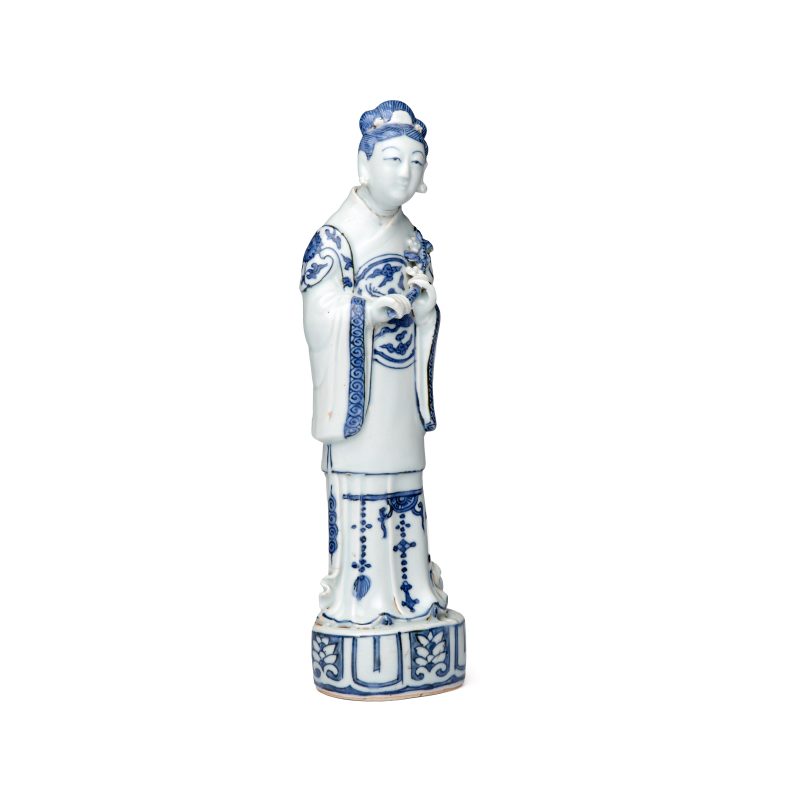

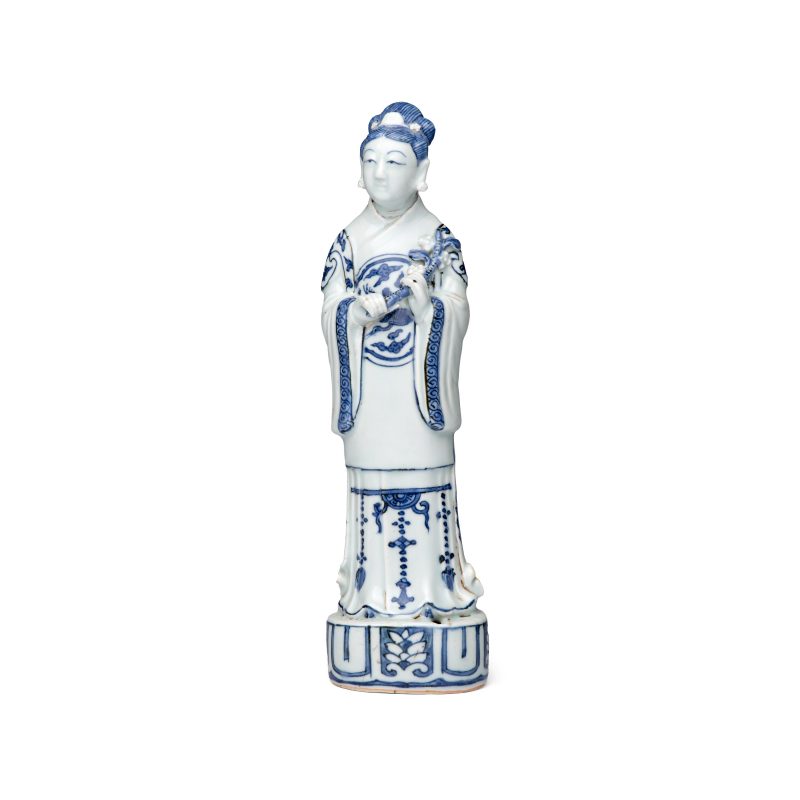
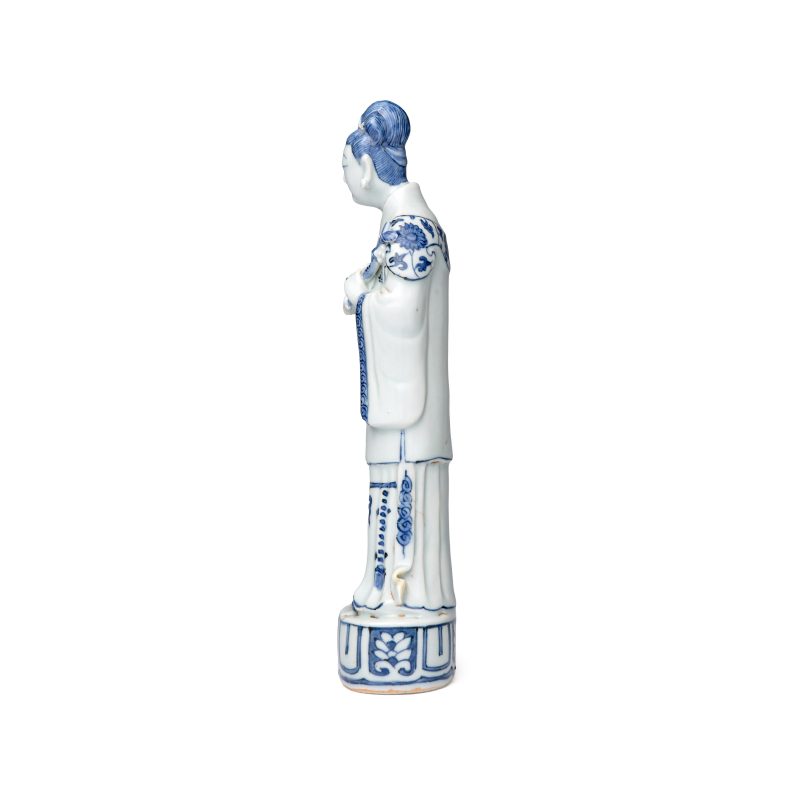
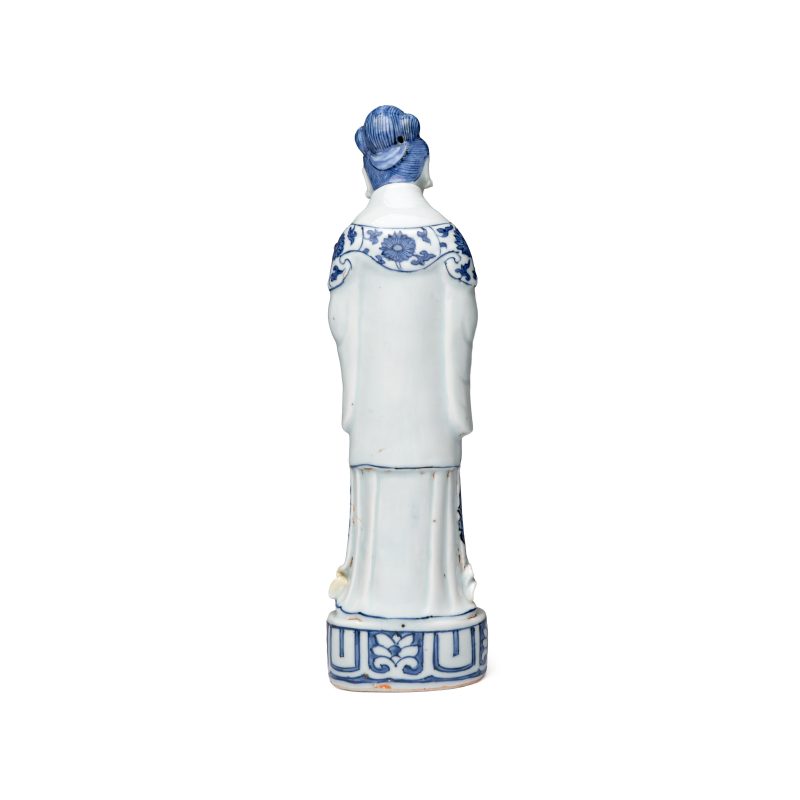
Lot 20 A Chinese blue and white figure of the immortal He Xiangu
落槌价
****
成交价
****
拍品信息
拍品名称
A Chinese blue and white figure of the immortal He Xiangu
年代
Jiajing
起拍价
未知
估值区间
€ 8.000 – € 12.000
尺寸
H: H. 23,1 cm
品相
未知
更多信息
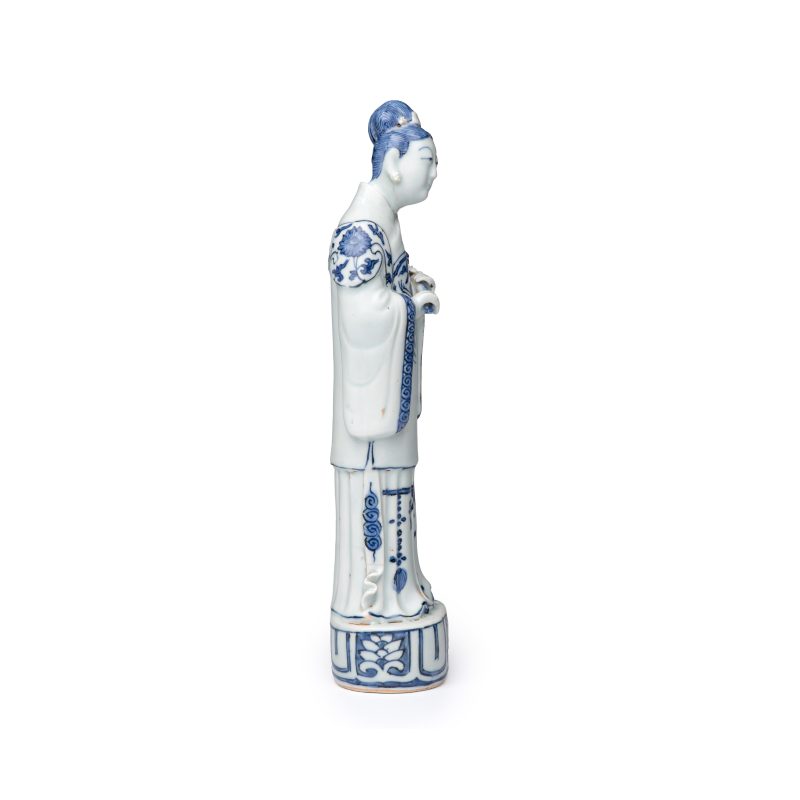
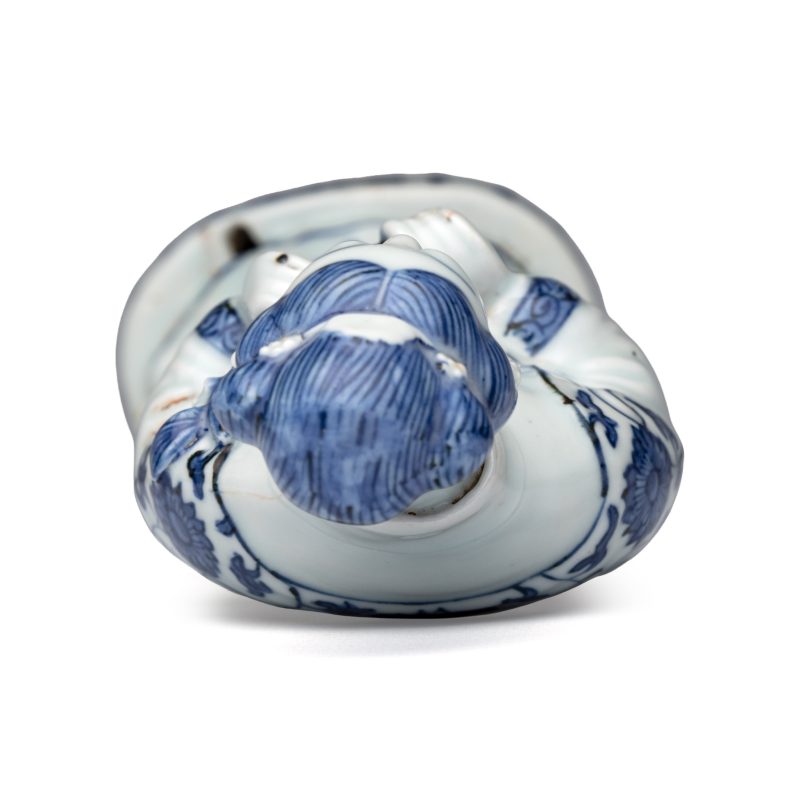
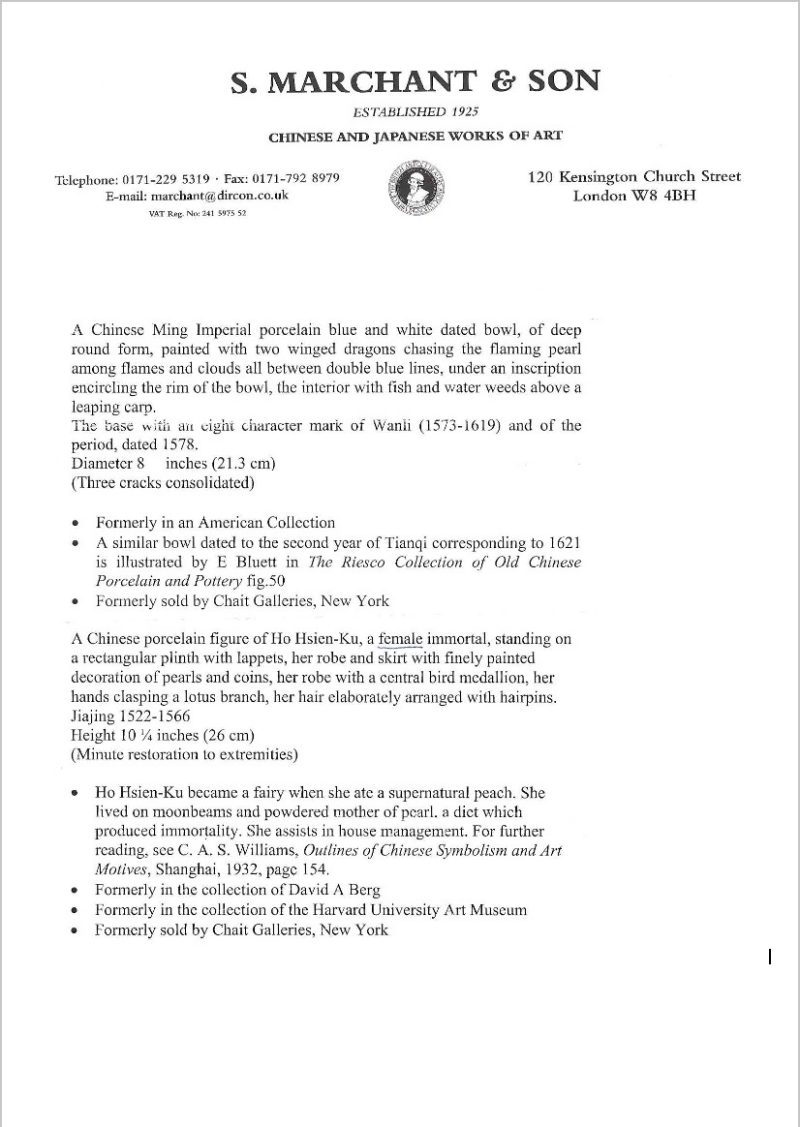
Finely modelled after He Xiangu (Ho Hsien-ku), the only female member of the Daoist Eight Immortals, standing gracefully upon an oval plinth decorated with pendent lappets and floral panels. She is depicted wearing a flowing robe and skirt painted in underglaze blue with elaborate pearl- and-cash motifs, the upper garment centred by a large medallion enclosing a bird amidst scrolling foliage. Her hands are clasped before her chest holding a lotus stem, while her hair is arranged in an elaborate coiffure secured with ornamental hairpins. The serene facial features and elegant posture are rendered with remarkable refinement, characteristic of the finest Ming porcelain sculpture.
He Xiangu was revered as a patroness of domestic harmony, health and longevity. According to Daoist tradition, she attained immortality after consuming a supernatural peach and thereafter subsisted upon moonbeams and powdered mother-of-pearl. She is most commonly identified by the lotus blossom, an emblem of purity and spiritual transcendence, which she carries in her hands. For a discussion of her attributes and iconography, see C. A. S. Williams, 'Outlines of Chinese Symbolism and Art Motives', 1932, p. 154.
此尊精塑道教八仙中唯一的女仙何仙姑,姿態優雅地立於橢圓形臺座之上,座側飾垂葉紋及花卉開光。身着飄逸長袍與裙裳,以釉下青花細繪瓔珞、錢紋等華麗紋飾,上衣中央飾一大型團花開光,內繪禽鳥穿遊於纏枝花葉之間。雙手合於胸前,持一枝蓮花,髮髻高挽,並簪飾華美髮釵。面容恬靜,體態端莊,塑工精細,體現明代高級瓷塑典雅細膩的藝術特色。
何仙姑被奉為護佑家庭和睦、健康長壽的女仙。據道教傳說,她服食仙桃後得道成仙,此後以月華及珍珠母粉為食。其形象通常以手持蓮花為主要識別特徵,蓮花象徵清淨與超凡脫俗。有關何仙姑的形象特徵及象徵意涵,可參見 C. A. S. Williams,《Outlines of Chinese Symbolism and Art Motives》,1932年,第154頁。
Provenance:
The David A. Berg Collection.
The collection of the Harvard University Art Museum.
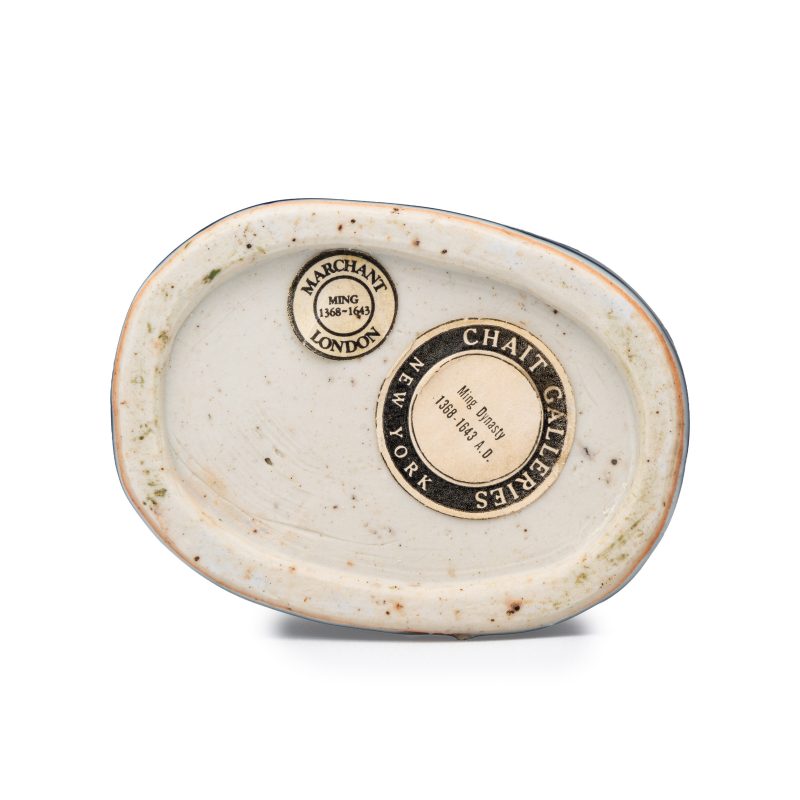
Ralph Chait Galleries, New York, with their label to the base.
S. Marchant & Son, London, with their label to the base.
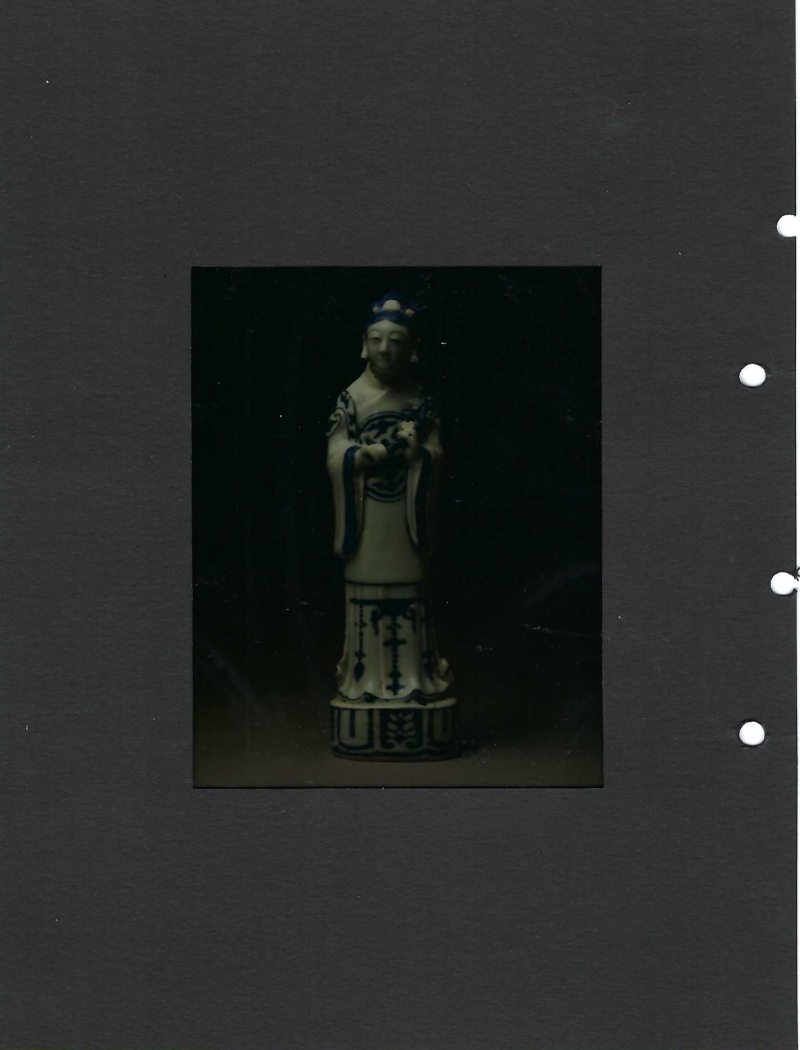
The Mr. and Mrs. Baert-Devos Collection, Belgium. Acquired from the above in 2001. (see added scan)
He Xiangu was revered as a patroness of domestic harmony, health and longevity. According to Daoist tradition, she attained immortality after consuming a supernatural peach and thereafter subsisted upon moonbeams and powdered mother-of-pearl. She is most commonly identified by the lotus blossom, an emblem of purity and spiritual transcendence, which she carries in her hands. For a discussion of her attributes and iconography, see C. A. S. Williams, 'Outlines of Chinese Symbolism and Art Motives', 1932, p. 154.
此尊精塑道教八仙中唯一的女仙何仙姑,姿態優雅地立於橢圓形臺座之上,座側飾垂葉紋及花卉開光。身着飄逸長袍與裙裳,以釉下青花細繪瓔珞、錢紋等華麗紋飾,上衣中央飾一大型團花開光,內繪禽鳥穿遊於纏枝花葉之間。雙手合於胸前,持一枝蓮花,髮髻高挽,並簪飾華美髮釵。面容恬靜,體態端莊,塑工精細,體現明代高級瓷塑典雅細膩的藝術特色。
何仙姑被奉為護佑家庭和睦、健康長壽的女仙。據道教傳說,她服食仙桃後得道成仙,此後以月華及珍珠母粉為食。其形象通常以手持蓮花為主要識別特徵,蓮花象徵清淨與超凡脫俗。有關何仙姑的形象特徵及象徵意涵,可參見 C. A. S. Williams,《Outlines of Chinese Symbolism and Art Motives》,1932年,第154頁。
Provenance:
The David A. Berg Collection.
The collection of the Harvard University Art Museum.
Ralph Chait Galleries, New York, with their label to the base.
S. Marchant & Son, London, with their label to the base.
The Mr. and Mrs. Baert-Devos Collection, Belgium. Acquired from the above in 2001. (see added scan)
常见问题
拍品的尺寸是多少?
H: H. 23,1 cm