
拍品信息
拍品名称
西藏 十八世紀 無畏生護唐卡 | A THANGKA OF ABHAYAKARAGUPTA
年代
TIBET, 18TH CENTURY
起拍价
HKD 150,000
估值区间
HKD 150000 - 250000
尺寸
未知
品相
未知
更多信息
TIBET, 18TH CENTURY
Distemper and gold on cloth, mounted with silks.
Himalayan Art Resources item no. 7718
Image: 68.6 x 46.7 cm (27 x 18 3/8 in.)
Footnotes
西藏 十八世紀 無畏生護唐卡
Provenance
Private New York Collection, acquired in 1960s, by repute
Thence by descent
Heritage, New York, 9 September 2019, lot 78314
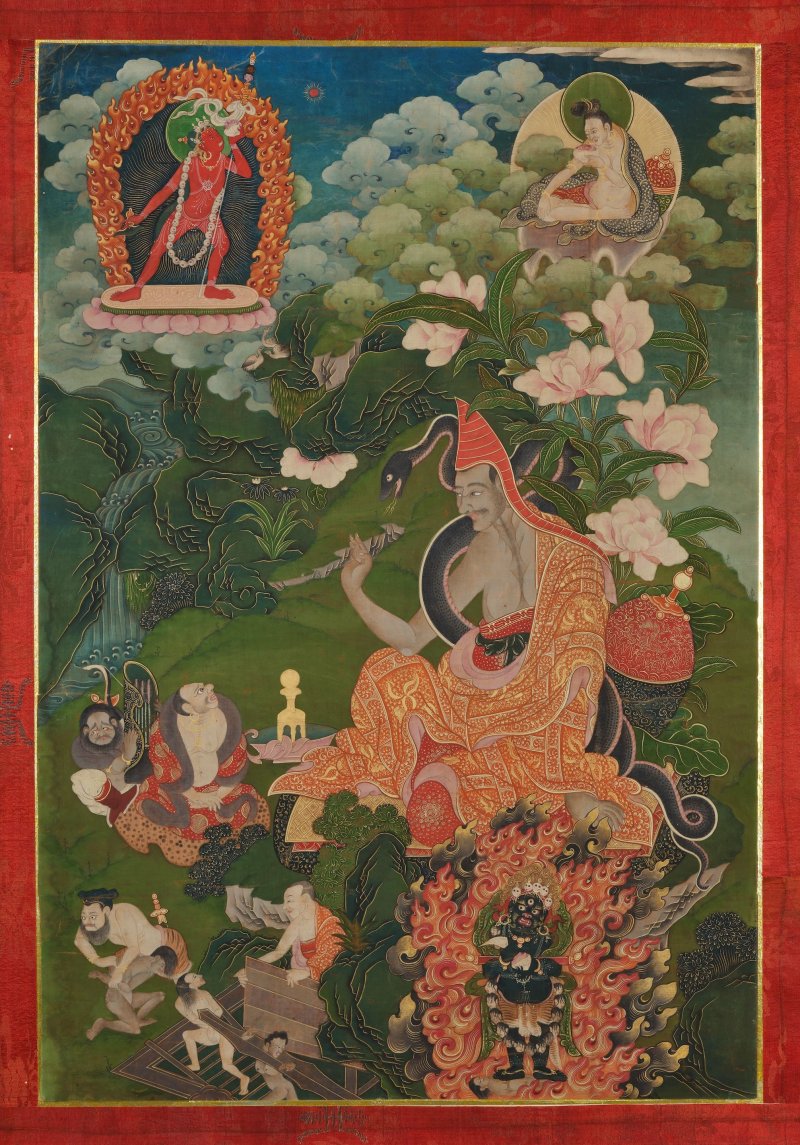
Among the most ambitious painting projects undertaken at Tashilhunpo was the visual construction of the Panchen Lamas' incarnation lineage—a sequence of Indian masters, Tibetan hierarchs and enlightened beings assembled to establish the Panchen line's descent through the whole history of the Dharma. The compositions crystallized in the 17th century under Choying Gyatso, the monastery's pre-eminent painter and the founder of what would become the New Menri style, and were reproduced in painted and printed sets for generations thereafter. The present thangka belongs to one such set, and depicts the great Indian scholar-adept Abhayakaragupta.
Abhayakaragupta—sometimes conflated with Abhayadatta, and honored under the title Vajrasana as abbot of the seat of enlightenment at Bodhgaya—was among the last great figures of Indian monastic Buddhism, active at Vikramashila around the turn of the 12th century. His authorship of the and , compendia that codified the mandalas and consecration rites of the tantras, made him foundational to Tibetan ritual practice, and he occupies the fourth position in the Narthang woodblock series of the Panchen incarnation lineage as transmitted in the Gelug tradition. He appears here in monastic robes and the pointed hat that marks him as an Indian scholar rather than a Tibetan.
Abhayakaragupta is seated in a mountain landscape, enveloped in robes of vivid orange and red heightened with gold. The setting draws deeply on Chinese pictorial convention, absorbed into Tibetan painting over the course of the Qing: the blue-and-green mineral palette of the rockwork descends from the Tang and Song qinglu shanshui tradition, while the clouds are modelled with a graded shading that has no precedent in earlier Tibetan work. The result is a landscape of real atmospheric depth, against which the figures register with unusual clarity.
That serenity is deliberately disrupted in the foreground. A standing Mahakala, encircled by a coiling serpent, is set against a mandorla of flame whose churning orange breaks violently across the cool tonality of the surrounding rocks—the protector's wrathful power admitted into the landscape as a visible intrusion. The red figure of Vajrayogini occupies the upper left, balanced across the composition by a further figure at the upper right, and the whole is worked with the fine detail characteristic of Tashilhunpo production at its best.
Related paintings from comparable sets are held in the Rubin Museum of Art, New York (P1998.17.3); the Yale University Art Gallery (1988.76.2); and the American Museum of Natural History, New York (70.2/1216).
Distemper and gold on cloth, mounted with silks.
Himalayan Art Resources item no. 7718
Image: 68.6 x 46.7 cm (27 x 18 3/8 in.)
Footnotes
西藏 十八世紀 無畏生護唐卡
Provenance
Private New York Collection, acquired in 1960s, by repute
Thence by descent
Heritage, New York, 9 September 2019, lot 78314
Among the most ambitious painting projects undertaken at Tashilhunpo was the visual construction of the Panchen Lamas' incarnation lineage—a sequence of Indian masters, Tibetan hierarchs and enlightened beings assembled to establish the Panchen line's descent through the whole history of the Dharma. The compositions crystallized in the 17th century under Choying Gyatso, the monastery's pre-eminent painter and the founder of what would become the New Menri style, and were reproduced in painted and printed sets for generations thereafter. The present thangka belongs to one such set, and depicts the great Indian scholar-adept Abhayakaragupta.
Abhayakaragupta—sometimes conflated with Abhayadatta, and honored under the title Vajrasana as abbot of the seat of enlightenment at Bodhgaya—was among the last great figures of Indian monastic Buddhism, active at Vikramashila around the turn of the 12th century. His authorship of the and , compendia that codified the mandalas and consecration rites of the tantras, made him foundational to Tibetan ritual practice, and he occupies the fourth position in the Narthang woodblock series of the Panchen incarnation lineage as transmitted in the Gelug tradition. He appears here in monastic robes and the pointed hat that marks him as an Indian scholar rather than a Tibetan.
Abhayakaragupta is seated in a mountain landscape, enveloped in robes of vivid orange and red heightened with gold. The setting draws deeply on Chinese pictorial convention, absorbed into Tibetan painting over the course of the Qing: the blue-and-green mineral palette of the rockwork descends from the Tang and Song qinglu shanshui tradition, while the clouds are modelled with a graded shading that has no precedent in earlier Tibetan work. The result is a landscape of real atmospheric depth, against which the figures register with unusual clarity.
That serenity is deliberately disrupted in the foreground. A standing Mahakala, encircled by a coiling serpent, is set against a mandorla of flame whose churning orange breaks violently across the cool tonality of the surrounding rocks—the protector's wrathful power admitted into the landscape as a visible intrusion. The red figure of Vajrayogini occupies the upper left, balanced across the composition by a further figure at the upper right, and the whole is worked with the fine detail characteristic of Tashilhunpo production at its best.
Related paintings from comparable sets are held in the Rubin Museum of Art, New York (P1998.17.3); the Yale University Art Gallery (1988.76.2); and the American Museum of Natural History, New York (70.2/1216).
常见问题
这件西藏 十八世紀 無畏生護唐卡 | A THANGKA OF ABHAYAKARAGUPTA的成交价是多少?
落槌价为 预展中。 成交价为 预展中。