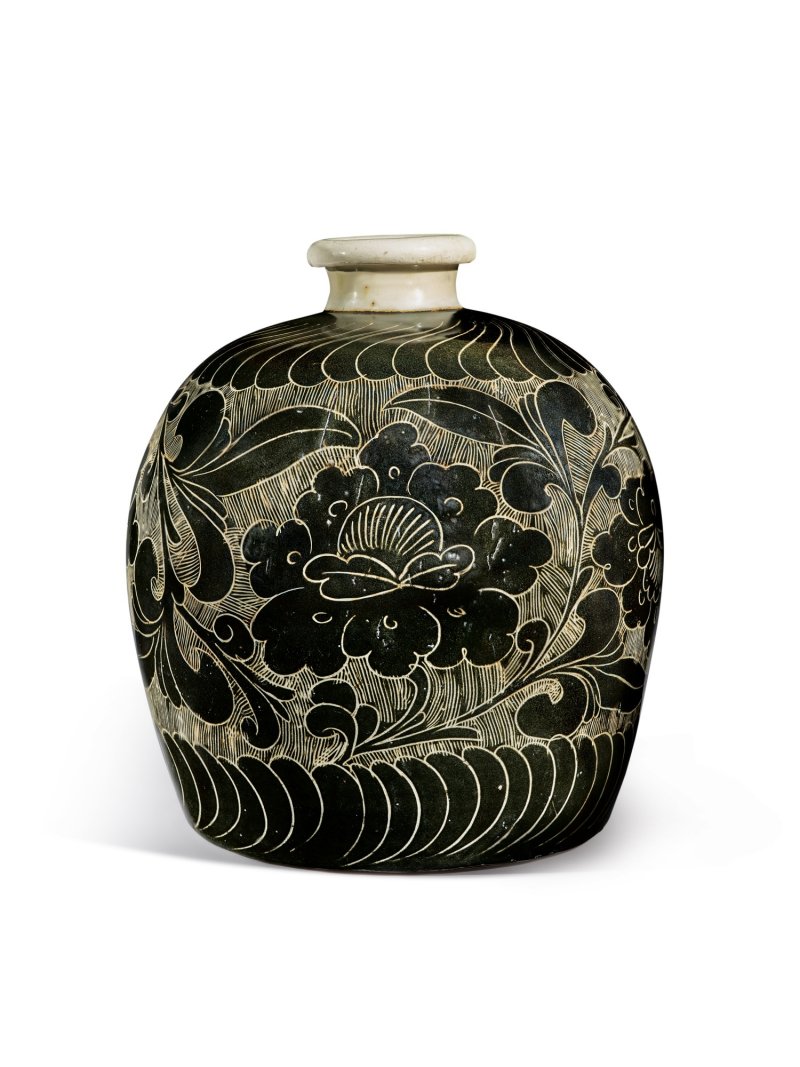

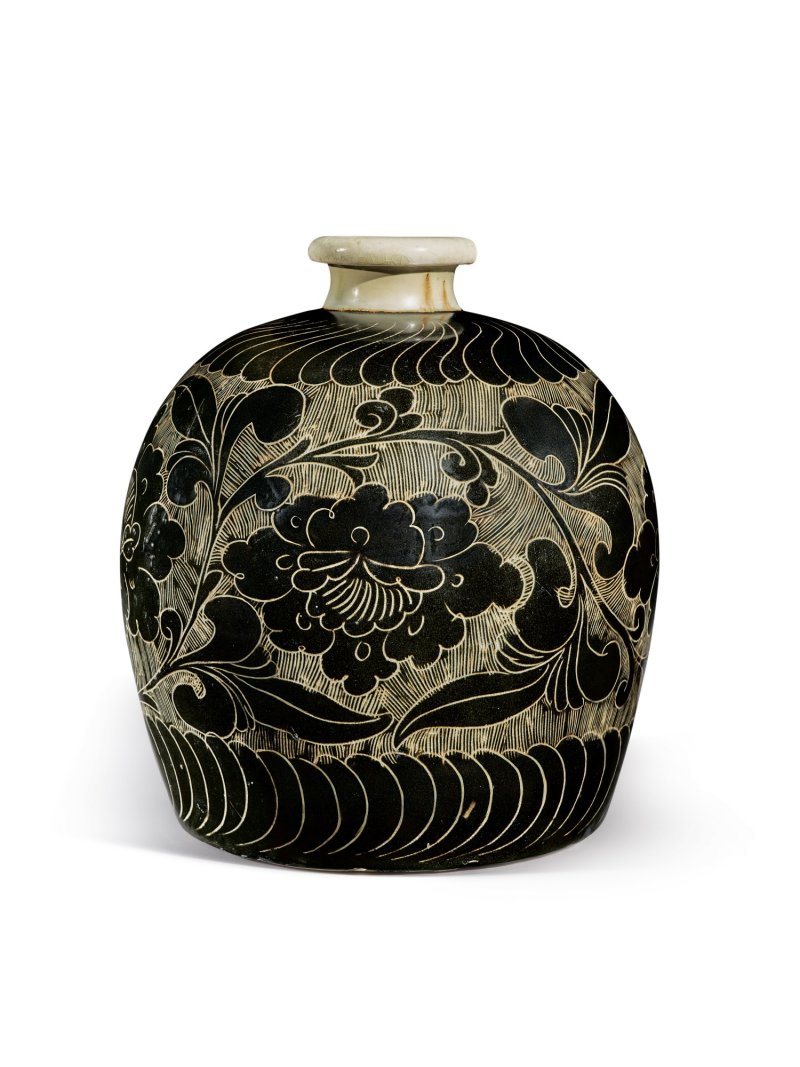
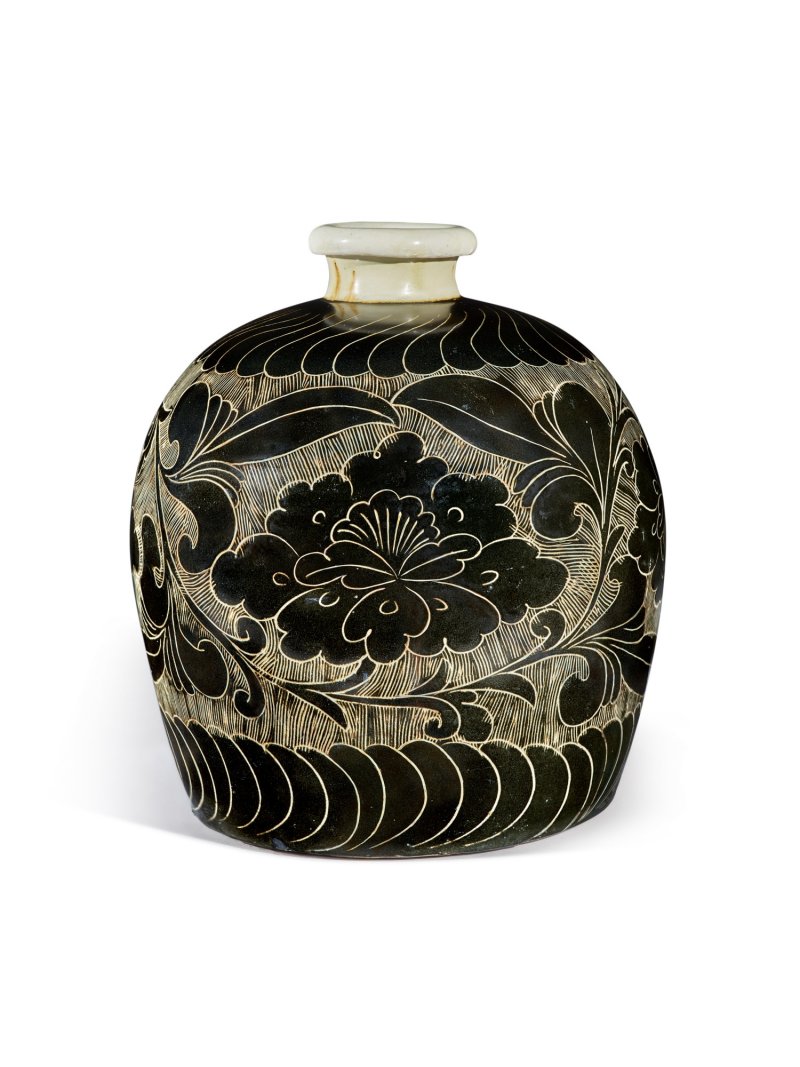
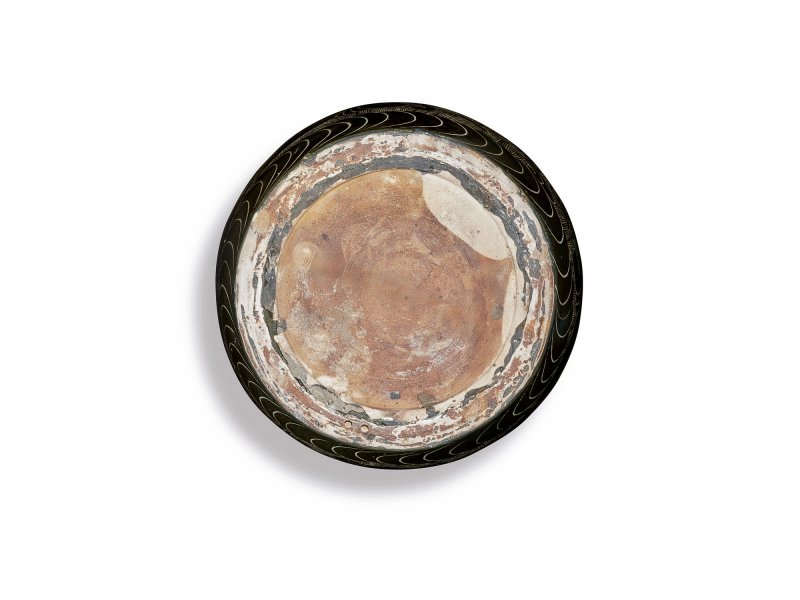
Lot 565 A Cizhou black-glazed sgraffiato 'peony' 'tulu' vase, Northern Song - Jin dynasty | 北宋至金 磁州窰黑釉劃牡丹紋吐魯瓶
落槌价
预展中
成交价
预展中
| 拍卖公司 | 苏富比 |
|---|---|
| 拍卖时间 | 2026年11月03日 |
拍品信息
拍品名称
A Cizhou black-glazed sgraffiato 'peony' 'tulu' vase, Northern Song - Jin dynasty | 北宋至金 磁州窰黑釉劃牡丹紋吐魯瓶
起拍价
HKD 500,000
估值区间
500,000 - 1,000,000 HKD
尺寸
未知
品相
如欲了解本拍品狀況的更多資訊,請聯絡 xiaoye.yang@sothebys.com
更多信息
A Cizhou black-glazed sgraffiato 'peony' 'tulu' vase
Northern Song - Jin dynasty
北宋至金 磁州窰黑釉劃牡丹紋吐魯瓶
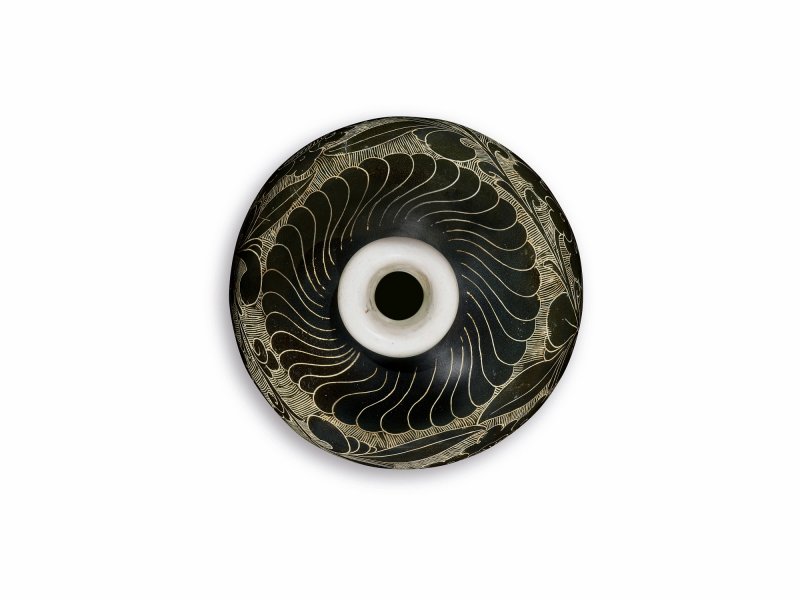
the bulbous ovoid body rising from a flat foot and countersunk base to a short constricted neck and lipped rim, freely carved through the top layer of black slip to the ivory-white layer beneath with four large peony blooms borne on a meandering scroll with trefoil leaves against a combed ground, all between wavy overlapping petal-lappets around the shoulder and the foot, applied overall with a transparent glaze stopping neatly around the unglazed foot
The dating of this lot is consistent with the results of Oxford Authentication Ltd. thermoluminescence test no. P206g24.
本拍品經牛津熱釋光檢測編號 P206g24,結果與其斷代相符。
h. 22.9
图录
说明:Some of the most attractive Cizhou wares are those made by various kilns in northern China with designs reserved in black against a white ground. The complicated technique used to create the striking decoration in contrasting colors seen on the present piece is known by the Italian term sgraffiato, literally ‘scratched’. It first appeared around the late eleventh century, and was created through the application of contrasting layers of slip or glaze. On the present bottle, a layer of black slip was applied over white slip, which was later carefully incised to create decorative patterns by revealing the pristine white layer beneath, and then finally covered by a layer of clear glaze. This labor-intensive and time-consuming technique adds a sense of opulence and luxury to the stoneware.
What makes this vase exceptional are the linear ground patterns on its surface. Large peony scrolls are a popular motif on vases decorated with the sgraffiato technique. This vessel, however, is unusually elegant in the fine texturing of the negative space, which distinguishes it from typical sgraffiato wares in which the ground framing the principal design is carved to a ubiquitous white. Here, the space between the floral scrolls is filled with fine hatching in different directions to contrast the bold peony blossoms and leaves. The fluid lines of carved decoration, together with the color scheme, are reminiscent of calligraphy and thus vessels such as the present piece would have been highly prized by literati.
The vase is also notable for its well-proportioned form, with small mouth, broad shoulder and wide base, which is known as ‘tuluping’ or ‘truncated meiping’. This form, which was produced at many northern kilns, is closely related to the taller meiping, a quintessential Song shape, but enjoyed a much shorter period of production. It was produced for only about a hundred years during the eleventh and twelfth centuries, leaving behind a relatively small number of extant examples.
Similar vases, but lacking the linear patterns in the background, are held in important public collections worldwide. See one with a different neck and an additional decorative band encircling the shoulder, in the Osaka City Museum of Fine Arts, included in the exhibition Charm of Black & White Ware: Transition of Cizhou Type Wares, Osaka City Museum of Fine Arts, Osaka, 2002, cat. no. 50; and another in the Baur Collection, Geneva, with a simpler peony design, illustrated in Mary Tregear, Song Ceramics, London, 1982, p. 17, fig. 6.
磁州窯系中最具魅力的作品,當數中國北方各窯口所燒造的白地留黑紋飾之器。本品色彩對比鮮明,紋飾奪目,其所用之繁複工藝在西方被稱為「sgraffiato」(源自義大利語,意為「刮擦」),即中國陶瓷工藝中的「剔花」。此技法約出現於十一世紀晚期,透過施加對比鮮明的化妝土或釉層來實現。本品先施白地化妝土,復罩黑地化妝土,其後精心剔刻紋飾,露出底層純淨之白地,最後施以透明釉。此工藝耗時費力,為器物平添了一份華貴之氣。
本瓶之出眾處,在於其器表的線條狀地紋。碩大的纏枝牡丹紋是剔花器物上常見的紋飾,然本器於留白處之精細紋理處理,顯得格外雅緻,有別於一般將主體紋飾外之地子全部剔白之典型剔花器。本品花葉之間填以不同方向之細密劃線,以襯托奔放的牡丹花朵與葉片。流暢的剔刻線條加之色彩對比,頗具書法之韻味,故此類器物在當時深受文人雅士所珍視。
此瓶器形比例勻稱,小口、豐肩、寬底,即所謂之「吐嚕瓶」或「截腹梅瓶」,亦甚為引人注目。這種器形在北方許多窯口均有燒造,與較為修長的宋代典型器「梅瓶」密切相關,但其燒造時期卻短得多。它僅在十一至十二世紀期間生產了約一百年,故存世之作相對較少。
世界各地的重要公共機構均藏有類似但地子無劃線紋飾之作。參考大阪市立美術館藏一例,其頸部略有不同,肩部多一圈裝飾帶,展於《白と黒の競演:磁州窯系陶器の広がり》(黑白之美:磁州窯系陶瓷之演變),大阪市立美術館,大阪,2002年,編號50;另一例藏於日內瓦鮑氏東方藝術館(Baur Collection),牡丹紋飾較為簡約,載於瑪麗·特里吉爾(Mary Tregear)著,《Song Ceramics》,倫敦,1982年,頁17,圖6。
常见问题
这件A Cizhou black-glazed sgraffiato 'peony' 'tulu' vase, Northern Song - Jin dynasty | 北宋至金 磁州窰黑釉劃牡丹紋吐魯瓶的成交价是多少?
落槌价为 预展中。 成交价为 预展中。
拍品的品相状况如何?
如欲了解本拍品狀況的更多資訊,請聯絡 xiaoye.yang@sothebys.com