
拍品信息
拍品名称
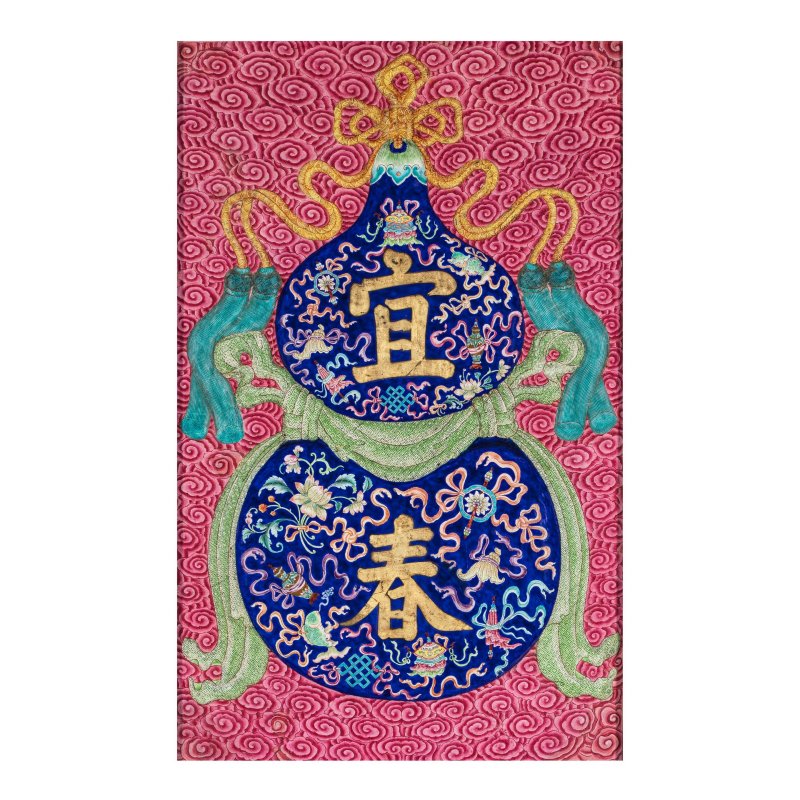
清乾隆/嘉慶 錘疊畫琺琅葫蘆八吉祥紋「宜春」掛屏 | AN EXCEEDINGLY RARE ENAMEL REPOUSSÉ 'DOUBLE-GOURD' 'YICHUN' PLAQUE
年代
Qianlong/Jiaqing period
起拍价
USD 30,000
估值区间
未知
尺寸
未知
品相
未知
更多信息
Qianlong/Jiaqing period
The metal body beaten to produce a three-dimensional effect, brightly enameled and centered with a beribboned double-gourd suspending two blue-ground medallions, strung with two gilt characters yichun (宜春, 'Welcoming Spring'), further surrounded and embellished by the eight Buddhist emblems interspersed with floral sprays and scrolling ribbons, flanked by turquoise tassels and tied with a gilt ribbon, all reserved against a densely painted pink ground of stylized cloud scrolls.
29 1/8 x 18 3/8in (74 x 46.6cm) including wood frame
Footnotes
清乾隆/嘉慶 錘疊畫琺琅葫蘆八吉祥紋「宜春」掛屏
The inscription yichun (宜春, 'Welcoming Spring') is an auspicious phrase commonly employed at the Qing imperial court during the New Year celebrations. According to the archives of the Imperial Workshops, every year on the twenty-sixth day of the twelfth lunar month, spring couplets bearing yingxiang and yichun (迎祥宜春, 'Welcoming Auspiciousness and Spring') were to be displayed at the imperial residences, serving both as elegant decorative furnishings and as auspicious wishes for the year ahead.
The present plaque is particularly noteworthy for containing the elaborate double-gourd form and auspicious decoration. The double-gourd, with its distinctive paired bulbs, is itself a highly auspicious motif, associated with longevity, abundance and the blessings of the immortals, while the eight Buddhist emblems adorning the plaque further imbued the composition with wishes for good fortune and auspiciousness.
A related and more widely employed auspicious expression is (大吉, 'Great Auspiciousness'), which was frequently incorporated into double-gourd-shaped decorative objects. Compare a double-gourd panel inscribed with and decorated with the eight Buddhist emblems in the collection of the Metropolitan Museum of Art, New York, accession no. 59.18; and a cloisonné-enamel and enamel-painted panel in the collection of the Shenyang Palace Museum, accession no. 1161609290777206784. Smaller plaques were likewise produced in gourd-shaped formats; see, for example, two examples sold at Bonhams Los Angeles, 14 December 2022, lots 16 and 17. The present plaque is particularly unusual in combining the double-gourd form with the inscription and the eight Buddhist emblems, creating an exceptionally rich program of New Year auspicious symbolism.
Hanging plaques bearing these auspicious inscriptions appear to be exceedingly rare. Compare a plaque with a comparatively simpler design, the gilt characters surrounded by bats and clouds against a blue ground, sold at Sotheby's Hong Kong, 18 April 2024, lot 625; and another with gilt characters reserved against a red ground, sold at Sotheby's Hong Kong, 25 November 2022, lot 307. Beyond porcelain plaques, the phrase was also frequently employed on hanging screens. The Palace Museum, Beijing, for example, preserves a hanging screen with characters framed in , which was included in the Palace Museum's special exhibition, (贺岁迎祥——紫禁城里过大年, 'Celebrating the New Year and Welcoming Auspiciousness: Chinese New Year in the Forbidden City') in 2019. Another pair of and panels were sold at Beijing Kuangshi auction, 8 June 2011, lot 88.
The metal body beaten to produce a three-dimensional effect, brightly enameled and centered with a beribboned double-gourd suspending two blue-ground medallions, strung with two gilt characters yichun (宜春, 'Welcoming Spring'), further surrounded and embellished by the eight Buddhist emblems interspersed with floral sprays and scrolling ribbons, flanked by turquoise tassels and tied with a gilt ribbon, all reserved against a densely painted pink ground of stylized cloud scrolls.
29 1/8 x 18 3/8in (74 x 46.6cm) including wood frame
Footnotes
清乾隆/嘉慶 錘疊畫琺琅葫蘆八吉祥紋「宜春」掛屏
The inscription yichun (宜春, 'Welcoming Spring') is an auspicious phrase commonly employed at the Qing imperial court during the New Year celebrations. According to the archives of the Imperial Workshops, every year on the twenty-sixth day of the twelfth lunar month, spring couplets bearing yingxiang and yichun (迎祥宜春, 'Welcoming Auspiciousness and Spring') were to be displayed at the imperial residences, serving both as elegant decorative furnishings and as auspicious wishes for the year ahead.
The present plaque is particularly noteworthy for containing the elaborate double-gourd form and auspicious decoration. The double-gourd, with its distinctive paired bulbs, is itself a highly auspicious motif, associated with longevity, abundance and the blessings of the immortals, while the eight Buddhist emblems adorning the plaque further imbued the composition with wishes for good fortune and auspiciousness.
A related and more widely employed auspicious expression is (大吉, 'Great Auspiciousness'), which was frequently incorporated into double-gourd-shaped decorative objects. Compare a double-gourd panel inscribed with and decorated with the eight Buddhist emblems in the collection of the Metropolitan Museum of Art, New York, accession no. 59.18; and a cloisonné-enamel and enamel-painted panel in the collection of the Shenyang Palace Museum, accession no. 1161609290777206784. Smaller plaques were likewise produced in gourd-shaped formats; see, for example, two examples sold at Bonhams Los Angeles, 14 December 2022, lots 16 and 17. The present plaque is particularly unusual in combining the double-gourd form with the inscription and the eight Buddhist emblems, creating an exceptionally rich program of New Year auspicious symbolism.
Hanging plaques bearing these auspicious inscriptions appear to be exceedingly rare. Compare a plaque with a comparatively simpler design, the gilt characters surrounded by bats and clouds against a blue ground, sold at Sotheby's Hong Kong, 18 April 2024, lot 625; and another with gilt characters reserved against a red ground, sold at Sotheby's Hong Kong, 25 November 2022, lot 307. Beyond porcelain plaques, the phrase was also frequently employed on hanging screens. The Palace Museum, Beijing, for example, preserves a hanging screen with characters framed in , which was included in the Palace Museum's special exhibition, (贺岁迎祥——紫禁城里过大年, 'Celebrating the New Year and Welcoming Auspiciousness: Chinese New Year in the Forbidden City') in 2019. Another pair of and panels were sold at Beijing Kuangshi auction, 8 June 2011, lot 88.