
拍品信息
拍品名称
清乾隆十八年(1753) 漆地剔彩嵌寶歲朝慶壽圖長方掛屏 | A RARE IMPERIAL CARVED CINNABAR LACQUER EMBELLISHED IMPERIALLY-INSCRIBED PANEL
年代
Qianlong seal mark, cyclically dated to the Guiyou year, corresponding to 1753 and of the period
起拍价
HKD 1,200,000
估值区间
HKD 1200000 - 1500000
尺寸
未知
品相
未知
更多信息
Qianlong seal mark, cyclically dated to the Guiyou year, corresponding to 1753 and of the period
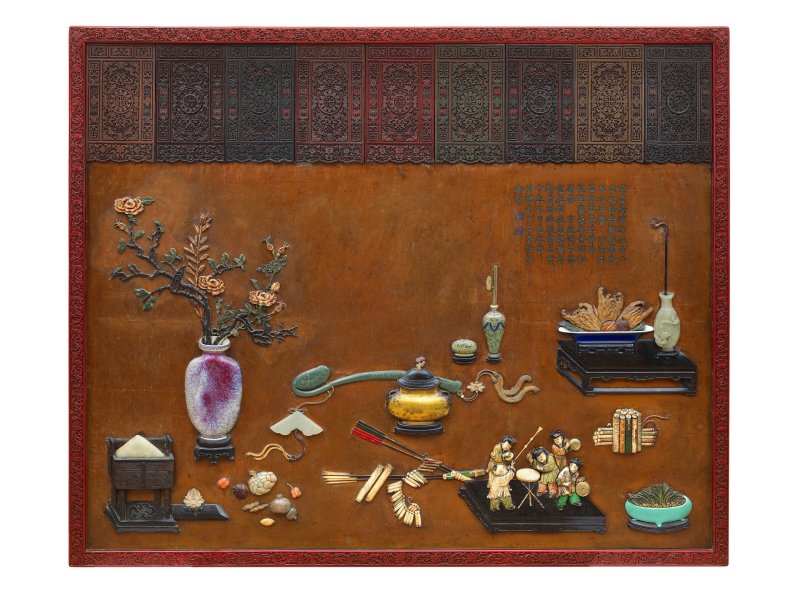
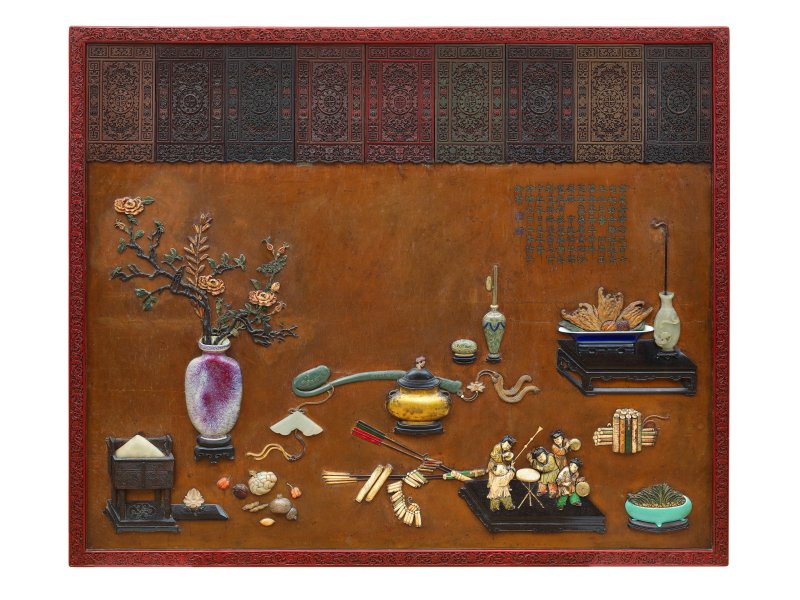
The rectangular panel depicting an auspicious arrangement of antiques and scholar's objects, including a porcelain-inlaid flambé vase issuing flowering branches, a green jade ruyi sceptre, a gilt-bronze incense burner, a cloisonné-enamel vase, a tray of finger citrons and other fruits, an archaic fangding with taotie pattern, chimes, hardstone fruits and nuts, and a stained-ivory group of children playing musical instruments, all reserved on an amber-brown ground and accompanied by an inscription and two seals reading Qian and Long, beneath a multicoloured carved-lacquer frieze imitating textile drapery and all within a cinnabar-lacquer frame carved with lotus scrolls.
105cm (41 3/8in) high x 132cm (52in) wide.
Footnotes
清乾隆十八年(1753) 漆地剔彩嵌寶歲朝慶壽圖長方掛屏
「癸酉元日立春帖子御筆」款 「乾」「隆」印
Provenance:
Christie's London, 25-26 November 1974, lot 162
倫敦佳士得,1974年11月25至26日,拍品編號162
The present panel belongs to the tradition of (博古圖), or 'Pictures of Antiquities', a pictorial genre that reached their height under the ambitious collecting practices of the Qianlong Emperor, when they were produced across a wide range of media. Comparable works include large cloisonné enamel panels, 18th century, in the Pierre Uldry collection, illustrated by H.Brinker and A.Luz, , Zurich, 1985, pls.307-310.
The present lot operates through what may be described as a form of 'reverse trompe-l'oeil': rather than creating illusionistic depth through painted means, three-dimensional materials: jade, hardstone, porcelain and gilt-bronze, are arranged to read as a flattened pictorial field. The result is a paradoxical surface in which real objects are orchestrated into an image-like arrangement, collapsing the distinction between material presence and pictorial representation. This is typical of the Qianlong period reflecting the Emperor's playful tastes. See a box and cover with similarly richly inlaid lacquer and hardstone embellishments, 18th century, in the Qing Court Collection, illustrated by E.Rawski and J.Rawson, , London, 2005, p.373, no.289.
The depiction of numerous antiques and vessels constitutes a highly codified visual statements of erudition, in which the arrangement of ancient bronzes, jades and scholarly objects articulates cultural memory, refined taste and intellectual lineage. At the centre of the composition is an archaistic bronze vessel cast with a mask, recalling the ritual bronzes of the Shang and Zhou dynasties. Such objects were long revered by collectors and scholars as tangible embodiments of antiquity, valued not only for their age but also for the moral and historical authority they were believed to embody. The panel further reflects the cultivated world of the scholar's studio through the inclusion of an incense burner and associated implements, alluding to the ritualised appreciation of fragrance as an essential component of literati life. The burning of incense structured moments of contemplation and aesthetic focus, engaging the senses while reinforcing ideals of cultivated restraint and refinement.
The present lot also incorporates auspicious and calendrical symbolism, suggesting that the present panel was intended for the celebration of the New Year period. Firecrackers are prominently included, recalling their traditional role in expelling malevolent forces at seasonal thresholds, a practice rooted in ancient customs of noise-making rituals. At the same time, they carry a well-established rebus meaning of renewal and continuity, evoking wishes for prosperity 'year after year'. Auspicious fruits such as the finger citron () further reinforce this layered symbolism, their form and name invoking blessings, longevity and abundance. The inscription highlights the time of New Year:
東皇綺律舒,三百六旬初。妙合麟經義,春王正月書。
四序正權輿,雲看三素殊。慈寧重疊慶,春酒介屠穌。
辛盤恰並椒盤獻,賀歲還兼賀節新。
宜拂硃牋書大吉,今年元日是元春。
癸酉元日立春帖子御筆。
Which may be translated as:
By combining antiquarian references, scholarly accoutrements and festive symbolism within a unified composition, the present lot may be understood as a Chinese counterpart to the European still life tradition. Yet whereas European still life often meditates on transience and mortality, Chinese compositions emphasise continuity with the past, cyclical renewal and the enduring presence of cultural inheritance.
See a related inlaid panel depicting vessels, fruit and flowers on stands, mid-Qing dynasty, with an Imperial poem inlaid in jade, illustrated in , Beijing, 2008, p.292, no.324.
Compare also with a similar pair of embellished lacquer panels, Qianlong period, bearing poems dated to the year (1775) and year (1788), which was sold at Sotheby's Hong Kong, 6 October 2015, lot 3001.
剔彩為框,屏心以漆地嵌百寶,飾賀歲吉慶圖案。畫面陳設琳琅,古玩文房羅列其間:窯變釉瓶插盛放花枝,青玉如意、白玉編磬、鎏金爐、掐絲琺瑯瓶盒錯落有致;右面有瓷盤盛佛手諸果,前有染色象牙奏樂童子,旁有賀歲爆竹;左下方有飾獸面紋之仿古方鼎,寶石瓜果點綴在側,雅趣盎然。掛屏設色絢麗,工藝精細,吉慶之氣溢於畫面。
本品飾「博古圖」,以表尊古敬意,盛於乾隆朝,為蒐古之風鼎盛之際,廣見於各式工藝媒材。比較數件十八世紀掐絲琺瑯掛屏,見H.Brinker與A.Lutz,《Chinesisches Cloisonné: Die Sammlung Pierre Uldry》,蘇黎世,1985年,圖版307至310。
此掛屏工藝別具匠心,採逆向錯視之巧思。不以繪筆營造景深,而取玉、石、瓷、銅等立體材質嵌飾成畫。以實物構圖,二維三維交織,虛實相生,別開生面。此類手法於乾隆朝屢見不鮮,正合帝王鍾好奇巧之品味。參考清宮舊藏一件十八世紀嵌百寶蓋盒,見E.Rawski與J.Rawson,《China: The Three Emperors 1662–1795》,倫敦,2005年,頁373,編號289。
畫面陳設古器物,青銅、玉器與文房雅玩羅列其間,尚古博學之趣盎然,盡顯清宮雅緻品味。仿古獸面紋方鼎,令人遙想商周禮器之遺韻,此類古物素為鑑藏家所珍,視為古意之化身,所重者非僅年代之遙,更在其所承載之道德與歷史分量。香爐與香具之出現,則呼應文人書齋之雅事;品香,既是靜觀審美之片刻,亦體現文人所追求之節制與韻致。
本品更融入歲時節慶之祥瑞意涵,當為新春賀歲而設。畫面中爆竹喧天,其傳統功能在於歲時交替之際驅除邪祟,此俗源於古代以聲響辟邪之儀式;同時爆竹亦具「歲歲平安」、「節節高升」之吉祥寓意。瑞果如佛手,以其形名寄寓福壽、豐足之願。畫面所題詩文更點明新春時節,曰:
東皇綺律舒,三百六旬初。妙合麟經義,春王正月書。
四序正權輿,雲看三素殊。慈寧重疊慶,春酒介屠穌。
辛盤恰並椒盤獻,賀歲還兼賀節新。
宜拂硃牋書大吉,今年元日是元春。
癸酉元日立春帖子御筆。
本品融古物之趣、文房之雅與節慶之祥於一體,可謂中國式靜物畫之代表。西方靜物畫多寄寓光陰易逝、生命無常之思,中國此類作品則強調與古為徒、循環復始與文化傳承之綿延不斷。
參考一件清中期百寶嵌博古掛屏,以玉嵌御製詩,見《故宮經典:明清宮廷家具》,北京,2008年頁292,編號324。市場可比例,包括一對乾隆時期漆地剔彩嵌寶歲朝福壽圖掛屏,飾有《乾隆乙未春帖子詞》及《乾隆戊申春帖子詞》,售於香港蘇富比,2015年10月6日,拍品編號3001。
The rectangular panel depicting an auspicious arrangement of antiques and scholar's objects, including a porcelain-inlaid flambé vase issuing flowering branches, a green jade ruyi sceptre, a gilt-bronze incense burner, a cloisonné-enamel vase, a tray of finger citrons and other fruits, an archaic fangding with taotie pattern, chimes, hardstone fruits and nuts, and a stained-ivory group of children playing musical instruments, all reserved on an amber-brown ground and accompanied by an inscription and two seals reading Qian and Long, beneath a multicoloured carved-lacquer frieze imitating textile drapery and all within a cinnabar-lacquer frame carved with lotus scrolls.
105cm (41 3/8in) high x 132cm (52in) wide.
Footnotes
清乾隆十八年(1753) 漆地剔彩嵌寶歲朝慶壽圖長方掛屏
「癸酉元日立春帖子御筆」款 「乾」「隆」印
Provenance:
Christie's London, 25-26 November 1974, lot 162
倫敦佳士得,1974年11月25至26日,拍品編號162
The present panel belongs to the tradition of (博古圖), or 'Pictures of Antiquities', a pictorial genre that reached their height under the ambitious collecting practices of the Qianlong Emperor, when they were produced across a wide range of media. Comparable works include large cloisonné enamel panels, 18th century, in the Pierre Uldry collection, illustrated by H.Brinker and A.Luz, , Zurich, 1985, pls.307-310.
The present lot operates through what may be described as a form of 'reverse trompe-l'oeil': rather than creating illusionistic depth through painted means, three-dimensional materials: jade, hardstone, porcelain and gilt-bronze, are arranged to read as a flattened pictorial field. The result is a paradoxical surface in which real objects are orchestrated into an image-like arrangement, collapsing the distinction between material presence and pictorial representation. This is typical of the Qianlong period reflecting the Emperor's playful tastes. See a box and cover with similarly richly inlaid lacquer and hardstone embellishments, 18th century, in the Qing Court Collection, illustrated by E.Rawski and J.Rawson, , London, 2005, p.373, no.289.
The depiction of numerous antiques and vessels constitutes a highly codified visual statements of erudition, in which the arrangement of ancient bronzes, jades and scholarly objects articulates cultural memory, refined taste and intellectual lineage. At the centre of the composition is an archaistic bronze vessel cast with a mask, recalling the ritual bronzes of the Shang and Zhou dynasties. Such objects were long revered by collectors and scholars as tangible embodiments of antiquity, valued not only for their age but also for the moral and historical authority they were believed to embody. The panel further reflects the cultivated world of the scholar's studio through the inclusion of an incense burner and associated implements, alluding to the ritualised appreciation of fragrance as an essential component of literati life. The burning of incense structured moments of contemplation and aesthetic focus, engaging the senses while reinforcing ideals of cultivated restraint and refinement.
The present lot also incorporates auspicious and calendrical symbolism, suggesting that the present panel was intended for the celebration of the New Year period. Firecrackers are prominently included, recalling their traditional role in expelling malevolent forces at seasonal thresholds, a practice rooted in ancient customs of noise-making rituals. At the same time, they carry a well-established rebus meaning of renewal and continuity, evoking wishes for prosperity 'year after year'. Auspicious fruits such as the finger citron () further reinforce this layered symbolism, their form and name invoking blessings, longevity and abundance. The inscription highlights the time of New Year:
東皇綺律舒,三百六旬初。妙合麟經義,春王正月書。
四序正權輿,雲看三素殊。慈寧重疊慶,春酒介屠穌。
辛盤恰並椒盤獻,賀歲還兼賀節新。
宜拂硃牋書大吉,今年元日是元春。
癸酉元日立春帖子御筆。
Which may be translated as:
By combining antiquarian references, scholarly accoutrements and festive symbolism within a unified composition, the present lot may be understood as a Chinese counterpart to the European still life tradition. Yet whereas European still life often meditates on transience and mortality, Chinese compositions emphasise continuity with the past, cyclical renewal and the enduring presence of cultural inheritance.
See a related inlaid panel depicting vessels, fruit and flowers on stands, mid-Qing dynasty, with an Imperial poem inlaid in jade, illustrated in , Beijing, 2008, p.292, no.324.
Compare also with a similar pair of embellished lacquer panels, Qianlong period, bearing poems dated to the year (1775) and year (1788), which was sold at Sotheby's Hong Kong, 6 October 2015, lot 3001.
剔彩為框,屏心以漆地嵌百寶,飾賀歲吉慶圖案。畫面陳設琳琅,古玩文房羅列其間:窯變釉瓶插盛放花枝,青玉如意、白玉編磬、鎏金爐、掐絲琺瑯瓶盒錯落有致;右面有瓷盤盛佛手諸果,前有染色象牙奏樂童子,旁有賀歲爆竹;左下方有飾獸面紋之仿古方鼎,寶石瓜果點綴在側,雅趣盎然。掛屏設色絢麗,工藝精細,吉慶之氣溢於畫面。
本品飾「博古圖」,以表尊古敬意,盛於乾隆朝,為蒐古之風鼎盛之際,廣見於各式工藝媒材。比較數件十八世紀掐絲琺瑯掛屏,見H.Brinker與A.Lutz,《Chinesisches Cloisonné: Die Sammlung Pierre Uldry》,蘇黎世,1985年,圖版307至310。
此掛屏工藝別具匠心,採逆向錯視之巧思。不以繪筆營造景深,而取玉、石、瓷、銅等立體材質嵌飾成畫。以實物構圖,二維三維交織,虛實相生,別開生面。此類手法於乾隆朝屢見不鮮,正合帝王鍾好奇巧之品味。參考清宮舊藏一件十八世紀嵌百寶蓋盒,見E.Rawski與J.Rawson,《China: The Three Emperors 1662–1795》,倫敦,2005年,頁373,編號289。
畫面陳設古器物,青銅、玉器與文房雅玩羅列其間,尚古博學之趣盎然,盡顯清宮雅緻品味。仿古獸面紋方鼎,令人遙想商周禮器之遺韻,此類古物素為鑑藏家所珍,視為古意之化身,所重者非僅年代之遙,更在其所承載之道德與歷史分量。香爐與香具之出現,則呼應文人書齋之雅事;品香,既是靜觀審美之片刻,亦體現文人所追求之節制與韻致。
本品更融入歲時節慶之祥瑞意涵,當為新春賀歲而設。畫面中爆竹喧天,其傳統功能在於歲時交替之際驅除邪祟,此俗源於古代以聲響辟邪之儀式;同時爆竹亦具「歲歲平安」、「節節高升」之吉祥寓意。瑞果如佛手,以其形名寄寓福壽、豐足之願。畫面所題詩文更點明新春時節,曰:
東皇綺律舒,三百六旬初。妙合麟經義,春王正月書。
四序正權輿,雲看三素殊。慈寧重疊慶,春酒介屠穌。
辛盤恰並椒盤獻,賀歲還兼賀節新。
宜拂硃牋書大吉,今年元日是元春。
癸酉元日立春帖子御筆。
本品融古物之趣、文房之雅與節慶之祥於一體,可謂中國式靜物畫之代表。西方靜物畫多寄寓光陰易逝、生命無常之思,中國此類作品則強調與古為徒、循環復始與文化傳承之綿延不斷。
參考一件清中期百寶嵌博古掛屏,以玉嵌御製詩,見《故宮經典:明清宮廷家具》,北京,2008年頁292,編號324。市場可比例,包括一對乾隆時期漆地剔彩嵌寶歲朝福壽圖掛屏,飾有《乾隆乙未春帖子詞》及《乾隆戊申春帖子詞》,售於香港蘇富比,2015年10月6日,拍品編號3001。
常见问题
这件清乾隆十八年(1753) 漆地剔彩嵌寶歲朝慶壽圖長方掛屏 | A RARE IMPERIAL CARVED CINNABAR LACQUER EMBELLISHED IMPERIALLY-INSCRIBED PANEL的成交价是多少?
落槌价为 预展中。 成交价为 预展中。