
拍品信息
拍品名称
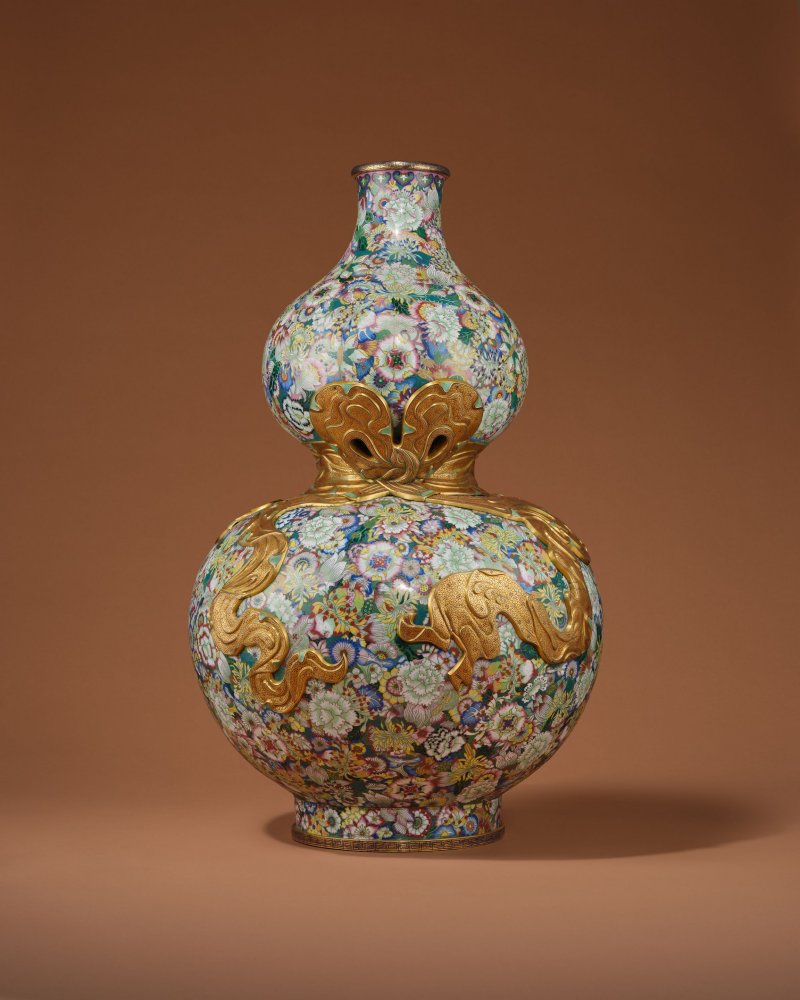
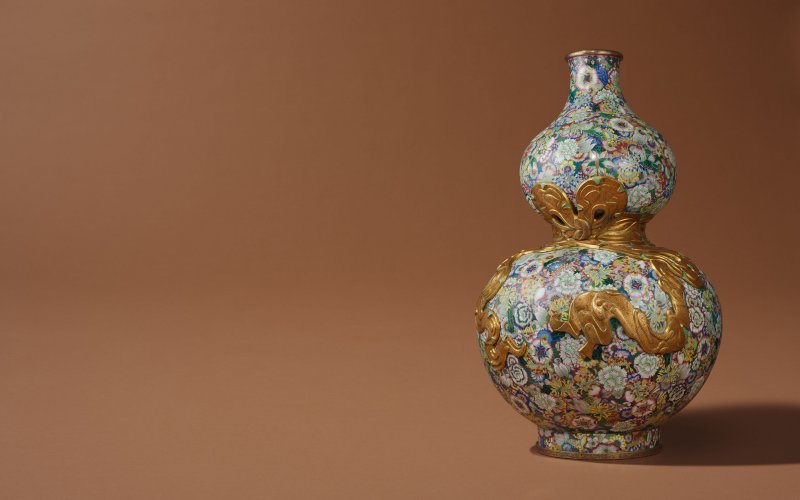
清乾隆 掐絲琺瑯百花紋綬帶大葫蘆瓶 | A MASSIVE GILT-BRONZE AND CLOISONNÉ ENAMEL 'MILLEFLEURS' DOUBLE-GOURD VASE
年代
Qianlong
起拍价
HKD 1,500,000
估值区间
HKD 1500000 - 2000000
尺寸
未知
品相
未知
更多信息
Qianlong
Robustly modelled with a compressed globular body rising from a short gilt-bronze foot to a slightly smaller upper bulb and waisted neck with a narrow gilt-bronze mouth, entirely decorated around the body in vibrant millefleurs design with a large elaborate gilt ribbon to the mid-section, the mouth and foot rims gilded and each circled with key-fret border.
99.5cm (39 1/4in) high.
Footnotes
清乾隆 掐絲琺瑯百花紋綬帶大葫蘆瓶
Provenance:
Dr Wou Kiuan (1910-1997)
Wou Lien-Pai Museum, coll. no. Q.1
來源:
吳權博士 (1910-1997) 收藏
吳蓮伯博物院,編號Q.1
Dr Wou Kiuan (Wu Quan, Heng Zhi), was son of the Republican politician Wou Lien-Pai (Wu Jinglian, Wu Lianbo) (1873-1944). He was born in Xingcheng, Liaoning Province in 1910. Educated at Zhendan University in Shanghai, he studied French before he moved to France to study law at the University of Grenoble and was awarded his doctorate degree from the Sorbonne in Paris. He was appointed Secretary-General for the Overseas Chinese Committee at the League of Nations in Geneva in 1937. In 1939, he joined the Chinese government Foreign Affairs Service at the French embassy in Paris, before moving to London in 1941 where he worked for the Chinese embassy in London until 1947 when he was recalled to China to serve in the Ministry for Foreign Affairs until his retirement in 1952. Settling back in London, Wou devoted his retirement to the study of Chinese archaeology and art. He developed a close friendship with the Cambridge-based scholar of Chinese art and archaeology, Professor Cheng Te-K'un (1908-2001), who was instrumental in guiding him in his early collecting journey. Wou was able to acquire works from the sales of some of the most prominent collectors of the early 20th century – Sir Percival David (1892-1964), Brenda Zara Seligman (1882-1965), Henry Knight (d. 1971), Nellie Ionides (1883-1962) and H.R.N. Norton (d. 1961/2) as well as Alfred Morrison (1821-1897), whose legendary collection was housed at Fonthill Abbey in Wiltshire.
The present vase is an exceptionally rare and impressive example of the large-scale double-gourd form in cloisonné enamel. A nearly identical example of comparable size (93.3 cm high) is in the Shenyang Palace Museum, illustrated in , Shenyang, 2007, p.25, no.18. The close correspondence in form and dimensions suggests that the present vase may originally have formed part of a pair. The Shenyang example is described as exemplifying the high-quality cloisonné enamel craftsmanship of the Qianlong period. See also a related cloisonné enamel double-gourd vase, but smaller (47.6cm high), now dated to the Qianlong period by the Palace Museum, Beijing, illustrated in , Beijing, 2011, p.286, no.229. Compare also with a smaller pair (22.2cm high) of Qianlong mark and period 'millefleurs' vases decorated with the trompe l'oeil ribbon but with the addition of Buddhist lion roundels, published by H.Brinker and A.Lutz, , Zurich, 1985, no.298.
The vase is further distinguished by its densely worked 'millefleurs' ('myriad flowers') decoration, an elaborate design requiring exceptional control in the application of the wirework and enamel. The 'millefleurs' pattern appears to have been introduced on Imperial wares during the Kangxi reign and reached a particularly sophisticated level during the Qianlong and Jiaqing periods. More commonly associated with porcelain, the design is exemplified by a Qianlong vase illustrated by Geng Baochang, (Appraisal of Ming and Qing Porcelain), Hong Kong, 1993, p.517, pl.127. On the present vase, the densely arranged flowers and foliage are rendered in an exceptionally rich palette, with subtle variations of colour and shading used to distinguish the individual blooms and leaves. The combination of an expansive surface, complex wirework and extensive palette demonstrates the technical sophistication achieved by the Imperial cloisonné workshops during the Qianlong period.
See also a related pair of cloisonné enamel 'millefleurs' double-gourd vases, bearing Qianlong four-character cast marks within double squares and of the period, which was sold at Christie's London, 6 November 2018, lot 138.
吳權博士(字衡之,1910-1997),乃民國政治家吳景濂(字蓮伯,1873-1944)之子,生於東北遼寧省興城。先就讀上海震旦大學,習法文,後赴法國格勒諾布爾大學攻讀法律,並於巴黎索邦大學取得博士學位。1937年,吳博士出任日內瓦國際聯盟華僑委員會秘書長;1939年,在法國駐巴黎大使館加入新成立的中國政府外事處;1941年移居倫敦,任職於中國駐英使館,直至1947年回國,在外交部任職,1952年退休。退休後,吳氏定居倫敦,潛心研究中國考古與藝術,與劍橋大學中國藝術與考古學者鄭德坤教授(1908-2001),二人相交甚篤,鄭氏在其收藏生涯之初,多有指引。吳氏得以購藏二十世紀初期諸多著名收藏家之舊藏,包括大維德爵士(Sir Percival David,1892–1964)、布倫達·薩拉·塞利格曼(Brenda Zara Seligman,1882–1965)、亨利·奈特(Henry Knight,卒於1971)、內莉·艾奧尼德斯(Nellie Ionides,1883–1962)、H.R.N.諾頓(H.R.N. Norton,卒於1961/62)及艾弗瑞·莫里森(Alfred Morrison,1821–1897)等,莫里森之傳奇收藏曾藏於英國威爾特郡的放山居大宅。
瓶作上小下大葫蘆式,小口,細頸,束腰,底足微撇。口沿、足圈鎏金,各鏨刻回紋一圈。通體以掐絲琺琅滿飾百花紋;束腰處有裝飾綬帶,施以鎏金,上飾暗紅碎雲紋。此葫蘆瓶,器形宏偉,比例勻亭,紋飾繁麗,色彩絢爛,充分展現清代鼎盛時期掐絲琺瑯工藝之卓越成就。
本品尺寸碩大,存世極罕,瀋陽故宮博物院藏一件尺寸相若(高93.3厘米)、紋飾幾乎完全相同之葫蘆瓶,載於《瀋陽故宮博物院院藏文物精粹:琺瑯卷》,瀋陽,2007年,頁25,編號18。二者皆為陳設品,極可能原作一對打造。該書編者指出此瀋陽故宮葫蘆瓶「充分反映出清代乾隆年間琺瑯製造技術的高超水平」。此類器物之製作一直延續至清晚期,例如北京故宮博物院藏一件尺寸較小(高47.6厘米)之例,可資參照,見《故宮博物院藏品大系:琺瑯器編4:清掐絲琺瑯》,北京,2011年,頁286,編號229。比較另一對尺寸較小(高22.2厘米)之乾隆款掐絲琺瑯百花紋瓶,有類似綬帶裝飾,並加飾獅球紋,見H.Brinker與A.Lutz,《Chinesisches Cloisonné Die Sammlung Pierre Uldry》,蘇黎世,1985年,編號298。
瓶身滿飾百花紋,又稱「萬花堆」、「百花不落地」,紋樣繁密精細,製作難度極高,需仰賴宮廷造辦處頂尖匠師方能完成。百花紋初見於康熙朝瓷器,至乾嘉時期工藝臻於巔峰,尤以瓷器為大宗,如一件乾隆款粉彩百花錦紋樽,錄於耿寶昌,《明清瓷器鑑定》,香港,1993年,頁517,圖版127。本品則展現乾隆朝掐絲琺瑯之創新發展,其釉色豐富,排列繁密,花瓣葉片施以深淺漸變,細節精緻入微,正合當時宮廷崇尚華麗之審美。
參考一對乾隆時期掐絲琺瑯萬花錦繡包袱紋葫蘆瓶,帶「乾隆年製」楷書款,售於倫敦佳士得,2018年11月6日,拍品編號138。
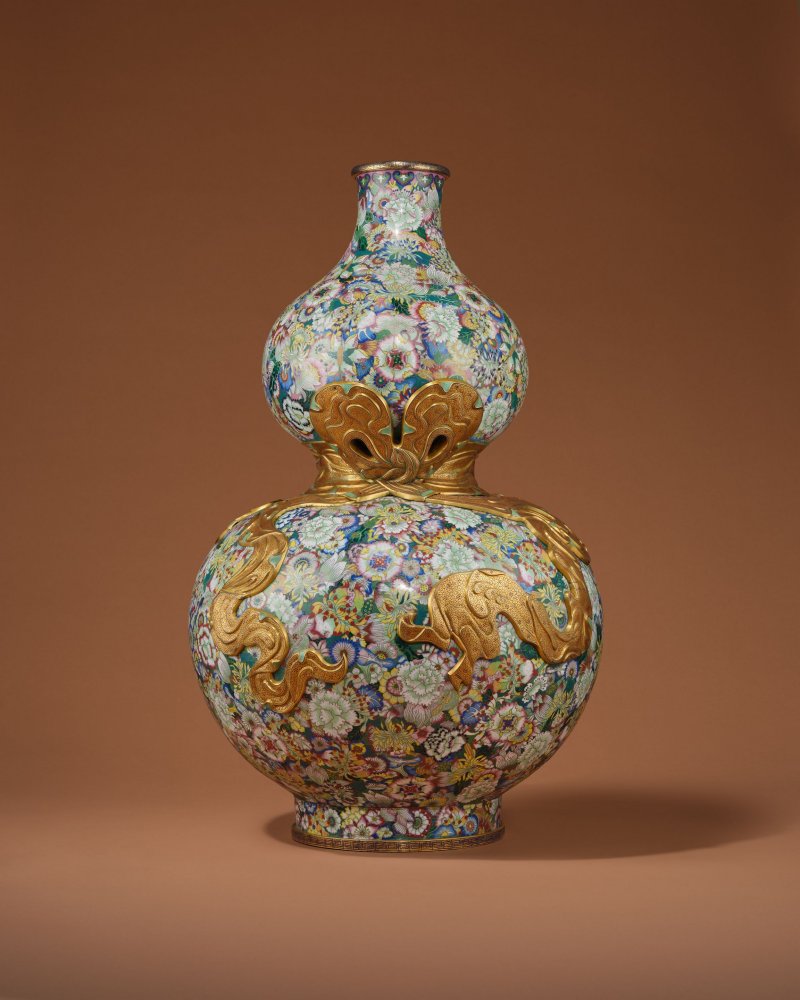
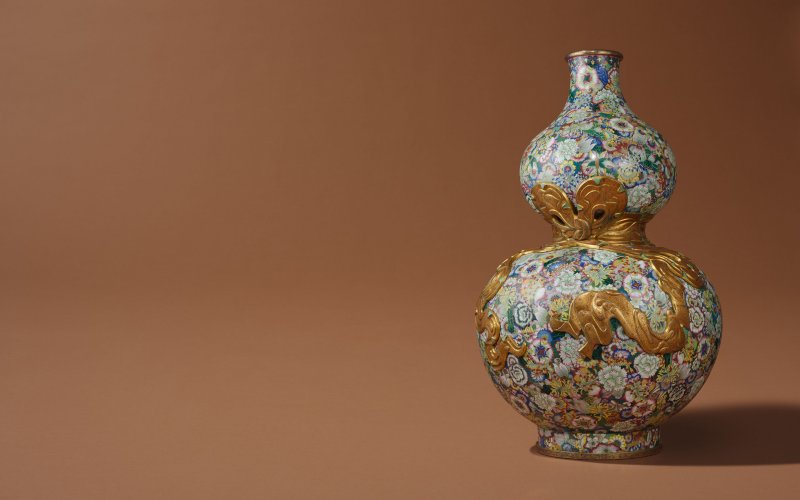
Robustly modelled with a compressed globular body rising from a short gilt-bronze foot to a slightly smaller upper bulb and waisted neck with a narrow gilt-bronze mouth, entirely decorated around the body in vibrant millefleurs design with a large elaborate gilt ribbon to the mid-section, the mouth and foot rims gilded and each circled with key-fret border.
99.5cm (39 1/4in) high.
Footnotes
清乾隆 掐絲琺瑯百花紋綬帶大葫蘆瓶
Provenance:
Dr Wou Kiuan (1910-1997)
Wou Lien-Pai Museum, coll. no. Q.1
來源:
吳權博士 (1910-1997) 收藏
吳蓮伯博物院,編號Q.1
Dr Wou Kiuan (Wu Quan, Heng Zhi), was son of the Republican politician Wou Lien-Pai (Wu Jinglian, Wu Lianbo) (1873-1944). He was born in Xingcheng, Liaoning Province in 1910. Educated at Zhendan University in Shanghai, he studied French before he moved to France to study law at the University of Grenoble and was awarded his doctorate degree from the Sorbonne in Paris. He was appointed Secretary-General for the Overseas Chinese Committee at the League of Nations in Geneva in 1937. In 1939, he joined the Chinese government Foreign Affairs Service at the French embassy in Paris, before moving to London in 1941 where he worked for the Chinese embassy in London until 1947 when he was recalled to China to serve in the Ministry for Foreign Affairs until his retirement in 1952. Settling back in London, Wou devoted his retirement to the study of Chinese archaeology and art. He developed a close friendship with the Cambridge-based scholar of Chinese art and archaeology, Professor Cheng Te-K'un (1908-2001), who was instrumental in guiding him in his early collecting journey. Wou was able to acquire works from the sales of some of the most prominent collectors of the early 20th century – Sir Percival David (1892-1964), Brenda Zara Seligman (1882-1965), Henry Knight (d. 1971), Nellie Ionides (1883-1962) and H.R.N. Norton (d. 1961/2) as well as Alfred Morrison (1821-1897), whose legendary collection was housed at Fonthill Abbey in Wiltshire.
The present vase is an exceptionally rare and impressive example of the large-scale double-gourd form in cloisonné enamel. A nearly identical example of comparable size (93.3 cm high) is in the Shenyang Palace Museum, illustrated in , Shenyang, 2007, p.25, no.18. The close correspondence in form and dimensions suggests that the present vase may originally have formed part of a pair. The Shenyang example is described as exemplifying the high-quality cloisonné enamel craftsmanship of the Qianlong period. See also a related cloisonné enamel double-gourd vase, but smaller (47.6cm high), now dated to the Qianlong period by the Palace Museum, Beijing, illustrated in , Beijing, 2011, p.286, no.229. Compare also with a smaller pair (22.2cm high) of Qianlong mark and period 'millefleurs' vases decorated with the trompe l'oeil ribbon but with the addition of Buddhist lion roundels, published by H.Brinker and A.Lutz, , Zurich, 1985, no.298.
The vase is further distinguished by its densely worked 'millefleurs' ('myriad flowers') decoration, an elaborate design requiring exceptional control in the application of the wirework and enamel. The 'millefleurs' pattern appears to have been introduced on Imperial wares during the Kangxi reign and reached a particularly sophisticated level during the Qianlong and Jiaqing periods. More commonly associated with porcelain, the design is exemplified by a Qianlong vase illustrated by Geng Baochang, (Appraisal of Ming and Qing Porcelain), Hong Kong, 1993, p.517, pl.127. On the present vase, the densely arranged flowers and foliage are rendered in an exceptionally rich palette, with subtle variations of colour and shading used to distinguish the individual blooms and leaves. The combination of an expansive surface, complex wirework and extensive palette demonstrates the technical sophistication achieved by the Imperial cloisonné workshops during the Qianlong period.
See also a related pair of cloisonné enamel 'millefleurs' double-gourd vases, bearing Qianlong four-character cast marks within double squares and of the period, which was sold at Christie's London, 6 November 2018, lot 138.
吳權博士(字衡之,1910-1997),乃民國政治家吳景濂(字蓮伯,1873-1944)之子,生於東北遼寧省興城。先就讀上海震旦大學,習法文,後赴法國格勒諾布爾大學攻讀法律,並於巴黎索邦大學取得博士學位。1937年,吳博士出任日內瓦國際聯盟華僑委員會秘書長;1939年,在法國駐巴黎大使館加入新成立的中國政府外事處;1941年移居倫敦,任職於中國駐英使館,直至1947年回國,在外交部任職,1952年退休。退休後,吳氏定居倫敦,潛心研究中國考古與藝術,與劍橋大學中國藝術與考古學者鄭德坤教授(1908-2001),二人相交甚篤,鄭氏在其收藏生涯之初,多有指引。吳氏得以購藏二十世紀初期諸多著名收藏家之舊藏,包括大維德爵士(Sir Percival David,1892–1964)、布倫達·薩拉·塞利格曼(Brenda Zara Seligman,1882–1965)、亨利·奈特(Henry Knight,卒於1971)、內莉·艾奧尼德斯(Nellie Ionides,1883–1962)、H.R.N.諾頓(H.R.N. Norton,卒於1961/62)及艾弗瑞·莫里森(Alfred Morrison,1821–1897)等,莫里森之傳奇收藏曾藏於英國威爾特郡的放山居大宅。
瓶作上小下大葫蘆式,小口,細頸,束腰,底足微撇。口沿、足圈鎏金,各鏨刻回紋一圈。通體以掐絲琺琅滿飾百花紋;束腰處有裝飾綬帶,施以鎏金,上飾暗紅碎雲紋。此葫蘆瓶,器形宏偉,比例勻亭,紋飾繁麗,色彩絢爛,充分展現清代鼎盛時期掐絲琺瑯工藝之卓越成就。
本品尺寸碩大,存世極罕,瀋陽故宮博物院藏一件尺寸相若(高93.3厘米)、紋飾幾乎完全相同之葫蘆瓶,載於《瀋陽故宮博物院院藏文物精粹:琺瑯卷》,瀋陽,2007年,頁25,編號18。二者皆為陳設品,極可能原作一對打造。該書編者指出此瀋陽故宮葫蘆瓶「充分反映出清代乾隆年間琺瑯製造技術的高超水平」。此類器物之製作一直延續至清晚期,例如北京故宮博物院藏一件尺寸較小(高47.6厘米)之例,可資參照,見《故宮博物院藏品大系:琺瑯器編4:清掐絲琺瑯》,北京,2011年,頁286,編號229。比較另一對尺寸較小(高22.2厘米)之乾隆款掐絲琺瑯百花紋瓶,有類似綬帶裝飾,並加飾獅球紋,見H.Brinker與A.Lutz,《Chinesisches Cloisonné Die Sammlung Pierre Uldry》,蘇黎世,1985年,編號298。
瓶身滿飾百花紋,又稱「萬花堆」、「百花不落地」,紋樣繁密精細,製作難度極高,需仰賴宮廷造辦處頂尖匠師方能完成。百花紋初見於康熙朝瓷器,至乾嘉時期工藝臻於巔峰,尤以瓷器為大宗,如一件乾隆款粉彩百花錦紋樽,錄於耿寶昌,《明清瓷器鑑定》,香港,1993年,頁517,圖版127。本品則展現乾隆朝掐絲琺瑯之創新發展,其釉色豐富,排列繁密,花瓣葉片施以深淺漸變,細節精緻入微,正合當時宮廷崇尚華麗之審美。
參考一對乾隆時期掐絲琺瑯萬花錦繡包袱紋葫蘆瓶,帶「乾隆年製」楷書款,售於倫敦佳士得,2018年11月6日,拍品編號138。
常见问题
这件清乾隆 掐絲琺瑯百花紋綬帶大葫蘆瓶 | A MASSIVE GILT-BRONZE AND CLOISONNÉ ENAMEL 'MILLEFLEURS' DOUBLE-GOURD VASE的成交价是多少?
落槌价为 预展中。 成交价为 预展中。