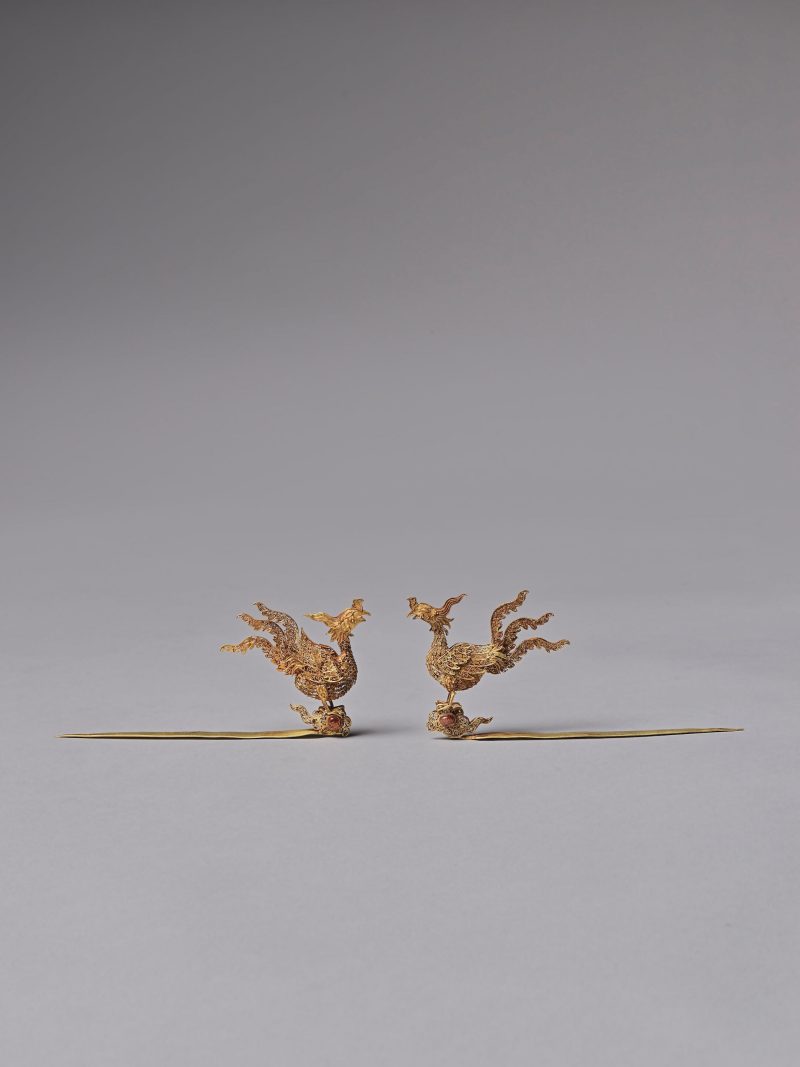

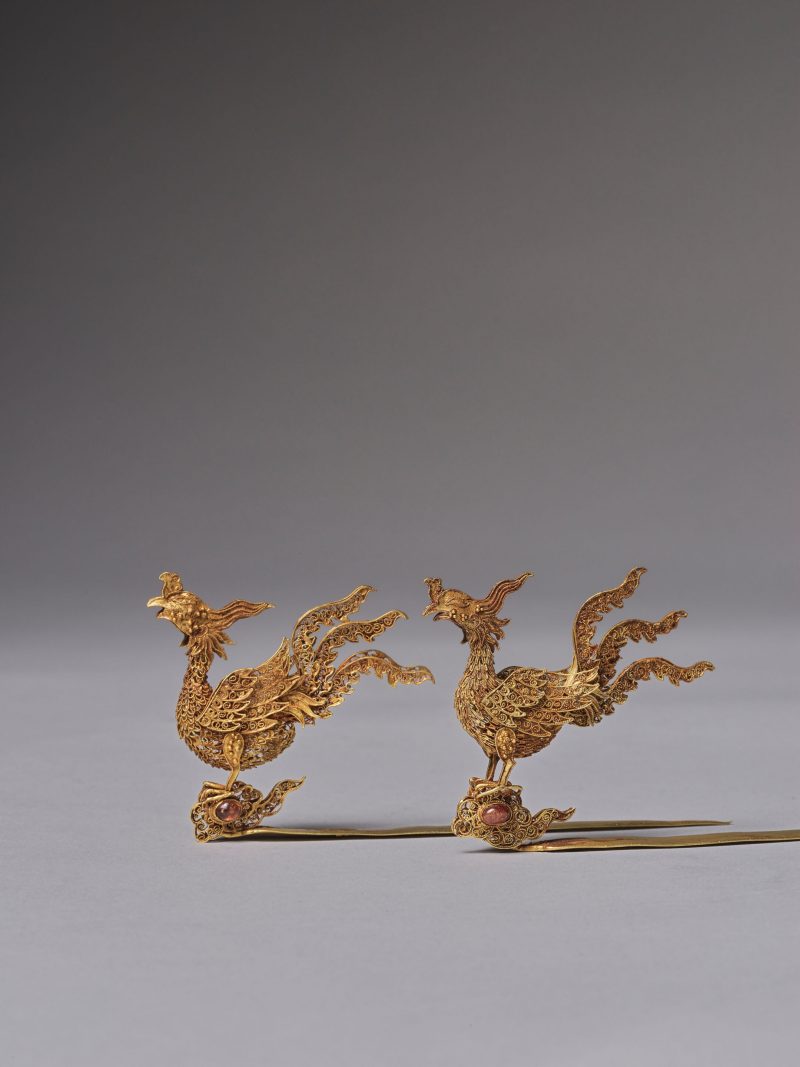
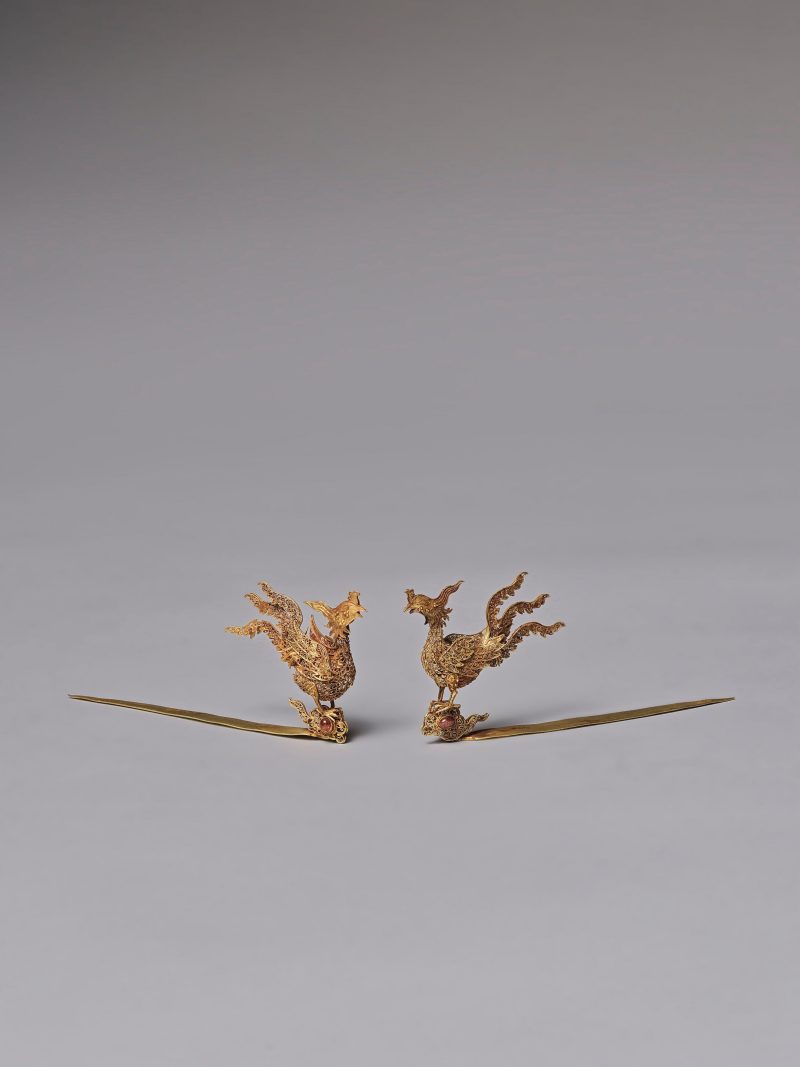
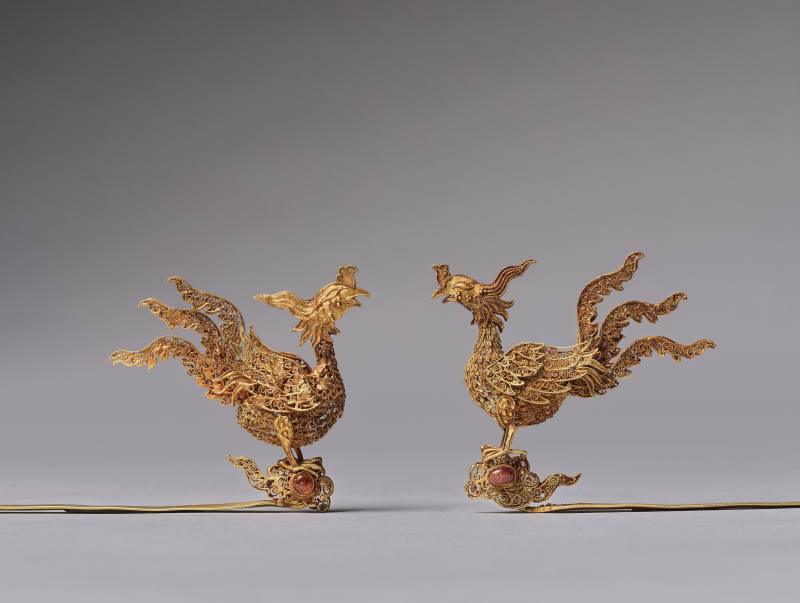
Lot 39 明代 金壘絲嵌寶鳳簪一對 | RARE PAIRE D'ÉPINGLES À CHEVEUX EN OR
落槌价
预展中
成交价
预展中
| 拍卖公司 | 邦瀚斯 |
|---|---|
| 拍卖时间 | 2026年12月10日 |
拍品信息
拍品名称
明代 金壘絲嵌寶鳳簪一對 | RARE PAIRE D'ÉPINGLES À CHEVEUX EN OR
年代
明代
起拍价
未知
估值区间
EUR 8,000–12,000
尺寸
Each 13 cm (5 1/8 in.) long
品相
未知
更多信息
RARE PAIRE D'ÉPINGLES À CHEVEUX EN OR
Dynastie Ming (1368-1644)
A RARE PAIR OF GOLD FILIGREE 'PHOENIX' HAIRPINS
Ming Dynasty
Each flat pin tapering to a pointed end, the other end surmounted by a naturalistically shaped phoenix standing on a small cloud base, head raised and tail feathers trailing, finely formed from foliate filigree and very thin gold sheet.
Each 13 cm (5 1/8 in.) long (2).
明代 金壘絲嵌寶鳳簪一對
Provenance:
Gisèle Croës Arts d'Extrême Orient, Brussels, 2007
來源:
Gisèle Croës Arts d'Extrême Orient,布魯塞爾, 2007年
Gold and silver hair ornaments were popular among the ladies of the Ming elite. Such luxurious accessories demonstrated wealth and identified the wearer as a member of the upper levels of Ming society. Under the Ming dynasty, sumptuary laws dictated that the use of gold vessels and accessories was the privilege of the Emperor and the Imperial family. However, archaeological discoveries of ostentatious gold headdresses, bangles, earrings and hair ornaments often set with precious stones and pearls unearthed from high-ranking Ming tombs such as those discovered in the Ming tomb of Lady Mei near Nanjing, demonstrate that these laws were disregarded.
Archaeological finds reveal that the use of extremely fine gold or silver wires twisted and soldered into lace patterns was just one sophisticated technique used by highly skilled Ming artisans in the manufacture of delicate pieces of jewellery. Another, highly complex technique involved extremely thin gold foil pressed into tight parallel folds, thus forming a light hollow structure.
Compare the present pair of gold hairpins with a pair of very similar gold filigree 'phoenix' hairpins found in the tomb of Liu Niangjing, dated 1560, excavated in Shechun, Hubei province, illustrated in Yang Zhishui, The Colour of Luxury - Song Yuan Ming Gold and Silverware, vol. II, Beijing, 2011, p. 5, pl. 1-1.1. Several other examples of such gold filigree 'phoenix' hairpins discovered in other Ming tombs in Hubei and Jiangxi province such as in the tomb of the King Duan of Yi (d. 1539) in Waiyuan, Nancheng, Jiangxi, illustrated in Yang Xiaoneng, 'Ming Art and Culture from an Archaeological Perspective - Part 1: Royal and Elite Tombs', in Orientations, June 2006, vol. 37, no. 5, p. 46, fig. 11, suggest that this type of ornament with a naturalistically-shaped phoenix whose underlying structure allowed for it to move was very popular.
以下内容由AI翻译:
【描述】
每根扁平发簪尖端逐渐变细,另一端饰有一只自然形态的凤凰站在小云朵底座上,头部抬起,尾羽拖曳,以叶形花丝和极薄的金片精细制成。
金、银发饰在明代精英女性中非常流行。这些奢华的饰品展示了财富,并标识佩戴者为明代社会的上层人士。在明朝,奢侈法规定使用金器和饰品是皇帝和皇室的特权。然而,从南京附近的梅夫人明墓等高级明墓中出土的华丽金头饰、手镯、耳环和发饰,常常镶嵌宝石和珍珠,表明这些法律并未得到遵守。
考古发现揭示了使用极细的金或银丝扭成并焊接成花边图案是一种高度熟练的明代工匠用于制作精致珠宝的技术。另一种复杂的技术涉及将极薄的金箔压成紧密的平行褶皱,从而形成轻巧的空心结构。
可比较湖北 Shechun 出土、年代为1560年的 Liu Niangjing 墓所见一对十分相近的金丝“凤凰”发簪,见于 Yang Zhishui,《奢华的颜色——宋元明金银器》,第二卷,北京,2011年,第5页,图1-1.1。在湖北和江西其他明墓中发现的其他几例金丝“凤凰”发簪,如江西南城县外园益端王(卒于1539年)墓中出土的发簪,见于杨晓能,《从考古角度看明代的艺术与文化——第一部分:皇家和贵族墓葬》,载于《Orientations》,2006年6月,第37卷,第5期,第46页,图11,表明这种具有自然形态凤凰且内部结构允许其活动的装饰品非常流行。
常见问题
这件明代 金壘絲嵌寶鳳簪一對 | RARE PAIRE D'ÉPINGLES À CHEVEUX EN OR的成交价是多少?
落槌价为 预展中。 成交价为 预展中。
拍品的尺寸是多少?
Each 13 cm (5 1/8 in.) long