
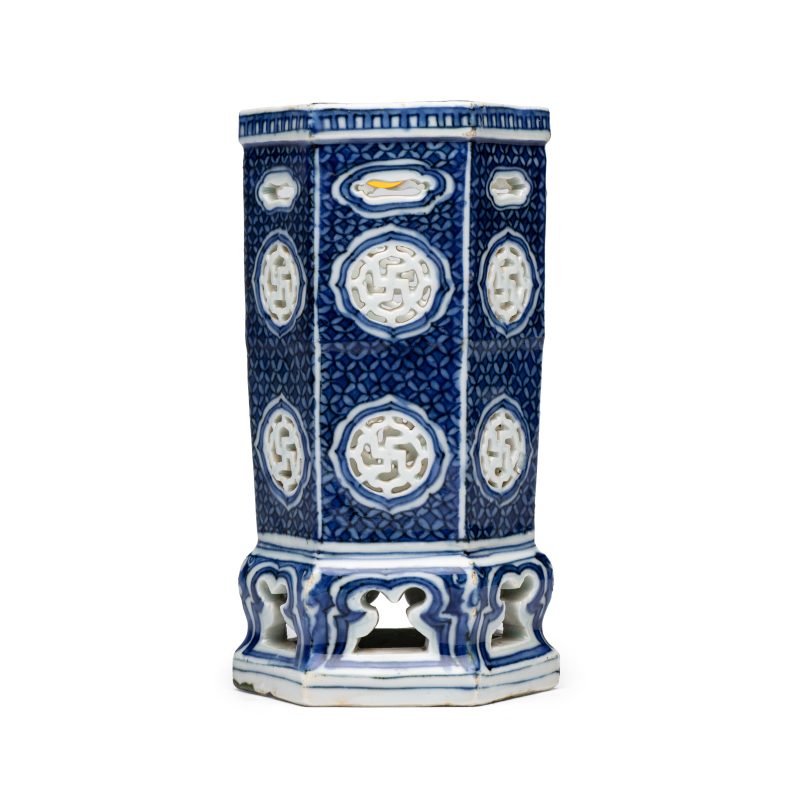
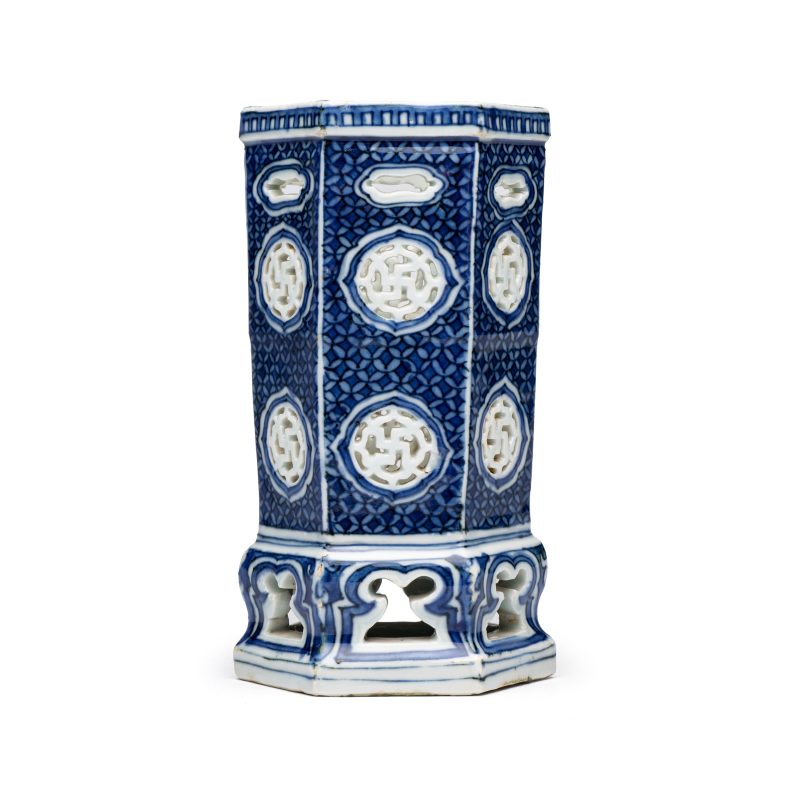
Lot 23 A Chinese blue and white openwork 'Linglong' incense stick holder
落槌价
****
成交价
****
拍品信息
拍品名称
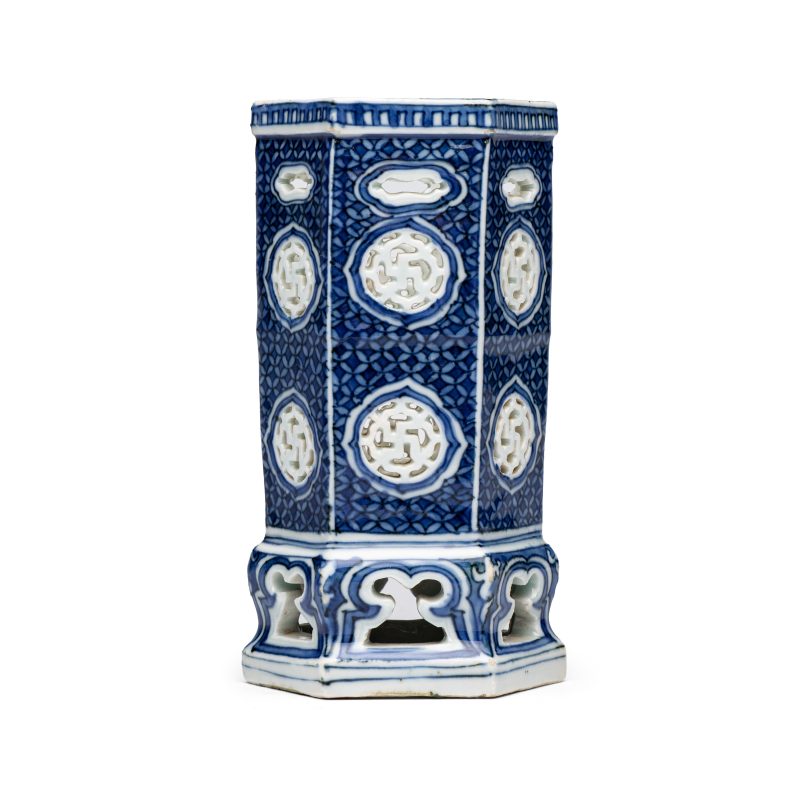
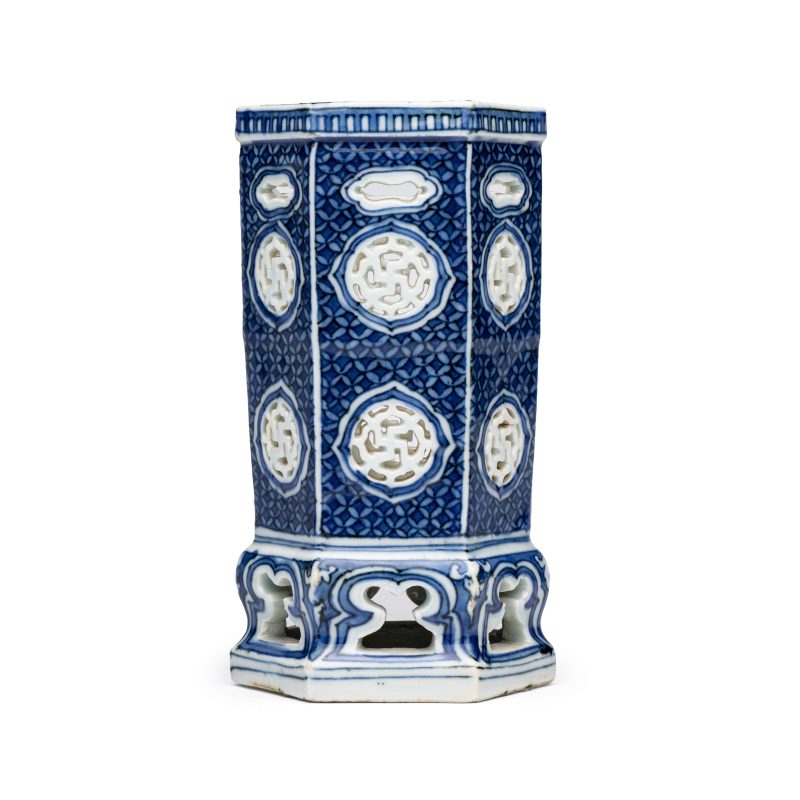
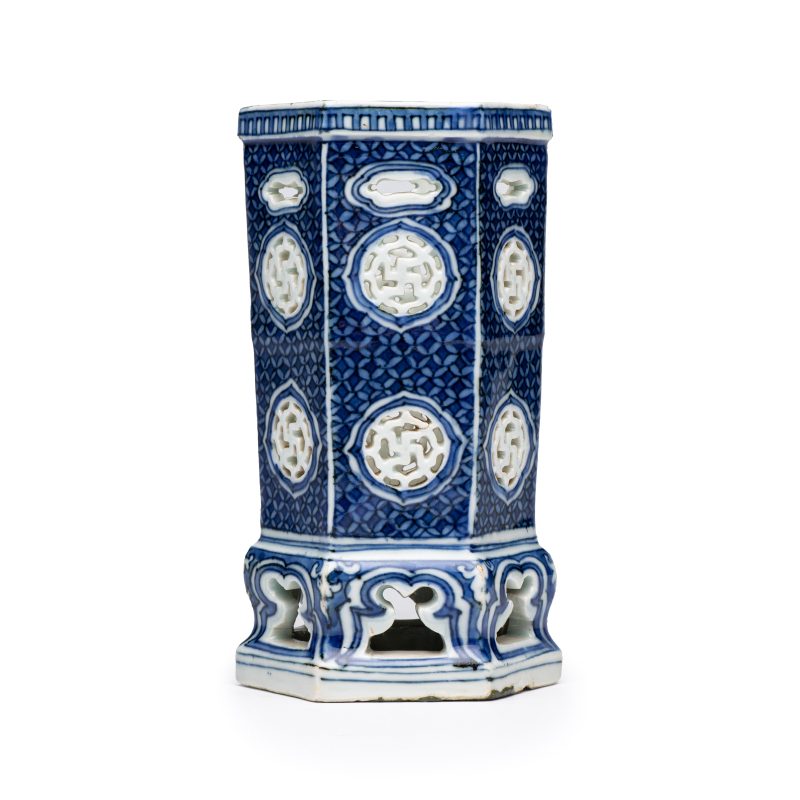
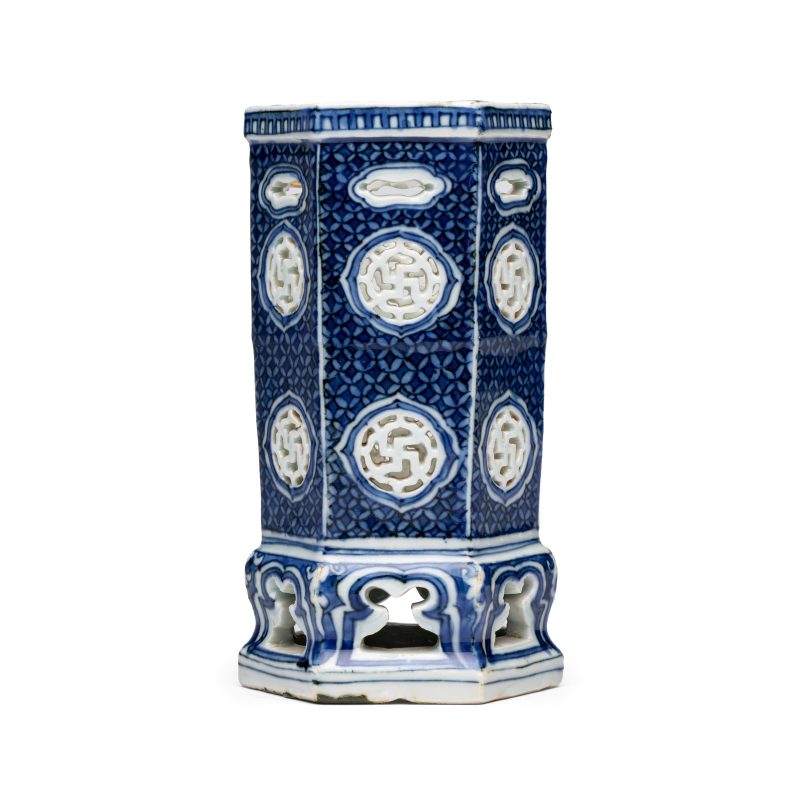
A Chinese blue and white openwork 'Linglong' incense stick holder
年代
Wanli
起拍价
未知
估值区间
€ 6.000 – € 12.000
尺寸
H: H. 15,6 cm, W. 8,3 cm, D. 7,1 cm
品相
(UV-checked):
Overall in very good condition, with normal minor superficial wear and typical spots of glaze loss. A baking flaw and negligible superficial chip to the foot rim.
Overall in very good condition, with normal minor superficial wear and typical spots of glaze loss. A baking flaw and negligible superficial chip to the foot rim.
更多信息
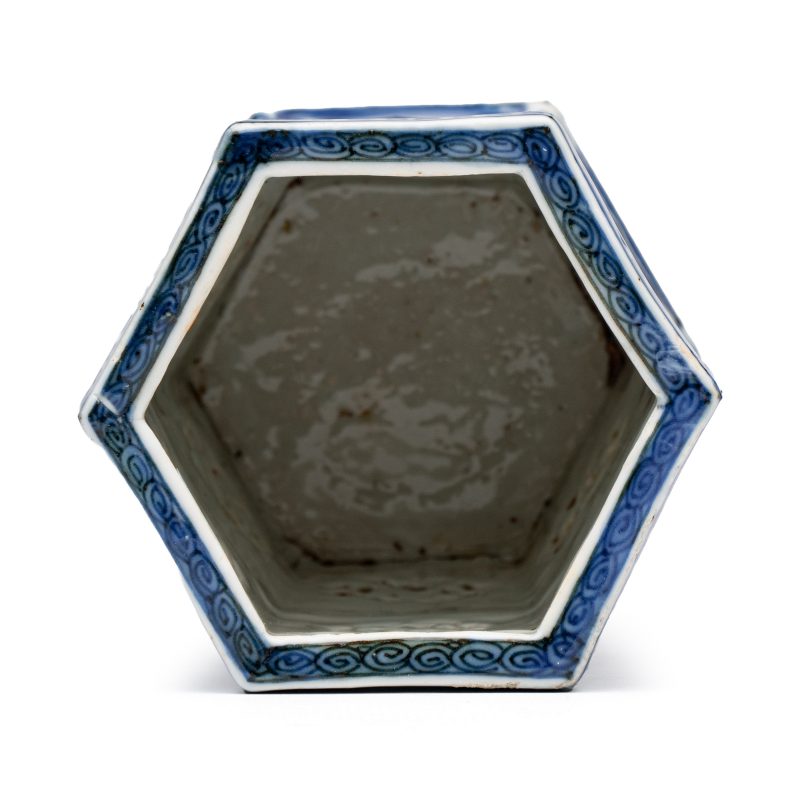
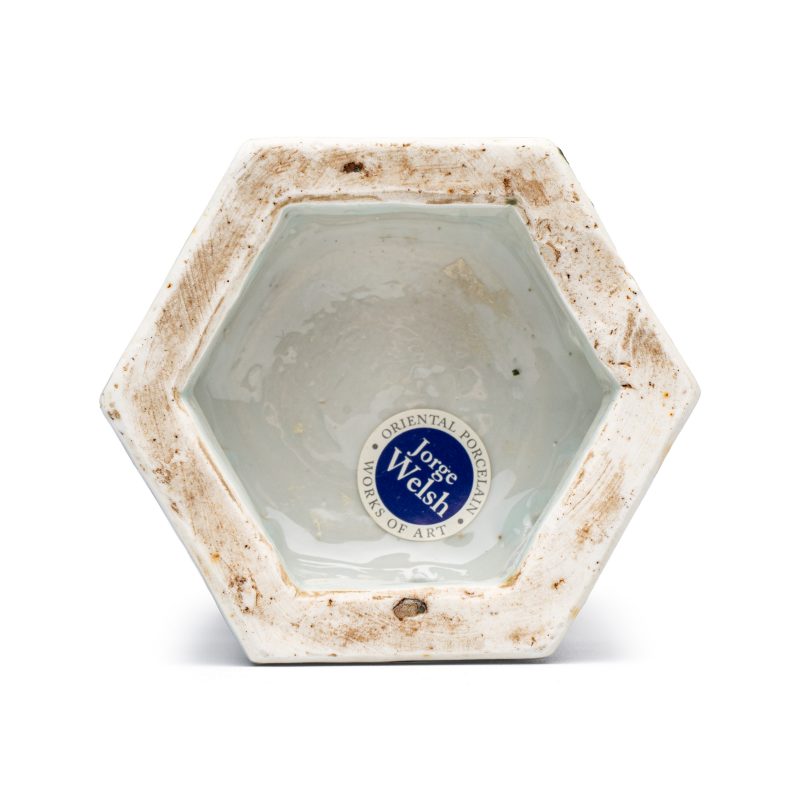
Of tall hexagonal form, raised on an integral openwork hexagonal stand, the body moulded with six panels, each pierced with two oval medallions enclosing the Buddhist wan (swastika) emblem alternating with elongated cloud-scroll cartouches, all reserved against a finely painted trellis-diaper ground in two tones of underglaze cobalt blue. The square, thickened rim is bordered with a narrow key-fret band, while the openwork stand is formed with six shoe-shaped arches joined by stretchers and accented with underglaze-blue scrollwork. The interior is fully glazed, the recessed base and foot rim are left unglazed.
Porcelain incense holders and stands with pierced decoration of this type represent an unusual continuation of forms first developed during the Yuan dynasty. Closely related examples are preserved in the Jinglesuan Collection, assembled by Roger and Alice King, including a qingbai incense burner, a qingbai vase stand, and a blue and white stand of comparable construction. Similar pierced porcelain stands have also been excavated from Yuan tombs in Shanghai and recovered from the fourteenth-century Sinan shipwreck, demonstrating the longevity of this decorative and functional form.
The principal decorative motif is the Buddhist wan (卍) symbol, one of the oldest auspicious emblems in Asia. In Chinese art it came to signify longevity, eternity, and the concept of wan (萬, “ten thousand”), expressing infinite blessings and good fortune. Alternating with stylised cloud scrolls, the motif reinforces the auspicious nature of the piece and its association with ritual and scholarly settings. The wan pattern became particularly popular during the Ming dynasty, appearing on porcelain, lacquer, textiles, and architectural decoration.
此器呈高六方形,下承一體鏤空六方座。器身模印六面,每面上下開橢圓形鏤孔,內飾佛教「卍」字紋,與長形如意雲頭開光相間排列,皆襯於雙色釉下青花細繪的錦地紋之上。厚方唇口沿飾一周梳齒紋。鏤空底座開六個馬蹄形鏤空,底部以橫棖相連,並以青花卷草紋點綴。內壁滿釉,內凹底部及足緣露胎。
此類鏤空瓷製香具及座架,是元代初創器形在後世的少見延續。Roger 與 Alice King 伉儷所藏 Jinglesuan Collection 中保存有多件近似器物,包括青白釉香爐、青白釉瓶座,以及一件結構相近的青花座。上海元墓及十四世紀韓國新安沉船中亦曾出土或發現類似鏤空瓷座,足見此類裝飾與實用兼備的器形流傳久遠。
器身主飾佛教「卍」字紋,為亞洲歷史悠久的吉祥符號之一。在中國裝飾藝術中,「卍」寓意長壽、永恆,並與「萬」字相通,象徵福澤無量、吉慶綿延。卍字與如意雲紋交替排列,進一步強化其吉祥寓意及禮儀、文房屬性。此類紋樣在明代尤為盛行,廣泛見於瓷器、漆器、織物及建築裝飾。
Provenance:
Jorge Welsh, Lisbon/London, with their label to the base.
The Mr. and Mrs. Baert-Devos Collection, Belgium. Acquired from the above in 2005 and acommpanied by a copy of their documentation folder. (see added scans)
Published:
Jorge Welsh Works of Art, included in their 2004 exhibition of 'Linglong' and published in the accompanying catalogue, pp. 40-43, no. 03.
Porcelain incense holders and stands with pierced decoration of this type represent an unusual continuation of forms first developed during the Yuan dynasty. Closely related examples are preserved in the Jinglesuan Collection, assembled by Roger and Alice King, including a qingbai incense burner, a qingbai vase stand, and a blue and white stand of comparable construction. Similar pierced porcelain stands have also been excavated from Yuan tombs in Shanghai and recovered from the fourteenth-century Sinan shipwreck, demonstrating the longevity of this decorative and functional form.
The principal decorative motif is the Buddhist wan (卍) symbol, one of the oldest auspicious emblems in Asia. In Chinese art it came to signify longevity, eternity, and the concept of wan (萬, “ten thousand”), expressing infinite blessings and good fortune. Alternating with stylised cloud scrolls, the motif reinforces the auspicious nature of the piece and its association with ritual and scholarly settings. The wan pattern became particularly popular during the Ming dynasty, appearing on porcelain, lacquer, textiles, and architectural decoration.
此器呈高六方形,下承一體鏤空六方座。器身模印六面,每面上下開橢圓形鏤孔,內飾佛教「卍」字紋,與長形如意雲頭開光相間排列,皆襯於雙色釉下青花細繪的錦地紋之上。厚方唇口沿飾一周梳齒紋。鏤空底座開六個馬蹄形鏤空,底部以橫棖相連,並以青花卷草紋點綴。內壁滿釉,內凹底部及足緣露胎。
此類鏤空瓷製香具及座架,是元代初創器形在後世的少見延續。Roger 與 Alice King 伉儷所藏 Jinglesuan Collection 中保存有多件近似器物,包括青白釉香爐、青白釉瓶座,以及一件結構相近的青花座。上海元墓及十四世紀韓國新安沉船中亦曾出土或發現類似鏤空瓷座,足見此類裝飾與實用兼備的器形流傳久遠。
器身主飾佛教「卍」字紋,為亞洲歷史悠久的吉祥符號之一。在中國裝飾藝術中,「卍」寓意長壽、永恆,並與「萬」字相通,象徵福澤無量、吉慶綿延。卍字與如意雲紋交替排列,進一步強化其吉祥寓意及禮儀、文房屬性。此類紋樣在明代尤為盛行,廣泛見於瓷器、漆器、織物及建築裝飾。
Provenance:
Jorge Welsh, Lisbon/London, with their label to the base.
The Mr. and Mrs. Baert-Devos Collection, Belgium. Acquired from the above in 2005 and acommpanied by a copy of their documentation folder. (see added scans)
Published:
Jorge Welsh Works of Art, included in their 2004 exhibition of 'Linglong' and published in the accompanying catalogue, pp. 40-43, no. 03.
常见问题
拍品的品相状况如何?
(UV-checked):
Overall in very good condition, with normal minor superficial wear and typical spots of glaze loss. A baking flaw and negligible superficial chip to the foot rim.
Overall in very good condition, with normal minor superficial wear and typical spots of glaze loss. A baking flaw and negligible superficial chip to the foot rim.
拍品的尺寸是多少?
H: H. 15,6 cm, W. 8,3 cm, D. 7,1 cm